
25%–80% of patients experience at least one medication discrepancy or a failure to communicate medication changes at discharge, according to World Health Organization evidence cited in the Joint Commission's transition-of-care report. That makes discharge writing more than an administrative task. It's the point where the hospital team must explain what changed and who takes responsibility next.
Learning how to write a discharge summary starts with recognizing its two readers: the clinician taking over care and the patient or caregiver carrying out the plan. Both need the same verified facts, but they need different language.
Required Sections of a Complete Discharge Summary
A completed document isn't necessarily a completed handoff. In a U.S. academic-hospital study of 377 discharges, summaries averaged 5.6 of 6 Joint Commission elements and 4.0 of 7 Transitions of Care Consensus Conference (TOCCC) elements; only 46.3% were dictated on discharge day, 32.4% more than 48 hours later, 24.7% more than a week later, and 38.3% weren't sent to an outpatient physician, according to the discharge-summary quality analysis.
The practical lesson is to treat the summary as a handoff document, not an archive. A long narrative doesn't compensate for a missing medication rationale or an unassigned result.
Required elements of a discharge summary
The table maps a practical template to the named frameworks. It isn't a claim that every framework uses these exact field names or requires every detail in every clinical setting.
| Element | What to write | Required by |
|---|---|---|
| Admission reason and principal diagnosis | Presenting problem and the diagnosis that drove the stay | Joint Commission and TOCCC |
| Hospital course | Each active problem, what was done, and how the patient responded | TOCCC |
| Procedures and significant results | Procedures, imaging, and labs that changed management | Joint Commission |
| Medication changes | New, stopped, resumed, and dose-changed drugs, each with a reason | Joint Commission and medication reconciliation standard |
| Condition at discharge | Clinical status plus relevant functional and cognitive status | CMS |
| Pending results | Each pending test, responsible clinician, and expected action | TOCCC |
| Follow-up | Appointments with dates or time windows, plus referrals still to arrange | CMS |
| Disposition and services | Home, facility, home health, hospice, or other services arranged | CMS |
| Patient instructions | Plain-language warning signs and whom to call | Joint Commission |
| Author and authentication | Author name, date, and time; co-signature if delegated | CMS |
The header should also identify the patient, admission and discharge dates, and responsible hospital clinician. Those details establish which admission the handoff describes.
Relevance matters more than volume. A significant result belongs beside the decision it changed. A pending result belongs beside the person responsible for acting on it, not buried in a copied laboratory list.
Final test: Could the next clinician act on the summary without opening the full hospital chart?
Turn an Admission Note Into the Discharge Summary
Start from the admission record rather than a blank page. The history and physical supplies the initial problem; the discharge summary explains how the team's understanding changed and what remains to be done.
Translate rather than paste
The admission history of present illness becomes a short explanation of why hospitalization was necessary. Replace provisional diagnoses with the final assessment, while preserving uncertainty when the team hasn't established a diagnosis.
Daily SOAP notes need more editing. A SOAP note describes an encounter. The discharge summary describes the whole stay and the transfer of responsibility.
| Starting material | Discharge-summary version |
|---|---|
| Admission history | Presenting problem, relevant context, and final diagnosis |
| Daily assessments | Problem-based account of treatment, response, and remaining issues |
| Procedure and result reports | Findings that changed management |
| Consultant notes | Recommendations adopted, deferred, or still requiring action |
| Final SOAP plan | Tasks with owners, timing, and escalation arrangements |
| Nursing and therapy documentation | Relevant function, cognition, support needs, and discharge condition |
For each active problem, retain the admission status, main intervention, response, and discharge status. Delete repeated examinations and unchanged daily plans unless they explain a consequential decision.
Reconcile the ending with the beginning
Medication drafting requires comparison across the home list, inpatient orders, and discharge prescriptions. Copying only the final inpatient list can preserve temporary treatments or lose medicines intentionally held during hospitalization.
The final plan also needs translation. An instruction to arrange follow-up becomes a task assigned to a person or service. A pending investigation becomes a named result with a reviewer and an intended response.
Structured electronic fields support this approach by keeping information in predictable locations. The useful constraint is not a fixed word count. It's that each field contributes something the receiving team needs, without forcing that team to reconstruct the admission.
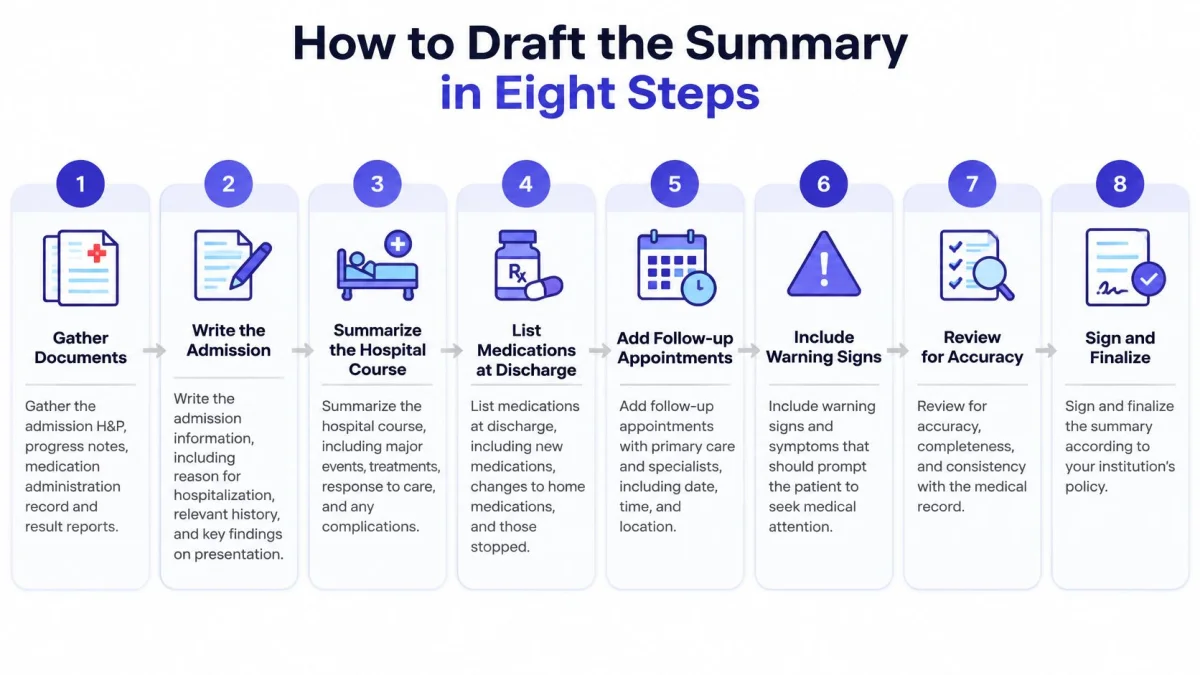
How to Draft the Summary in Eight Steps
A discharge summary serves two readers: the clinician taking over care and the patient following the plan at home. Draft both layers from the same clinical record, then check that they agree. The sequence below follows the structured discharge approach in the AHRQ Re-Engineered Discharge toolkit.
Build the clinical handoff
Gather the source records. Review the admission H&P, progress notes, medication administration record, consultant recommendations, and result reports. These records establish the clinical facts; the discharge conversation alone may not capture the decisions made during the stay.
The visual workflow provides a compact reminder during drafting.
Complete the actionable plan
Use the medication table to document changes. Preserve the reason for each change and any monitoring responsibility. The table should make intentional stops, starts, and dose changes clear.
Check the fields most easily missed
Close with a consistency check: do the pharmacy prescription, clinician handoff, and patient instructions describe the same plan? Correct any discrepancy or explain why the instructions differ.
The final review should identify unfinished work, not merely confirm that every heading contains text.
Medication Changes Without Losing the Reason
A discharge medication list needs to show what changed and why. Admission medicines, inpatient orders, and intended discharge prescriptions can differ. Resolve the differences across each list before documenting the final plan.
A systematic review of discharge-letter quality found medication-documentation discrepancies in 10.8% of patients, with drug omission the most common inconsistency. It also reported an association between higher-quality letters and 45% fewer medication errors per patient, and described a separate compliance study in which communication about changes to pre-admission medicines was absent in 82.3% of cases.
What to document for each medication change
Change What to document Why it matters Started Drug, dose, route, indication, duration, and who monitors it The next clinician knows why it was started and what to check Stopped Drug, prior dose, reason stopped, and whether or when to restart The stop is not mistaken for an omission Dose changed Old dose, new dose, reason, and who adjusts it next Both values remain visible for comparison Resumed Held drug, restart date, or restart criteria The restart decision is explicit Continued unchanged Home medicine kept at the same dose, confirmed with the patient The list is complete rather than partial Unresolved discrepancy What conflicts, who resolves it, and by when The conflict stays visible instead of being dropped without comment An intentional deprescription without a reason can look like a transcription error. A copied medicine can also appear deliberately continued when nobody reviewed it. The rationale makes the change auditable.
Monitoring instructions should identify the parameter, timing set by the treating team, and clinician responsible for the next decision. Do not assume a specialist will monitor a medicine because that specialist recommended it.
Make the home list usable
For older adults and patients taking many medicines, keep the patient-facing list consistent with the reconciled clinical table. Teach-back should establish which medicines changed and how the patient will take them.
For ongoing mental-health care, reVIBE Mental Health's medication management guide offers patient-facing context for continuing medication discussions. A medication reconciliation aid can support comparison of the lists; verify the final plan against current orders.
Ownership rule: No unresolved discrepancy should leave the summary without a named owner and a resolution date.
Phrasing That Works for Clinicians and Patients
Clear phrasing makes responsibility visible. A peer-reviewed discussion of discharge-summary quality identifies persistent problems with content, usability, and timely communication, supporting a distinction between the clinical handoff and understandable patient instructions.
Replace vague statements with usable facts
The following are hypothetical documentation examples, not treatment recommendations.
Weak: Labs pending.
Stronger: Blood culture pending at discharge; Dr. Lee will review the final result and notify the primary care clinician if action is needed.Weak: Continue home meds.
Stronger: Home medicines continue unchanged except for the documented dose reduction; the medication table records the reason and cardiology review plan.Weak: F/u PCP.
Stronger: Primary care appointment booked; provider, date, time, location, and clinic contact appear in the appointment field.Weak: Pt stable.
Stronger: Walking independently, breathing room air, and eating full meals at discharge.These phrases work because they replace interpretation with observable status or assigned action. Abbreviations should follow local policy, and the patient-facing layer should avoid unexplained shorthand.
Keep the two layers aligned
The clinician needs precise drug names, doses, findings, and clinical reasoning. The patient needs a clear account of what changed, what to do next, and whom to contact.
An after-visit summary template can organize that patient layer. Procedure-specific material, such as Vein and Wound Institute's information on warning signs after vein closure, should be checked against the treating team's actual instructions before inclusion.
- Name an owner: Every open item needs a responsible clinician or service.
- State timing: Use the appointment date or the team's agreed time window.
- Remove stale text: Admission wording shouldn't survive when the discharge assessment has changed.
Plain language should simplify expression, not remove necessary detail.
Specialty Examples From Psychiatry to Rehabilitation
Consider a psychiatric discharge to supported housing. A summary that says symptoms improved and outpatient follow-up was advised leaves the receiving team without essential context about functioning and practical support.
Under CMS psychiatric-hospital guidance, the summary should explain admission circumstances, treatment achieved, psychiatric, physical, and social functioning at discharge, and the patient's or family's response. Appropriate aftercare details include appointment dates, provider names and addresses, housing, transportation, community resources, access needs, and family involvement.
Turn the psychiatric plan into a handoff
For this scenario, the writer should distinguish the patient's clinical response from the arrangements that make aftercare possible. A booked appointment and transport arrangement are different facts, and both may matter.
The summary should also distinguish confirmed support from proposed support. Naming a community service doesn't establish that the service has accepted the referral.
Specialty additions to the core discharge summary
These are template prompts. The listed specialty authority should supply the applicable clinical instructions; the table itself doesn't establish treatment requirements.
Specialty Add beyond core elements Source to cite Psychiatry Admission circumstances, treatment response, functioning, appointment details, housing, transportation, and family involvement CMS psychiatric-hospital guidance Internal medicine Problem-based course, consultant recommendations, and pending results with owners Joint Commission and TOCCC elements Cardiology Diuretic and other medication changes with reasons, patient-specific weight or symptom limits, and cardiology follow-up Society guideline the team follows Orthopedics and surgery Procedure details, prescribed weight-bearing and activity limits, wound care, and anticoagulation plan with an applicable stop date Surgical society guideline the team follows OB/GYN Relevant delivery details, maternal and infant status, agreed contraception plan, and postpartum follow-up dates ACOG guidance Physiotherapy and rehabilitation Functional status and goals, home exercise plan, equipment, and services Professional body guideline for the discipline Disease-specific thresholds belong in the summary only when the treating team has selected them for that patient. Generic template text shouldn't create a new weight limit, activity restriction, or medication duration.
For rehabilitation, concrete assistance needs communicate more than a broad statement that mobility improved. For surgery, the discharge instructions should reproduce the surgeon's actual restrictions rather than a default pathway.
The efficient approach is to maintain a core template with a relevant specialty block. Consistent organization matters more than identical length. Adding irrelevant specialty fields creates more text to verify without improving the handoff.
Drafting Faster With an AI Scribe
A discharge conversation often covers medicines, appointments, and warning signs in a few minutes. An AI scribe can turn that discussion into a draft, but the clinician still needs to check the chart and confirm that spoken arrangements have been completed.
In the review stage, the clinician walks the patient and caregiver through the draft.

Keep the clinician in the verification loop
PatientNotes turns a recorded encounter into a structured note moments after recording stops. The clinician reviews and edits it as needed, confirms what the scribe captured, then copies it into the EHR.
A template helps make missing fields visible. It cannot confirm that a medication matches the discharge prescription, that someone owns a pending result, or that an appointment is booked. Verify each item against the chart and the discharge plan before signing.
The video illustrates how recording and review fit into the drafting workflow.
Choose a template without adding unnecessary fields
Use a discharge-summary template that supports the handoff without adding fields the team cannot complete reliably. PatientNotes offers discharge summaries alongside SOAP Notes, Progress Notes, H&P Notes, Procedure Notes, and Consultation Notes. Its medical scribe guide explains the recording and note-drafting workflow.
Sign Date and Send on the Day of Discharge
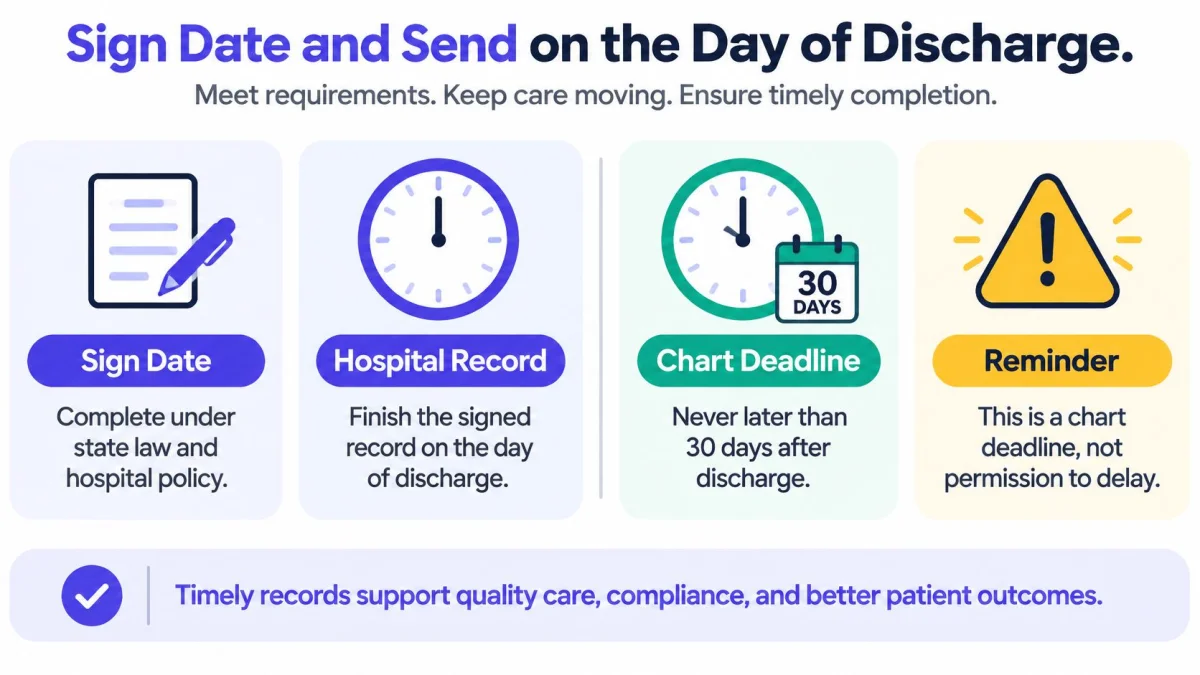
The hospital record must be completed within the deadline set by state law and hospital policy, no later than 30 days after discharge. For post-acute transfers, necessary information about the illness, treatment, goals of care, and treatment preferences must be available at discharge, according to CMS hospital-record guidance. Sending the clinical handoff promptly is a separate task from completing the full record.
Close the documentation and communication tasks
CMS authentication guidance requires the hospitalization outcome, disposition, follow-up provisions, and authentication with date and time. If completion is delegated, the responsible physician must co-authenticate and date the summary.
- Verify the destination: Confirm the receiving clinician and arranged services.
- Authenticate the entry: Complete the required signature and timestamp.
- Send the handoff: Transmit the summary to the receiving clinician.
Assign one person to confirm delivery. That step supports how technology supports seamless care, but the handoff still needs a clear owner.
A 2025 quality-improvement study raised completion within 48 hours from 40% to 90% using a template and education package, although the improvement was not sustained. A reliable send step helps prevent a completed summary from remaining only in the hospital record.
PatientNotes can generate structured discharge-summary drafts with suggested follow-ups and patient instructions for clinician review. Visit PatientNotes to use a discharge template, compare the draft with the final orders, and establish a review-and-send workflow.