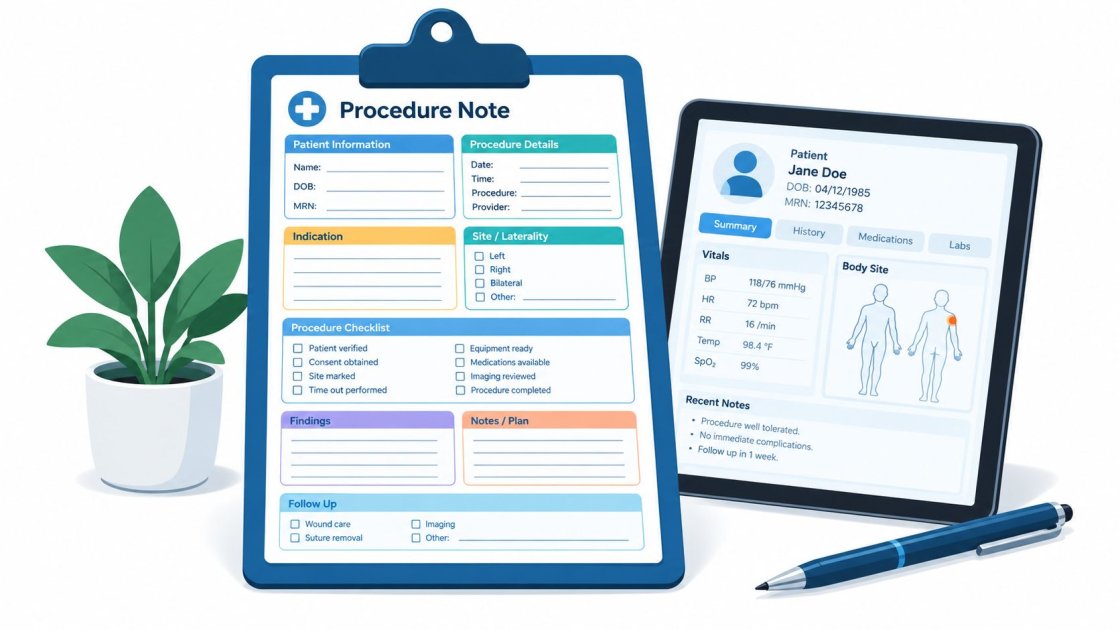
A dental hygiene SOAP note is a four-part record of a hygiene visit: Subjective findings, Objective exam and charting data, Assessment as a dental hygiene diagnosis, and Plan. The six ready-to-adapt examples below cover common visit types, from routine recall to informed refusal.
The next patient has arrived, but the previous patient's periodontal chart still needs a narrative. A physician-style template offers space for symptoms and an examination, yet little guidance on bleeding sites, maintenance intervals, or interdental instruction.
Subjective records what the patient reports. Objective records what the clinician measures, observes, reviews, and performs. Assessment explains what those findings mean. Plan records recommendations, patient discussions, and the next steps. The ADA's dental documentation guidance recognizes SOAP as an appropriate charting method.
- Clinical sequence: Connect assessment, dental-hygiene diagnosis, planning, implementation, evaluation, and documentation.
- Measurement discipline: Preserve site-level findings rather than replacing the periodontal chart with a general description.
- Individualization: Connect the home-care recommendation and reassessment target to the findings.
That approach follows the ADHA Standards of Dental Hygiene Practice. These are illustrative documentation examples, not patient records. Bracketed fields require actual findings, and every diagnosis and treatment decision requires clinician review.
1. Routine Adult Prophylaxis Recall Note (Healthy Patient, Gingivitis)
A routine recall note should distinguish an otherwise healthy patient from healthy gingival tissues. Reported sensitivity, localized bleeding, and interdental plaque deserve specific entries even when the appointment proceeds without complications.

Adaptable Recall Phrasing
- S: “Patient attends scheduled recall. Reports cold sensitivity at [location] and inconsistent interdental cleaning. Health history and medications reviewed today; [reported changes or no changes].”
- O: “Hard- and soft-tissue findings: [findings]. Localized marginal erythema and bleeding at [sites]. Plaque score [measured value]; bleeding on probing [measured value]. Probing depths [site-level chart reference and summary]. Radiographs [taken, reviewed, or not obtained, with reason]. Vital signs [values, if taken]. Adult prophylaxis completed using [actual methods].”
- A: “Localized plaque-associated gingival inflammation at [sites], consistent with documented gingivitis. Interdental plaque control requires improvement. Sensitivity at [location] requires [documented assessment or dentist review].”
- P: “Demonstrated [specific interdental aid and technique]. Discussed [named product, if recommended] for [reason]. Recall scheduled for [individualized interval]. Dentist review requested for [finding], if applicable.”
A shared template helps hygienists preserve the same essential fields. It doesn't justify carrying forward normal findings or an unchanged recall interval without review. The dental SOAP notes guide provides another starting structure.
Practical rule: A completed cleaning isn't a complete assessment. The note still needs findings, interpretation, and a patient-specific plan.
US billing: Describe the prophylaxis delivered, then verify the current CDT selection and payer requirements. CMS dental billing guidance emphasizes accurate procedure selection; its medical-condition and physician-information requirements apply when relevant to the claim.
For patient-facing context, information about teeth cleanings at Eric Wiitala DDS can accompany an explanation of the appointment. It doesn't replace individualized clinical instructions.
2. Periodontal Maintenance Note with Staging and Grading
“Periodontal maintenance completed” says little about disease status. The useful comparison is between the current chart and the previous chart, with exact locations for persistent bleeding or deterioration.
A treated-periodontitis patient may have mostly unchanged findings but an isolated area that needs review. That distinction belongs in the assessment, not only in a chart graphic.
Document the Comparison Before the Conclusion
S: “Patient returns for periodontal maintenance after completed active therapy. Reports [symptoms], [interdental routine], and [relevant health or medication changes]. Previous recommendations reviewed.”
O: “Full-mouth periodontal chart updated. Probing depths, recession, bleeding, mobility, and furcations recorded by site. Sites at or above [practice-selected reporting threshold]: [count and locations]. Compared with [dated chart], [specific changes]. Maintenance instrumentation completed at [areas], using [methods].”
A: “History of treated periodontitis. Existing dentist-established stage [stage] and grade [grade], with classification source recorded in the diagnostic record. Current findings show [documented stability or areas requiring further evaluation]. Prognosis and need for additional assessment discussed with [clinician].”
P: “Continue maintenance at [interval], based on [documented risk and findings]. Reinforced [site-specific technique]. Arrange dentist review of [sites] and consider further treatment or periodontal referral after review. Reassess [named measures] at [appointment].”
The periodontal charting resource can help organize the comparison. Existing stage and grade shouldn't be copied into a new assessment as though current measurements independently establish them.
Avoid false certainty: When charting or diagnostic information is incomplete, “insufficient information to determine current periodontal status” is more useful than an unsupported stable-disease label.
The ADHA documentation principles described earlier support recording collected data, diagnosis, services, outcomes, prognosis, and recommendations. A concise summary can accompany the full chart, but it shouldn't replace site-level measurements.
US billing: Identify prior periodontal treatment, current findings, and maintenance services performed. The earlier CMS coding principle applies: verify the service against current CDT descriptions and payer rules rather than allowing a template label to determine the claim.
3. Scaling and Root Planing Note with Local Anesthesia and Post-Operative Follow-Up
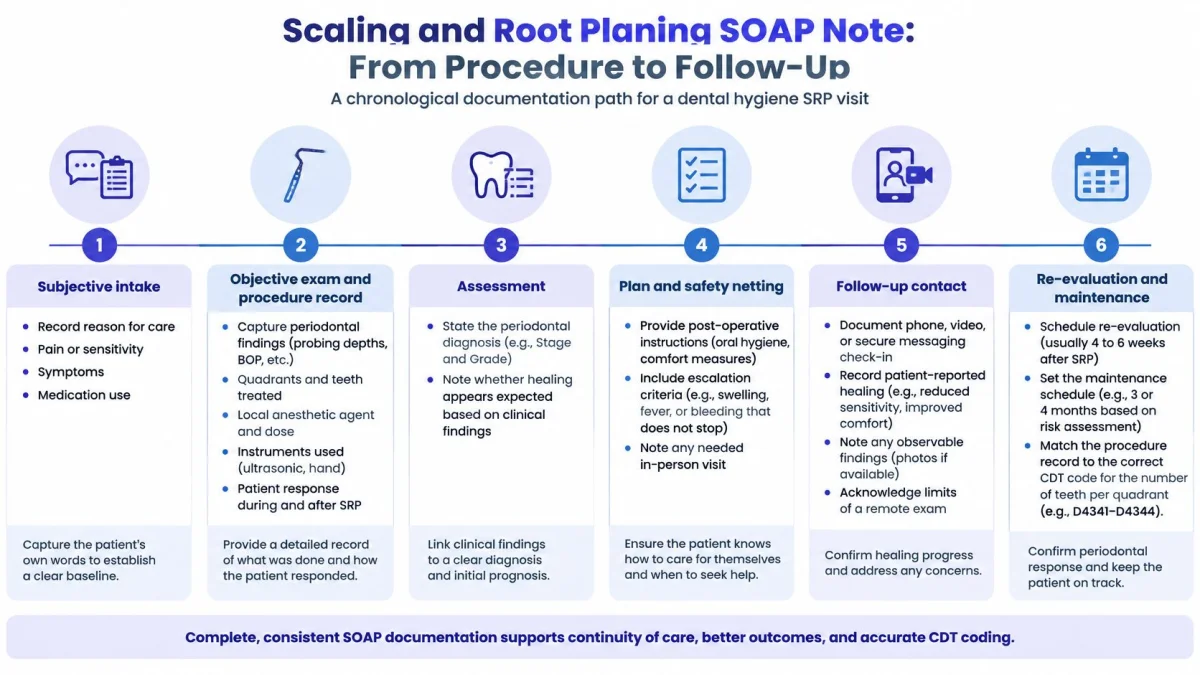
An SRP record needs a procedure account and a follow-up comparison. Combining them into “scaling completed, tolerated well” loses the treated locations, anesthesia details, and evidence needed to evaluate response.
Procedure and Follow-Up Phrasing
- S: “Patient attends planned SRP. Reports [pain, sensitivity, symptoms, and medication use]. Questions about treatment reviewed.”
- O: “Pretreatment periodontal findings: [chart reference and relevant sites]. Treated [quadrants and individual teeth]. Local anesthetic: [agent, concentration, vasoconstrictor, actual dose, route, and sites]. Instrumentation: [methods]. Patient response and complications: [observations].”
- A: “Periodontal diagnosis per [responsible clinician and dated assessment]. Planned treatment completed at [locations]. Remaining treatment needs: [details].”
- P: “Post-operative instructions provided and understanding checked. Escalation instructions covered [clinician-specified symptoms, contact route, and urgency]. Periodontal reevaluation booked within the individualized follow-up interval.”
At a telephone follow-up, patient reports no bleeding belongs in Subjective. It isn't an observed finding. An appropriate Objective entry is: “Telephone contact only; probing depths, bleeding on probing, and attachment changes not assessed.”
The follow-up assessment can state that reported symptoms appear consistent with the clinician's expected course, while expressly limiting that interpretation to the information available. The plan should identify whether an in-person examination is needed.
Improvement should be documented with comparable findings, not inferred from a patient's report that the mouth feels cleaner.
A peer-reviewed periodontal treatment study illustrates reporting change through probing depth and bleeding outcomes. Its findings aren't a promise of an individual patient's response.
US billing: Record teeth treated within each quadrant before verifying the applicable CDT description. Anesthetic quantities and treatment locations must reflect the procedure, not an automatically populated default.
Patient information about recovery after scaling and root planing may support counseling. The signed note should still identify the actual instructions delivered.
4. Medically Complex Patient Note (Cardiac Condition and Antibiotic Decision)
A cardiac history requires a documented decision, not a prechecked “premedication required” box. For a patient reporting a prosthetic valve or previous infective endocarditis, the note should distinguish the patient's account from verified medical information and the responsible clinician's decision.
The ADA's patient-record guidance supports documenting relevant histories, treatment discussions, the person providing care, and dated authorship. It doesn't establish a particular antibiotic regimen or resolve an individual cardiac case.
Record the Decision and Its Source
S: “Patient reports [cardiac condition or procedure]. Current medications and allergies reviewed, including [reported changes]. Patient reports [previous prophylaxis instructions], not yet verified.”
O: “Relevant medical correspondence reviewed: [document and date]. Vital signs: [actual readings, if obtained]. Planned dental procedure: [specific procedure]. Oral and periodontal findings: [findings].”
A: “Cardiac history requires review of antibiotic-prophylaxis eligibility before planned care. Decision by [dentist or physician]: [indicated, not indicated, or pending clarification]. Guideline and version consulted: [reference]. Clinical rationale: [documented reasoning].”
P: “Consulted [clinician] by [communication method] on [date]. Instructions received: [exact instructions]. Prescription or administration details, if applicable: [verified record]. Treatment [proceeded, modified, or deferred] following that decision. Written instructions provided.”
The distinction between pending clarification and not indicated matters. Neither the patient's recollection nor an old template establishes the current decision.
- Guideline verification: Identify the current American Heart Association guidance reviewed before recording a US prophylaxis decision.
- Accountability: Name the dentist or physician who made the decision, especially when the history is incomplete.
- Regional practice: UK clinicians should verify applicable local guidance rather than importing a US decision pathway.
US billing: Document the dental service and any relevant medical coordination separately. A cardiac diagnosis doesn't automatically establish coverage; the earlier CMS requirements apply only where relevant.
A medically complex note can remain concise. Its value lies in showing what was verified, what remained uncertain, who decided, and what care followed.
5. Pediatric Caries Management Note with Caries Risk Assessment
The parent's report, the child's findings, and the clinician's risk assessment belong in separate fields. Frequent sweetened drinks may inform assessment, but that report alone shouldn't become a definitive diagnosis or a preselected treatment protocol.

Make the Risk Assessment Traceable
- S: “Parent or guardian reports [diet and feeding pattern], [brushing assistance], and [fluoride exposure]. Child reports [symptoms]. Medical history and medication review completed.”
- O: “Findings recorded by tooth and surface: [findings]. Detection system used: [system used]. Radiographs [obtained or reviewed], with [documented interpretation]. Plaque distribution and relevant soft-tissue findings: [details].”
- A: “Caries risk assessed as [level] using [named assessment tool and version]. Supporting factors: [documented findings]. Dentist's caries diagnosis: [diagnosis], or dentist review pending.”
- P: “Discussed [specific dietary change] and demonstrated [brushing technique]. Preventive treatment [recommended or delivered] under the verified clinical plan. Parent or guardian discussion and consent: [details]. Review interval and referral: [individualized plan].”
The AAPD-hosted dental record-keeping guidance emphasizes authentic, accurate, objective records, including histories, assessments, recommendations, and progress notes. It supports this documentation structure, not a blanket fluoride-varnish or silver-diamine-fluoride protocol.
Before either treatment is built into a template, the treating clinician should verify current AAPD guidance and document the actual indication and consent discussion. For silver diamine fluoride, the note should record the discussion of staining rather than merely mark “consent obtained.”
Specific counseling reads better than “diet advice given.” A useful entry identifies the parent-reported habit, the agreed change, and the planned reassessment without inventing intake quantities.
US billing: Record the preventive agent, application sites, and service delivered. Verify current CDT and payer requirements separately; a risk label doesn't substitute for a procedure record.
6. Informed Refusal or Declined Treatment Note
A patient may understand a recommendation and still decline it. A useful refusal note records the clinical concern and the conversation without labeling the patient difficult or noncompliant.

Document the Decision Without Judgment
S: “Patient declines recommended [treatment, radiographs, or referral]. Stated reason: [patient's exact words]. Questions and concerns: [details].”
O: “Findings supporting the recommendation: [specific measurements, examination findings, and available imaging]. Discussion attended by [clinicians, family member, or interpreter, as applicable].”
A: “Recommended care remains indicated based on [documented assessment]. Discussed patient-specific consequences of delaying or declining care, including [risks explained]. Diagnostic limitations from declined investigations: [limitations].”
P: “Discussed proposed treatment, expected benefits, risks, alternatives, and no treatment. Patient demonstrated understanding by [documented response] and chose [decision]. Offered [relevant alternative, financial discussion, referral, or further appointment]. Follow-up and contact instructions: [details].”
The ADA treatment-discussion guidance cited earlier supports recording benefits, risks, alternatives, and no treatment. A checked “risks explained” field isn't a substitute for the actual discussion.
A refusal form supports the record. It doesn't replace the findings, recommendation, patient's reason, and follow-up discussion.
The informed-consent resource can help structure the conversation record. Clinicians should still verify applicable state dental-board requirements and professional standards before adopting a refusal workflow.
For UK practices, the NHS England dental clinical policies framework supports consistent record keeping. Applicable GDC standards and local NHS requirements also need checking; a generic SOAP template shouldn't be treated as jurisdiction-specific legal advice.
US billing: Distinguish recommended but declined treatment from services that were provided. The note should never imply that periodontal therapy, imaging, or another procedure occurred when the patient declined it.
6 Dental Hygiene SOAP Note Examples Compared
| Example | Implementation Complexity | Resource Requirements | Expected Outcome | Ideal Use Case | Key Advantage |
|---|---|---|---|---|---|
| Routine Adult Prophylaxis Recall Note | Low; repeatable SOAP template | Routine exam findings, hygiene scores, and brief charting time | Consistent documentation of preventive care and follow-up | Six-month adult recall visits with routine hygiene needs | Fast to complete and easy to audit |
| Periodontal Maintenance Note with Staging and Grading | High; requires detailed charting and classification | Full-mouth probing data, bleeding and tissue findings, prior records | Tracks disease stability or progression and guides maintenance | Follow-up after periodontal treatment | Longitudinal data supports interval and treatment decisions |
| Scaling and Root Planing Note with Follow-Up | High; documents procedure, anesthesia, and follow-up | Quadrant and tooth details, anesthetic records, post-operative contact | Clear treatment record and planned re-evaluation | SRP appointments requiring detailed procedure and recovery documentation | Connects treatment details with follow-up and safety instructions |
| Medically Complex Patient Note | Moderate; requires current medical-risk review | Updated health and medication history, vital signs, possible physician consultation | Documents the risk assessment and rationale for the care decision | Dental care affected by cardiac conditions or other medical factors | Makes clinical reasoning and consultation visible to the care team |
| Pediatric Caries Management Note | Moderate; includes risk scoring and guardian counseling | Tooth-surface findings, caries-risk tool, diet and fluoride history | Supports preventive care and recall based on caries risk | Children with active caries or elevated risk | Connects risk assessment to preventive planning |
| Informed Refusal or Declined Treatment Note | Moderate; requires clear, patient-centered discussion documentation | Clinical findings, treatment options, risks, and patient decision | Records the patient's choice and follow-up offer | When a patient declines recommended care | Documents patient autonomy and the discussion of risks |
A Faster Way to Write Every Hygiene Note
The visit type decides what the note must prove. A recall entry earns its length through a prevention plan. A maintenance entry earns it through comparison with prior findings. SRP documentation has to carry site-level detail and a reassessment date, while a medically complex chart has to show the reasoning behind the decision to treat, defer, or consult.
Four habits keep each of these notes defensible:
- Individualize the entry: remove defaults that were not assessed or performed.
- Keep numbers objective: confirm measurements against the periodontal chart.
- Identify the clinical basis: name the guideline consulted and record uncertainty where it exists.
- Preserve the conversation: consent, refusal, instructions, and agreed follow-up all belong in the record.
The ADA guidance cited earlier recommends completing treatment notes within 24 hours where possible. The treating clinician documents the care. The dentist stays responsible for the accuracy of codes and record content, even when a hygienist or assistant enters the note.
Drafting Support Without Delegating Judgment
PatientNotes records the appointment and drafts a structured note using its dentistry and periodontics template or a custom format built with its AI template builder. It includes specialty templates across 37 specialties; check the current PatientNotes product page for the latest coverage. The software also extracts recall and follow-up tasks, produces patient instructions, and writes notes and tasks in the clinician's own language.
Its coding suggestions cover ICD-10, CPT, and CDT codes for US billing only. Treat them as a starting point and check each one against the documented service and applicable payer rules. Ambient capture also means the clinician still has to verify probing depths, tooth-level findings, anesthesia details, and home-care instructions before signing.
The company is London-based. The product offers web recording and a native iOS app with offline recording, is HIPAA compliant with a BAA included at no extra cost, and supports Semble as its only EHR integration; every other EHR moves by copy and paste.
The PatientNotes pricing page currently lists $70 per user per month billed monthly or $50 per user per month billed annually, with a 7-day free trial requiring no credit card and a 14-day money-back guarantee; verify the live pricing page for current terms. There is no enterprise tier and no sales call. A small practice can test the workflow against its existing note format without switching EHRs.
PatientNotes combines recorded-appointment drafting, dental specialty templates, and follow-up tasks aimed at individual clinicians and small practices. Visit PatientNotes to try a hygiene template, compare the draft against the periodontal chart, and judge whether the review step fits your practice.