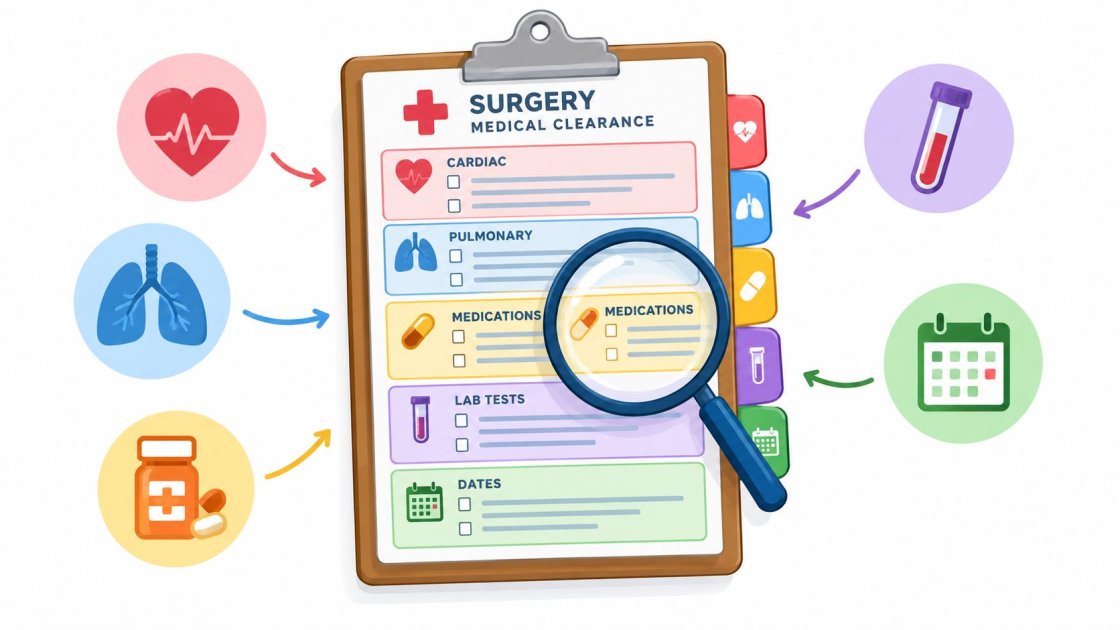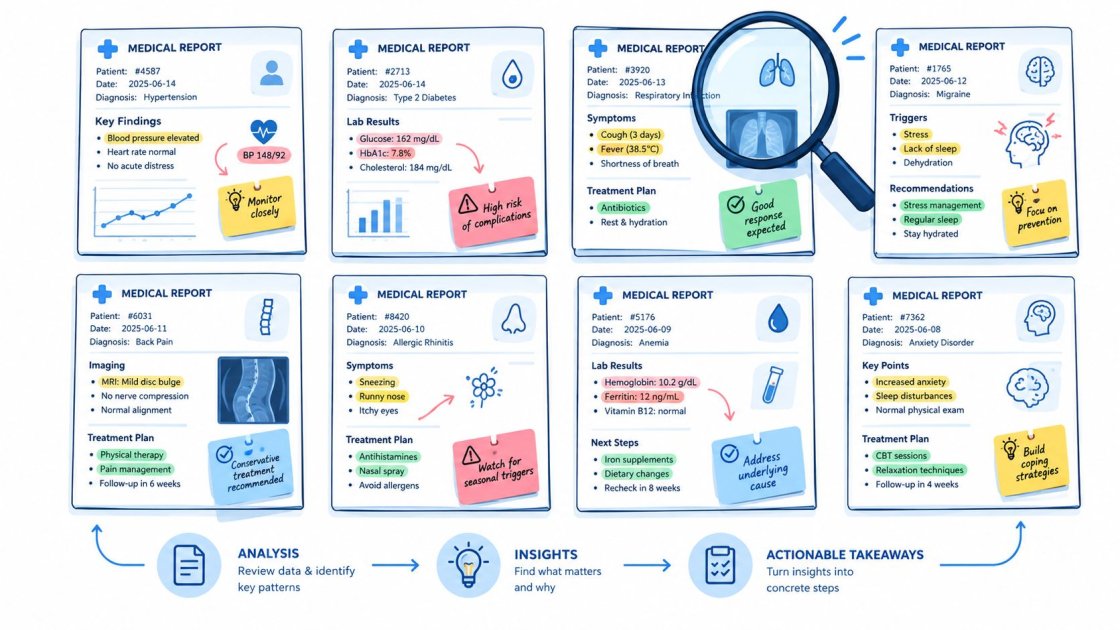
The last consultation has finished, but the note is still open. The EHR template has carried forward an old examination, the follow-up plan sits in a separate task list, and the clinician needs a sample medical report that's safe to adapt, not just tidy enough to copy.
Why a Sample Medical Report Is Harder Than It Looks
A useful sample medical report has to answer more than what belongs under each heading. It needs to show where information came from, what remains uncertain, and who takes responsibility for the final record. A polished paragraph doesn't establish any of those things by itself.
For solo clinicians and small practices in the US and UK, the practical starting point is the report's purpose. An outpatient follow-up note, a diagnostic report, a discharge summary, and an independent assessment aren't interchangeable. They may share identifiers and authentication fields, but their clinical questions differ.
Choose the report before choosing the template
- Routine follow-up: A SOAP format separates reported symptoms, observed findings, clinical interpretation, and next steps.
- Diagnostic reporting: The report needs an overall conclusion plus traceable underlying results.
- Transitions of care: The receiving clinician needs unresolved problems, medication decisions, and responsibility for follow-up.
- Independent assessment: The report needs a clearly defined assessment purpose rather than assumptions about ongoing treatment.
The worked example below uses a primary-care diabetes follow-up. It's an educational illustration, not a real patient record or treatment recommendation. Unavailable measurements, medication details, and codes remain explicitly unfilled rather than being invented.
Practical rule: A sample is useful when it makes missing information visible. A template that silently replaces missing information with normal findings is unsafe to copy.
An annotated SOAP note, a separate patient-facing explanation, and a signing checklist serve different purposes. Together, they offer a more usable starting point than a completed-looking note alone.
How Clinical Reports Became Structured
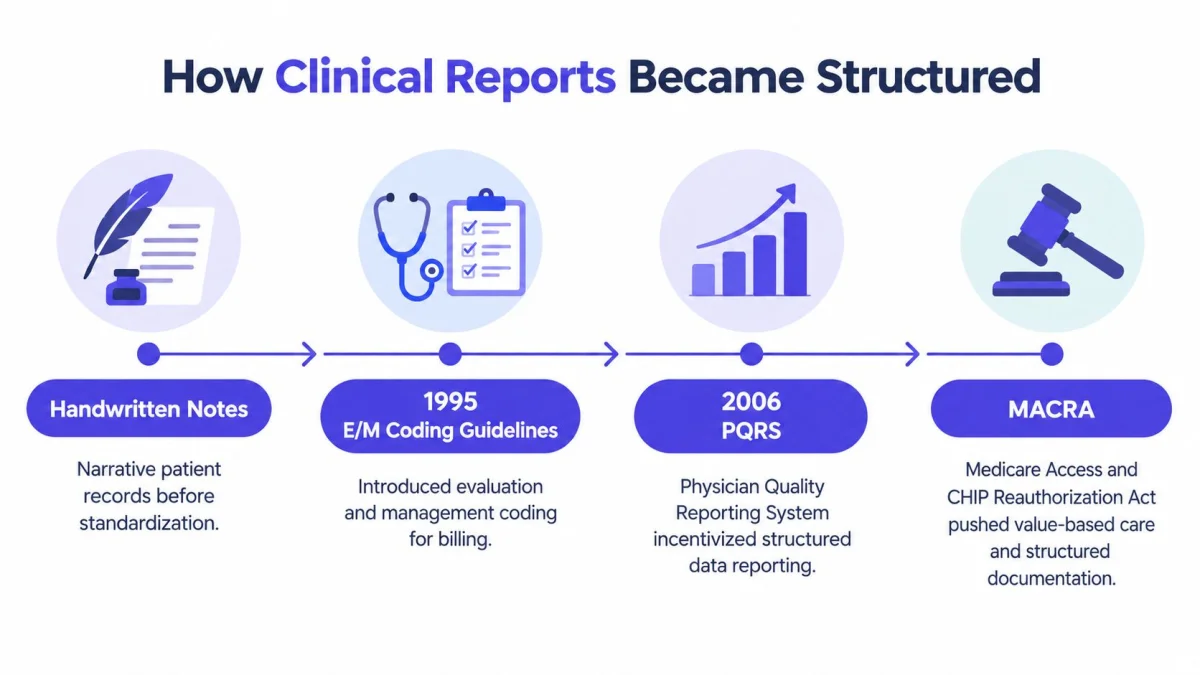
Medical documentation began as written clinical narratives long before electronic records existed. Early electronic medical-record systems appeared in the 1960s, while later digital systems added structured forms, required fields, billing elements, and quality-reporting requirements. In the US, Evaluation and Management coding guidelines arrived in 1995, the Physician Quality Reporting System began in 2006, and the Primary Care Incentive Program followed in 2011, with MACRA and MIPS subsequently strengthening the connection between documentation, payment, and performance measurement, as described in this history of clinical documentation.
The timeline summarizes that progression.
A modern report consequently serves several readers. Another clinician needs the patient's story. A billing reviewer needs support for the service. A quality team may need structured information that can be retrieved without interpreting every sentence.
Structure should clarify the encounter
Headers, result fields, and authentication details aren't substitutes for clinical reasoning. Their purpose is to make the reasoning attributable and retrievable.
For readers comparing note formats across jurisdictions, TOOLii's explanation of structured notes for Australian medical practices offers additional context on organizing clinical information. Local administrative requirements still need separate consideration.
The useful distinction is between structure that supports a decision and text added merely because a field exists. A report can be thorough without repeating the same history under several headings. The clinician's task is to preserve the patient's story while making its evidence and decisions easy to locate.
Every Field a Sample Medical Report Should Carry
A report header should establish whose care is documented, which encounter it concerns, and whether the document is ready to use. The clinical body then needs enough patient-specific information to explain the service.
For US teaching-physician documentation, CMS guidance on medical-record authentication and patient-specific content recognizes dictated, transcribed, typed, handwritten, and computer-generated records. It requires the responsible physician or resident to personally sign and date the record and permits macros within secured systems when patient-specific content is added.
An annotated report header
| Field | What it establishes |
|---|---|
| Patient name, date of birth, record identifier | The person to whom the report belongs |
| Encounter identifier and service date/time | The specific episode of care |
| Report type and category | Whether the document is a progress note, consultation, diagnostic report, or another format |
| Ordering or requesting clinician | Who requested the service, where applicable |
| Performing clinician and organization | Who delivered and documented the service |
| Status and completion time | Whether the report is draft, final, or amended |
| Specimen or test context | What was examined or measured, when relevant |
| Findings and conclusion | The evidence and the interpretation |
| Result references | Where supporting measurements can be retrieved |
| Author role and authentication | Who accepts responsibility for the completed record |
| Amendment history | What changed after completion and why |
These fields serve different purposes. Identifiers support correct record placement. Clinical content supports communication and medical necessity. Authentication and amendment fields establish accountability. Structured result references support interoperability.
Never omit: Patient identity, encounter context, patient-specific findings, assessment, actionable plan, and responsible-clinician authentication.
A draft should also identify unresolved fields. “Allergy status not yet reconciled” is more transparent than allowing a template to imply that allergies were reviewed. Copied-forward content needs active reconciliation, not an assumption that the previous encounter still describes the patient.
Subjective Block in the Worked SOAP Example
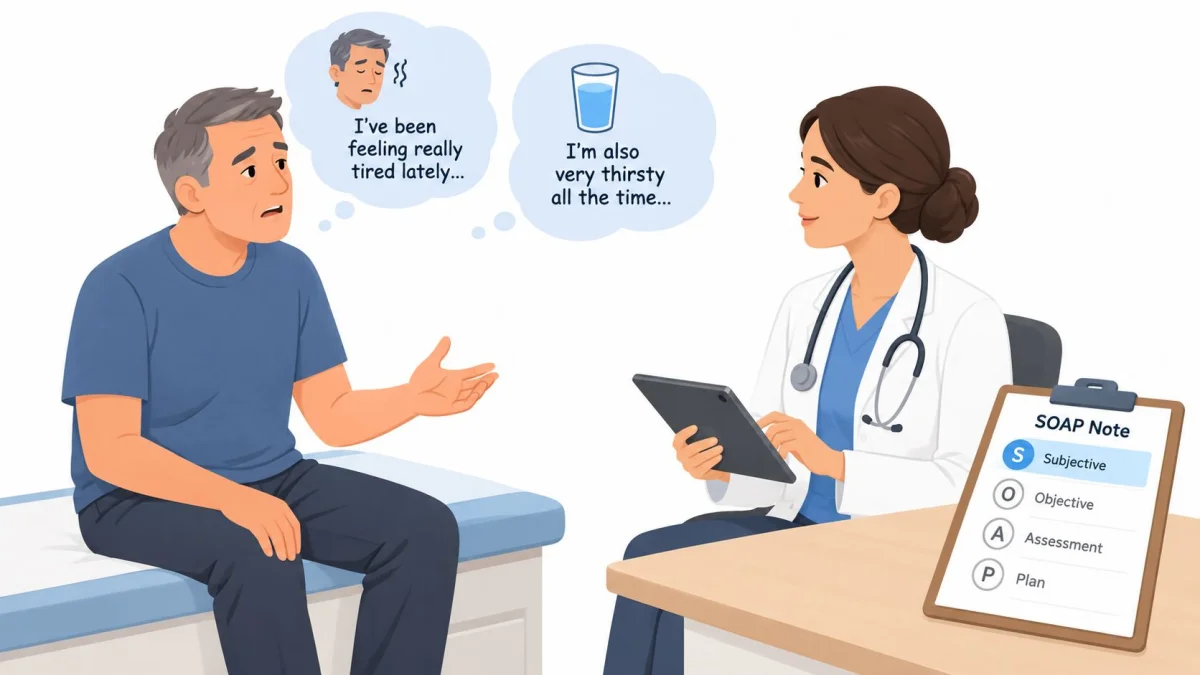
The example concerns a 54-year-old returning for a type 2 diabetes review. No actual consultation transcript or measurements are available, so the illustrative history below demonstrates attribution and completeness rather than supplying a finished clinical record.
The consultation image illustrates the distinction between listening to a patient and documenting a verified finding.
Illustrative subjective entry
Reason for visit: Follow-up of type 2 diabetes.
Patient-reported concerns: Increased thirst and fatigue. Symptom onset, progression, and modifying factors require clarification.
Medication history: Current medicines, dose, frequency, adherence, and adverse effects require reconciliation.
Relevant history: Previous diabetes care, other conditions, family history, and social circumstances require confirmation.
Allergies: Not yet verified.
Review of systems: Additional symptoms and relevant negatives have not been established.
The opening identifies the problem without manufacturing a direct quotation. When the patient's exact wording is available, the clinician can preserve it. When it isn't, a paraphrase should remain a paraphrase.
The history of present illness needs a usable timeline. “Recently” leaves the next clinician guessing. The completed entry should establish when symptoms began, whether they changed, and what makes them better or worse.
Medication reconciliation also needs more than a copied list. The report should distinguish the prescribed regimen from what the patient reports taking. Relevant barriers belong in the history without being recast as blame or unsupported conclusions.
Patient-reported isn't the same as clinician-confirmed. Under the documentation safeguards described earlier, symptoms, adherence, and home readings should remain attributed until independently checked.
For a patient-facing version, “increased thirst” is already understandable. Abbreviated problem lists, unexplained medication shorthand, and vague phrases such as “poor compliance” need clearer, more specific wording.
Objective Block and Coded Observations
The objective section should contain what was observed, measured, or obtained from an identified source. It shouldn't transform the patient's report of fatigue into an examination finding or turn an unavailable laboratory result into a diagnosis.
In HL7 FHIR R4, a DiagnosticReport represents the overall diagnostic-service report, while individual Observation resources represent discrete measurements or assertions. The FHIR guidance on observations and their relationship to diagnostic reports supports keeping individual results addressable rather than burying them entirely in prose.
Sample objective observations
| Observation | Value | Unit | Reference range | Flag |
|---|---|---|---|---|
| Blood pressure | Not supplied | Enter recorded unit | Use applicable clinical context | Unassigned |
| Pulse | Not supplied | Enter recorded unit | Use applicable clinical context | Unassigned |
| Weight | Not supplied | Enter recorded unit | Not automatically applicable | Unassigned |
| Glycated hemoglobin | Result not supplied | Preserve laboratory unit | Preserve laboratory range | Pending result |
| Relevant examination findings | Examination not supplied | Not applicable | Not applicable | Unassigned |
This table deliberately contains no fabricated normal results. It's a worked report-design example, not evidence that an examination or test occurred.
The underlying structured entry should also retain the standardized code, coding system, observation time, source, and method or specimen details when material. Those details can sit behind the display table without making the clinician-facing note unreadable.
Keep the result separate from its meaning
A laboratory result belongs in the observation record. The diagnostic service's conclusion belongs in its report. The treating clinician's interpretation belongs in the assessment.
That separation makes review easier. A clinician can check the measurement, its date, its flag, and the conclusion drawn from it without guessing which sentence contains the original evidence. If the source result changes, the reviewer can identify which interpretation needs reconsideration.
Assessment and Plan With US Billing Codes
The assessment should explain what the clinician concludes from the available evidence. In this example, the history establishes the purpose of the visit, but the missing measurements don't support declaring diabetes poorly controlled or confirming essential hypertension.
Illustrative assessment and plan
| Problem | Assessment wording | Plan documentation needed |
|---|---|---|
| Type 2 diabetes | Follow-up encounter; current control not established from the available information | Verified results, medication decisions, agreed monitoring, follow-up responsibility |
| Thirst and fatigue | Patient-reported symptoms; explanation not established | Clinician reasoning, relevant evaluation, and individualized escalation advice |
| Hypertension | Include only if established in the verified record | Current assessment, treatment decision, and follow-up |
The plan fields are documentation prompts, not orders. A completed note should record what the clinician decided, including the reason for a change or for continuing treatment.
US billing suggestions require separate review. CMS identifies ICD-10-CM as the diagnosis classification, CPT as the professional-service code set maintained by the American Medical Association, and CDT as the dental procedure and supply code set maintained by the American Dental Association. CMS also describes CDT as a subset of HCPCS Level II in its overview of coding and classification systems.
A proposed diabetes-with-hyperglycemia code, essential-hypertension code, or established-patient office-visit code therefore remains unselected until the documentation substantiates it. No specific code can safely be assigned from this incomplete example.
The E/M coding guide provides a focused follow-on resource. Coding should describe the documented encounter, not encourage a clinician to add unsupported diagnoses or reasoning. These US code-set suggestions don't automatically transfer to UK billing.
Pairing the SOAP With a Patient-Facing Version
A technically complete record can still leave a patient unsure what happened. In a 2025 study of 3,016 respondents, only 46.7% considered information in their online medical record or patient portal very easy to understand, according to the study of patient understanding of online health records.
A patient-facing explanation therefore needs deliberate rewriting. Copying the SOAP note under an “instructions” heading doesn't change its audience.
The same information for different readers
| Clinician-facing wording | Patient-facing wording |
|---|---|
| Type 2 diabetes follow-up; current control not established | The visit concerned diabetes. The available information doesn't yet show how well it's controlled. |
| Patient reports thirst and fatigue | Thirst and tiredness were discussed during the visit. |
| Medication reconciliation incomplete | The medicine list still needs checking. |
| Etiology not established | The cause of the symptoms hasn't been confirmed. |
| Follow-up plan requires completion | The next steps and who will arrange them still need confirmation. |
The plain-language column preserves uncertainty. It doesn't turn a possible explanation into a confirmed diagnosis or suggest that missing work has already happened.
Separate explanation from instructions
A release-ready patient instruction block should contain the clinician's confirmed decisions:
- Medication changes: State the medicine, the agreed change, and the instructions authorized.
- Warning signs: Include the individualized escalation advice given during the encounter.
- Follow-up: Identify the next action, responsible person, and agreed timing.
- Outstanding information: Explain pending results or unresolved questions without implying completion.
For this incomplete example, those fields remain draft-only. Generic reassurance isn't an acceptable substitute for an agreed plan.
The after-visit summary guide offers a useful companion format. A final readability check should ask whether the patient can identify what changed, what remains uncertain, and what action comes next without translating clinical shorthand.
Verifying and Signing an AI-Assisted Note
A fluent draft still needs comparison with the encounter. The Australian guidance on implementing AI scribes in healthcare workflows emphasizes clinician responsibility, informed consent before recording, review for omissions and hallucinations, appropriate speaker attribution, and protection of recordings and transcripts.
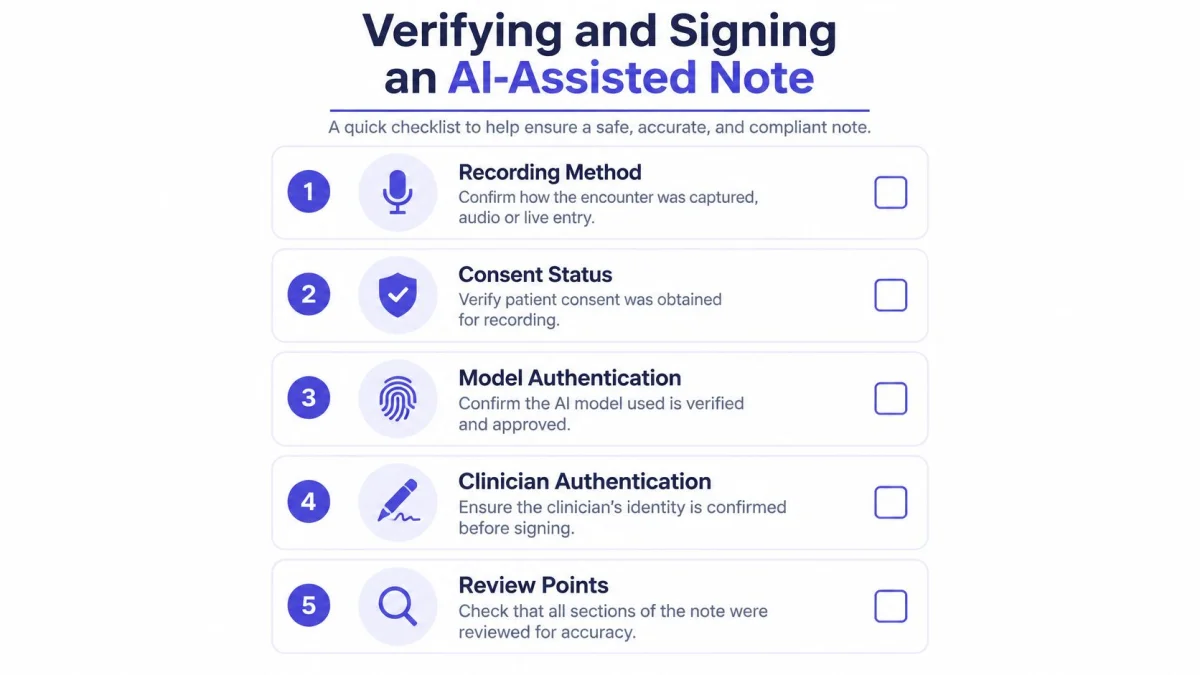
The checklist provides a visual reminder of the review stages.
Verification before authentication
- Establish provenance: Record capture method, consent status, assistive technology used, draft author, and reviewing clinician. Record model information when available under local policy.
- Check attribution: Confirm that patient, caregiver, and clinician statements haven't been merged.
- Compare high-risk details: Check negations, medication doses, allergies, laterality, dates, and result values against their sources.
- Review reasoning: Remove unsupported diagnoses, invented examinations, inappropriate inferences, and code suggestions that don't match the text.
- Complete the record: Resolve missing decisions, review patient instructions, then authenticate under the applicable documentation process.
A model identifier isn't proof of clinical accuracy. Neither is a checked consent box proof that the patient received an adequate explanation.
A missing “not” can change the meaning of an otherwise convincing note.
An illustrative correction entry could read: Draft corrected before signing. Medication statement reassigned from caregiver to patient after source review. Reviewer and completion time recorded. If correction occurs after finalization, the amendment process should preserve the original record and identify the change.
A workflow demonstration can complement the checklist, but it doesn't replace source-by-source review.
Documentation Burden and Where the Hours Go
Late charting isn't merely an organizational inconvenience. A nationally representative study of 1,524 office-based physicians found an average of 1.77 hours daily spent documenting outside regular office hours; a related analysis found 60.0% considered EHR documentation time inappropriate and 76.1% spent more than an hour daily documenting outside clinic hours, as reported in JAMA Internal Medicine's analysis of documentation burden.
The practical implication isn't that every note should be shorter. Clinicians need less avoidable rework: finding missing results, reconciling duplicate text, retrieving an unfinished plan, and rewriting shorthand for patients.
Reduce rework without moving responsibility
A stable report structure can give both templates and assistive documentation tools a clearer destination. It can also expose unfinished work before the clinician reaches the signature field. That's a workflow rationale, not a promise of a particular time saving.
The documentation time-saving tips offer process ideas that small practices can evaluate against their own charting habits. Any trial should consider correction effort and missed information, not merely draft-generation speed.
Privacy arrangements also belong in that evaluation. Under HHS guidance on business associates, a covered entity using a business associate to handle protected health information needs a written agreement defining permitted uses, safeguards, and reporting obligations.
A BAA is a contract, not a marketing badge. The HHS model business associate provisions further address security obligations, breach reporting, compliance access, and support for patient-record responsibilities. Practices comparing a documentation service's published pricing and included safeguards should review those contractual details alongside cost.
Specialty Variations on the Same Skeleton
SOAP provides an organizing pattern, not a universal examination checklist. Different clinicians need different fields because they're answering different questions.
The following matrix offers template-design examples, not specialty-specific clinical guidelines. Each practice should validate its required content against applicable professional guidance and local policy.
Specialty field additions to the SOAP skeleton
| Specialty | Added subjective fields | Added objective fields | Added assessment or plan fields |
|---|---|---|---|
| Family medicine | Patient priorities, home monitoring, treatment barriers | Relevant examination and verified results | Problem-linked decisions and coordination |
| Psychiatry | Patient account, collateral source, functional concerns | Mental status examination findings actually assessed | Clinical formulation, documented risk assessment, agreed follow-up |
| Dentistry | Dental symptoms, treatment history, patient concerns | Tooth-specific findings and periodontal charting when performed | Procedure decisions and applicable US dental billing review |
| Physical therapy | Functional limitations, activity goals, symptom behavior | Tests performed and documented functional measurements | Functional goals, intervention plan, reassessment decisions |
The most important design decision is often what not to prefill. An unperformed test shouldn't appear normal because a specialty template expects a result. A risk-assessment heading shouldn't imply that an assessment occurred.
Specialty templates and an AI template builder can help a clinician preserve preferred headings and terminology. They don't change the verification standard established above.
The specialty template library offers starting formats for adaptation. A useful template should reflect the clinician's work, preserve source attribution, and leave absent information visible rather than making the report appear more complete than the encounter.
From Sample to Daily Workflow
A repeatable documentation process begins with a suitable template and ends with a verified record in the correct chart. Between those points, the practice needs an agreed method for consent, capture, review, patient instructions, and task ownership.
A sensible evaluation uses the same report requirements across manual entry, dictation, and assisted drafting. The clinician can then assess whether a different capture method reduces rewriting without introducing harder-to-find errors.
Practical service details
The London-built service described here produces structured notes, follow-up tasks, and plain-language patient instructions, with notes and tasks in the clinician's own language. Its native iOS app supports offline recording and recording with the screen locked; its library includes 37 specialties and an AI template builder, as detailed in the specialty template information.
Semble is the only EHR integration. Every other EHR uses copy and paste, so final chart placement remains an explicit workflow step. The service isn't designed for health systems requiring deep Epic integration.
The service is HIPAA compliant, with a BAA included at no extra cost. Pricing is $70 per user per month billed monthly, or $50 per user per month billed annually, with a 7-day free trial requiring no credit card and a 14-day money-back guarantee, according to the pricing and trial terms.
There's no enterprise tier and no sales call. The documentation resource library provides further reading for clinicians adapting report formats.
The useful outcome isn't a note that merely looks finished. It's a report whose evidence, decisions, patient instructions, and authorship remain clear after the consultation has ended.
PatientNotes offers consultation capture, structured draft reports, follow-up tasks, and patient instructions for individual clinicians and small practices. A clinician can use the free trial to adapt a familiar template, review a draft against the verification checklist, and assess the correction effort before making it part of daily practice.