You finish the last patient at ten past six and the notes are still open on the screen. Two are half written, one has a plan that says "as discussed" and nothing else, and tomorrow's list starts in twelve hours.
The template is where that problem gets fixed or repeated. A consultation note template isn't a form to fill in. It's a set of prompts that decides what you notice, what you write down, and what goes missing before you sign.
Core Template Fields and What Each One Records
Every template is a decision about what a reader will be able to find six months from now. The list below is the full field set, in the order a covering clinician or a colleague will look for them.
| Field | What to record | Minimum entry |
|---|---|---|
| Header | Patient ID, date, time, clinician, visit type | Name, date of birth, date, visit type |
| Reason for visit | Chief concern in the patient's own words | One sentence |
| History | Changes since last visit, relevant past history, medications, allergies | Current symptoms and allergy status |
| Examination | Findings relevant to the concern, including pertinent negatives | Named findings or "not examined" |
| Assessment | Working diagnosis or differential with reasoning | One diagnosis or problem list |
| Plan | Investigations, prescriptions, referrals, procedures | Each action listed separately |
| Follow-up and instructions | Review interval, return criteria, patient advice | Interval and safety-netting advice |
| Attestation | Clinician name, date and signature | Signed by the author |
The header and the attestation bracket everything else, which is why both belong in the template rather than in a practice policy nobody reads. A note without a visit type can't be audited later as a phone review or a face-to-face encounter, and a note without a signature has no author to ask.
Why the order is not arbitrary
The four-part sequence descends from the problem-oriented medical record Lawrence Weed described in 1964 and set out in his 1968 New England Journal of Medicine article, "Medical Records that Guide and Teach," as a review of the problem-oriented record explains. Weed organised the record around problems rather than chronology, tying each problem to findings, interpretation and a management plan. His early progress note carried five elements, Subjective, Objective, Rx, Interpretation and Plan, and that structure later settled into Subjective, Objective, Assessment and Plan.
Because the structure has already changed once, it should stay configurable. A specialty can add history of present illness, review of systems, diagnostic results, risk assessment, procedures, medications, patient instructions or follow-up without disturbing the reasoning sequence. What the template must never allow is a jump from findings straight to a plan with nothing in between.
The test a finished note has to pass: hand it to a colleague who wasn't in the room. If they can't say why the patient was seen and what happens next, a field did its job badly.
The same discipline applies to documents that leave the practice. Referral letters travel with the note and carry the same obligation to separate the question asked from the answer given, which is why worked referral letter examples are worth reading alongside your consultation template rather than instead of it.
Field-by-Field Entries With Worked Examples
A patient comes for a blood pressure review, reports missed doses and has a reading above target. Each finding needs a clear place in the consultation note, so the next reader can distinguish what was reported, measured and decided.
Documentation also takes time: a national study of US office-based physicians reported an average of 1.77 hours a day completing documentation outside office hours (JAMA Internal Medicine). Give each field a defined job, and make omissions visible before signing.
Metadata that makes the note findable
Start with patient, encounter, author, creation time, document type, language and provenance. These fields identify whose care the document describes, when it was created and where its content came from.
HL7's FHIR document guidance describes a clinical document as a bundle beginning with a Composition resource, followed by the resources it references. A small practice can use the same organisational discipline without implementing FHIR: keep the note tied to its encounter and author.
One entry per field
- Reason for visit: record the patient's words close to verbatim. “Cough for nine days, worse at night, no fever” gives more information than “respiratory complaint.”
- History: include relevant positives and what the patient denies. “No fever, no chest pain, no breathlessness at rest” records answers to specific questions. Use “not discussed” when a topic was not covered.
- Examination: state measured findings and relevant negatives. “Chest clear to auscultation, no wheeze; temperature 37.9°C” identifies what was assessed. Avoid filling an unexamined system with normal findings.
- Assessment: give each problem its status, such as improving, stable or worsening, with a clause explaining the judgement.
- Plan: put each action on its own line with its reason. Record the actual decision about medication, testing or referral, rather than leaving a suggested action in place.
Worked example, a hypertension review
Reason for visit: “Here for my blood pressure check. No headaches, no visual changes.”
History: On amlodipine 5 mg daily since March. Reports missing about two doses a week. No dizziness, no ankle swelling. Allergy status confirmed unchanged, no known drug allergies.
Examination: Seated blood pressure 148/92 mmHg, repeated after five minutes and still above target. Pulse 74 and regular. No ankle oedema. Heart sounds normal.
Assessment: Essential hypertension, above target, with reported adherence gaps. Not controlled; missed doses need to be considered in the treatment decision.
Plan: Address missed doses and document the agreed medication plan, including the reason for any dose change. Home readings twice weekly.
Follow-up and instructions: Review in four weeks with the home log. Record the advice actually discussed about chest pain, breathlessness at rest or visual disturbance.
The medication field must reflect the clinician's decision. An above-target reading and reported missed doses should remain visible together when that decision is reviewed.
What a blank field hides
Leave the examination field empty and the reader cannot tell whether blood pressure was measured, copied or unavailable. Write “not examined, telephone review” or “unable to assess, patient declined” when accurate. Label an undisclosed history item “not discussed.”
These entries make the template a safety control. Before signing, check that every finding was obtained, every denial was asked about and every instruction was given. Replace plausible template text with an explicit gap whenever the encounter does not support it.
Keeping Notes Concise Without Losing Key Findings
Longer feels safer. It isn't. A note padded with a full review of systems copied forward from six months ago looks thorough and tells the reader nothing about today, while the two lines that changed sit buried in the middle.
The after-hours problem that pushes clinicians toward templates doesn't disappear just because a tool exists. In 2024, 75% of physicians surveyed by the American Medical Informatics Association said they had not noticed a recent decrease in the time or effort required for documentation tasks, as the American Academy of Family Physicians reported. Structure helps only when it removes work rather than relocating it.
Rules that keep a note short and complete
- Match the field to the visit. A repeat blood pressure check needs the reading, the trend, the adherence question and the plan. It doesn't need a family history.
- Delete prompts that stay empty. A template field that is blank for every patient is teaching everyone to skip that part of the page.
- Use a one-line update for stable items. "Social history unchanged since March" is a complete statement. Re-typing the whole social history is not.
- Replace whole-note copying with a dated update. Carry the problem list forward, then write today's changes as changes, with the date attached.
- Never carry forward a finding you didn't confirm. Old errors travel with old text, and the next reader has no way to tell which lines are current.
Contrast two diabetes follow-ups. The first reads: "Type 2 diabetes, stable. Metformin 1 g twice daily, no side effects. HbA1c above target last month. No foot symptoms. Review in six months." The second reproduces a twelve-system review from the previous visit, including a respiratory section describing a cough that resolved in the spring. The first note is shorter, and it's the one that supports a decision.
Review rule: when a field's content is identical across three consecutive visits, check that it is still true before you sign it.
Template Variants by Specialty and Setting
The core fields stay. What changes is the module bolted on top, and the code set the practice bills under.
| Setting | Extra fields | Usual format | Code set |
|---|---|---|---|
| Family medicine | Problem list, preventive care, screening | SOAP | ICD-10-CM and CPT (US) |
| Psychiatry and psychology | Mood, risk assessment, session goals | DAP or biopsychosocial | CPT (US) or local |
| Dentistry | Tooth numbers, procedure, materials | Procedure note | CDT (US) |
| Physiotherapy | Functional measure, goals, progress | SOAP | CPT (US) or local |
| Specialist consultation | Test results, risk scores, opinion to referrer | Consultation note | ICD-10-CM and CPT (US) |
| UK NHS or private clinic | Referral reason, safeguarding flags | SOAP or letter | Local UK coding |
The fields that change most
Three additions do most of the differentiating work. Risk assessment appears in mental health, in safeguarding and in any note where the patient's safety is part of the clinical question. Functional measures and goals belong to physiotherapy and rehabilitation, where progress against a baseline is the assessment. The written opinion to the referrer belongs to specialist consultation notes, which answer a specific question rather than summarise a visit.
Everything else is a local convention. DAP and biopsychosocial layouts are widely used formats, not fixed standards, and no licensing body mandates a particular heading order.
Keep code sets separate from the narrative
In the United States, outpatient claims commonly pair an ICD-10-CM diagnosis code with a CPT procedure code, and CMS identifies ICD-10-CM as the diagnosis code set and CPT as the code set for outpatient services and procedures. Dental procedures use CDT, the Code on Dental Procedures and Nomenclature, as CMS explains in its code set guidance. These are three different systems serving different purposes.
That separation matters outside the US too. A software feature that suggests US codes should label them as US billing features, because those suggestions don't map to NHS, private UK or other national coding rules. UK clinicians should keep coding fields optional or switched off, and check required record content against GMC Good Medical Practice and whatever record standard their employer uses.
A shared clinical core across all six settings means one review process, one audit method and one training session, however many specialties the practice covers.
Coding Fields and the US Billing Requirement
For US office and outpatient visits, the E/M level is set by either medical decision-making or total time on the date of service. Under current CPT Evaluation and Management guidance, history of present illness, review of systems and physical examination elements no longer determine the level, as the AMA's summary of the E/M changes sets out.
An MDM-oriented template therefore needs three discrete fields, and at least two of them must meet or exceed the level selected.
Problems addressed. Which problems were evaluated, and how complex each one is. Status or progression belongs here, so "atrial fibrillation, rate controlled on metoprolol, no palpitations since last visit" does the work that a diagnosis label alone cannot.
Data reviewed and analysed. Records and tests you independently interpreted, discussions with other clinicians, and independent historians plus the reason one was needed. "Reviewed outside ECG from 12 May, rate controlled" is a data point; "records reviewed" is not.
Risk of management decisions. This includes risks considered even when an intervention wasn't performed, which is the element most templates omit. A decision not to anticoagulate carries risk, and the note has to say so.
The verification duty in plain terms
A suggested code is advisory. The clinician confirms that the documented encounter supports the proposed US CPT code before it goes on a claim, and no template does that confirmation on the clinician's behalf. ICD-10-CM, CPT and CDT are distinct systems with distinct purposes, and the narrative record stays separate from all three.
If the coding side of this leaves your notes thin, the evaluation and management coding guide walks through how the levels map to documented work. For UK practices the rule is simpler still: keep the coding fields off and follow local rules, because US code suggestions are not NHS coding.
Verification Checklist Before You Sign
The template only becomes a safety control at the point of signature. A 2025 study of clinical notes evaluated 12,999 clinician-annotated sentences across 450 notes and found a 1.47% hallucination rate and a 3.45% omission rate, with 44% of hallucinated sentences classed as major errors that could affect diagnosis or management if not corrected, as reported in npj Digital Medicine. Those rates are low per sentence and not low per clinic day.
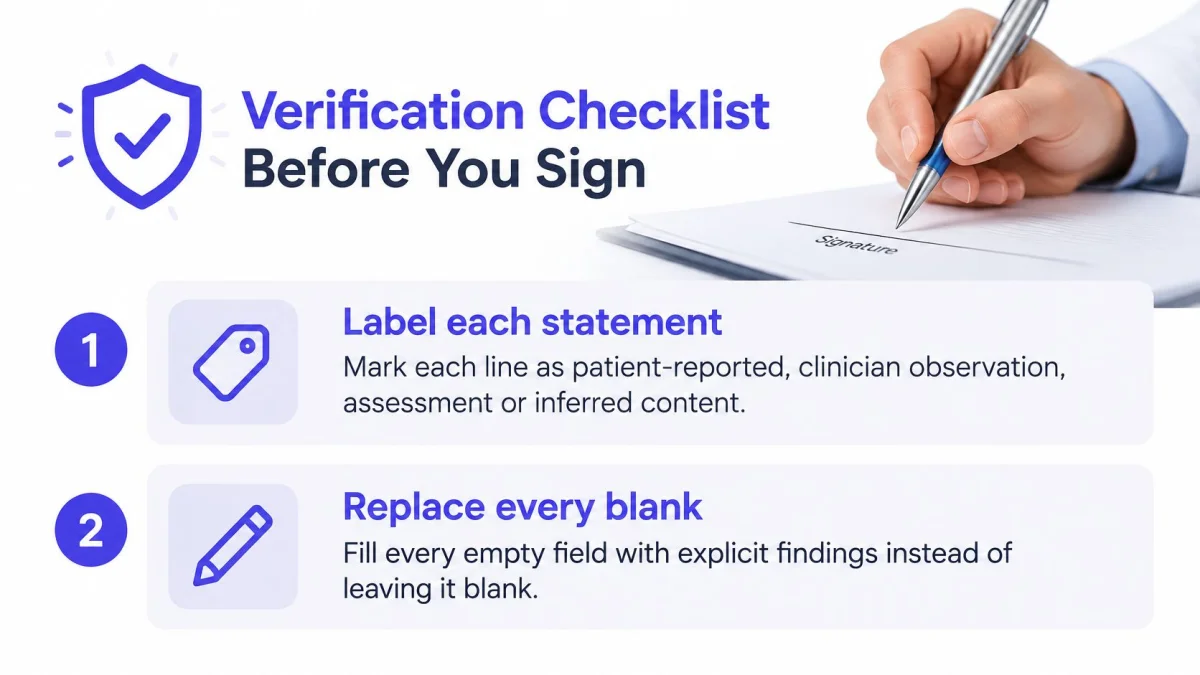
Run these eight checks on every note, templated or not.
- Label the source of each statement. Patient-reported, clinician observation, assessment or inferred content. A reader who can't tell the difference can't weigh the evidence.
- Replace every blank with a stated gap. "Not discussed" or "unable to assess" is information. A silent blank reads as a negative finding.
- Reconcile medications and allergies against the record. This is the highest-consequence omission in any note, and the one most likely to survive copy-forward.
- Confirm red flags were considered and recorded. Chest pain, suicidal ideation, new neurological signs. Each prompt should name the guideline behind it, such as a national chest pain standard or a suicide-risk assessment framework, so reviewers know why it's there.
- Check the follow-up interval and the return criteria. A plan with no review date and no safety-netting sentence leaves the patient without instructions.
- Trace each important statement to the encounter. If a line can't be tied to something said or done in the room, it doesn't belong in the note.
- Compare every coding suggestion with the documentation. The note supports the code, never the reverse.
- Keep the pertinent negatives, the patient's preferences and the reasoning. Compression that removes these makes a note shorter and weaker.
A short note isn't automatically a safe one. Aggressive trimming can strip out the negative findings, the patient's stated preference and the reasoning that made the plan defensible.
The checklist is the last line, not the only one. If a field repeatedly needs the same correction, the template is the thing to fix.
Adapting the Template to Your Workflow
The workflow that works is short. Record the visit, in person, by phone or by video. Pick up the structured note moments after recording stops. Review it, edit what's wrong, and copy it into the EHR. Three steps, in that order, with the review sitting between generation and the patient record rather than after it.
That middle step is where quality is won or lost. A 2025 systematic review of 11 studies found generally positive clinician views of AI documentation and reduced task load, but continuing concerns about the reliability and validity of generated records, with 96% of participants in one included study naming data-quality concerns as a major short-term implementation challenge, according to the published review. Copy and paste, carry-forward, inherited templates, prompts and model versions all change what appears in the record, and all of them let erroneous content persist.
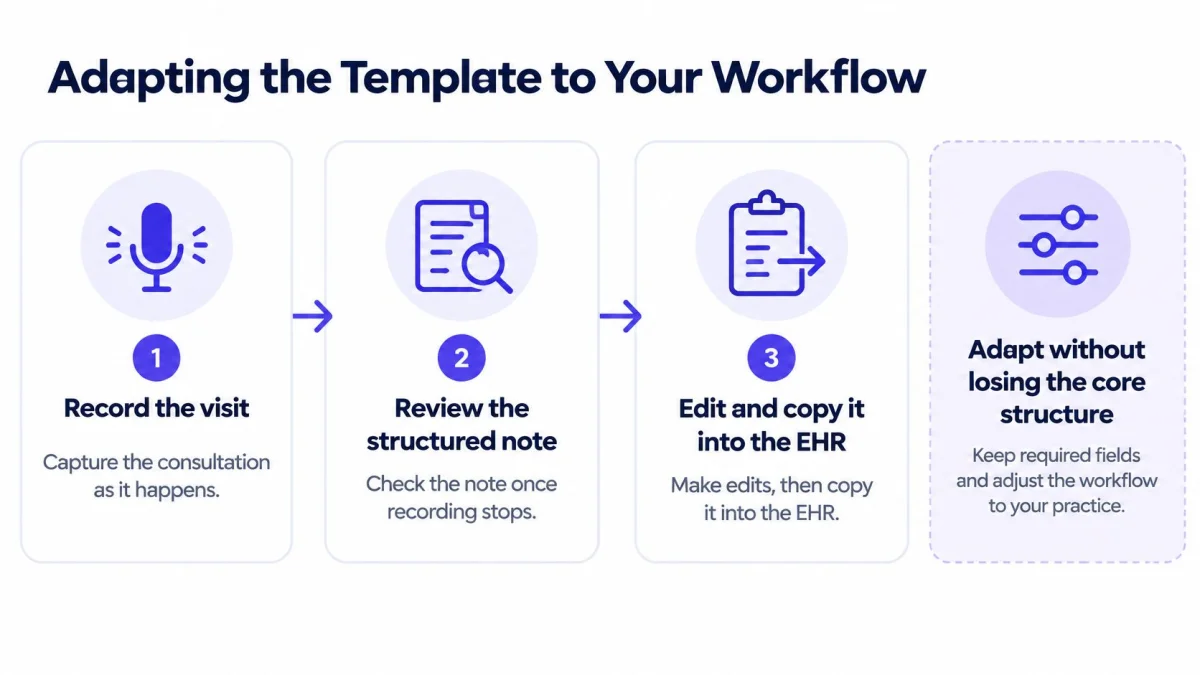
Keep a stable core and bolt on modules
The clinical core stays fixed: reason for encounter, relevant history, examination, assessment, shared decisions, safety-netting and follow-up. Everything else is a module. US ICD-10 and CPT fields are one module. UK referral and safeguarding workflows are another. Dentistry, mental health and rehabilitation each add their own.
That split keeps payer-specific content out of the clinical narrative and makes it obvious which parts of a note exist for billing rather than for care. It also means a practice that changes payer or jurisdiction can swap a module without rebuilding the note.
Version control in five rules
- Stamp every template with a version number and a date.
- Log each change and the reason for it, in one line.
- Set a review date at least yearly, and again after any change in payer or jurisdiction rules.
- Record which version a note was built from, so an audit can tell what prompts the clinician was working with.
- Assign one owner who approves changes, or the template will drift by accretion.
If after-hours charting is the specific problem you're trying to solve, the practical steps in this guide to reduce after-hours charting time sit alongside template design rather than replacing it.
The help center's walkthrough on custom templates shows how to build and change a template without breaking the core fields.
One warning worth stating plainly. A more complete template can make documentation worse. Extra fields invite irrelevant text, and irrelevant text hides the clinical signal. Measure a template by what it prevents, not by how much it captures.
Test Your Template on Three Real Notes
Run the next three visits on the new template before anyone else uses it. Pick notes that differ: one short follow-up, one consult with a long history, and one visit where several items were never raised. You are checking whether each field still shows what was asked, what was found, and what was not discussed, so an omission is visible before you sign.
Start from the core field table in the first section, or from a specialty template for your discipline, and leave the reasoning sequence intact. Keep only the fields your setting uses. A field that never earns its space trains the next reader to skim past the line that mattered.
Work the verification checklist on all three notes. Write down every blank you marked "not discussed" and every copied line that was out of date. The same blank on all three means that field is forcing a conscious entry instead of hiding a gap. If a field stays empty because it never applies, I would cut it before the fourth patient, then use the template on the rest of the list.
For PatientNotes users, the specialty library covers 37 specialties, with note formats including SOAP, progress, H&P, procedure, consultation and discharge summaries. Pricing is $70 per user per month billed monthly or $50 per user per month billed annually ($600 per year). A 7-day free trial needs no credit card, a 14-day money-back guarantee applies, and US practices get a BAA at no extra cost; HHS describes that agreement as the written arrangement requiring the business associate to safeguard protected health information and support applicable Privacy Rule duties (HHS guidance on business associates).
ICD-10, CPT and CDT suggestions apply to US billing only. Semble is the only EHR with a direct integration, and every other EHR takes notes by copy and paste. There is no enterprise tier and no sales call. That fits solo clinicians and small teams, and it will not fit a health system that needs deep record integration.
PatientNotes records the consultation, writes it into a structured consultation note template in the clinician's own language, and leaves every field visible for review before signing. Templates cover SOAP, H&P, progress, procedure, consultation and discharge formats, plus a library of specialty templates and an AI builder for your own layout. Start with the 7-day free trial, no credit card required, at PatientNotes.