It's 9:40 pm. The last client left two hours ago and the note is still a blank box with a blinking cursor. The session comes back in outline: the topic, the tearfulness, the moment the room went quiet. Whether the safety screen happened out loud or only in your head stays fuzzy.
The format carries most of the blame. The therapy session notes template picked on day one decides how much gets captured while the client is still talking and how much has to be reconstructed later. A structure that matches the work fills itself in. A structure that fights the work waits until the details blur.
Therapists, counselors, psychologists, psychiatrists and allied health clinicians all hit the same fork. The right answer depends on the setting, the payer and whether the note belongs in the medical record or in a psychotherapy process file kept apart from the billing chart. A 2026 report citing a therapist survey found that therapists seeing roughly 18 clients a week spent about 2.5 hours weekly, or 10 hours monthly, on progress notes, as summarized in this survey write-up on therapist admin time. That looks small on a weekly line and lands as a reliable nightly tax.
Visit type shifts the answer too. A therapy hour and how psychiatric evaluations work call for different documents, and one template should serve both only at the cost of doing either well. Seven formats follow, each matched to the setting it was built for, with a copy-ready snippet and the point where each one starts to fail.
1. SOAP Note (Subjective, Objective, Assessment, Plan)
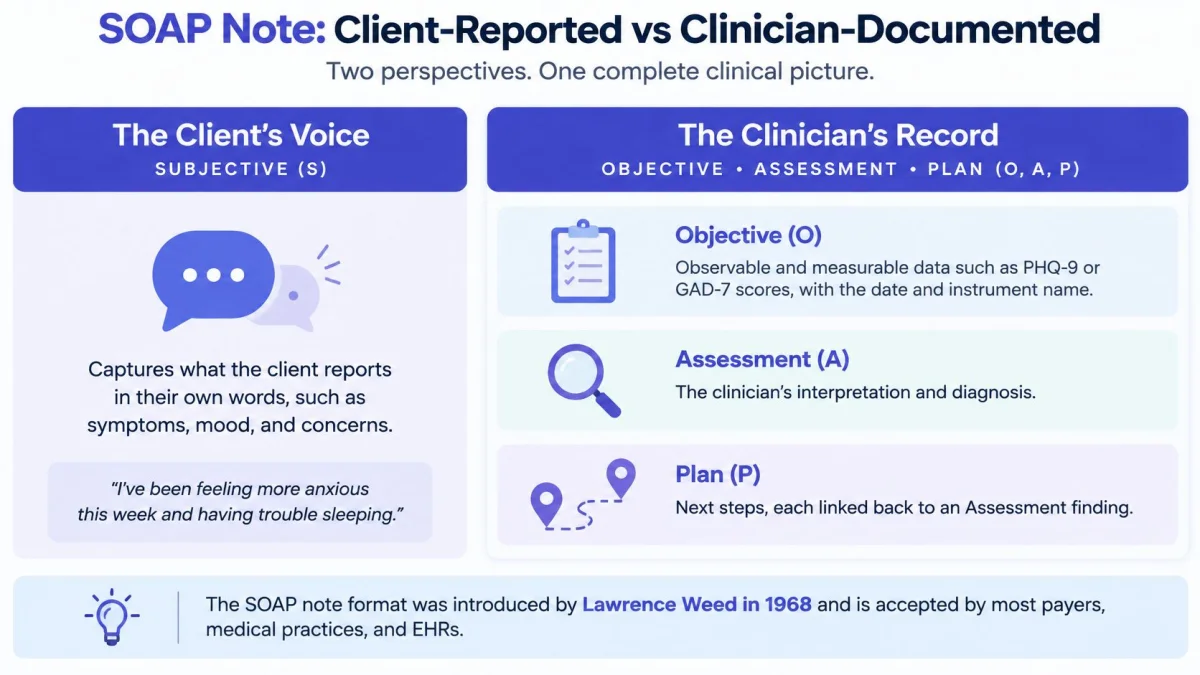
SOAP is the default because it's the one structure nearly every payer, EHR and medical colleague already recognizes. It splits a session into four boxes: what the client reports (Subjective), what the clinician observes or measures (Objective), the interpretation (Assessment), and the next steps (Plan).
The structure comes from Lawrence Weed's problem-oriented medical record reforms in the 1960s, which organized the chart around a problem list and worked through those four components in order, as described in the University of Toronto psychotherapy charting guidance. That guidance recommends SOAP for psychotherapy while allowing other formats that capture history, mental status, diagnosis and assessment, physical health and allergy information, medications, treatment planning, progress notes, outcome assessment and a termination note. It also asks follow-up notes to record what changed since the previous visit and how the client responded to therapy.
Where SOAP Earns Its Place
Medication management, physiotherapy and mixed medical-psychiatric visits fit SOAP because the format has a natural home for a measured number. A depression follow-up in primary care puts the PHQ-9 score, instrument name and date in Objective. A physiotherapy visit puts range of motion and a pain rating in the same box. Neither belongs in Subjective, where the client's own words live.
Get the sequence right and the clinical reasoning becomes traceable without extra sentences.
- Put validated measures in Objective. "PHQ-9 = 12, 14 May" is data. "Client seems more depressed" is a conclusion with no evidence under it.
- Keep Subjective close to verbatim. Quote the one sentence that matters, then stop.
- Tie every Plan item to an Assessment finding. If the Assessment names sleep disruption, the Plan names the sleep intervention.
Where It Gets Awkward
SOAP invites padding. Subjective swells into a transcript and Plan collapses into "continue weekly". The fix is a word ceiling per section, not a longer template. Standard abbreviations help a covering clinician read the note cold, and a running list of therapist abbreviations settles most of the ambiguity.
2. DAP Note (Data, Assessment, Plan)
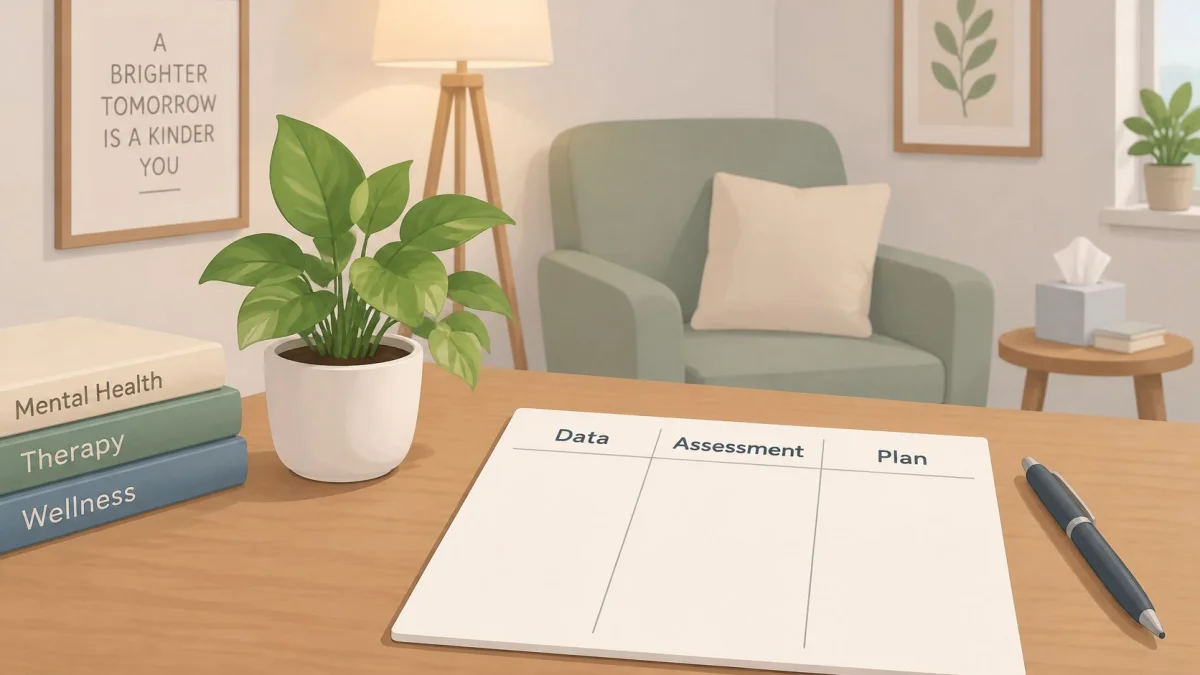
Say a client arrives for session six of weekly therapy for anxiety and there are eight minutes between appointments to write it up. DAP is built for that room. Three sections: Data, Assessment, Plan. Data merges what the client said with what the clinician observed. Assessment carries the interpretation and progress toward goals. Plan lists what happens next.
DAP suits psychotherapy because the line between subjective and objective is blurry in a talking session. Whether a client "reported" or "appeared" anxious is often the same piece of information, and splitting it into two boxes taxes the writer without adding clinical value.
The Time Math
Therapists commonly add 15 to 25 minutes of documentation to every session, according to the workload evidence summarized alongside a 2026 clinician survey reported by a commercial source. At 15 minutes, six sessions add 90 minutes. At 25 minutes, the same caseload creates 2.5 hours of post-session writing. The same survey material reports that 40% of licensed behavioral-health clinicians spend six or more hours each week on documentation and administrative work, and 49% say they could immediately take on more patients if that burden dropped. Read those as survey evidence, not a universal estimate.
A shorter format doesn't remove the work. It removes the decisions about what goes where, and those decisions are where the delay lives.
- Write Data in observable terms. What the client said, how they presented, what was covered. In a weekly anxiety session that's mood, sleep and session content; in a community mental health group note it's participation and peer interaction.
- Name the goal in Assessment. Reference it by number or by its exact wording from the plan.
- Standardize the Plan line. Next session date, homework, and anything the client agreed to between sessions.
Practical rule: draft the Assessment first. If the change can't be stated in one sentence, the session content isn't the problem. The goal was never specific enough.
3. BIRP Note (Behavior, Intervention, Response, Plan)
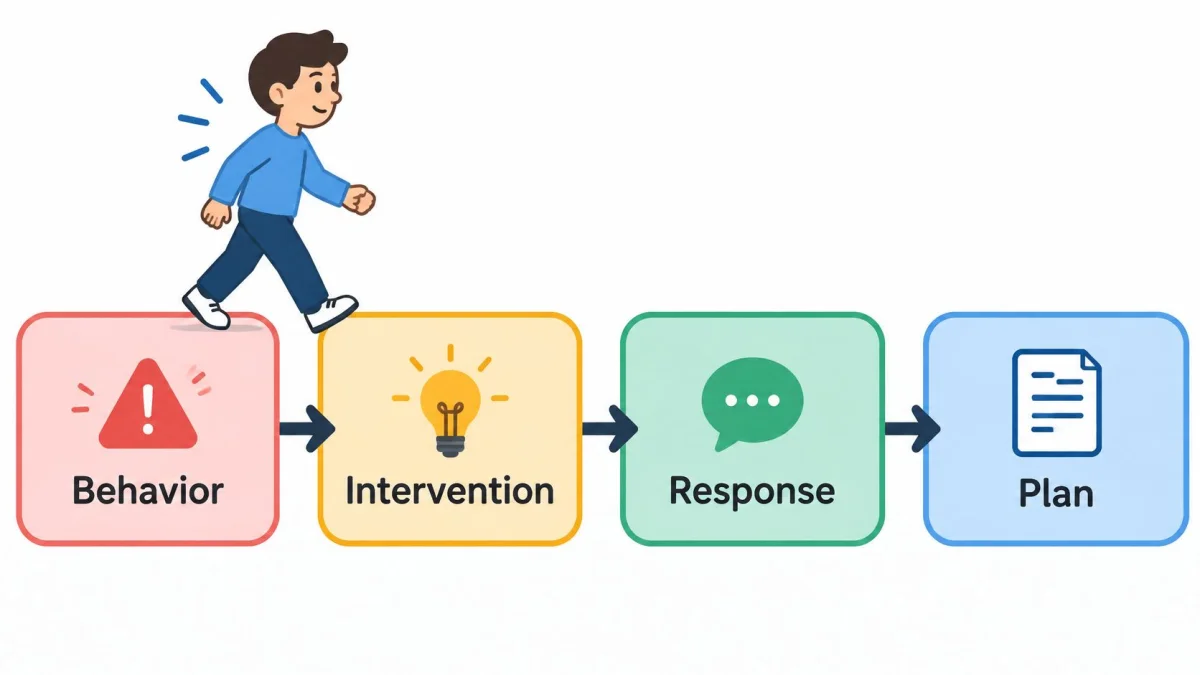
BIRP shows up in residential treatment, substance use programs and community behavioral health, settings where the chart has to prove that a specific clinical action produced a specific client response. Four parts: Behavior (what the client did, said or presented), Intervention (the technique used), Response (how the client reacted), Plan (next steps).
Why Auditors Like It
A note that says "discussed coping skills" documents a conversation. A note that says the clinician practiced urge surfing after a reported craving, and the client rated the urge 6/10 afterward, documents a treatment. BIRP forces the second version, because Intervention and Response sit next to each other and neither has anywhere to hide.
That adjacency matters most in a relapse prevention session, where the whole clinical claim rests on whether a skill was used in a high-risk moment and what happened next.
- Name the technique. Cognitive restructuring, motivational interviewing, DBT skills, exposure. Not "processing".
- Keep Response in the client's words where possible. "Client stated she 'felt better talking about this'" carries more weight than "client engaged well".
- Check the agency or payer format first. Some settings require a specific structure, and a beautifully written BIRP note in the wrong format still fails review.
The Coding Boundary
Behavioral health notes travel with codes, and the suggestion layer needs a hard stop. ICD-10-CM reports diagnoses. CPT and CDT are separate systems used for professional medical and dental services. Suggested codes can sit beside the finished note for convenience, but a clinician or billing professional confirms each one against the documented service, the diagnosis, the payer rules and the date of service. In American practice that review is routine. It shouldn't be automated away.
4. GIRP Note (Goals, Intervention, Response, Plan)
GIRP is BIRP with the camera moved. Instead of opening on the client's behavior, it opens on the treatment goal the session served. That single change turns a session note into a progress report against a written plan, which is what utilization reviewers consistently ask for.
What the Structure Buys
A large evaluation of AI-generated psychotherapy notes covering 850,000 appointments, more than 8,700 providers and 189,000 patients found that clinicians using the tool documented 25% faster and submitted notes 8.2 hours sooner than clinicians who did not. Patient continuity was slightly higher among adopters, while depression and anxiety outcomes were equivalent between the two groups, according to this preprint of the psychotherapy documentation evaluation. Faster finalization and unchanged outcomes can coexist. Keep in mind the results are a preprint, so treat the effect sizes as provisional.
For a GIRP template, the useful part is structural.
Discrete fields plus a review step before signing produce both speed and completeness. Length produces neither.
- Copy the goal wording exactly from the treatment plan into the Goals line, numbers and dates included.
- Add an unplanned-content line. Sessions rarely follow the plan, and the detour is often the clinically important part.
- Review the goals on a schedule. Every 90 days suits many plans; some payer contracts demand more often.
An intensive outpatient program reporting goal progress at set intervals gets a clean audit trail from this format. An individual therapist working from a detailed plan gets a shorter note that still proves movement.
Build the plan first, since GIRP is only as good as the goals it cites. A therapy treatment plan template gives the Goals line something exact to quote.
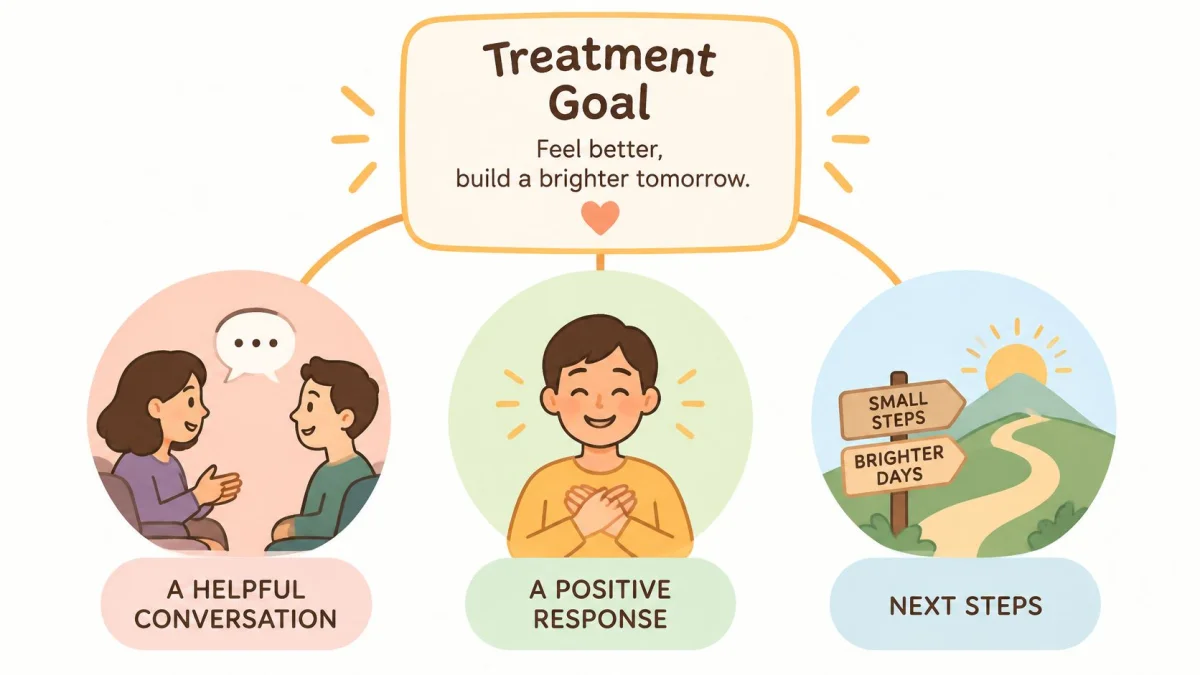
5. DARP Note (Data, Assessment, Response, Plan)
DARP adds one letter to DAP and picks up the intervention-response link that BIRP has, without losing DAP's brevity. Data records session content and the client's presentation. Assessment interprets it. Response records how the client responded to the interventions used. Plan lists next steps. It's the compromise format, useful when a practice wants a single note structure across every client and every modality.
The Response Line
The line most clinicians forget is Response. A note that lists what the clinician did but not what shifted reads like a session agenda, not a treatment record.
For a behavioral activation assignment in a depression session, Response is where the outcome goes: whether the client completed the activity, what got in the way, and what the client said about it afterward. Keep it about the client's change, not the clinician's effort.
- Name the intervention inside Data or Response so the pair can't drift apart.
- Confirm the format with each payer before it carries an insurance claim.
- Don't stretch DARP over medication management. It has no home for adherence, side effects and dose rationale, and squeezing those into Assessment makes the note unreadable.
What the Time Savings Really Look Like
A 2025 US pilot study of 70 licensed psychotherapists found AI-assisted documentation cut average note-writing time by 55%, from 20 minutes to 9 minutes per session, per this report on the psychotherapy documentation pilot. Those saved minutes only pay off if the destination format has a slot for treatment response. Otherwise the tool produces a tidy note with the clinical point missing.
6. APIE Note (Assessment, Plan, Intervention, Evaluation)
APIE is the rehabilitation format, and it runs in almost the opposite direction from SOAP. It starts with the examination. Assessment records findings. Plan sets goals and the intended course of care. Intervention lists what was delivered. Evaluation records the response and progress. The order mirrors the clinical reasoning sequence laid out in the American Physical Therapy Association's Guide to Physical Therapist Practice, which is why it reads naturally to a physiotherapist and oddly to nearly everyone else.
What Belongs in Each Box
An outpatient visit for low back pain opens with Assessment: Oswestry score, range of motion, pain rating, each with the date attached. Plan states the goal and the expected frequency. Intervention lists the manual therapy, exercise progression or modality delivered. Evaluation answers the only question a reviewer cares about, which is whether the client is better, worse or unchanged since the last visit.
The same skeleton carries post-operative rehabilitation notes that track range of motion and gait, and occupational therapy notes that track functional tasks.
- Record one or two validated outcome measures each visit, with dates and scores. Guessing at progress costs more than measuring it.
- Link each intervention to a stated goal in the Plan. An intervention with no goal behind it reads as habit.
- Check CMS and payer functional reporting rules before billing, since the requirements vary by plan and change.
Keep Assessment and Plan Separate From the Narrative
The most common APIE failure is a note where assessment, plan and narrative blur into one paragraph. Structure exists to give each item a defined place for review and completion. That means clinical reasoning has to be visually distinct from the session description, and generated text stays a draft until a clinician has read it against the encounter.
The walkthrough below covers the reasoning sequence behind the format and how it maps onto a written note.
7. Psychotherapy Process Note (Narrative Note)
This is the only format on the list that is deliberately kept out of the medical record. A process note is a free-form narrative of a psychotherapy session: the clinician's detailed observations, the dialogue that mattered, reactions, hypotheses and the interventions used. It supports supervision and clinical thinking. It never replaces the progress note used for billing and continuity.
The Legal Split
HIPAA defines psychotherapy notes as notes recorded by a mental health professional that document or analyze the contents of a counseling session, kept separate from the rest of the medical record under 45 CFR 164.501, as explained in this HHS guidance on the extra protections for mental health information. They carry stronger protections than an ordinary progress note, and most disclosures need a specific authorization, including some care coordination with another provider. A progress note may document diagnosis, functional status, treatment plan, symptoms, prognosis, progress, session timing, modality and treatment frequency. A private process note is a different kind of document entirely.
Patients generally have a right to access medical-record information. Separately maintained psychotherapy notes are the exception. Copying private process material into the chart moves it into the accessible record, which is the most common way clinicians lose the protection by accident.
If a vendor stores those notes, the vendor is a business associate, and the covered entity needs written satisfactory assurances that define permitted uses and disclosures, require appropriate safeguards and prevent use outside the agreement, per this HHS business associate guidance.
- Store process notes separately, with stricter access controls than the chart.
- Use the progress note for billing, continuity and anything a colleague might need to read.
- Check state law and board rules, which can add requirements beyond HIPAA.
If it goes in the chart, it becomes disclosable. That's the whole test.
A supervision session reviewing a hard termination belongs in the private file. A psychiatrist's reflections on therapy content belong nowhere near the medication management note. A guide to session notes covers the record-keeping side in more detail.
How the seven therapy note formats compare
| Item | Sections | Best for | Typical setting | Payer familiarity |
|---|---|---|---|---|
| SOAP Note (Subjective, Objective, Assessment, Plan) | Subjective, Objective, Assessment, Plan | Medical and mixed medical-psychiatric care | Medical practices, physiotherapy, EHRs | High; widely accepted |
| DAP Note (Data, Assessment, Plan) | Data, Assessment, Plan | Brief psychotherapy documentation | Community mental health and private practices | Moderate; less standardized than SOAP |
| BIRP Note (Behavior, Intervention, Response, Plan) | Behavior, Intervention, Response, Plan | Showing how interventions relate to client responses | Residential, substance use, and community behavioral health | Variable; check payer requirements |
| GIRP Note (Goals, Intervention, Response, Plan) | Goals, Intervention, Response, Plan | Tracking progress against treatment goals | Outpatient therapy and intensive outpatient programs | Useful for progress reviews; familiarity varies |
| DARP Note (Data, Assessment, Response, Plan) | Data, Assessment, Response, Plan | Concise notes that capture clinical reasoning and treatment response | Individual therapy and counseling practices | Limited; confirm acceptance with payers |
| APIE Note (Assessment, Plan, Intervention, Evaluation) | Assessment, Plan, Intervention, Evaluation | Rehabilitation and functional progress tracking | Physical therapy and allied health clinics | Familiar in physical therapy; check payer rules |
| Psychotherapy Process Note (Narrative Note) | Free-form narrative; no fixed sections | Clinical reflection, supervision, and consultation | Kept separate from the main medical record | Not for billing; use a progress note instead |
Build Your Template, Then Test It on Real Sessions
Documentation is one of the few parts of practice a clinician can redesign without touching clinical care. The American Medical Association's 2024 survey reported that 43.2% of surveyed physicians experienced at least one symptom of burnout in 2024, down from 48.2% in 2023 and 53% in 2022, across more than 100 health systems and organizations in 43 states. A template won't fix a broken system. It does target one contributor.
So build one format per setting, save it as a reusable template, and run it for a week of real sessions before deciding it works. Track four things: median time from session end to signed note, the share of notes finished before the end of the workday, after-hours documentation minutes, and how often a note needs a real correction rather than a typo fix. Those numbers tell you more than any productivity claim.
Don't Trust Satisfaction Alone
Feedback ratings flatter templates. An observational evaluation of an AI documentation workflow reported more than 286,000 generated mental health notes from 162 full-time and 1,366 contract providers, with over 98% of submitted feedback ratings positive, yet only 30,519 of 466,139 notes, or 6.5%, received formal quality ratings, per this JMIR preprint on AI mental health documentation. Positive ratings from a small self-selected group are a signal, not proof.
Pull 20 of your own notes and read each one against the session it describes. Look for unsupported inferences, missing risk documentation, contradictory mental status findings and carry-forward text that no longer fits the client.
One Tool That Fits This Workflow
PatientNotes includes SOAP, progress and H&P templates, a library of templates across 37 specialties, and an AI template builder for formats that don't exist yet. Pricing is $50 per user per month billed annually or $70 billed monthly, with a 7-day free trial and no credit card required. Compare plans at PatientNotes pricing and browse the specialty template library.
Whatever you build, keep the privacy boundaries intact. Patient privacy rights in therapy is worth re-reading before notes move into any new system.
PatientNotes records the session, writes it into the note format you've chosen, and extracts follow-up tasks, all in the language you work in. If late charting is the reason you're reading about templates, that's the problem it's built for: HIPAA compliant with a business associate agreement included at no extra cost, and no sales call required. Start with a 7-day free trial and test it on one week of real sessions.