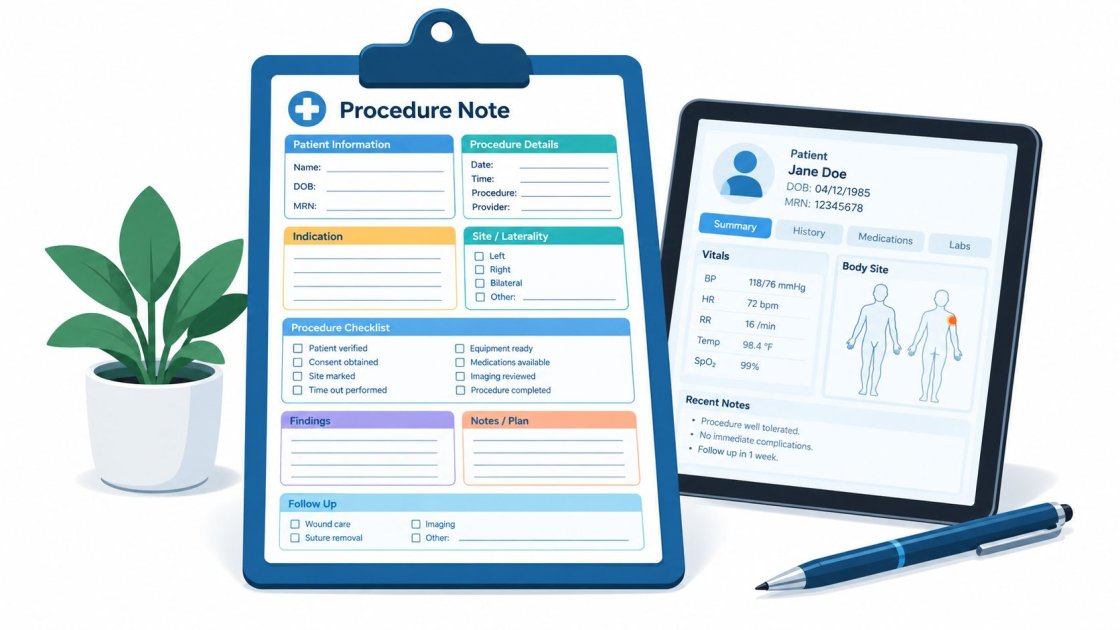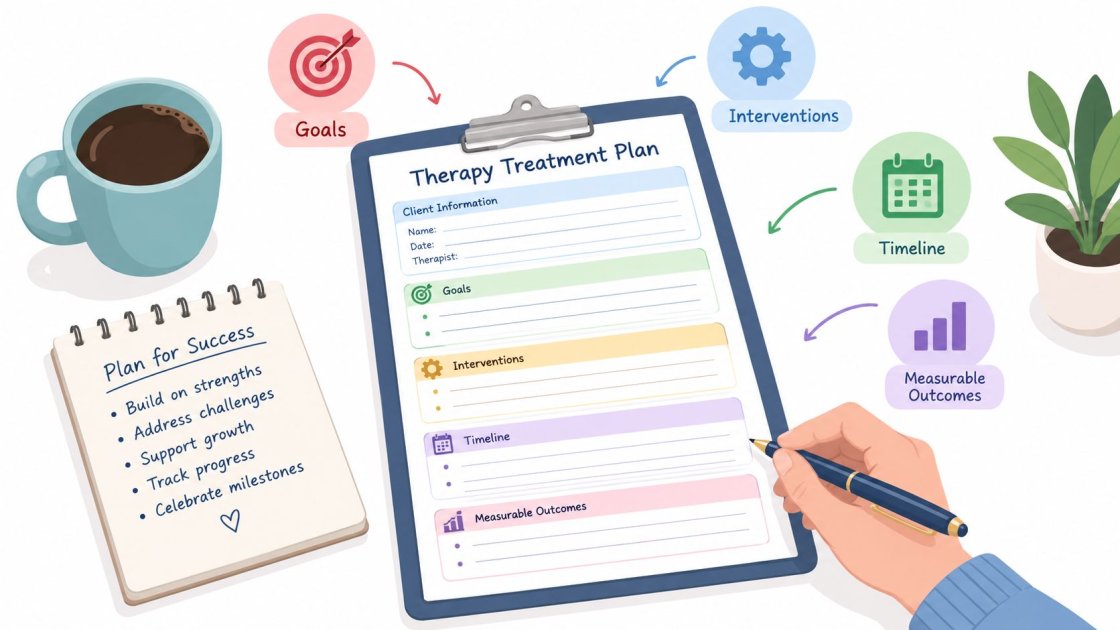
A clinician finishes the last session of the day, opens the chart, and finds a treatment plan that says only “improve mood” or “reduce anxiety.” The intake contains useful detail, and the progress notes describe what happened, but neither document tells the next clinician what should happen next. That gap creates extra work during every review and leaves the practice with a weak explanation of ongoing care.
A well-built therapy treatment plan template solves that problem when it functions as a clinical operating document. It translates assessment findings into goals, objectives, interventions, review points, and discharge criteria. It also gives each session a defined purpose instead of turning documentation into a collection of disconnected historical notes.
The Critical Role of a Treatment Plan in Therapy
A treatment plan has a different job from an intake assessment or a progress note. The intake assessment gathers history, symptoms, risks, strengths, diagnoses, and relevant context. A progress note records what occurred during a specific encounter. The treatment plan sits between those documents. It turns the assessment into a forward-looking strategy that guides the work.
That distinction matters during chart review. A progress note can show that a session took place, but it may not show why the intervention was clinically appropriate or how it relates to the expected outcome. A treatment plan should make that connection visible without requiring an auditor or covering clinician to reconstruct the case from scattered entries.
Practical rule: The plan should answer three questions at a glance: what problem is being treated, what change is expected, and how the team will know whether the change is happening.
A useful template begins with the presenting problem in the patient's own words, then connects that problem to the assessment and diagnosis when applicable. It records the patient's strengths, relevant barriers, risk factors, and agreed treatment approach. The clinician and patient should be able to recognize the plan as a shared working agreement, not as a diagnosis copied into a form.
The plan should direct the next session
The most useful test is operational. If a clinician opens the treatment plan before a follow-up, can the document support a clear session strategy? It should show the active goal, the current objective, the intervention being used, and the evidence that will be reviewed.
A plan that merely lists symptoms has limited clinical value. A plan that identifies a target behavior, assigns a method, and sets a review point helps the clinician decide what to ask, what to measure, and what to change.
The plan also supports medical necessity
Structured documentation has become closely connected to reimbursement requirements. The American Speech-Language-Hearing Association's summary of Medicare therapy documentation identifies an evaluation, a plan of care or treatment plan, diagnoses, long-term goals, service type, amount, duration, frequency, progress reports, and a discharge summary as required elements. Its guidance also notes that a single format isn't prescribed, which leaves practices room to adapt the structure to their workflow.
That flexibility doesn't make the content optional. A treatment plan with no measurable targets, service details, or review logic is difficult to defend months later. The template is valuable because it makes omissions harder and keeps the clinical rationale visible.
Core Components of an Effective Treatment Plan Template
A reliable template should be compact enough to use and detailed enough to withstand a chart review. The following components form the core.
Clinical diagnosis and presenting problem
The diagnosis should appear with the applicable coding reference, such as an ICD-10 code in a US workflow. The code shouldn't replace clinical reasoning. It should sit alongside a concise description of the patient's actual concern, ideally using the patient's own words where appropriate.
The presenting problem gives the plan context. “Anxiety disorder” is not a sufficient description of the work by itself. A useful entry might describe avoidance of work meetings, disrupted sleep, or difficulty leaving home, provided those details are supported by the assessment.
Long-term treatment goals
Goals describe the meaningful outcome of treatment. They should relate to function, symptoms, participation, or quality of life rather than just repeat the diagnosis.
A goal such as “increase participation in daily activities” gives direction, but it still needs objectives that define the expected change. Goals should be collaborative. If the patient doesn't recognize the goal as relevant, adherence and shared decision-making become weaker.
Measurable objectives
Objectives break the goal into observable milestones. Each objective needs a criterion, a timeframe, and a measurement source. That source might be a validated scale, a session record, a behavior log, a caregiver report, or a functional measure appropriate to the specialty.
One template approach recommends that each active problem have at least one goal and that each goal have at least one objective connected to a criterion, timeframe, and measurement source. The approach is outlined in guidance on treatment-plan goals and objectives.
Interventions and service details
The intervention field should identify the therapeutic method and explain how it relates to the objective. It should also record the modality, frequency, and duration of care. These details turn an intention into an executable plan.
A plan that says “provide therapy” doesn't tell a covering clinician what approach is intended. A stronger entry identifies the intervention, the target, the planned cadence, and any between-session activity.
Responsibility, risk, and review
A solid template identifies the responsible clinician and records relevant strengths, support systems, risks, barriers, consent, and review dates. It should also include discharge or transition criteria where applicable.
The biopsychosocial assessment template can help practices carry the intake information into a more structured planning process.
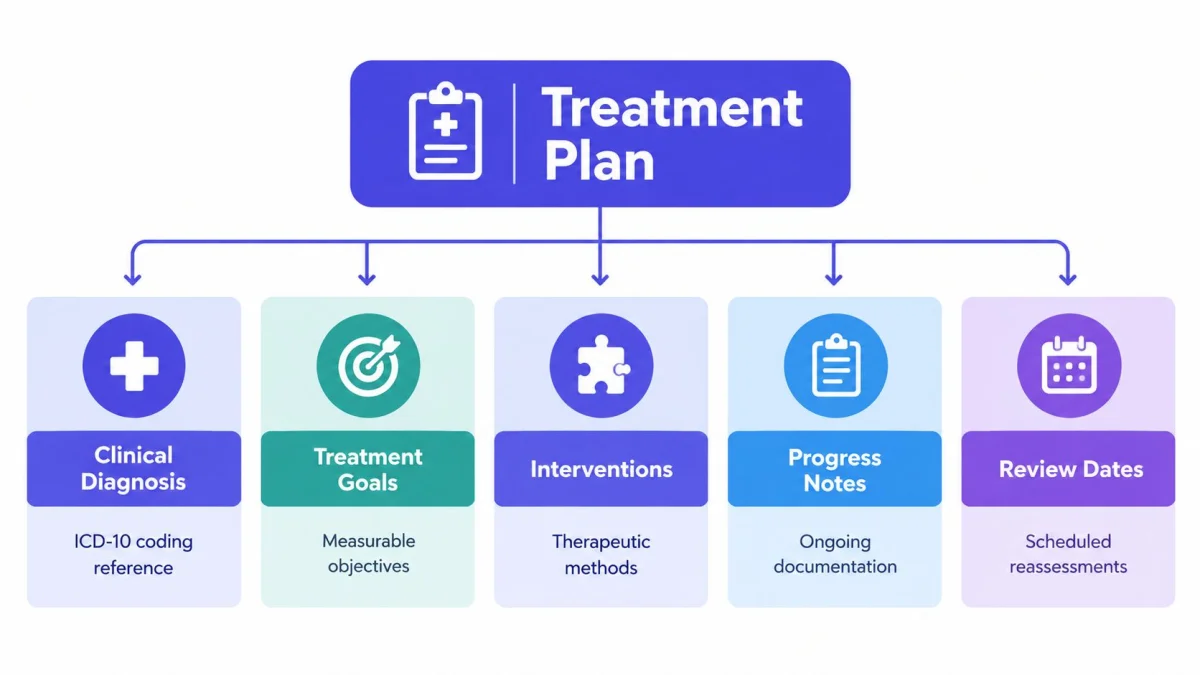
A good template doesn't force every specialty into identical fields. It preserves the essential logic while allowing the clinical measures and intervention details to change.
Writing SMART Goals and Measurable Objectives
Vague goals are the most common weakness in therapy treatment plans. “Improve mood,” “reduce anxiety,” and “increase coping” may describe a clinical intention, but they don't establish how progress will be judged. They also make it difficult for another clinician to continue the work without repeating the original assessment.
SMART objectives make the plan operational. The familiar framework uses objectives that are Specific, Measurable, Achievable, Realistic, and Time-bound. The wording should remain clinically honest. An objective shouldn't promise a result that the patient or clinician can't reasonably control.
Start with the behavior or function
The first question is what the patient will do differently. A symptom rating can be useful, but observable function often gives the plan greater clinical value.
A weak objective might say:
- “The patient will improve social interaction.”
A stronger objective might say:
- “The patient will initiate a conversation with a peer three times per week for four weeks, measured through session logs.”
The second version identifies the behavior, frequency, timeframe, and measurement source. It also gives the clinician something concrete to review. If the target isn't met, the clinician can examine barriers, modify the intervention, or revise the objective rather than just recording that progress is limited.
Keep goals broad and objectives precise
A long-term goal can describe the desired direction of care. The objectives should define the steps. For example, a goal focused on improved participation might include objectives related to leaving home, completing a routine, using a coping strategy, or returning to a specific activity.
Each active problem should connect to a goal, and each goal should connect to at least one measurable objective. That alignment prevents unrelated interventions from accumulating in the plan. It also gives progress notes a clear structure because each note can identify the objective addressed and the evidence discussed.
A clinician developing or reviewing objectives may use Coachful's goal-setting tool as a general worksheet for organizing measurable targets. The clinical decision still belongs in the treatment plan and must reflect the patient's assessment, preferences, and care context.
Choose a measurement source before finalizing the objective
A measurement source can be formal or practical. A symptom scale may suit one case, while a behavior log, functional observation, caregiver report, or patient diary may suit another. The source should be available to the clinician at review time.
The psychological scales resource can support a more consistent approach to selecting and tracking measures. The template should leave enough space to record the baseline, the target, the date for review, and the result.
A target without a measurement source is an intention, not a usable objective.
Review the plan when the clinical picture changes
SMART doesn't mean rigid. A patient's risk, diagnosis, access to care, capacity, or priorities may change. The clinician should document the reason for revising the objective and preserve the relationship between the change, the assessment, and the updated intervention.
A treatment plan becomes defensible when it shows clinical judgment over time. It shouldn't look as if the same generic goals were copied forward without review.
Adapting the Template Across Different Therapies
A treatment plan should retain a reliable core while changing the clinical evidence required by each service. The document needs to show the active problem, agreed goals, measurable objectives, interventions, responsible clinician, review point, and the rationale connecting them. This structure supports session planning and gives billing reviewers a clear record of why the service was provided.
Physical therapy requires functional evidence. Relevant fields may include range of motion, strength, mobility, activity tolerance, pain-related function, transfer ability, walking, work tasks, and discharge criteria. A diagnosis alone does not show whether the patient is performing daily activities more effectively. The plan should identify the movement or participation target, the intervention selected, and the functional change the clinician will reassess.
Psychotherapy and psychiatry call for different documentation. The plan may address symptom patterns, behavioral observations, coping skills, safety concerns, medication management, adherence, and participation in daily life. The intervention field should distinguish psychotherapy methods, skills practice, psychoeducation, care coordination, and medication-related activity when those services apply. That distinction helps keep the plan aligned with the actual session and the billed service.
Shared structure, specialty-specific evidence
A generic template becomes clinically weak when it asks every discipline to prove progress in the same way. Keep the field structure consistent, then change the prompts and evidence for each specialty.
| Shared plan element | Physical therapy emphasis | Behavioral health emphasis |
|---|---|---|
| Presenting problem | Functional limitation or activity restriction | Patient-identified symptoms, behavior, or participation concern |
| Goal | Improved mobility, tolerance, or independence | Improved symptoms, coping, safety, or daily functioning |
| Objective | Observable functional milestone | Behavior, symptom measure, or skill-use criterion |
| Intervention | Therapeutic exercise, training, or manual method | Psychotherapy method, skills practice, coordination, or medication management |
| Discharge criteria | Functional status and self-management | Sustained progress, transition plan, or agreed care endpoint |
Many adult mental health frameworks organize care around patient-identified problems, collaboratively set goals, proposed interventions, and a planned review date. This arrangement keeps the patient's priorities visible and gives the clinician a defined point for judging whether the current approach remains appropriate. A psychology treatment plan structure overview illustrates this type of organization.

Build variations instead of separate philosophies
Group practices can use a shared template family rather than separate documentation systems for every discipline. Keep the diagnosis, presenting problem, goals, objectives, interventions, responsible clinician, and review fields stable. Add specialty prompts for the evidence and operational details each service requires.
A behavioral health version may include a crisis plan, risk review, medication coordination, and symptom tracking. A rehabilitation version may add functional testing, home exercises, equipment, precautions, and mobility-based discharge criteria. The mental health treatment plan examples can help practices choose appropriate behavioral health fields without turning the form into an oversized checklist. Each variation should make the clinical decision, session strategy, and billing connection easy to verify.
Integrating the Plan into Your Clinical Workflow
A treatment plan has clinical value only when it appears in the workflow at the moment decisions are made. A PDF stored in a desktop folder won't guide a follow-up session, remind a clinician about a review date, or connect an intervention to the next progress note.
The most practical workflow starts with the intake assessment. The clinician identifies the active problems, agrees on goals, selects measurable objectives, and records the intervention details before the plan becomes a forgotten administrative task. At the start of each follow-up, the active objective should be visible. At the end, the progress note should show what was addressed and whether the plan needs modification.
Reduce construction work
A structured digital template reduces the amount of administrative composition required after a full clinic day. It should provide fields for clinical decisions rather than ask the clinician to recreate the document in free text every time.
Useful workflow features include:
- Immediate access: The plan should be available from the patient record at intake and follow-up.
- Reusable structure: Common fields should remain consistent across clinicians and specialties.
- Review tracking: Planned reviews and target dates should be easy to identify.
- Progress linkage: Notes should connect the session's work to an active goal or objective.
- Revision history: Changes should remain attributable and understandable.
Protect revenue cycle continuity
The treatment plan also affects billing operations. If the diagnosis, service details, goals, interventions, and progress evidence don't align, coding review becomes slower and payer questions become harder to answer. A well-maintained plan doesn't guarantee payment, but it gives the chart a coherent clinical rationale.
Practice owners should treat late plans and stale objectives as operational risks. They consume staff time, slow claims work, and make handoffs less reliable. The right template shortens documentation decisions without shortening the clinical reasoning behind them.
Operational insight: The strongest workflow is the one that makes the correct documentation path easier than copying an old plan forward.
Streamlining Documentation with PatientNotes
Individual clinicians and small practices need a treatment plan process that fits the actual consultation. A system that only offers a fixed form may still leave the clinician dictating elsewhere, rewriting the content, and manually transferring tasks into another record. The more handoffs a workflow requires, the more opportunities it creates for omissions and inconsistent phrasing.
PatientNotes is designed for individual clinicians and small practices. It provides specialty templates across 37 specialties, including mental health, dentistry, physiotherapy, and other clinical areas, along with an AI template builder that can turn a dictation, chat, or uploaded document into a reusable structured template. That approach lets a practice adapt the treatment plan format to its own clinical workflow rather than relying on one universal note layout.
The platform records consultations in person, by phone, or through telehealth, separates speakers in the transcription, and writes a structured note to the clinician's selected template. It also extracts follow-up tasks, produces notes and tasks in the clinician's own language, and suggests ICD-10, CPT, and CDT codes for review. Those coding suggestions apply to US billing only, so clinicians in the UK or other markets should apply the coding workflow relevant to their jurisdiction.
Consider the practical constraints
PatientNotes includes a native iOS app with offline recording, which supports recording when connectivity is poor and keeps recording with the screen locked. It is HIPAA compliant, with a BAA included at no extra cost. Semble is the only EHR integration. Every other EHR works through copy and paste, and the product doesn't include a Chrome extension.
The commercial model is straightforward. Pricing is $70 per user per month billed monthly or $50 per user per month billed annually. There's a 7-day free trial with no credit card, a 14-day money-back guarantee, no enterprise tier, and no sales call. The service is intended for individual clinicians and small practices, not health systems that require deep Epic integration.
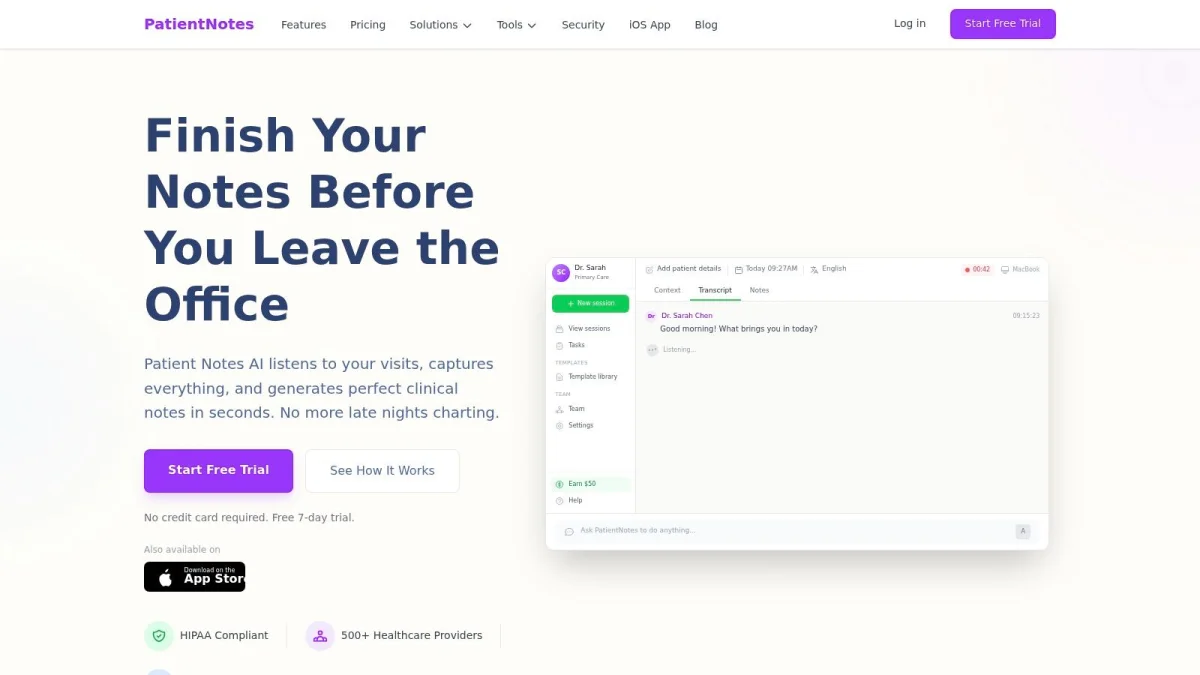
The clinical standard still comes first. An AI-generated draft must be checked against the assessment, the patient's stated priorities, the selected objectives, risk information, and the actual intervention delivered. The tool can reduce template construction and follow-up capture, but the clinician remains responsible for accuracy, appropriateness, and final sign-off.
A practice evaluating the workflow should check whether the system supports the required specialty fields, preserves the clinician's preferred language, handles its EHR process, and makes review dates easy to maintain. The right therapy treatment plan template is the one that remains accurate and usable after the session ends, not merely the one that looks complete during setup.
PatientNotes provides specialty templates, an AI template builder, structured consultation notes, follow-up task extraction, and US billing-code suggestions to support a more consistent therapy treatment plan workflow. Clinicians and small practices can review the options and start the 7-day free trial without a credit card by visiting PatientNotes.