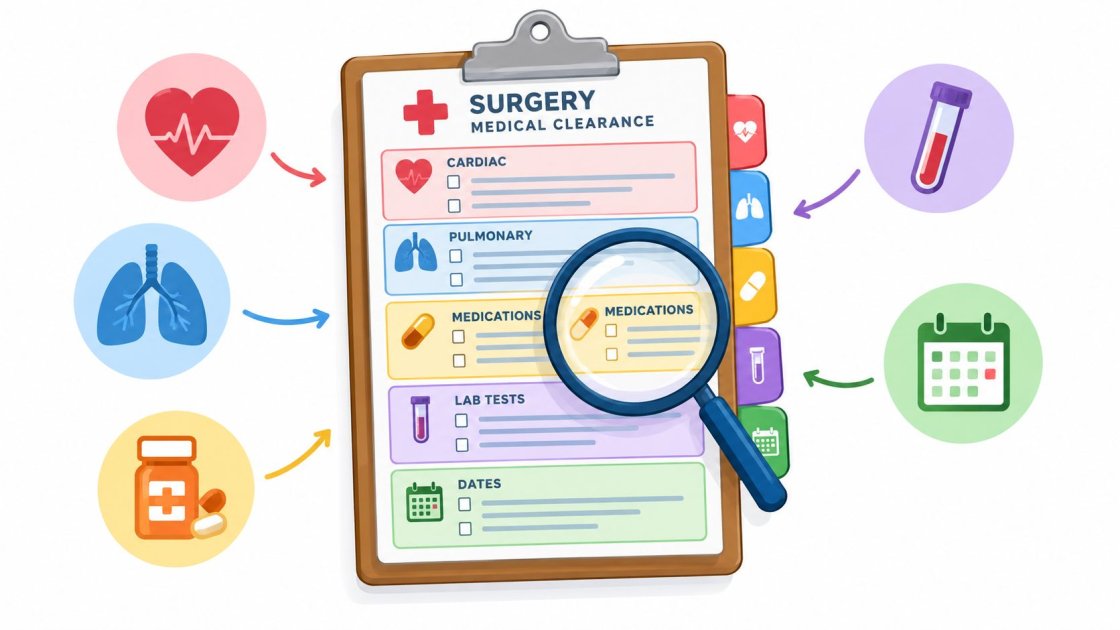
An OT finishes a treatment session with the next patient waiting, messages unanswered, and roughly twenty minutes left before the workday ends. The note still needs to show what the patient said, what changed during the session, why the intervention required skilled OT, and what happens next.
That pressure creates predictable documentation problems. A note may describe contact time without showing functional change, list exercises without connecting them to occupation, or repeat “tolerated treatment well” without giving a reviewer anything measurable. SOAP notes for occupational therapy work when they make clinical reasoning visible and connect each intervention to medical necessity.
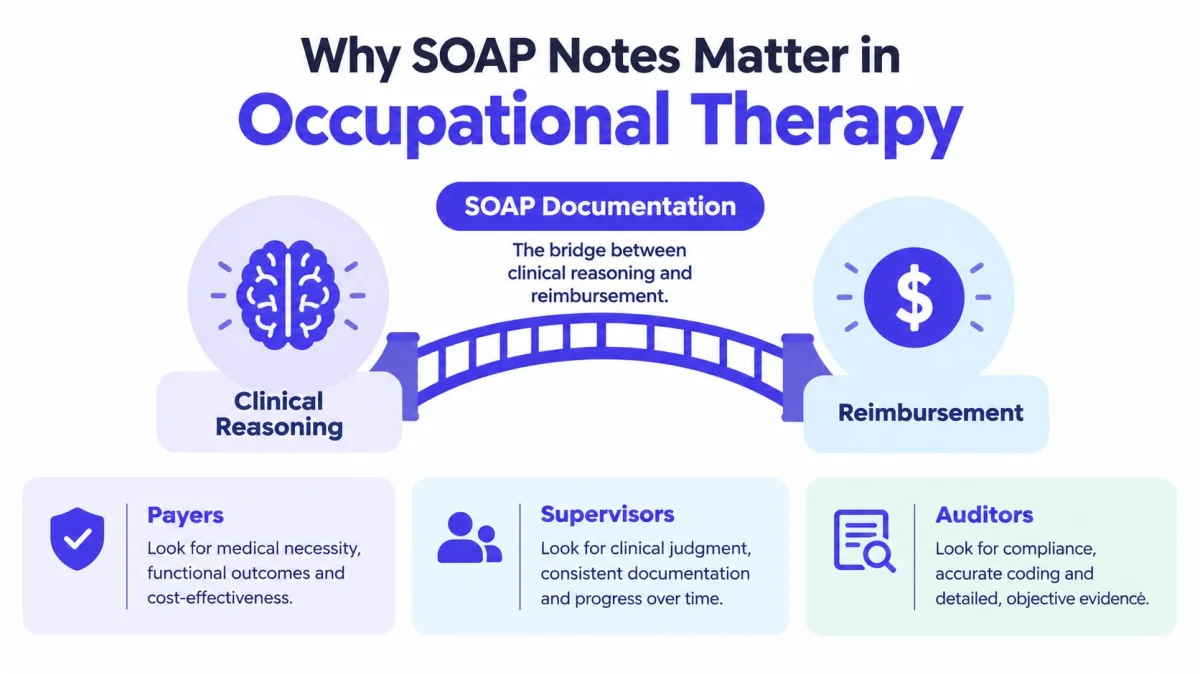
Why SOAP Notes Matter in Occupational Therapy
SOAP notes give the daily record a stable structure. Subjective, Objective, Assessment, and Plan separate the patient's report, observed performance, professional interpretation, and next steps. The format became associated with the problem-oriented medical record after Dr. Lawrence Weed introduced the approach in 1968, and it remains commonly used in electronic and handwritten OT documentation, as described in this occupational therapy documentation guide.
For OT, the structure matters because the meaningful outcome is usually occupational performance. A payer isn't only looking for an isolated strength finding or a list of therapeutic activities. The record should connect those findings to dressing, grooming, bathing, meal preparation, work tasks, home management, safety, or participation. A SOAP note isn't a billing form, but it is the narrative evidence supporting the medical necessity behind the services billed.
Four reasons the format holds up
- Continuity of care: A clear note helps another clinician understand the patient's current function, precautions, response to treatment, and remaining barriers across outpatient, school, home health, and other settings.
- Audit defensibility: Medicare and commercial reviewers need enough detail to connect the service delivered with the plan of care and the claim.
- Team communication: OTAs and COTAs may carry out parts of the plan. The note should communicate the intended progression, cueing strategy, and functional target.
- Progress accountability: Documentation must show whether treatment remains necessary, including at required progress-report and recertification points.
The most useful starting point is the occupational therapy specialty documentation resource, but a template alone won't make a note defensible. The clinician still has to select meaningful measures, interpret them, and state why the next intervention requires skilled judgment.
Practical rule: If a reviewer can remove the occupation from the note without changing its meaning, the note probably isn't OT-specific enough.
Writing Subjective and Objective in OT SOAP Notes
The Subjective section records what the patient or caregiver reports about occupational performance since the previous visit. It should sound like the patient, not like a diagnosis list. Relevant content may include difficulty grooming because of shoulder pain, reduced confidence using stairs, disrupted sleep affecting the morning routine, or caregiver strain during transfers.
Use a direct quote when the patient's words clarify the functional problem. For example, “I can wash my face, but I can't reach the back of my head” gives more clinical direction than “patient reports ongoing shoulder difficulty.” The clinician can add a brief attribution when a caregiver, teacher, or family member provides important information.
The Objective section records what the clinician observed and measured. Depending on the setting and goal, useful measures may include AM-PAC scores, 9-Hole Peg Test times, grip strength in pounds or kilograms, Berg Balance sub-scores, minutes tolerated in standing, assistance level, cueing, repetitions, accuracy, or the specific ADL or IADL task practiced.
Keep the distinction clear
| Subjective, patient voice | Objective, measured data |
|---|---|
| “My hand gets tired when I type.” | Completed a typing task with documented duration, rest breaks, and observed hand use. |
| Caregiver reports increased difficulty with morning dressing. | Required a recorded assistance level and specific cues to don a shirt. |
| Patient reports less confidence on stairs. | Completed a defined stair task with documented rail use, assistance, and safety cues. |
| Patient reports pain during grooming. | Completed grooming with a recorded pain response, task duration, and compensations. |
The SOAP note template for occupational therapy can help preserve the section structure, but the clinician must replace placeholders with task-specific evidence. “Patient tolerated treatment well” doesn't show what the patient did, what changed, or what skilled action occurred. “Will continue current plan” doesn't explain what the next session will address.
Avoid past-tense intervention summaries that read like boilerplate. Instead, document the observable performance and the clinician's action. “Completed meal-preparation simulation while standing, with two seated rest breaks and verbal cues for energy conservation” tells the reader far more than “participated in therapeutic activity.”
Turning Assessment Into Visible Clinical Reasoning
The Assessment section is where the clinician interprets the data. It shouldn't repeat the Subjective statement, copy the diagnosis, or create a second Objective section. A strong Assessment usually answers three questions in a concise clinical narrative.
- How does the current performance compare with the previous visit and the goal?
- What does the gap mean for occupational performance?
- Does the data support the current skilled OT hypothesis?
A useful sentence pattern is:
Current performance shows [measurable change], which affects [occupation] because [functional implication]. Skilled OT remains necessary to [specific clinical action].
For example, a clinician might write: “Patient tolerated 12 minutes of upright kitchen task simulation with two rest breaks and one verbal cue for energy conservation, consistent with the short-term goal of 15-minute standing tolerance for meal preparation.” The sentence compares performance with a goal, identifies the occupation, and explains why the intervention remains relevant.
Interpret, don't inventory
An impairment list without functional meaning is weak:
- Reduced grip strength.
- Limited shoulder range.
- Decreased endurance.
- Requires cues.
A defensible interpretation connects those findings to a task:
- Reduced grip strength limits sustained utensil use during meal preparation.
- Limited shoulder range prevents independent upper-body dressing.
- Decreased endurance requires rest breaks during standing grooming.
- Reduced scanning affects safe item retrieval on the neglected side.
The Assessment is also the right place to record clinical judgment about progression, regression, barriers, prognosis, referral, or discharge readiness. If the patient isn't responding as expected, the clinician should state what that means for the treatment approach rather than hiding the issue in vague language.
A broader occupational therapy evaluation overview can help clinicians think through the relationship between performance, environment, activity demands, and occupational goals. Daily notes should carry that same reasoning forward in a shorter, visit-specific form.
Medicare reviewers often look for evidence that the intervention required professional judgment. The Assessment should therefore make the skilled decision visible, such as grading task demands, modifying cueing, selecting a compensatory strategy, or progressing treatment within precautions.
Building a Plan That Survives a Reimbursement Review
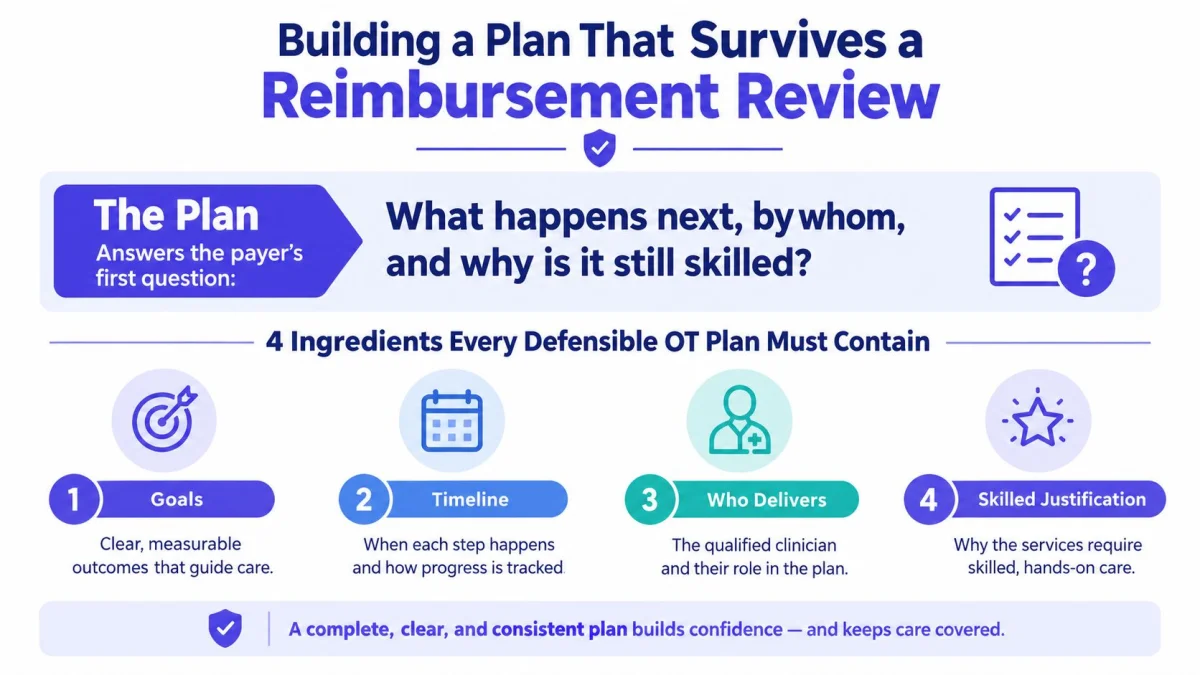
The Plan answers the payer's practical question: What happens next, who will do it, and why is skilled OT still needed? A plan that says “continue skilled OT” leaves all three questions unanswered.
A defensible Plan contains four ingredients:
- Next-session intervention: Name the task, technique, or progression tied to the Assessment problem.
- Frequency and duration: State the treatment schedule in concrete units, such as two sessions per week for four weeks.
- Measurable goals: Include the activity, assistance or performance level, and projected target date.
- Reporting milestones: Record when the next progress report, reassessment, or recertification is due.
For a post-CVA upper-extremity case, a specific Plan could state that the next session will use task-specific grooming and grasp-release practice, with progression of cueing based on left-side scanning performance. It could identify reassessment of the relevant FIM or AM-PAC measure, state the treatment frequency and duration, and name the date or visit for the next progress report. The plan should also explain that the OT will grade task complexity and modify cueing to improve safe self-care performance.
A boilerplate version would say: “Continue skilled OT per plan of care. Patient tolerated treatment well. Progress as tolerated.” It doesn't identify the next task, the functional target, the skilled decision, or the reporting milestone.
The Plan should also anticipate discharge. Once the patient is approaching the functional goal, begin documenting home-program progression, caregiver training, equipment use, environmental changes, and the criteria that will trigger discharge. That preparation supports a logical discharge visit instead of making discharge appear unexpectedly.
The embedded clinical documentation video can supplement local training, but each practice should still follow its payer contracts, state requirements, and facility policy.
Aligning SOAP Notes With US Billing and Coding
US billing requires the clinical note, plan of care, and claim to tell the same story. CMS states that medical-record documentation is required for every treatment day and every therapy service, and that outpatient therapy records must support the codes and units billed on the claim in its outpatient therapy documentation requirements.
For timed CPT services such as therapeutic exercise, therapeutic activities, and self-care training, the note should show what was performed, how long it was performed, and how the intervention related to the functional goal. Clinicians should track treatment time during the session rather than reconstructing it at the end. The total treatment minutes and per-code time must reconcile with the billed units and the facility's billing process.
AOTA directs occupational therapy practitioners to select appropriate ICD-10 and CPT codes to describe services in its coding guidance for occupational therapy. Code selection doesn't replace clinical reasoning. The diagnosis should connect to the functional problem, the intervention, and the documented medical necessity.
| Billing element | Where it appears in SOAP |
|---|---|
| ICD-10 diagnosis and functional linkage | Subjective, Objective, and Assessment |
| CPT intervention | Objective, with the specific activity and skilled action |
| Timed minutes and total treatment time | Objective and treatment-time record |
| Medical necessity | Assessment |
| Next reporting or certification milestone | Plan |
| Signature, credentials, and date | Final sign-off |
The US OT coding and documentation guide can support a clinic's workflow, but it shouldn't be treated as a substitute for CMS, payer, or professional guidance. The record also needs the treatment date, intervention or modality, total timed-code minutes, total treatment time, and professional signature and identification.
Some requirements are US-specific. The -KX modifier, applicable threshold-related billing situations, the Medicare Part B progress-report framework, the date of onset on the plan of care, and physician or NPP certification don't transfer directly to UK practice. CMS-linked OT guidance states that certification should be obtained within 30 calendar days of the initial therapy treatment, with recertification at least every 90 calendar days from the initial treatment date or for the duration of the plan of care, whichever is less, as described in this OT documentation reference.
UK clinicians should follow HCPC standards, NHS requirements where applicable, and private-payer or employer policies. The same clinical principle still applies: the note should show what changed, why the intervention was skilled, and what happens next.
Common SOAP Note Pitfalls and How to Fix Them
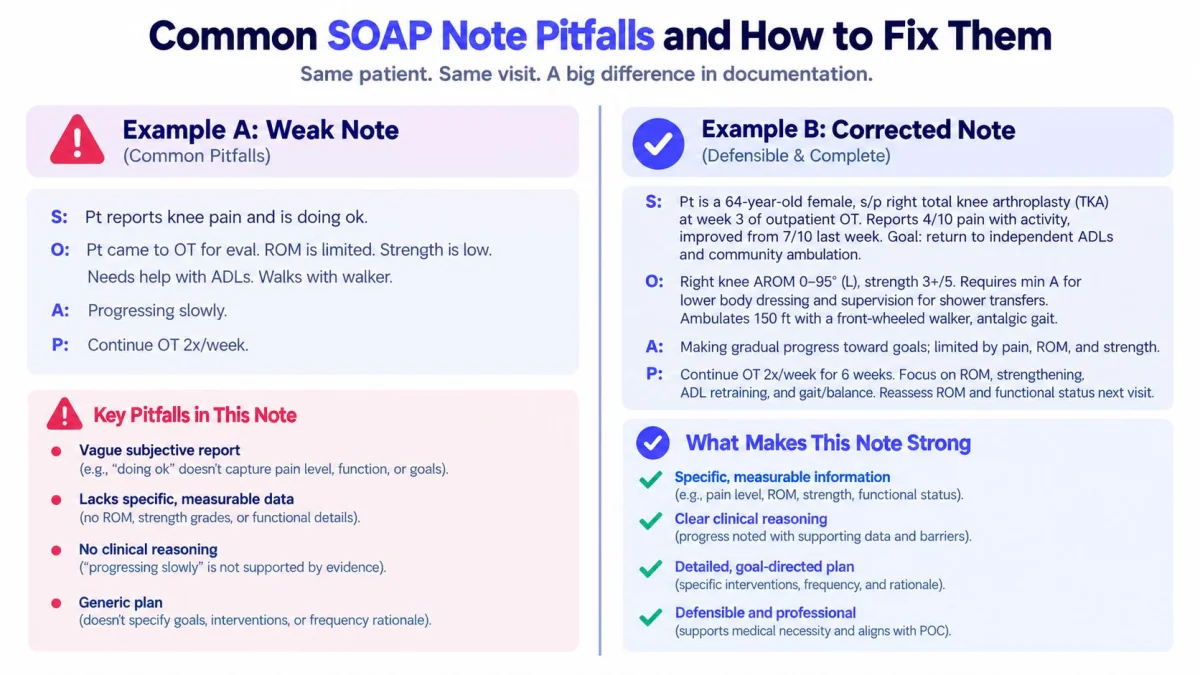
An OT supervisor might place two versions of the same type of note side by side during an in-service. The weak version says:
“Patient tolerated treatment well. Continue plan of care. Billing therapeutic activities for two units.”
The problem isn't only the wording. The note lacks functional data, treatment-minute detail, a clear skilled action, an interpretation of progress, and a specific next step. A reviewer can't determine whether the service addressed the patient's occupational goal or whether the billed intervention is supported by the record.
A stronger version would identify the patient's reported change in confidence with sit-to-stand, the observed change in quadriceps strength compared with the prior visit, the current functional outcome measure, and the exact neuromuscular re-education progression. It would state the verbal cueing provided, explain how the intervention affected mobility or daily activity, and identify the next task and the date of the upcoming progress report.
The example should be written as a hypothetical training case, not as a claim about a real patient. A concise defensible pattern might read:
- Subjective: Patient reports increased confidence during sit-to-stand at home but still avoids low chairs.
- Objective: Completed repeated sit-to-stand from a defined surface height with documented assistance, cueing, rest breaks, and treatment minutes. Functional mobility measure recorded and compared with the previous visit.
- Assessment: Improved lower-extremity activation supports progression to a more demanding closed-chain task, but reduced control during descent continues to limit safe transfers.
- Plan: Progress transfer practice and home-safety training at the next visit. Review measurable mobility progress at the scheduled reporting milestone.
Four recurring fixes
- Quantify the task: Add repetitions, duration, assistance, cues, accuracy, score, distance, or another relevant unit.
- Name the skilled action: State how the OT graded, modified, instructed, facilitated, or progressed the activity.
- Tie the intervention to the goal: Connect the activity to dressing, transfers, grooming, work, home management, or participation.
- Date the milestone: Identify the next reassessment, progress report, recertification, family-training event, or discharge criterion.
The same discipline helps in adjacent documentation fields. For a useful example of how practitioners translate session observations into caregiver-facing records, see this guide to writing ABA notes for parents. The format differs, but the need for observable, attributable, functional documentation is similar.
A Pre-Sign Checklist for Every OT SOAP Note
A pre-sign check should take less time than correcting a denied or questioned claim. The clinician can keep the following blocks beside the keyboard.
Subjective and Objective
- Patient attribution: The patient or caregiver is identified, with a quote when the exact wording matters.
- Measured task data: The note includes units, assistance, cues, duration, score, repetitions, or accuracy.
- Functional context: The data connects to an ADL, IADL, work task, safety concern, or participation goal.
- Time reconciliation: Time in, time out, total treatment time, and CPT units match the billing record.
- Skilled intervention: The note names what the clinician changed, graded, taught, or facilitated.
Assessment
- Clinical reasoning: At least one sentence connects current data with functional change.
- Updated problem list: Active barriers and progress are current rather than copied forward.
- Prognosis or progress: The note states whether the patient is progressing, stable, or declining and why.
- No repeated S-line: The Assessment interprets the patient report instead of restating it.
Plan
- Measurable goals: Short-term and long-term targets include performance criteria and target dates.
- Specific next step: The next intervention is tied to the active problem.
- Frequency and duration: The schedule is concrete and consistent with the plan of care.
- Reporting date: The next progress report or recertification point is visible.
- Discharge trigger: The note identifies the functional criteria, home program, or caregiver training needed for discharge.
Billing alignment
- Primary ICD-10 code: The diagnosis supports the documented functional problem.
- CPT code and units: The intervention and timed units match the recorded service.
- Medical-necessity sentence: The Assessment explains why skilled OT remains required.
- Signature details: The qualified professional signs with credentials and date.
The two fastest denial checks are missing functional outcome linkage and absent medical-necessity language. If either is missing, the note may describe a real session without proving why the billed service was necessary.
A defensible signature confirms more than contact time. It confirms skilled change, functional relevance, and a clear clinical next step.
PatientNotes records consultations in person, by phone, or by telehealth, separates speakers, and drafts structured notes in the clinician's chosen language, with OT templates and an AI template builder available across a library covering 37 specialties. It offers a 7-day free trial without a credit card, costs $70 per user monthly or $50 per user monthly when billed annually, and includes HIPAA compliance with a BAA at no extra cost, with Semble as the only EHR integration and copy-and-paste use for other EHRs. Visit PatientNotes to review the workflow, pricing, and fit for a small OT practice.