
An HR portal asks for a note covering last Tuesday through Thursday. A school wants a child excused from gym for a week. A patient with a strained back wants the words light duty on paper so the warehouse moves him off the loading dock. Three requests, three different documents, and all three land on the same clinician before the end of the day.
None of it is clerical filler. Physicians in a national cross-sectional study of 203,728 U.S. ambulatory clinicians spent an average of 9.5 minutes per visit writing notes, inside an average of 27.2 minutes of electronic health record work per visit, and the clinicians producing the longest notes also spent more time in the chart after hours and closed fewer visits on the day of the encounter (study of EHR metadata from 203,728 physicians). Note length is a workflow decision, not a stylistic one.
The format has settled over time. Lawrence Weed's problem-oriented medical record pushed documentation toward the patient's problems rather than a chronological story in the 1950s, and that reorganization is the direct ancestor of the SOAP structure most notes still follow (a history of the clinical note). What survived the format wars is the test that matters: can another clinician tell what happened, what was found, what was concluded, and what comes next? A sick note and a disability accommodation letter answer that question in completely different ways, and most advice on writing a doctor's note treats them as the same document.
Templates for Sick Notes, Fit-for-Work and Medical Leave
The request decides the document. A note covering three days off after a stomach bug and a letter supporting a workplace accommodation for a chronic condition arrive in the same inbox and get the same filename, yet they follow opposite disclosure rules. A routine work note generally needs only the dates affected, functional restrictions, the expected return or review date, and provider authentication, and it usually should not disclose a diagnosis, medications, or test results. An accommodation request is a different clinical and legal task, because it has to connect a medical impairment to specific job limitations and the adjustment being asked for (Havellum's guide to doctor's notes for work).
| Note type | Include | Leave out | Sample phrasing |
|---|---|---|---|
| Sick note (absence) | Absence dates, return or review date | Diagnosis, medications, test results | Absent from work [start] to [end] for medical reasons |
| Fit-for-work or return-to-work | Clearance date and restrictions with numbers | Diagnosis unless required | May return [date] with no lifting over 10 pounds |
| Medical leave extension | New absence period and new review date | Repeated content from earlier notes | Absence should continue until [date]; review on [date] |
| Modified duties | Specific functional limits and duration | Vague terms such as light duty | Avoid standing over 30 minutes for six weeks |
| Attendance-only statement | Date of visit and attendance confirmation | Any clinical content | [Patient] attended a visit on [date] |
| Accommodation support letter | Link between impairment and job tasks, and the adjustment requested | Full medical record | Requires patient authorization and job-specific detail |
Two rows deserve extra care. Attendance-only statements exist because patients often need proof of the visit, not proof of illness. Accommodation support letters need patient authorization before they leave the building, plus job-specific detail, which is usually the part the clinician doesn't have. Ask for the written job description or the employer's essential functions list. If neither exists, say so in the letter rather than guessing at what the job involves.
Why light duty fails as a restriction
A phrase with no defined limit can't be implemented. The supervisor either sends the patient home or puts them back on full duties and hopes, and the note has protected nobody. Every restriction needs a number and a duration, because that's what turns a clinical opinion into a schedule change.
Sick note: I examined [patient] on [date] and advised [he/she/they] be absent from work from [start date] to [end date] for medical reasons.
Fit-for-work note: [Patient] may return from [date] with no lifting over 10 pounds for two weeks.
The UK fit note uses the same test
A UK fit note, formally the Statement of fitness for work, is structured around three choices: fit for work, may be fit for work with advice on adjustments, or not fit for work. The middle option is where the quality sits. Write any suggested adjustment in plain functional terms, using the number-and-duration rule, so an employer can act on it without calling the surgery.
One more routing question comes up in US practice. Leave of a few days is handled by the note alone; longer absences or a patient's own serious health condition usually move to employer paperwork under the Family and Medical Leave Act, and the clinician's note then supports a certification rather than replacing it. Pick the row that matches the request before writing a single word.
Essential Components Every Doctor's Note Needs
Most rejected notes are missing a field, not a diagnosis. An employer cannot schedule around a restriction with no end date, and a school office cannot file an excuse with no start date. Build the document from what the reader has to do with it.
A doctor's note certifies a clinical assessment. Treating that assessment as a legal right to leave, or as an entitlement to an accommodation, leaves the patient exposed the moment an employer pushes back. A routine sick or work note and a disability or accommodation document do different jobs. The sick note confirms the visit date, the period covered, and what the patient can and cannot do. Function is enough: "no standing longer than 20 minutes at a time, through Friday" tells a supervisor how to staff the shift without naming the condition. The accommodation document is the one that may include the diagnosis, and only because the request requires it. CMS sets a reasonable floor for the record behind either document: the reason for the encounter, relevant history, examination findings, earlier test results, an assessment or diagnosis, the plan of care, the date of service, and the legible identity of the clinician (CMS guidance on evaluation and management documentation).
| Component | What to include | What to leave out |
|---|---|---|
| Patient identity | Full name and date of birth | Full medical record or unrelated history |
| Encounter date | Date you saw the patient, in person or by telehealth | Backdated dates or dates you did not evaluate |
| Clinician details | Name, credentials, license number, contact information | Personal details beyond what identifies you |
| Period covered | Exact start and end dates of the absence or restriction | Open-ended wording such as until further notice |
| Functional status | Specific limits with numbers, such as a weight cap of 10 pounds | Vague terms with no measurable limit |
| Return or review date | Date the patient will next be assessed | Blank field |
| Diagnosis | Only when the patient agrees or the request requires it | Routine diagnoses in a standard work note |
Two rows carry most of the risk. Encounter date means the day of the visit, in person or remote, and it never shifts to match the absence. If the patient was seen Wednesday and needs Tuesday covered, the note says Wednesday and the certified period is stated separately. Diagnosis stays out of a routine work note. It goes in only when the patient agrees or the request requires it, which is rare for absence certification and normal for an accommodation letter. Describe the limit. Leave the condition off the page unless that second document needs it.
The rule that resolves every gap
A field that can't be supported by what was observed gets left out or flagged for clarification. It never gets guessed, softened, or filled from a prior note.
Working rule: A note that says less is easier to defend than one that says more than the visit supports.
How to Write a Doctor's Note Step by Step
The five-step documentation method behind a full clinical record adapts cleanly to a short note, and the order matters because each step feeds the next (AHRQ documentation and coding toolkit).
Five steps, in the order they have to happen.
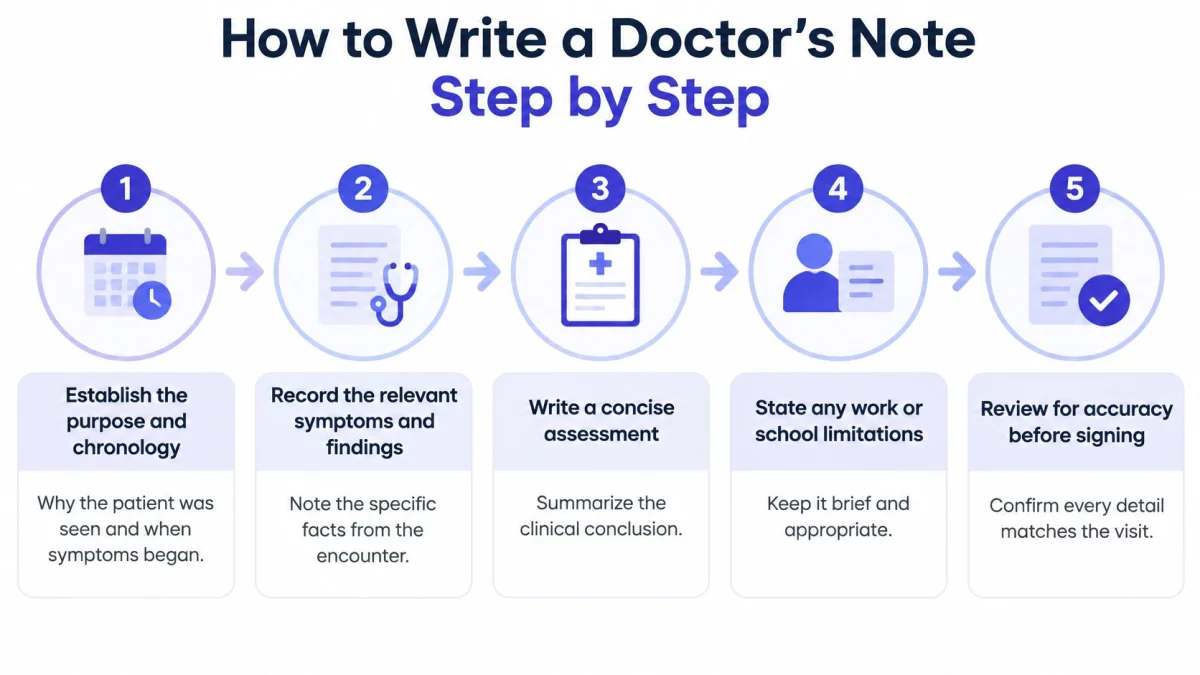
- Establish the purpose and chronology. Why was the patient seen, and when did the symptoms begin? A restriction without a timeline reads as open-ended, and open-ended restrictions get challenged.
- Record the subjective findings. What the patient reports, plus the pertinent negatives that matter: no fever, no numbness, no night pain. The negatives are what make the assessment legible to the next clinician.
- Record the objective findings. Examination findings, vital signs, and any test results with their dates. If a result came from an outside lab, name the date it was performed.
- State the assessment. Give the working diagnosis, label uncertainty explicitly as possible or rule out, and give the clinical reason for the restriction. This is the sentence an employer's medical reviewer looks for.
- End with the plan. Treatment, the return-to-work decision, the review date, and the instructions the patient leaves with.
AHRQ is specific on two points. Record the outcome of any "rule out," "consider," or "possible" diagnosis so the next clinician knows whether it was pursued. And when information is missing, conflicting, ambiguous, or illegible, raise a clarification query instead of inferring the answer.
A worked example for low back pain
A patient is seen on a Tuesday with acute low back pain after lifting at work. The note records the onset, the absence of red flags, reduced lumbar flexion on examination, a working diagnosis of a lumbar strain, and a review booked in seven days. The wording that leaves the room draws only on the assessment and the plan: no lifting over 10 pounds for two weeks, return to modified duties on Wednesday, review next Tuesday. The full reasoning stays in the chart.
That split is the whole skill. The chart holds the differential, the negatives, and the uncertainty; the certification holds the dates, the function, and the review. Draft a note for a real visit under those five headings, then delete every line that doesn't belong in the version the patient hands to an employer.
Wording That Stays Accurate and Defensible
A copied line can certify the wrong person. A 2020 estimate put the share of a clinician note copied and pasted from earlier notes at about 50%, up from 33% in 2015, and for a clinician seeing 10 patients a day that duplicated material can run to at least 85 pages of single-spaced text across nearly 700 notes (AHRQ PSNet on copy and paste in the EHR).
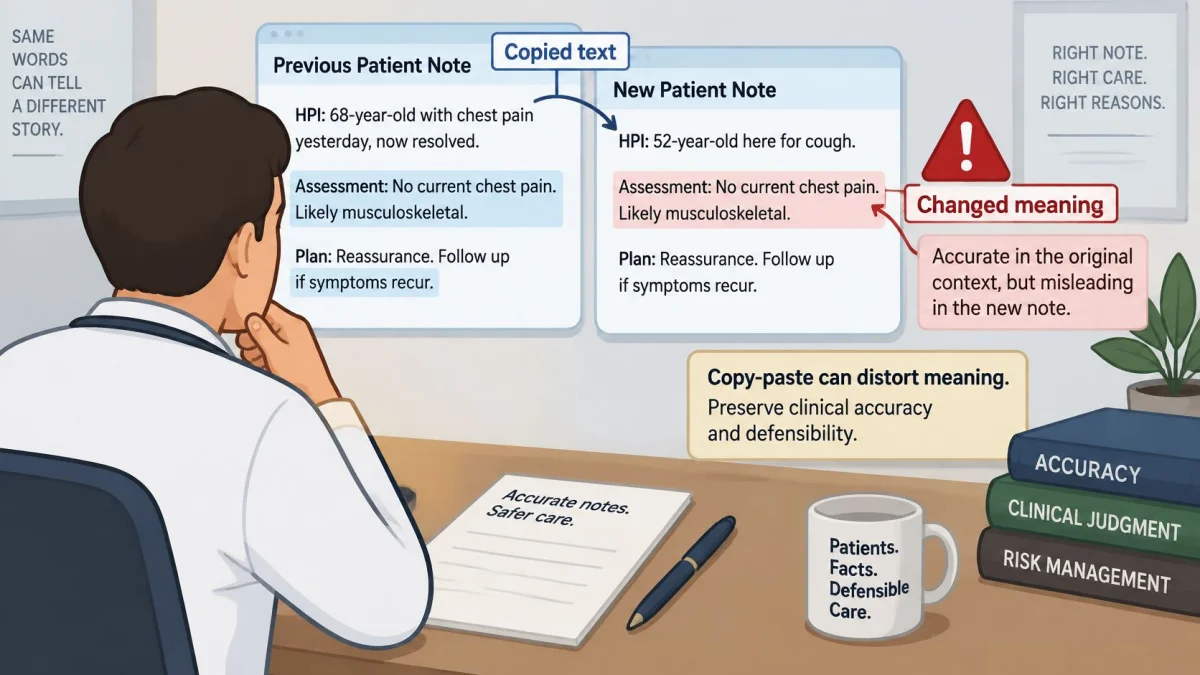
Reuse small, deliberately chosen phrases, such as a normal lung-examination line. Then check every imported item against this encounter: doses, laterality, allergies, work restrictions, dates, and negations. A copied-forward "no numbness" in a patient who now has numbness reverses the clinical meaning of the note.
State function, and keep the diagnosis in the chart on a routine sick or work note. "Patient says he can't work and feels unwell" is unusable. "Patient reports lower back pain rated 6 out of 10 that limits sitting beyond 20 minutes; examination shows reduced lumbar flexion and no neurological deficit" separates what the patient reports from what the examination shows. A disability or accommodation note can say what the person can do, and for how long, without naming the diagnosis unless the patient authorized that disclosure.
Patients read their own notes, including wording written for the chart. Drop judgmental labels such as claims or drug-seeking, and tell the patient how to request a correction.
Drafted text needs the same check as pasted text. With PatientNotes, the clinician confirms what the scribe captured before signing the chart. Clinical documentation integrity guidance covers what to check line by line.
Handling Late, Remote and Third-Party Requests
Thursday afternoon, a patient asks for a note covering last week. Nobody in the practice saw them on those days. Certifying a period that was not observed turns a helpful clinician into an unreliable witness. A defensible note rests on the clinician's own judgment. Keep the date of evaluation separate from the period being certified, and do not imply direct observation of incapacity the history does not support.
I am unable to certify your absence for [dates] because I did not evaluate you on those dates. I can confirm that you attended on [date].
| Request | Action | Documentation |
|---|---|---|
| Dates you did not evaluate | Do not certify; offer an attendance-only statement | Refusal wording with the visit date |
| Dates reported by the patient with thin history | Record as patient-reported; certify only clinically supported limits | Flag the gap and request clarification |
| Request for diagnosis or clinical detail | Disclose only with written patient authorization | Authorization names information, recipients, expiry and right to revoke |
| Correction to a signed note | Add a dated addendum | Never alter the original entry |
| Telehealth visit | Name the modality and the limits of the remote exam | State any limit on certifying function |
Corrections and remote visits
The fix for an error is a dated addendum appended to the record, saying what changed and why. The original entry stays. Editing a signed note after the fact turns a clerical error into a credibility problem. In a disputed absence, the original is the document that gets examined.
For telehealth, name the modality and state what the remote exam could and could not establish. A video visit can document reported function and visible movement. It cannot document a hands-on examination, and the note should not imply otherwise. If sitting tolerance or lifting was not observed, certify only the limits the history and the remote findings support, and put an end date on each one.
Releasing the note to an employer or school
A routine sick or fit-for-work note and a disability or accommodation document are different jobs. The first confirms attendance and a time-limited functional limit: what the person can and cannot do, and until when. The second asks you to describe function for a third party. Leave the diagnosis out unless that party is entitled to it.
A note written during ordinary care may still need specific written authorization before an employer or school receives it. CMS explains that a disclosure for anything outside treatment, payment, or health care operations requires written authorization in plain language that identifies the information to be disclosed, names who is disclosing and receiving it, carries an expiration date, and explains the patient's right to revoke it (CMS privacy program guidance).
Front-desk staff field these requests more often than clinicians do, so the release process has to be as clear as the note. The minimum-necessary habit set out in XO's guide to patient confidentiality keeps a routine certification from turning into a full record release, and how a HIPAA authorization form must be written is worth keeping wherever the fax machine lives.
Run the Final Check Before You Sign
The chart is closed, the patient has left, and the only thing left is a signature on a note an employer or school may read without the rest of the record. That pass is about the file, not about rewriting the visit.
The card to keep at the desk:
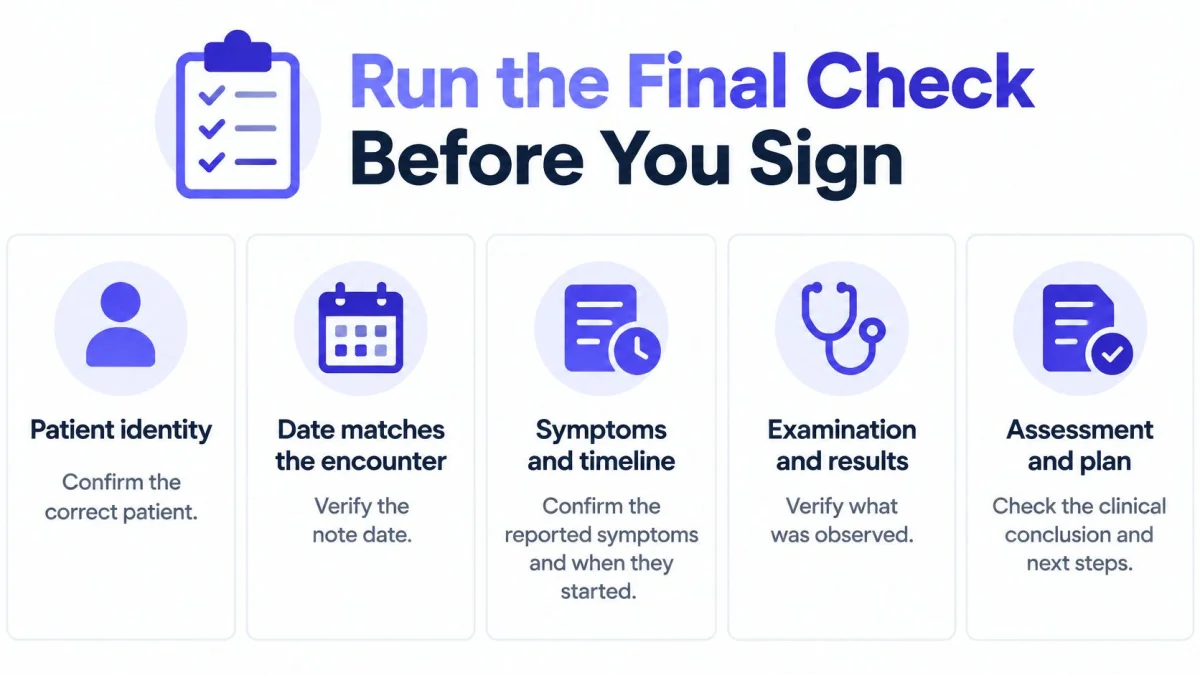
- Document type. A routine sick or fit-for-work note is not a disability or accommodation letter. The heading should match the request in front of you.
- Function, not the diagnosis. State what the person can and cannot do, with a number and an end date. Leave the diagnosis out unless that form requires it.
- Retention period. Confirm the clock that applies before the note leaves the desk.
- Retrievable signed copy. Store the signed version where it can be pulled later, not only in the window where it was typed.
- Sample for review. Set aside a few signed notes each quarter and read them as a payer would, without the chart open beside them.
I hold the signature until those five are true. A softener does not fix a missing end date or a note filed only on the desktop.
Retention sits in that same pass. CMS guidance says providers must maintain medical records for seven years from the date of service (CMS medical record maintenance requirements). State law, a payer contract, or accreditation can require longer, so the period you confirm is the longest one that applies to that chart. A 2024 longitudinal study of more than 18,000 outpatient doctors across over 300 U.S. healthcare organizations found that teamwork for clinical note-writing reduced documentation time by 9.1% on average (report on the teamwork documentation study). Shared drafting still leaves the signature with the clinician who saw the patient.
PatientNotes is an AI scribe for small practices: the clinician talks with the patient, the note is written from that conversation, and the clinician confirms what was captured before signing the chart.
A quarterly pass with a documentation audit checklist shows whether those signed notes would survive a payer review.
A disputed absence is defended from the stored, signed note, not from memory of the visit. PatientNotes records the visit on the web or the native iOS app, drafts the structured note in the clinician's own language, and leaves the final judgement and the signature with the clinician. It is HIPAA compliant with a BAA at no extra cost, runs $70 per user per month billed monthly or $50 per user per month billed annually, and starts with a 7-day free trial that needs no credit card. Specialty templates cover 37 specialties. Visit PatientNotes and try it on your next clinic day.