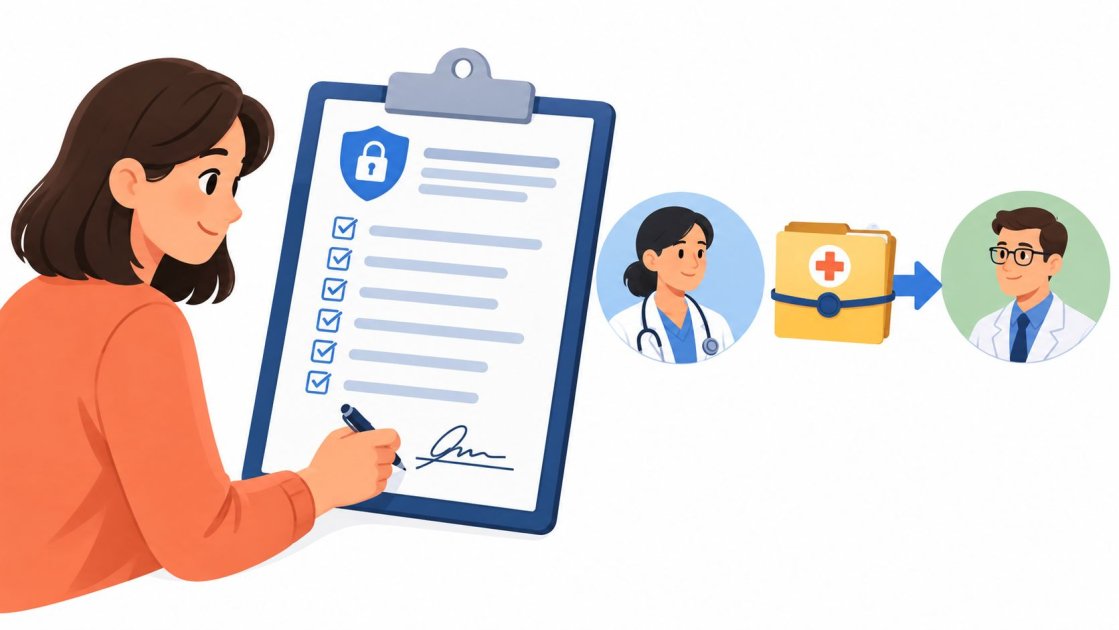
A patient asks the practice to send records to a new specialist, a spouse, and an attorney. The receptionist finds a signed release, but the recipient line is blank and the form has no expiration. Meanwhile, a documentation vendor needs access to the consultation. These requests involve different permissions, and one generic release won't resolve them all.
What a HIPAA Authorization Form Permits
A HIPAA authorization form is specific written permission for a covered entity to use or disclose protected health information, or PHI, when another Privacy Rule permission doesn't cover the purpose. The HHS summary of the Privacy Rule distinguishes authorization from disclosures for treatment, payment, and health care operations, which generally don't require separate authorization.
For the patient requesting several transfers, staff should assess each recipient separately. The specialist generally can receive ordinary chart information for treatment. An attorney handling a claim generally needs authorization, while sharing with a spouse requires checking whether a family-involvement permission applies or a broader records release is being requested.
A signature isn't blanket permission. Staff need to establish what permits the particular disclosure.
A general consent-to-treatment form, a Notice of Privacy Practices acknowledgment, and a verbal agreement at reception aren't interchangeable with a HIPAA authorization. Each serves a different purpose. Staff shouldn't use whichever signed document happens to be easiest to find.
The US and UK distinction
HIPAA is US federal law governing covered entities and their business associates. A company's London address doesn't change the authorization requirements applicable to its US covered-entity customers.
A UK clinic doesn't satisfy UK GDPR by adopting a HIPAA form. Under UK GDPR Articles 6 and 9, and the ICO's guidance on health data, the clinic needs an appropriate lawful basis and a condition for processing health information. For US releases requiring authorization, the checklist below provides a practical way to assess an existing template.
Six Elements Every Valid Form Needs
Core elements of a valid HIPAA authorization
| Element | What a valid entry includes |
|---|---|
| Description of the PHI | Named records and a date range or data type |
| Who may disclose | The practice, clinician, or a defined class |
| Who may receive | A named person, organization, or class |
| Purpose | Each purpose, or at the request of the individual |
| Expiration | A date or an event tied to the person or purpose |
| Signature and date | Individual signs and dates; a representative's authority is described |
Under 45 CFR § 164.508, a valid authorization needs these six core elements, alongside required statements about the individual's rights and the consequences of signing. Checking only for a signature misses most of the work.
Check the scope and the parties
Describe the information meaningfully. A useful entry identifies office visit notes and laboratory results associated with a defined course of care. An unrestricted all-records entry deserves clarification unless that breadth is intentionally intended; broad scope isn't automatically invalid, but it shouldn't be accidental.
Identify who may disclose. North Street Family Medicine is a concrete practice identifier. A defined class can also work, but a blank sender field leaves staff unable to establish which entity has permission to act.
Identify who may receive. Dr. Helen Chen at Lakeside Endocrinology names both a person and an organization. An unspecified future recipient doesn't give staff a reliable destination, and a fax number alone may not identify the authorized recipient adequately.
State the purpose. For a patient-initiated disclosure, at the request of the individual is permitted wording. A preprinted any-purpose entry can obscure what the patient intends and whether the release matches the actual request.
A useful intake habit is to compare these fields with the accompanying message. If the patient asks for laboratory results but the template authorizes the entire chart, staff should resolve the mismatch rather than assume the broader permission was deliberate.
Check the endpoint and signature
An expiration entry can identify a date or an event connected to the individual or the disclosure's purpose. Completion of a specified records review is more workable than an undefined future need. Staff must be able to recognize when the permission ends.
The individual must sign and date the authorization. If a personal representative signs, the form must describe that person's authority; spouse or adult child alone doesn't establish the legal authority to sign for someone else.
Electronic handling doesn't remove these checks. A valid signed authorization can be transmitted electronically or by fax, and electronic signatures must be assessed under applicable law. For background on signature methods and evidence, PDFWix on legally binding e-signatures offers a useful explanation, but signature technology doesn't cure missing authorization fields.
Include the required statements
The same regulation requires plain language and statements addressing the following:
- Written revocation: Explain the individual's right to revoke, the process, and applicable exceptions.
- Conditioning: State whether treatment, payment, enrollment, or eligibility for benefits can be conditioned on signing, including consequences where a permitted exception applies.
- Redisclosure: Explain that the recipient may redisclose the information and that it may no longer receive HIPAA protection.
The practice must also give the individual a copy of the signed authorization. Staff should preserve the completed version, not merely a blank template or a signature image detached from its terms.
Release checkpoint: Missing information, recipient, purpose, or expiration means staff shouldn't release records in reliance on that authorization.
When a Release Needs Authorization
Staff should classify the request before printing paperwork. The following table describes the usual Privacy Rule route, subject to applicable exceptions and other law.
Does this disclosure need a HIPAA authorization?
| Situation | Authorization needed? | Why |
|---|---|---|
| Another provider treating the patient | No, generally | Treatment is a permitted disclosure |
| Claim to a health plan | No, generally | Payment is a permitted purpose |
| Quality review inside the practice | No, generally | Health care operations |
| Patient asking for their own record | No | This is an access request, not an authorization |
| AI scribe or billing vendor under a BAA | No separate authorization for the permitted service | The BAA governs the business associate relationship |
| Spouse, adult child, or employer | Usually yes for a broad records release | Outside treatment, payment, and operations unless another permission applies |
| Attorney or insurer for a claim | Yes, generally for an attorney or life insurer | Not an ordinary treatment, payment, or operations disclosure |
| Marketing use of PHI | Yes, generally | The Privacy Rule requires authorization, with exceptions |
| Separately kept psychotherapy notes | Yes, even for treatment, with limited exceptions | Special protection applies |
The routine disclosure categories can be distinguished visually.
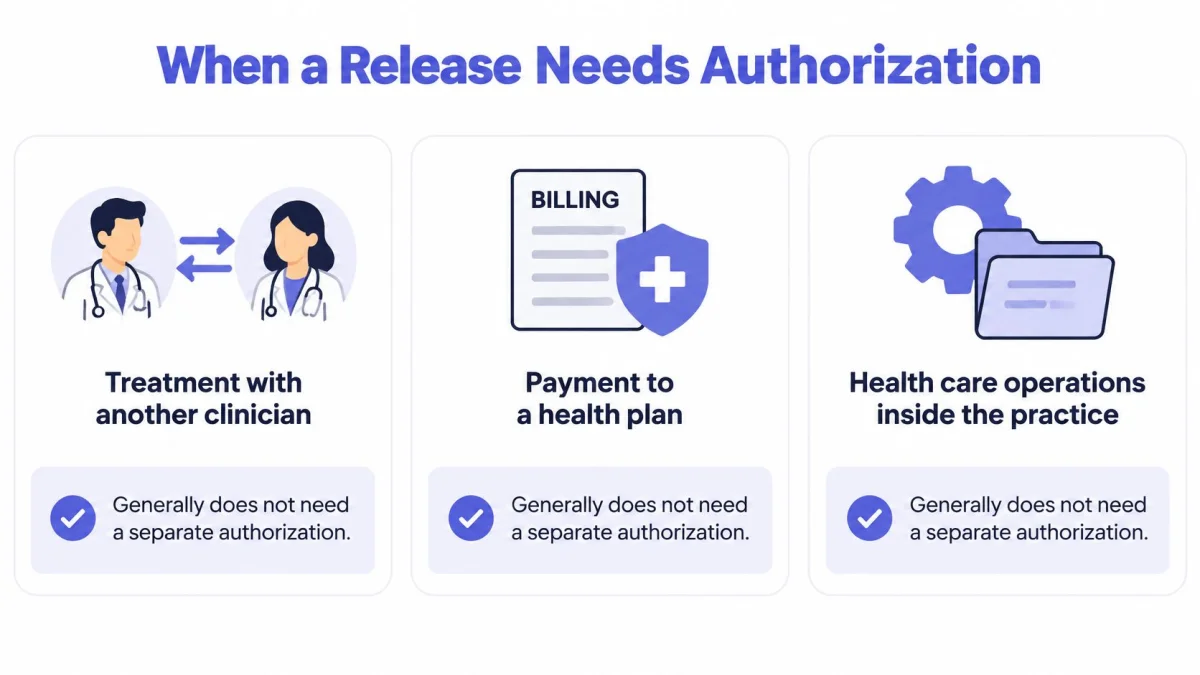
Patient requests and vendor access are different
The Privacy Rule addresses routine disclosures in § 164.506, patient access in § 164.524, and marketing authorization in § 164.508(a)(3). FaxZen's medical records request guide provides practical request-document context, but a request form shouldn't automatically be treated as an authorization.
Research generally needs authorization unless a permitted alternative applies, such as an institutional review board or privacy board waiver under § 164.512(i). A clinic template isn't that waiver. Section 164.508 also generally prohibits conditioning treatment or benefits on authorization, with narrow exceptions such as research-related treatment.
An AI scribe, transcription service, or billing company handling PHI for the practice generally acts as a business associate. Sections 164.502(e) and 164.504(e) govern that relationship through a business associate agreement, not merely a patient-recipient checkbox.
PatientNotes operates as a Business Associate under HIPAA. Customers processing PHI agree to its BAA, incorporated into its Terms by reference, at no extra cost. The HIPAA BAA requirements explainer addresses that separate contracting question.
A BAA doesn't authorize unrestricted vendor use. Neither does a patient authorization remove applicable state privacy law, professional obligations, or minimum-necessary requirements where those requirements apply.
Expiration Dates and Written Revocation
A HIPAA authorization doesn't automatically expire after 30 or 90 days; the HHS expiration guidance instead requires an expiration date or an event connected to the individual or disclosure purpose. Staff shouldn't reject a form merely because it exceeds a familiar local default.
The distinction is between a legally usable endpoint and a practice's preferred scheduling interval. A practice may design a shorter permission period for a particular workflow, but that choice isn't a universal federal expiration rule.
The practical sequence is to establish the endpoint, then monitor whether the patient withdraws permission before it arrives.
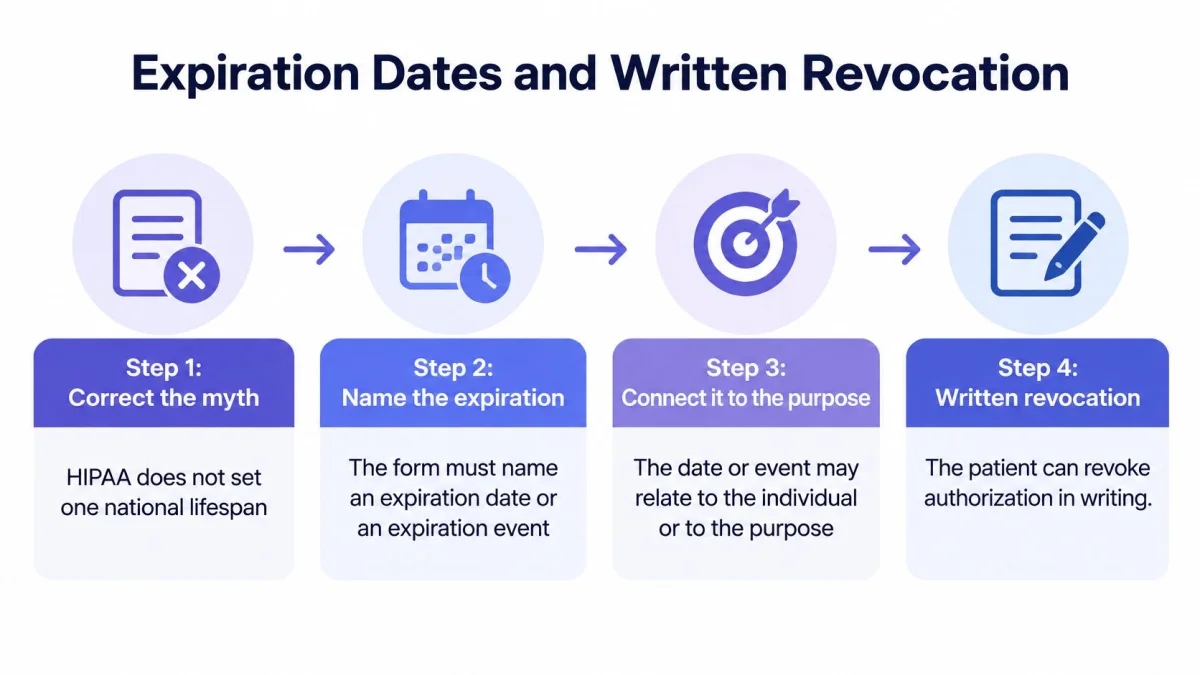
Choose an endpoint staff can recognize
A calendar date works well for a discrete records request. An event can be appropriate when the purpose has a clear conclusion, such as the end of specified health-plan enrollment. An event shouldn't be so vague that reception staff and the privacy contact reach different conclusions about whether it occurred.
For example, a practice preparing records for an external review can identify the particular review rather than use an indefinite ongoing-care description. If staff cannot verify the event, the form creates an avoidable operational problem.
A more restrictive state law may shorten an authorization's effective life. A nationally distributed template therefore needs jurisdictional review rather than an assumption that identical wording works everywhere.
Record revocation where release staff will find it
Under the HHS authorization guidance, revocation generally must be in writing and doesn't undo actions already taken in reliance on the authorization. The governing provision is § 164.508(b)(5), including the insurance exception in paragraph (b)(5)(ii).
The form should identify a real destination for written revocation, such as the practice privacy contact's mailing address or an accepted secure electronic channel. A generic instruction to notify the office leaves patients and staff guessing about where the request belongs.
- On receipt: Record when the revocation arrived and associate it with the signed authorization.
- Before transmission: Remove queued releases that depend on the withdrawn permission and notify the staff responsible for sending them.
- In the record: Preserve the revocation and mark the authorization so it can't appear active during a later search.
A telephone request alone may not satisfy the federal written-revocation requirement. The practice can nevertheless pause a pending release while helping the patient submit written notice, consistent with its procedures and applicable law.
Revocation stops future reliance on the authorization. It doesn't retrieve copies already lawfully sent.
The insurance exception is narrow. When authorization was a condition of obtaining insurance and another law permits the insurer to contest a claim or policy, revocation may not prevent that contest. Staff should escalate that situation rather than promise that withdrawal cancels every downstream use.
Psychotherapy Notes Need a Separate Path
Can a patient authorize release of a mental-health note, and does that permission include the therapist's raw session notes? The answer depends on what the record contains and how the clinician maintains it, not whether the appointment involved mental-health care.
The HHS mental-health privacy guidance distinguishes separately maintained psychotherapy notes from the ordinary clinical record. Most disclosures of psychotherapy notes require authorization, including disclosure to another treating provider, and patients generally don't have a HIPAA access right to those notes.
Classify the material before choosing the form
Psychotherapy notes document or analyze the contents of private counseling sessions and are kept separate from the medical and billing record. A clinician's private process notes may fit this definition. Merely calling a document confidential or sensitive doesn't establish its classification.
The ordinary mental-health chart is different. Diagnosis, symptoms, treatment plans, prognosis, progress, medication monitoring, and session timing are excluded from the special definition when maintained as ordinary clinical-record information. A psychiatric progress note doesn't become a psychotherapy note solely because it describes a difficult conversation.
The classification decision should precede any release request.
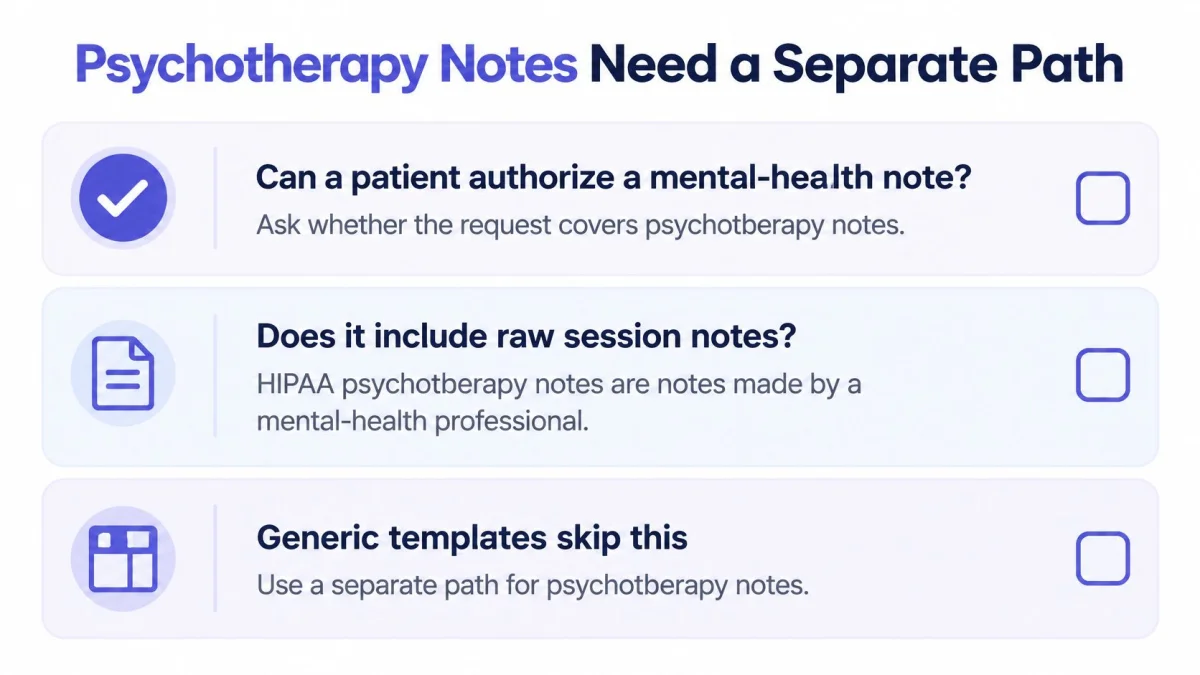
Section 164.508(a)(2) establishes the special authorization rule, while § 164.524(a)(1)(i) excludes psychotherapy notes from the ordinary access right. Limited exceptions exist, so staff shouldn't translate the rule into an absolute prohibition on every disclosure.
Separate the ordinary chart from private process notes
A useful release workflow distinguishes the following categories:
- Ordinary mental-health record: Identify the clinical documents requested and apply the ordinary disclosure rules, subject to other applicable law.
- Separately maintained psychotherapy notes: Route the request through a dedicated authorization and review process.
- Both categories requested: Prepare separately scoped authorizations rather than combining everything into a universal mental-health release.
The distinction matters because § 164.508(b)(3)(ii) generally permits an authorization for psychotherapy notes to be combined only with another authorization for psychotherapy notes. A single checkbox covering both ordinary records and private process notes can conceal a compound-authorization problem.
Say a therapist keeps a structured progress note in the chart and separate reflections about the session elsewhere. A request for the chart shouldn't automatically pull in both documents. Staff should verify the classification with the clinician before selecting files for transmission.
The same analysis applies to AI-assisted documentation. A structured progress note placed in the chart is ordinary PHI; the involvement of an AI scribe doesn't itself create heightened psychotherapy-note status. Separate private process notes require their own assessment.
For electronic workflows, preserve the signed version, signature evidence, authorized scope, expiration, and later revocations. Valid electronic signatures don't change the record category or permit broader disclosure. The guide to HIPAA-compliant email for therapists addresses transmission considerations, which remain separate from whether permission exists to send the material.
A Sample Release and Phrases That Fail
Consider this fictional family-medicine release. It illustrates completed fields, not a state-specific form or a substitute for counsel's review.
A records discussion should establish the intended scope before anyone signs.

A completed example
- Patient: Maria Alvarez, date of birth March 4, 1982.
- Information: Office visit notes and laboratory results from January 1, 2025, through December 31, 2025.
- Discloser: North Street Family Medicine.
- Recipient: Dr. Helen Chen at Lakeside Endocrinology.
- Purpose: At the request of the individual, for a second opinion.
- Expiration: June 30, 2026.
- Signature and date: Maria Alvarez, March 2, 2026.
In this hypothetical historical example, Maria signs before the stated expiration. Staff considering a new disclosure after that endpoint couldn't rely on the same authorization.
The accompanying statements identify the practice privacy officer as the destination for written revocation, explain that treatment won't be conditioned on signing, and warn about possible redisclosure. The practice gives Maria a copy. Because a second opinion is treatment, the practice should also recognize that ordinary provider-to-provider sharing may have another permitted route without requiring this authorization.
The published text of § 164.508 makes the authorization specific to its information, parties, purpose, and endpoint. Those fields should match the actual transfer, not merely resemble a familiar release template.
Wording that needs correction
Now consider a version containing all medical records, an unidentified recipient, any purpose, no expiration, and a spouse's signature without described authority. Staff shouldn't rely on that document as a valid authorization.
The problems aren't equal. Broad record scope can be intentional, but missing expiration and unidentified recipients leave required information unresolved. A spouse's signature also requires an authority assessment rather than an assumption based on marriage.
Useful distinction: Broad permission may be deliberate. Incomplete permission isn't permission staff should complete by guessing.
If a transcription vendor or consultant receives PHI, staff must identify the appropriate legal route for that access. A business-associate service belongs under its BAA; a separate disclosure requiring authorization must match the actual recipient and purpose. Neither arrangement should conceal a broader disclosure behind narrower wording.
The accompanying video can be viewed alongside the field review.
Preserve the evidence of permission
Keep the signed authorization associated with the release record, including which documents were sent and to whom. Don't substitute an edited template for the version the patient signed.
HIPAA authorization documentation must be retained for at least six years, as summarized in HIPAA Journal's Privacy Rule guidance; the primary documentation provision is § 164.530(j), which measures retention from creation or the last effective date, whichever is later.
Practices seeking different paperwork can find free intake and health-history templates among the PatientNotes resources. Those documents collect background information; they don't replace a disclosure authorization.
Confirm Scope Before You Disclose
The last check belongs at transmission, not only when the form arrives. A complete authorization can become unusable before a delayed records request reaches the sending queue.
Compare the outgoing files with the permission
Staff should read the proposed release against these lines:
- Information and dates: Do the selected documents fall within the authorized categories and period?
- Named recipient: Does the destination belong to the person, organization, or class identified?
- Purpose: Does the proposed use match the permission?
- Psychotherapy-note scope: Are separately maintained notes included through the appropriate authorization or excluded from the transfer?
If a required field is blank, the scope exceeds the request, or the authorization has expired or been revoked, staff shouldn't disclose in reliance on that form. The patient should receive a copy of the completed authorization, and the practice should retain the signed version with its release documentation.
A final revocation check should cover written notices received before transmission. Staff also need a way to interrupt queued deliveries rather than merely mark the patient's chart.
Use the BAA route for documentation vendors
A documentation vendor handling consultation PHI for the practice generally needs a business associate agreement, not an added recipient line on a patient release. PatientNotes signs a BAA with every customer, including during the free trial, at no extra cost.
Practices evaluating documentation costs can review the pricing page. This is an operational explanation of the federal authorization standard in § 164.508, not legal advice for a particular state or case.
PatientNotes creates structured clinical notes and follow-up tasks, with a BAA included at no extra cost. Its 7-day free trial requires no credit card, so practices can assess the documentation workflow while keeping patient authorizations and vendor agreements separate. Visit PatientNotes to explore the service.