The most common advice on GDPR audit log retention is also the weakest: pick 12 or 24 months, apply the same rule to every event, and move on. That approach may be easy to configure, but it doesn't explain why a clinician's sign-in record should follow the same schedule as a bulk export or a deletion event.
The defensible answer is purpose-based. The UK Information Commissioner's Office explains that UK GDPR sets no specific time limit for different categories of personal data. A small practice should therefore document what each log proves, who owns it, when the need will be reviewed, and how disposal will happen.
Why There Is No Universal GDPR Audit Log Retention Period
A round number copied from a vendor policy doesn't become defensible because it appears in a security questionnaire. GDPR audit log retention must follow the purpose of the record, the sensitivity of the data, the risk of keeping it, and any legal or professional obligation that applies to the practice.
The ICO states that organisations must not keep personal data longer than necessary. It also says that the UK GDPR doesn't set specific time limits for different data categories, and that an organisation must be able to justify how long identifiable information remains in its systems. That justification should appear in a written schedule, not exist only in the head of a practice manager or engineer.
Healthcare creates competing pressures. A security team may need enough sign-in history to investigate suspicious access. A clinical-access record may need a different review period because it helps establish who viewed a consultation record. A formal clinical-audit record may follow a healthcare retention schedule that isn't appropriate for an ordinary application event. NHS England's schedule lists six years for audit reports and ten years for clinical audit records, while also stating that records containing personal data remain subject to UK GDPR requirements. Those are healthcare record examples, not universal defaults for application logs. NHS England's retention schedule makes that distinction clear.
The decision must survive scrutiny
A regulator, insurer, complainant, or data subject may ask why a particular event still exists. A policy that says “all logs are kept for 24 months” answers only what happened, not why.
A defensible schedule should identify:
- Record type: such as failed authentication, clinical-record access, export, or deletion.
- Purpose: the security, accountability, operational, contractual, or legal question the record answers.
- Owner: the person responsible for review and disposal.
- Review trigger: a calendar review, an incident, a complaint, a legal hold, or a change in processing.
- Disposal action: deletion, anonymization, pseudonymization, or aggregation.
Practical rule: If a practice can't explain what a log proves and when that proof stops being necessary, the period isn't ready for approval.
A hosted clinical service should also be assessed against its documented privacy practices. The PatientNotes privacy information is a useful example of the type of vendor material a practice should review, alongside broader operational perspectives such as ServiceNow and Halo insights. The objective isn't to find a universal duration. It's to build a record-by-record decision that can be defended without rewriting the policy after an incident.
The Storage Limitation Principle Applied to Audit Logs
Storage limitation is simple in operational terms: keep a record while its defined purpose remains active, then remove or transform it when that purpose ends. Audit logs aren't exempt because they support security. They are often personal data themselves, especially when they identify a clinician, patient, device, tenant, or consultation.
A healthcare application should map each event to a specific question.
Authentication and session events
A successful sign-in, failed sign-in, password reset, session termination, or multifactor authentication event can support account-security investigations. The log should normally contain the minimum metadata needed to identify the actor, time, outcome, and relevant session. It shouldn't contain credentials, tokens, clinical free text, or an entire request payload.
Clinical-record access
A record-access event answers a different question: who accessed a protected record, which action occurred, and whether the access was allowed. The application should avoid copying the note, transcript, diagnosis, or attachment into the audit payload. A pseudonymous resource identifier may be enough for routine investigation, with controlled re-identification available when a legitimate investigation requires it.
Exports and administrative changes
An export, bulk download, permission change, role change, archive restoration, or integration action can affect many records at once. These events need clear actor and outcome fields because they support accountability for privileged actions. The purpose is not general debugging. It is proving what a privileged user or process did.
Billing, consent, and deletion
Billing and entitlement events support account administration and financial reconciliation. Consent receipts support evidence about a processing relationship. Deletion and erasure events prove that a requested or scheduled action was executed. These categories shouldn't be merged just because they all appear in an administrative database.
The EDPB data-protection basics guidance supports a documented, purpose-based approach and expects personal data to be deleted or anonymized when it is no longer necessary for the original or a compatible purpose.
A useful test: Can the practice name the purpose, lawful basis, retention decision, owner, and review date for this log line?
If the answer is no, the event is either under-specified, over-collected, or missing from the retention schedule. That test should be applied whenever a new feature adds a new event type.
Log Categories and Their Defensible Retention Periods
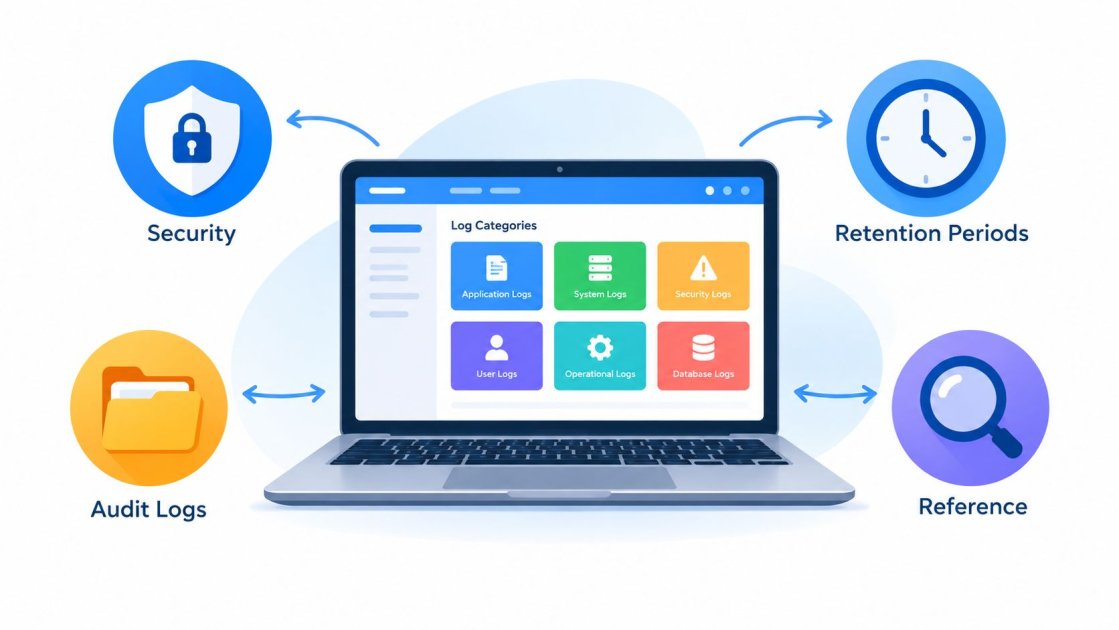
A retention schedule should assign a decision to each category, not hide every event behind one blanket rule. The periods below are governance starting points, not GDPR defaults. Each practice should adjust them when an applicable healthcare, contractual, insurance, employment, or legal requirement supports a different outcome.
Authentication and session logs
The purpose is to detect account misuse, investigate failed access, and reconstruct suspicious sessions. A practice can assign a defined operational period, with the security owner reviewing the period when incident patterns, threat exposure, or contractual requirements change. Records connected to an open investigation should be preserved under a documented hold rather than deleted by the routine job.
Clinical-record access events
The purpose is accountability for access to patient information. These records may deserve a longer period than ordinary debugging logs where complaints, professional obligations, or clinical-negligence risk make access history relevant. The privacy or compliance owner should review the decision with the clinical governance lead.
Export and bulk-download events
Exports deserve close attention because a single action may involve many patient records. The event should capture the actor, target scope, outcome, approval context where applicable, and correlation identifier. The security owner should review the period after incidents, major changes to export functionality, or changes in contractual obligations.
Administrative and configuration changes
Role changes, permission changes, integration settings, archive actions, and security-policy changes support accountability. The system owner should retain them for a defined administrative period and review them when staff roles, delegated administration, or the product architecture changes.
Billing and entitlement events
These records support account administration and financial reconciliation. The finance or operations owner should map the period to the applicable financial record requirement rather than assuming that the application-log schedule is suitable.
Deletion and erasure events
A deletion record should prove what was removed, when the action ran, which policy or request triggered it, and whether the operation succeeded. A compact, pseudonymized summary may remain useful after the underlying event detail is removed, but indefinite retention of identifiable deletion data requires its own justification.
| Log category | Purpose | Lawful basis | Default period | Owner | Disposal |
|---|---|---|---|---|---|
| Authentication and session | Detect misuse and investigate access | Security and accountability basis documented in the processing record | Defined operational window, reviewed periodically | Security or privacy lead | Secure deletion or anonymization |
| Clinical-record access | Demonstrate access accountability | Applicable documented basis for care, security, or legal accountability | Longer only where clinical or professional risk supports it | Clinical governance and privacy leads | Pseudonymization or secure deletion |
| Export and bulk download | Investigate high-volume disclosure risk | Security and accountability basis | Defined forensic window, extended only for an active matter | Security lead | Secure deletion after hold release |
| Admin and configuration changes | Prove privileged actions | Security and accountability basis | Defined administrative window | System owner | Secure deletion |
| Billing and entitlement | Support account and financial administration | Contractual, legal, or legitimate administrative basis as documented | Period mapped to applicable financial obligation | Finance or operations owner | Secure deletion or controlled archive |
| Deletion and erasure | Prove disposal execution | Legal accountability and documented processing basis | Summary retained only while necessary to prove compliance | Privacy lead | Anonymized summary or deletion |
The schedule should state the rationale beside every period. “Vendor default” isn't a rationale.
Security Controls for the Logs Themselves
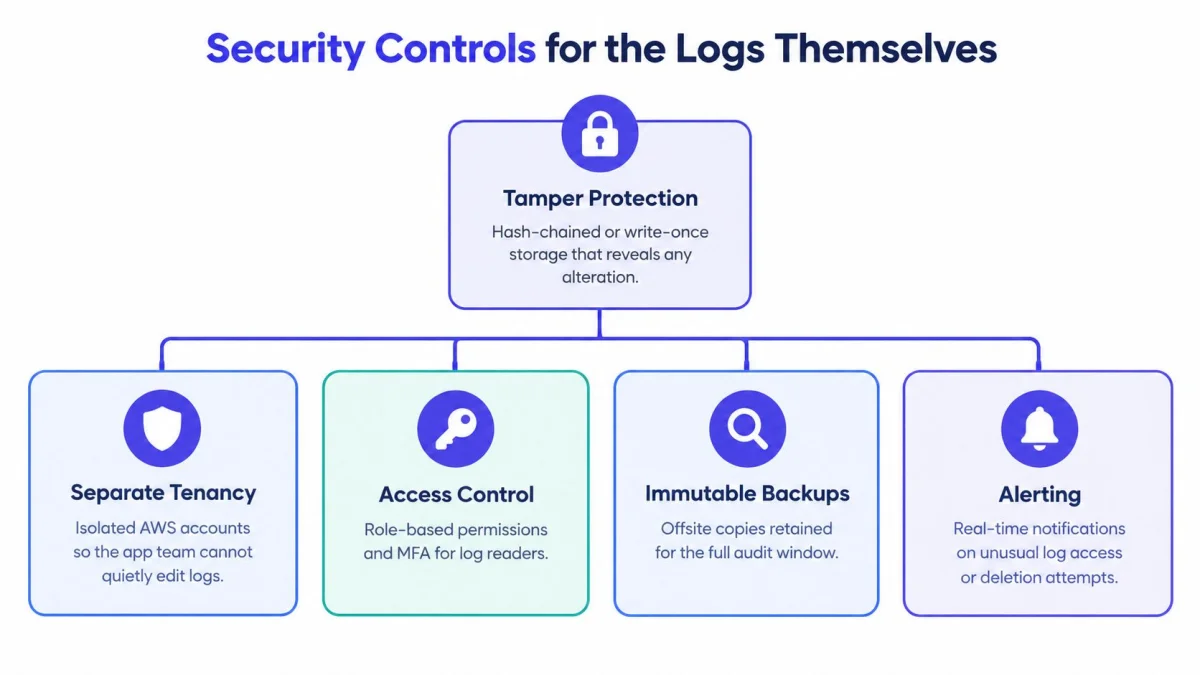
A retention policy fails if the log store can be edited by the same administrator who generated the event. Audit data needs its own security boundary, access model, monitoring, and disposal controls.
Protect integrity and limit access
Use append-only or tamper-evident storage. Hash chaining, write-once controls, or equivalent mechanisms should reveal alteration attempts. Store the audit trail separately from the clinical application database, with administrative separation so application operators can't change or delete evidence undetected.
Access should be limited to named security, privacy, and compliance roles. Require strong authentication and record access to the logs themselves. Every read, export, configuration change, and deletion-rule change should create a separate audit event.
Keep the payload clean
The safest clinical log is usually a metadata record, not a copy of the clinical record. Strip free-text notes, transcript content, birth dates, attachments, credentials, tokens, and unnecessary record identifiers before events reach the log sink. Use pseudonymous actor and resource identifiers where investigators can still correlate activity without exposing full identity in routine queries.
A sound event commonly includes a synchronized timestamp, tenant or organization identifier, actor identifier, event type, target resource, outcome, source context where justified, and a correlation ID. It should not include the underlying note merely because an application exception captured the request body.
Treat backups as part of retention
Backups must follow the same schedule and disposal logic as the primary log store. Object-lock or equivalent immutability, version control, isolated storage, and tested restoration can help prevent silent alteration. A backup policy should also prevent deleted records from reappearing after recovery and should reapply suppression or deletion rules after restoration.
The PatientNotes security information illustrates the kind of vendor security material a practice should request and assess. The practice still needs to confirm how the vendor handles log access, retention changes, backups, legal holds, and disposal evidence.
Security monitoring should alert on attempted log-store deletion, retention-rule changes, unusual log reads, failed access, and unexpected export volume. Those alerts must themselves be retained under a defined security-event schedule.
Retention Interacts With Incident Response and Breach Records
Ordinary audit logs and incident records serve different purposes. The operational stream shows events as they occur. The incident register records the human decisions made after something unusual is detected. Evidence preservation freezes the relevant material before an automated deletion job can remove it.
A practice should maintain three distinct artefacts.
The operational audit stream
This follows the approved category schedule. It should support detection, access review, and routine investigation. It shouldn't be kept forever just because an incident might occur someday.
The incident register
This records the incident identifier, known facts, likely effects, containment steps, decisions, responsible people, communications, and review outcome. The ICO expects breach-management records to capture facts, likely effects, and response measures, with a defined retention period, lawful basis, periodic senior review, and checks for excessive personal information. The ICO's breach-management guidance provides the operational basis for this separation.
The evidence hold
When a suspected incident, complaint, legal dispute, or investigation involves particular events, the responsible privacy or security lead should place the relevant log slice on hold. The hold should identify its scope, owner, reason, start date, review date, and release decision. Automated deletion must stop only for the defined material, not automatically for every tenant and every event.
| Artefact | Default retention | Owner | Override on legal hold |
|---|---|---|---|
| Operational audit stream | Category-specific schedule | System or security owner | Relevant records frozen |
| Incident register | Documented incident-governance period | Privacy lead | Entire related record preserved |
| Preserved evidence slice | Until investigation, complaint, or legal matter ends and release is approved | Security and privacy leads | Hold remains active |
The handoff must be explicit. The on-call engineer identifies the event range, alerts the privacy lead, records the preservation action, and confirms that the deletion scheduler has excluded the affected material. A practice can also review HIPAA and BAA requirements for clinical software when its US compliance responsibilities overlap with its UK GDPR analysis.
A Retention Schedule Template You Can Adapt
A useful schedule is short enough to maintain and detailed enough to operate. Each row should describe a log category rather than a vague system name. The owner should be a real role, not “the vendor,” and the disposal field should describe what the system does.
The lawful-basis field needs care. An audit log may support security or accountability without making every event a new clinical-care record. Where an event contains special-category health data, the organisation should also document the applicable Schedule 1 condition and minimize the content so that the condition isn't stretched beyond the underlying purpose.
Required schedule fields
- Log category: the class of event.
- Example events: sign-in, access, export, role change, deletion, or security alert.
- Lawful basis: the documented UK GDPR Article 6 basis and, where relevant, the Schedule 1 condition.
- Retention period: the approved duration and its written rationale.
- Review trigger: the date or event that forces reassessment.
- Storage location: the isolated log store and backup treatment.
- Disposal method: deletion, anonymization, pseudonymization, or aggregation.
- Named owner: the role accountable for sign-off.
A filled-in schedule might look like this:
| Log category | Lawful basis | Retention | Disposal | Owner |
|---|---|---|---|---|
| Authentication attempts | Security and accountability basis | Defined period suitable for anomaly review | Secure deletion or aggregation | Security lead |
| Clinical-record access | Documented care, accountability, or legal basis | Period supported by clinical and professional risk | Pseudonymization or secure deletion | Clinical governance lead |
| Export and bulk download | Security and accountability basis | Period supported by forensic and contractual needs | Secure deletion after hold review | Privacy lead |
| Admin configuration changes | Security and accountability basis | Defined administrative period | Secure deletion | System owner |
| Billing and entitlement | Contractual or legal administrative basis | Period mapped to financial obligations | Secure deletion or controlled archive | Finance lead |
| Consent receipts | Documented consent basis where consent is used | While the account relationship and proof remain necessary | Pseudonymization or secure deletion | Privacy lead |
| Soft-deleted account records | Legal, contractual, or security basis | Only while recovery or accountability is necessary | Permanent deletion with evidence | Operations lead |
| Security event stream | Security and incident-response basis | Category-specific period, with holds for active matters | Secure deletion after release | Security lead |
The ICO's retention guidance for records management emphasizes the same essentials: identify the record category, purpose, period, end action, owner, and review process.
Disposal needs evidence. The job should record completion, exceptions, failed deletions, and legal holds. Encrypted archives may require cryptographic shredding when the archive is no longer needed, while ordinary storage requires permanent deletion or an equivalent approved transformation. A practice should retain periodic evidence that disposal ran successfully, without keeping the entire deleted payload as proof.
For additional policy structure, a data-retention policy guide from Fivenines can help a practice organize its register. It shouldn't replace the practice's own purpose and risk analysis.
Common Pitfalls in Healthcare App Audit Logging
The most damaging failures are predictable. They arise when developers treat audit events as ordinary application messages and when privacy teams approve a schedule without testing its enforcement.
| Pitfall | Why it fails GDPR | Corrective control |
|---|---|---|
| Indefinite retention by default | It lacks a necessity decision and increases exposure | Set category schedules with review and disposal jobs |
| One blanket period for every event | It ignores different purposes and risks | Separate security, clinical access, export, admin, billing, and deletion streams |
| Clinical content in payloads | It creates an unnecessary secondary store of health data | Use field allow-lists and reject free text, transcripts, and attachments |
| Backups resurrect deleted rows | Disposal isn't effective if recovery restores expired data | Apply backup exclusions, deletion markers, and restoration tests |
| Shared clinical and audit database | Clinical backup cycles can silently extend log retention | Isolate the audit store and its lifecycle |
| Developers can delete their own trail | Evidence loses integrity and separation of duties | Restrict deletion and monitor administrative access |
Payload capture is a recurring failure
A logger that records the complete exception context may capture a consultation note, diagnosis fragment, patient name, or attachment. The application may never intend to retain that content as an audit record, but the log pipeline does it anyway. A schema allow-list should define the permitted fields and reject unexpected payload content before storage.
Backup recovery needs a test
A deletion job that passes in production can still fail operationally if the next restore reintroduces expired rows. The practice or vendor should test restoration, verify that deletion and suppression rules are reapplied, and document the result. The ICO's accountability, records-management, and security guidance supports treating disposal as part of the control, not as an administrative afterthought.
During procurement, clinicians can ask:
- Which exact events are logged when a clinician views, exports, edits, restores, or deletes a record?
- Can the vendor show the retention schedule for each category?
- What happens to expired logs in primary storage and backups?
- Who can read, export, alter, or delete the audit trail?
- Can the vendor provide evidence that deletion and legal holds work as described?
Quick Reference Checklist and Review Cadence
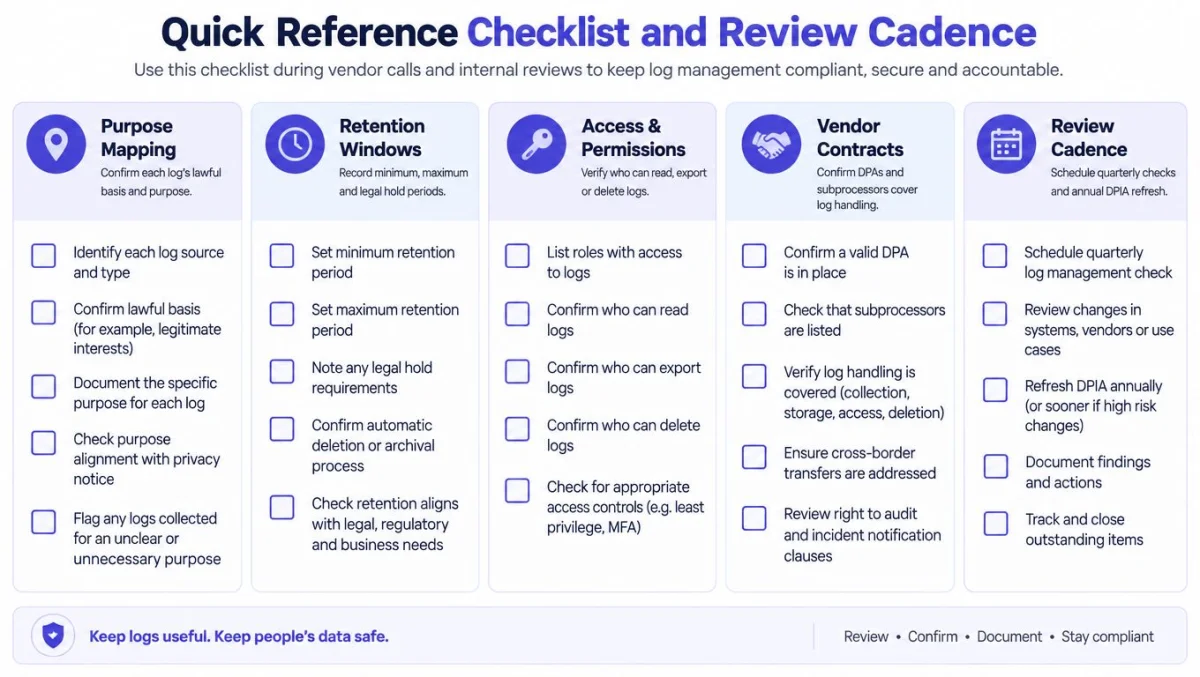
A practice manager should be able to review a vendor's audit-log policy without interpreting a long security document. The following questions turn the policy into a working control.
Purpose mapping
- Events: Does the schedule list each material event type?
- Purpose: Does every category state what question the log answers?
- Content: Does each field have a documented need?
- Basis: Does the record identify the relevant processing basis and, where needed, the special-category condition?
Period assignment
- Window: Does each category have its own documented period?
- Review: Is there a named review trigger?
- Exception: Does the policy explain legal holds and active investigations?
- Expiry: Does the system perform deletion, anonymization, or aggregation automatically?
Security controls
- Integrity: Is the store append-only or tamper-evident?
- Access: Are log readers named, limited, and authenticated strongly?
- Separation: Is the log store separate from the clinical database?
- Backups: Do backup copies follow the same lifecycle?
Incident linkage
- Detection: Do suspicious reads, exports, and deletion attempts create alerts?
- Register: Is there a separate incident record?
- Preservation: Can the team freeze only the relevant evidence?
- Handoff: Does the on-call process prevent accidental deletion?
Disposal evidence
- Execution: Does each disposal job record success and failure?
- Testing: Has restoration been tested?
- Review: Does a responsible person sign off on exceptions?
- Proof: Can the practice show that expired data was removed?
| Review cadence | Check | Sign-off owner |
|---|---|---|
| Monthly | Failed disposal jobs, unusual log access, active holds | Security or privacy lead |
| Quarterly | Access permissions, retention-rule changes, backup and restoration evidence | Data protection lead |
| Annually | Purpose mapping, processing documentation, risk assessment, and clinical-data review | Data protection lead with clinical governance sign-off |
The four-question self-audit is deliberately blunt:
- Does the practice know what the system logs?
- Does it know why each category exists?
- Does it know when each category is deleted or transformed?
- Can it prove all three with current evidence?
A “no” means the vendor policy or internal schedule needs work before the next procurement review, complaint, or security investigation.
PatientNotes records consultation activity with audit trails, supports HIPAA compliance with a BAA included at no extra cost, and provides note and task workflows for individual clinicians and small practices. Clinicians can review the product's recording, language, template, EHR workflow, and pricing details at PatientNotes.