Can you become a medical scribe for free?
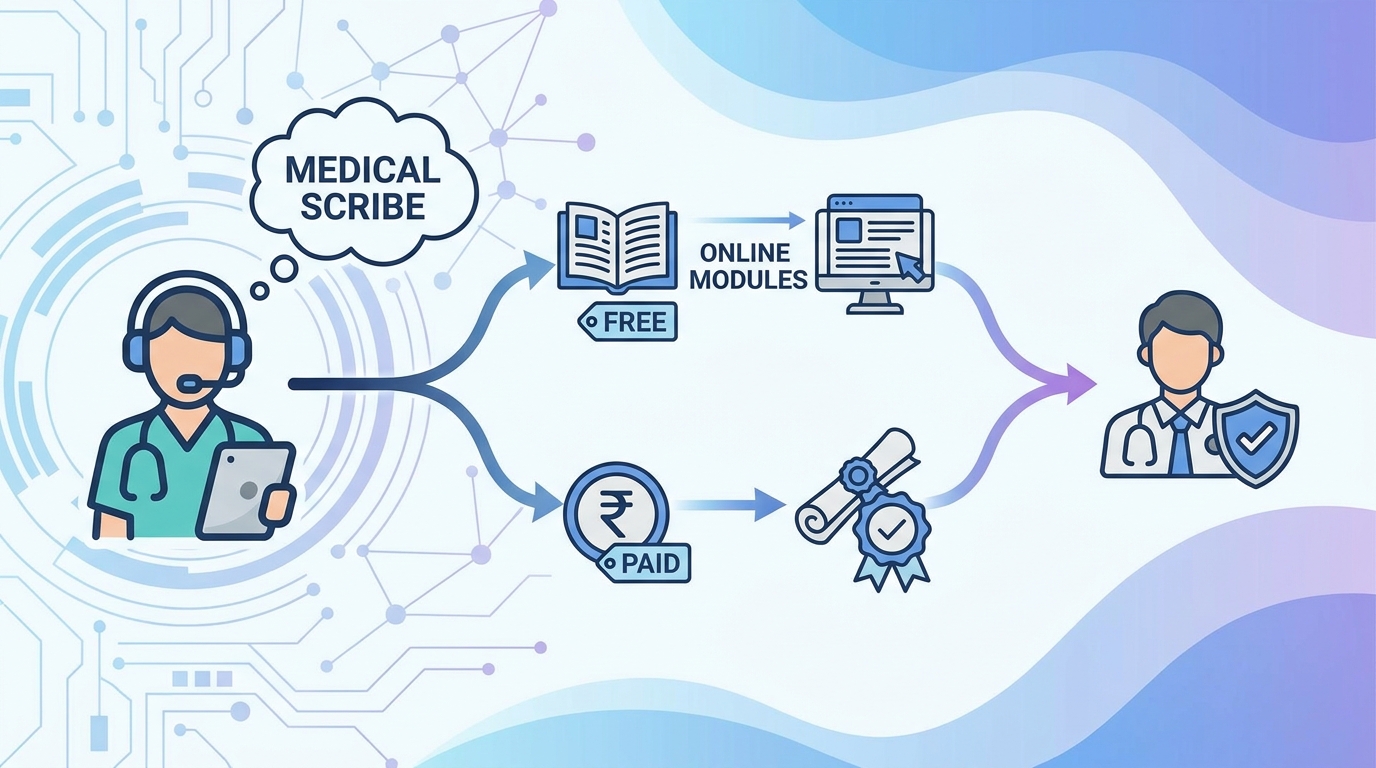
Short, honest answer: you can get trained for free, but a recognized certification almost always costs money. The two ideas get tangled together, so separate them:
- Free training is realistic. The largest scribe employers — ScribeAmerica, PhysAssist, ProScribe — hire entry-level applicants and train them at no cost, because you learn on the job while getting paid. You do not need to buy a course first to get hired.
- Free certification is mostly a myth. Credentialing bodies charge an exam or program fee. There is no widely accepted "free certificate" that carries weight with employers.
So if your goal is a scribe job, the free path is usually: study free resources to build medical-terminology basics, then apply to a company that trains and pays you. If your goal is a credential on your resume, budget a few hundred dollars. The rest of this guide breaks down each option, real 2026 costs, and whether the job is still worth pursuing as AI changes the role.
Free vs. paid: how the paths actually differ
Most people arrive assuming they must pay for a course before anyone will hire them. In practice the industry runs the other way for entry-level roles. Companies would rather hire coachable applicants and run them through their own onboarding — classroom modules plus supervised shifts — than rely on outside certificates they cannot verify.
Paid programs still have a place. They help career changers who want structure, applicants in markets without large scribe employers, and people who want a credential to stand out. Just go in knowing what you are buying: preparation and a line on your resume, not a guarantee of a job.
Medical scribe training & certification options (2026)
| Option | Typical cost | Duration | Best for |
|---|---|---|---|
| Employer on-the-job training (ScribeAmerica, PhysAssist, ProScribe) | $0 — you are paid | A few weeks of classroom + supervised shifts | People who want to earn while they learn; usually a minimum work commitment |
| Free self-study (Khan Academy, YouTube channels, Alison) | $0 | Self-paced | Testing your interest and building medical-terminology basics before applying |
| Community college / continuing-ed course (e.g., Triton College online) | Around $450, varies by school | A few weeks to a semester | Career changers who want a structured, local credential |
| Online course + certificate (e.g., Medical Scribes Training Institute) | Roughly $300–$600 | Self-paced, several weeks | Applicants who want a resume credential before interviews |
| Professional certification exam (e.g., AHDPG MSCE) | About $165 | Exam only; you study on your own | People who already have the basics and want a recognized credential |
Prices verified in July 2026 from provider pages and can change — always confirm current pricing directly with the provider. Employer training is "free" in that you are not charged, but many companies ask for a minimum commitment (often around a year) in exchange.
A few notes on the paid credentials specifically. The AHDPG (American Healthcare Documentation Professionals Group) offers scribe specialty training and its MSCE credential; other bodies such as the ACMSS run their own certification exams. Exam and program fees vary widely between providers and membership tiers, so treat any single number as a starting point and check the source before paying.
What free training actually covers
Before you spend anything, free resources can carry you a surprising distance:
- Medical terminology and anatomy — Khan Academy and free university lecture material cover the vocabulary that trips up new scribes.
- EHR and workflow basics — YouTube channels (including training institutes' own channels) walk through how charting works.
- HIPAA and documentation standards — free primers cover the privacy rules every scribe must follow.
- Note structure — understanding how a clinical note is built is core to the job. Our guide to SOAP notes explains the structure scribes document every shift.
If you can speak fluently about terminology, note structure, and HIPAA in an interview, you have covered most of what a free course would teach — often enough to land a role where the employer trains you the rest of the way.
Is scribing a good job in 2026?
This is the question worth sitting with, because the honest answer has changed. Scribing was long treated as a near-guaranteed stepping stone for pre-med and pre-PA students — clinical exposure, provider mentorship, and a paycheck. Much of that value still holds. But the role is being reshaped by AI.
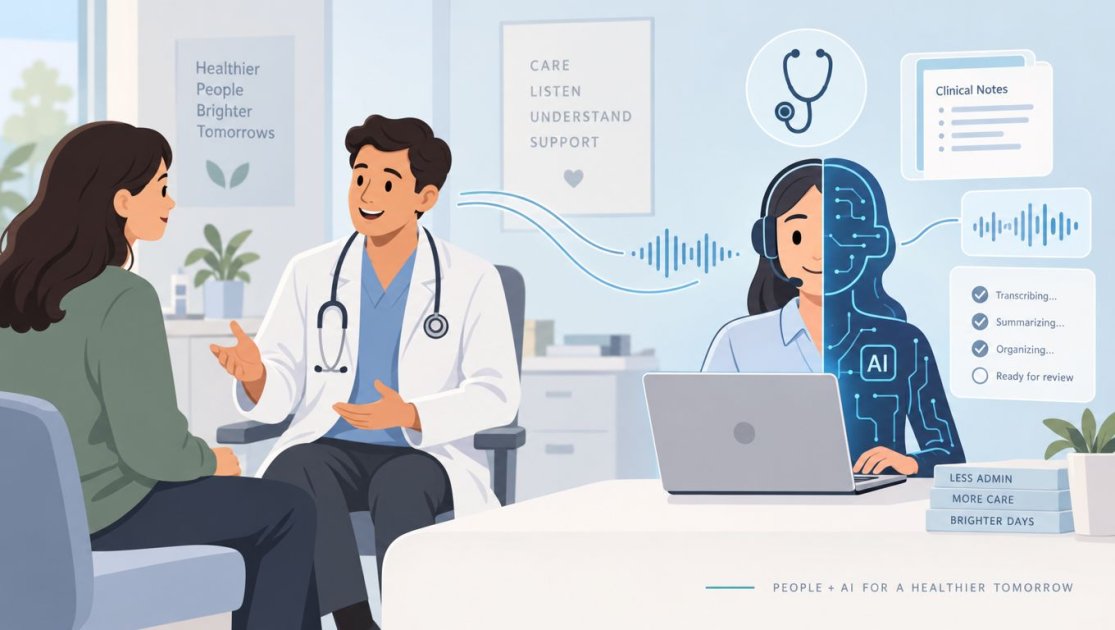
Ambient AI scribes have been adopted unusually fast, and many practices now run tools that draft the clinical note automatically from the visit conversation. If you are comparing options as a practice manager, our overview of the best AI scribes walks through how they work, and tools like PatientNotes sit in this category. That shift is exactly why the human role is changing rather than simply disappearing.
The realistic 2026 picture is a hybrid model: an AI tool produces a first-draft note, and a human reviews, corrects, and finalizes it. AI is good at capturing what was said; it is far weaker at judging clinical nuance, catching errors, and protecting against risky phrasing. That review work — ensuring a note is correct, complete, and defensible — is where human scribes are increasingly valuable.
The practical takeaway for anyone entering the field:
- Clinical exposure still matters. For pre-med and pre-PA applicants, time beside a provider remains one of the best reasons to scribe.
- The skills transfer. Fluency in documentation, terminology, and EHRs maps directly onto emerging roles like documentation specialist, note QA reviewer, and AI-scribe editor.
- Go in with open eyes. Treat scribing as a way to build clinical and documentation skills, not as a role guaranteed to look the same for the next decade.
If you are a practice manager weighing human scribes against AI on cost, our virtual scribe cost breakdown compares the models directly.
Frequently asked questions
Do you need a certification to be a medical scribe?
Usually no. Most large scribe employers hire based on aptitude and train you themselves. Certification can help you stand out — especially in competitive markets or if you lack healthcare experience — but it is rarely a hard requirement for entry-level roles.
How long does medical scribe training take?
Employer onboarding is commonly a few weeks of classroom modules followed by supervised shifts before you work independently. Self-paced online courses vary from a few days to several weeks depending on how much time you put in.
Is medical scribe certification worth the cost?
It depends on your situation. If a large scribe company operates in your area and will train you for free, paying for certification first is often unnecessary. If you are a career changer, live in a market without big scribe employers, or want a credential to strengthen your application, a few hundred dollars can be a reasonable investment.
Will AI replace medical scribes?
AI is changing the role more than eliminating it. Routine documentation is increasingly drafted by ambient AI, but complex encounters, quality review, and finalizing accurate notes still need human judgment. The strongest position is to build skills — documentation accuracy, terminology, EHR fluency — that transfer into these evolving roles.
What free resources help you prepare to become a scribe?
Khan Academy (anatomy, physiology, medical terminology), free HIPAA primers, and training-institute YouTube channels cover most of the fundamentals at no cost. Pair them with an understanding of how clinical notes are structured and you will be well prepared for interviews.