The toddler is crying, the caregiver is describing fewer wet diapers, and the next patient is waiting. The clinician has enough information to make a decision, but the unfinished note still blends reported symptoms with examination findings. A useful pediatric SOAP note example separates those details without losing who said what or how the child looked.
Acute Visit Pediatric SOAP Note Example
A worked sick-visit note
The following hypothetical documentation example illustrates the labels and chart language. It isn't a prescribing protocol or a complete medication order. Clinicians can copy the structure, replace the findings, and complete treatment details from the actual encounter.
Subjective
Purpose: Fever and right-ear pain.
Caregiver report: Child aged 26 months with one day of fever and right-ear pulling. Maximum temperature at home 102.4°F. Two fewer wet diapers than usual; no vomiting. No recent antibiotics. Immunizations up to date per caregiver.
Child communication: Points toward right ear. Caregiver reports crying when laid flat.
Objective
Age 26 months. Weight: enter measured kilograms; weight percentile: enter from the growth chart in use. Temperature 38.6°C, tympanic. Heart rate 148 beats/min while awake and crying. Respiratory rate 28 breaths/min. Oxygen saturation 98% on room air.
Capillary refill under 2 seconds. Mucous membranes moist. No extra work of breathing. Right tympanic membrane bulging and opaque. Left ear examination normal. Lungs clear.
Assessment
Right acute otitis media, clinical impression. Dehydration not supported by the examination at this visit despite caregiver-reported reduction in wet diapers.
Plan
Analgesia: enter the selected medication, actual dose in milligrams, route, and interval, after confirming measured weight, allergies, formulation, contraindications, and the applicable prescribing reference. The entry must be completed before this note is signed; “weight-based dose” alone isn't a usable medication instruction.
Antibiotic treatment or observation: document the clinician's decision, rationale, and any complete prescription. This example deliberately leaves that clinical decision unresolved.
For this hypothetical encounter, the documented safety net is return for fewer wet diapers, fast breathing, or lethargy. Follow-up with the treating practice in 48 to 72 hours if fever persists. Caregiver repeats the agreed medication instructions and return precautions; understanding documented.
What makes the example usable
Pediatric SOAP organizes Subjective information, Objective findings, Assessment, and Plan around the child's problems. Its purpose is to connect the history and examination with clinical reasoning and next steps, consistent with the problem-oriented record described in this historical review of Weed's documentation model.
The finished note should distinguish known findings from unfinished decisions. A blank prescription field is a prompt to complete an order, not permission to send an incomplete instruction home. The same applies to missing weight, allergies, or follow-up arrangements.
For learners who need a general explanation of how information moves between the headings, the Ace Med Boards SOAP note guide offers a companion framework. The pediatric adaptation requires particular attention to the historian, developmental context, and measurement conditions.
The diagram summarizes the structure of the illustrative encounter.
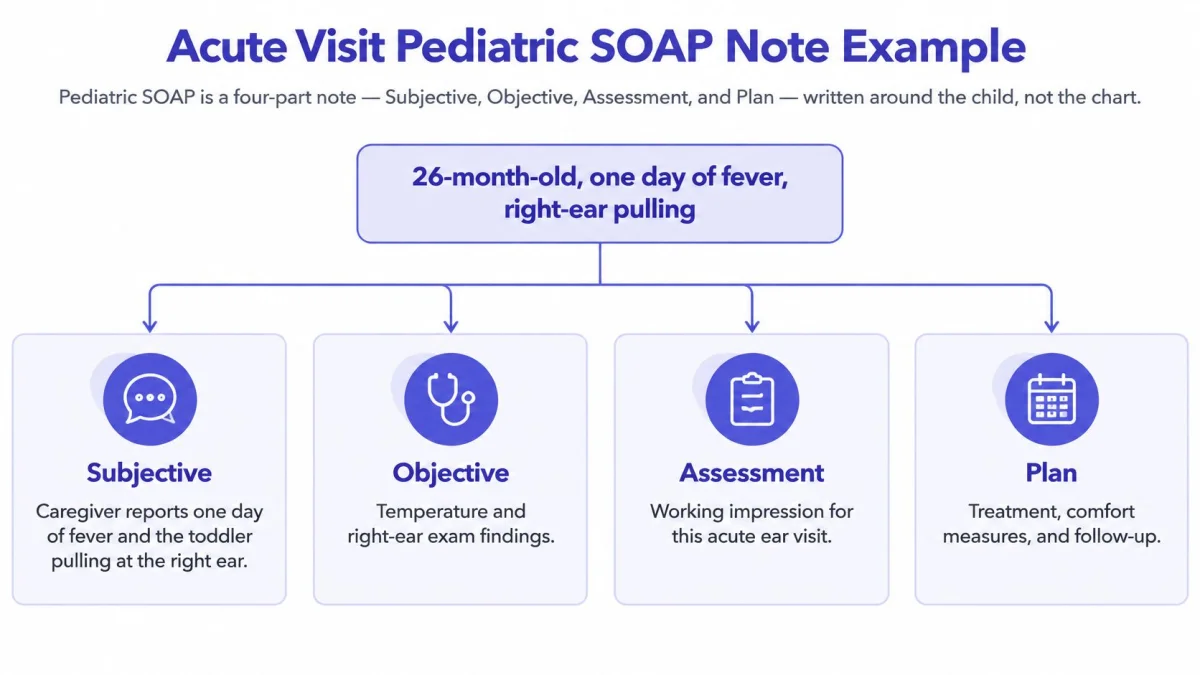
Copy the labels, not the findings. A template should prompt an examination and a decision, not supply either one.
A signed version also needs the clinician's actual treatment choice. The ear findings, reported fever, and reduced urine output belong in the record because they explain the decision, not because every ear-pain visit should contain identical wording.
Age Norms That Change the Same Number
A pediatric vital sign shouldn't be called normal without the child's age, measurement conditions, and state. The Maine EMS pediatric vital-sign reference lists the following awake heart-rate and respiratory-rate bands.
Awake heart and respiratory rates by age
| Age band | Awake heart rate (beats/min) | Respiratory rate (breaths/min) | Clinical reading |
|---|---|---|---|
| Neonate | 100–205 | 30–53 | A respiratory rate of 30/min can be expected |
| Toddler, 1–2 years | 98–140 | 22–37 | Interpret with crying versus quiet state |
| Preschool, 3–5 years | 80–120 | 20–28 | Do not use adult thresholds |
| Adolescent, 12–15 years | 60–100 | 12–20 | A respiratory rate of 30/min is abnormal |
The teaching contrast is straightforward: a respiratory rate of 30/min can be expected in a neonate and abnormal in an adolescent, using these reference bands. The number alone doesn't carry the interpretation.
Record the conditions before interpreting the result
In the illustrative ear-pain note, the heart rate was measured while the toddler was awake and crying. Removing that context would leave the next clinician interpreting a different, less complete observation. A repeat measurement, if obtained, should have its own conditions documented rather than replacing the earlier value.
When relevant to the encounter, the Objective section should contain:
- Age and weight: Record age precisely enough to select an appropriate reference and weight in kilograms.
- Temperature: Include the measurement route.
- Oxygenation and breathing: Record pulse oximetry and observed respiratory effort.
- Heart-rate state: State whether the child was quiet, crying, awake, or asleep.
- Blood pressure: Include the measurement site and cuff size when they affect interpretation.
Fever, distress, dehydration, and medication effects can alter rates. The Assessment should interpret the measurement alongside the illness and examination, rather than treating a reference boundary as a diagnosis.
Growth documentation needs the same care with context. A pediatric growth tool can support the growth-review workflow, while the chart should still identify the measurements and reference used.
Practical revision: Replace a generic normal-vitals entry in an old note with measured values, the applicable age band, and the child's state.
The resulting line may be longer. It also gives another clinician something concrete to reassess.
What Belongs in Each SOAP Section
Subjective and Objective answer different questions
Subjective identifies the account being reported. It names the historian, states the purpose of the encounter, and summarizes relevant symptoms and changes. The child's contribution belongs alongside caregiver history when development and communication allow it.
A concise summary isn't a transcript. The East London NHS clinical-record policy uses Subjective, Objective, Analysis, and Plan, and expects the purpose of the session plus a clear summary of key points. UK clinicians may therefore encounter a different word for the third heading without a different underlying task.
Objective records what was measured or examined. In an acute visit, a useful template prompts explicit observations about hydration, respiratory effort, and overall appearance. These are particularly important when the history includes fever, vomiting, diarrhea, reduced intake, or reduced urine output.
For the ear-pain example, moist mucosa and capillary refill are examination findings. Fewer wet diapers is caregiver history. Putting both in the same paragraph without attribution makes the relationship harder to follow.
Assessment and Plan show the clinician's work
The Assessment connects the findings to a working diagnosis or differential. It shouldn't repeat the examination. The useful statement explains what the findings support, what remains uncertain, and which concerns aren't supported at that encounter.
The Plan records decisions and responsibility. Treatment instructions need enough detail to be carried out. Monitoring and safety-net language should describe observable changes rather than use unexplained shorthand, and follow-up should identify the responsible clinician or service.
A practical drafting pattern is:
- Treatment: State what was prescribed, advised, deferred, or declined.
- Monitoring: Identify what the caregiver or patient will watch.
- Escalation: Record the agreed reason and route for seeking further care.
- Ownership: Name who arranges review, checks results, or contacts the family.
Separate active problems deserve separate reasoning. If constipation is addressed during an ear-pain encounter, a distinct SOAP block keeps its history, findings, assessment, and plan from becoming mixed with the acute illness.
That separation isn't merely cosmetic. In a peer-reviewed pediatric ward-round quality-improvement study, compliance with displaying the SOAP acronym increased from 13% to 90% after an acronym-based intervention. The inpatient finding doesn't establish an outpatient outcome, but it illustrates how explicit headings can become a measurable documentation practice.
Before sign-off, the writer can apply a brief check:
- Source named: The reader can identify who supplied the history.
- Numbers measured: Values aren't replaced by generic reassurance.
- Appearance explicit: Relevant examination observations are visible.
- Plan findable: Another clinician can locate the actions during handoff.
Whose Words Belong in the History
A longer, partitioned history can be safer than a short blended one. Compression can turn a caregiver's concern into an established fact or erase disagreement between caregiver and child. Concision is useful only if the source and meaning survive.
The pediatric ambient-documentation challenges described in this AMIA clinical informatics presentation include speaker attribution, consent, transcript access, and confidential adolescent sections. These are workflow problems, not details that can safely be left to automatic transcription.
Separate the voices without separating the story
For a hypothetical school-age child with abdominal pain, a practical pattern is:
- Caregiver report: Pain interrupts play.
- Patient report: Pain is around the umbilicus and worse after lunch.
- Clinician observation: Abdomen soft; no peritoneal signs on examination.
The final line belongs in Objective, even if the template displays these prompts together during drafting. The labels prevent a reported symptom from becoming an examination finding.
Early development may limit a child's ability to describe timing or severity. A communication disability may require a different communication approach, additional time, or a supporting historian. Neither situation justifies treating an adult's interpretation as the child's own words.
A teacher's account should be labeled as a teacher's account. Another relative's report should identify that relationship. If sources disagree, the note can preserve both accounts without choosing one merely to make the paragraph shorter.
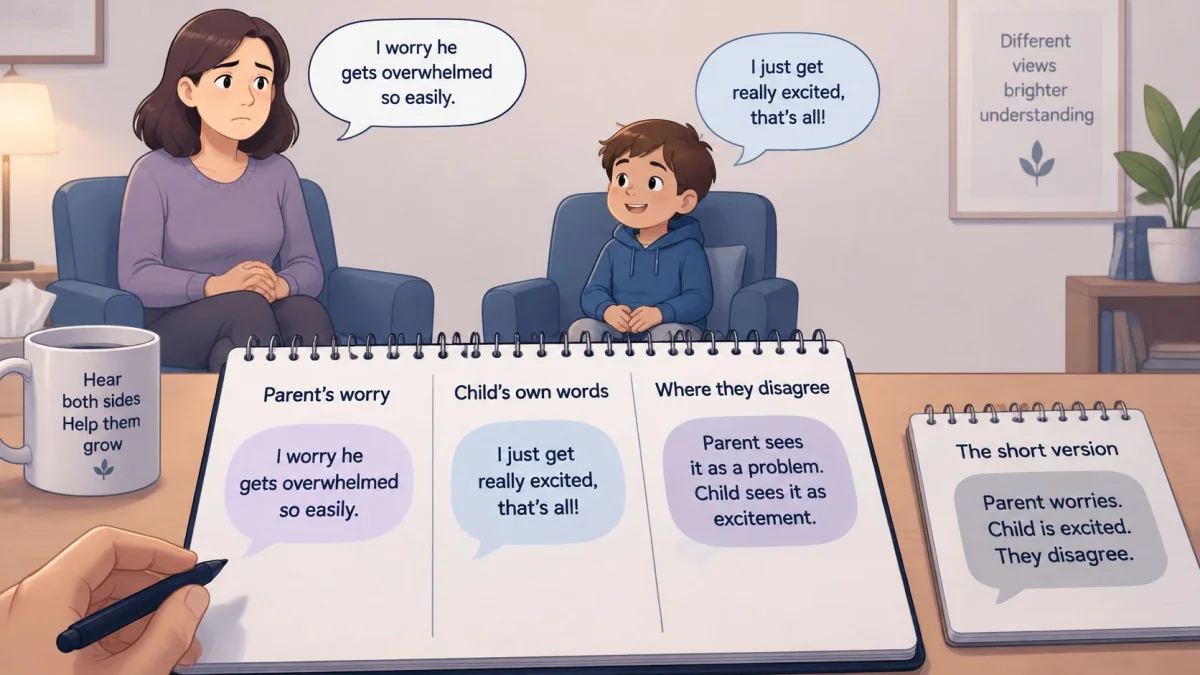
The image illustrates the multi-speaker setting in which attribution matters.
Adolescent privacy needs a deliberate workflow
Mental health, substance use, and reproductive concerns may require a private adolescent interview. Documentation should record that the private discussion occurred and the consent or confidentiality discussion that took place, within applicable local policy and law.
Sensitive material shouldn't be placed automatically into a shared note before the clinician understands proxy access and the record's confidentiality controls. A separate confidential field is useful only when its access behavior is understood.
A correctly attributed sentence can still be placed in the wrong part of a shared record.
An AI draft needs active review, especially when several people speak over one another or background noise obscures a speaker. Clinicians can use a patient history-taking sample to refine the interview structure, then add caregiver report, patient report, and clinician observation labels before shortening the acute note.
Well Child Notes and What Gets Left Out
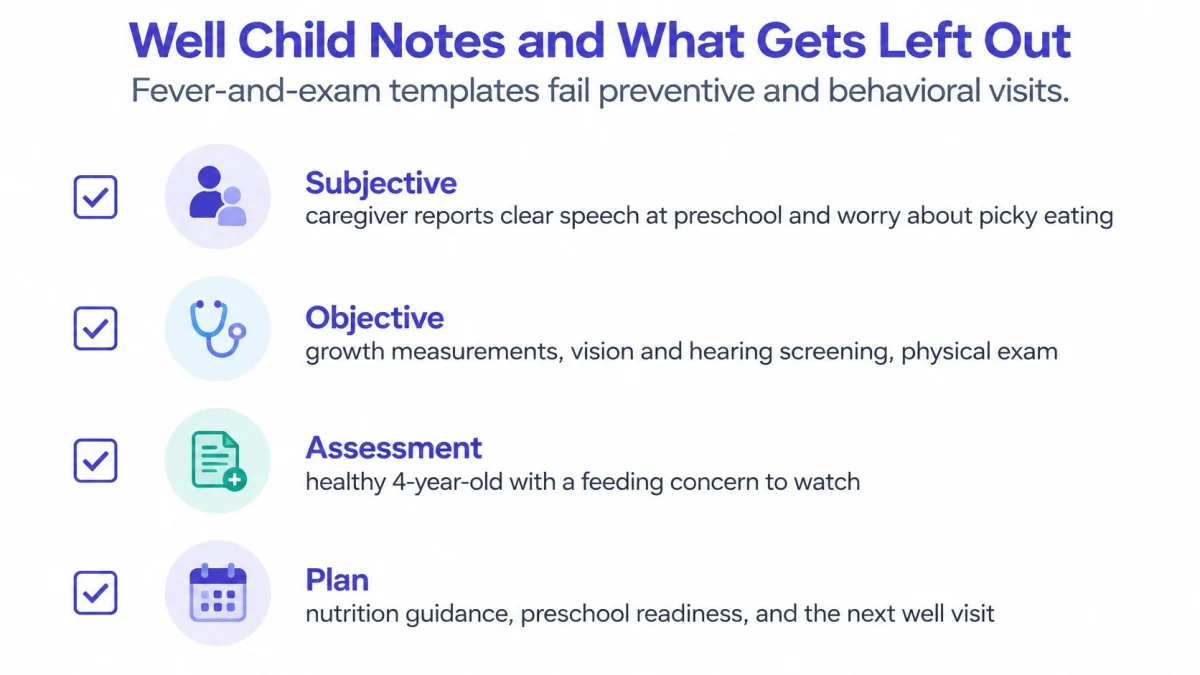
A fever-and-examination template doesn't adequately prompt preventive or behavioral documentation. A well-child encounter needs space for development, school functioning, screening, family concerns, and decisions that may not produce a prescription.
The infographic highlights the preventive domains that need a deliberate place.
A preventive-visit drafting example
The following hypothetical 4-year well-child note uses completion fields where results must come from the encounter. No screening result should be inferred from conversation alone.
Subjective
Caregiver report: Speech is clear at preschool. Caregiver is concerned about picky eating.
Patient report: School is fine.
School functioning, behavior, sleep, and relevant family or social concerns: record the actual discussion separately from standardized screening results.
Objective
Weight and height: enter measured values, percentiles, and the growth chart used.
Vision: LEA Symbols screening, enter actual result and testing conditions. Hearing: enter screening method and actual result.
Development: ASQ-3, enter the age-appropriate questionnaire used and actual domain scores. Record relevant physical-examination findings.
Assessment
Routine preventive encounter. Caregiver feeding concern requires assessment in the context of growth and dietary history. Any positive screening result is documented as a result requiring assessment, not automatically converted into a diagnosis.
Plan
Reconcile immunization status with available records. Record anticipatory guidance discussed, any social need affecting the plan, and the decision shared with the caregiver. Name the clinician or service responsible for screening follow-up and the planned review.
Check omissions rather than template length
NHS England's Healthy Child Programme information standard includes screening tests, immunizations, and developmental milestones as shareable child-health information. These items deserve identifiable fields rather than a single free-text paragraph.
A pediatric primary-care study reported ambient-scribe use in 6,249 of 19,264 eligible encounters, or 32%, with greater usefulness for urgent visits and history summaries than preventive and behavioral content. Its discussion also cites a synthesis in which omissions accounted for 86.3% of documentation errors. Those findings favor checking what is missing rather than assuming a fluent draft is complete.
A preventive-note sign-off check can stay short:
- Development: Tool, actual results, interpretation, and action recorded.
- Safety: Relevant counseling documented without prefilled claims.
- Behavior: Caregiver concerns distinguished from screening findings.
- Vaccines: Status and decisions reconciled.
- Follow-up owner: A person or service is responsible for the next action.
The accompanying video provides another format for reviewing the documentation workflow.
A checked field should mean that the topic was addressed. It shouldn't mean that the template supplied reassuring language.
Detail That Supports the Pediatric Code
The clinical record must support the selected code; the coder shouldn't have to invent missing clinical detail. The CMS pediatric ICD-10 clinical concepts document identifies specific information needed for common pediatric presentations.
Clinical detail CMS expects in pediatric notes
| Situation | Detail to record | Where it sits |
|---|---|---|
| Otitis media | Type and infectious agent when known | Assessment |
| Newborn feeding problem | The problem and the treatment recommended next | Assessment and Plan |
| Diarrhea | Diarrhea, fever, dehydration, dry mouth, vomiting; nausea with vomiting versus vomiting without nausea | Subjective and Assessment |
| Child not vaccinated when it affects the visit | Why the child is not vaccinated | Subjective or Plan |
Put specificity where the decision already lives
For otitis media, a documented type is more useful than an unspecified ear-infection label when the clinician has established the distinction. The infectious agent should be recorded when known. If it isn't known, an explicit unknown entry distinguishes uncertainty from a field that was overlooked; it must not become an invented organism.
For newborn feeding problems, the diagnosis label alone doesn't describe the encounter. The Assessment should identify the actual feeding problem, and the Plan should state the recommended response. A reader should be able to connect that recommendation to the problem described.
Diarrhea-related documentation needs the symptoms that were present or assessed. The distinction between nausea with vomiting and vomiting without nausea should remain visible when applicable. A template shouldn't populate every listed symptom because those symptoms appear in a coding reference.
When nonvaccination affects the visit, the reason belongs in the clinical account. An unexplained empty immunization field doesn't communicate the same information.
Keep coding assistance separate from clinical judgment
ICD-10, CPT, and CDT suggestions are a US billing aid and require clinician review; this isn't a coding manual. UK clinicians can use the same clinical specificity while following their own record and coding requirements.
An evaluation and management coding guide can support a separate review of documentation requirements. It shouldn't replace the encounter's clinical account or encourage the addition of findings that weren't established.
For the acute ear example, the useful editing task is concrete: confirm laterality, type, and whether an infectious agent is known. Any missing specifier should be added only when supported by the encounter.
Use a Scribe for the Next Note
PatientNotes is a documentation tool, not a diagnostic or clinical decision-making system. Built by a London-based company for individual clinicians and small practices, it drafts the record while the clinician remains responsible for confirming what was captured before signing.
Draft to the practice's format
PatientNotes records consultations in person, by phone, or through telehealth, separates speakers, and writes to the clinician's chosen template. Pediatrics is among its 37 specialties; the library also includes Primary Care, Family Medicine, Internal Medicine, Cardiology, and Psychiatry. An AI template builder supports a local variation rather than requiring a fixed format.
Notes and tasks are produced in the clinician's own language, with follow-up tasks and plain-language patient instructions. ICD-10, CPT, and CDT suggestions apply to US billing only and remain suggestions.
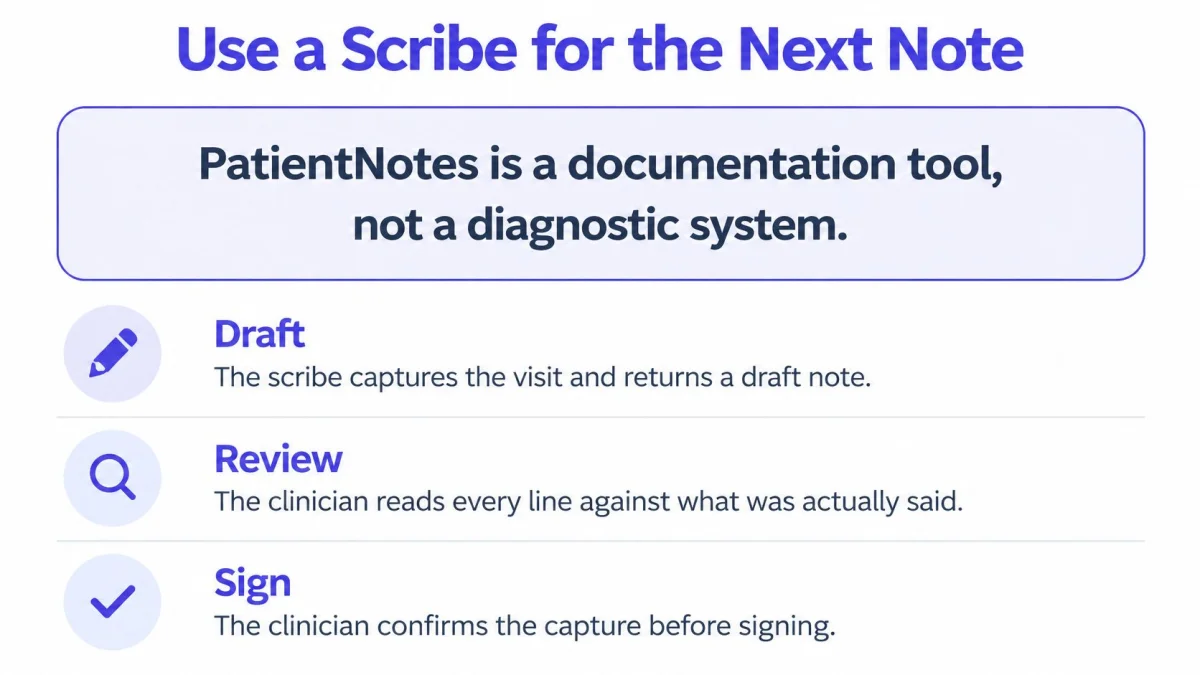
The workflow keeps the draft and the signed record distinct.
Know the practical limits before starting
- Price: $70 per user per month billed monthly, or $50 per user per month billed annually.
- Trial and guarantee: A 7-day free trial requires no credit card, and a 14-day money-back guarantee applies.
- Purchase: There's no enterprise tier and no sales call.
- Privacy: PatientNotes is HIPAA compliant, with a BAA included at no extra cost.
- Mobile capture: The native iOS app supports offline recording.
- EHR workflow: Semble is the only EHR integration. Every other EHR works by copy and paste.
The pricing page, specialty directory, comparison information, and resource library provide practical starting points for evaluating fit.
A small practice can begin with an authorized real encounter and its existing documentation workflow. Placing that visit under the SOAP headings establishes the desired output before deciding whether a scribe should draft the next note.
PatientNotes offers pediatric templates and editable drafts for clinicians who want a structured starting point for sick visits and preventive care. A clinician can organize one real visit under the SOAP headings, then visit PatientNotes to try drafting the next note while retaining responsibility for review and sign-off.