
The last patient of the day has gone and one chart is still open. The note needs the month's change, the sertraline decision, a risk line, and a follow-up date. The clinician types "doing better, continue meds, follow up in four weeks," signs, and goes home.
That note records attendance. It doesn't record a decision. Three weeks later, when the patient reports worse sleep and a covering clinician opens the chart, nothing in it explains what the last visit concluded or why.
A psychiatry progress note template fixes this only if it does more than supply headings. Each score, risk finding, and medication change has to state what the clinician did because of it. Build the note from the follow-up visit outward, because that's the visit most clinicians write most often and the one where decisions hide in plain prose.
Psychiatry Progress Note Template for Follow-Up Visits
A follow-up psychiatry note answers two questions. What changed since the last visit, and what happens next because of it. Documentation guidance treats the note as a longitudinal safety-and-treatment record rather than a billing form, and a reviewer expects the same core sections each time: interval symptoms and functioning, medication adherence and adverse effects, mental-status findings, assessment, risk, treatment response, and next steps.
Start with the template below and fill it in chart order. It is built for a 20-minute medication follow-up, and it holds up for a combined visit with small additions. The middle column carries the decision rule for the whole note: each entry states what the clinician did because of the finding, not only which heading was filled.
The template in chart order
| Block | Record this visit | Leave out or shorten |
|---|---|---|
| Visit header | Date, visit type (medication, therapy, telehealth, or combined), interval since the last visit, and a consent and participants line | Intake paperwork repeated in the note |
| Interval history | Symptoms, function at work, school, or home, sleep, appetite, substance use, and the patient's goal for today | Full history already in the intake |
| Medications | Name, dose, adherence, missed doses, adverse effects, and today's change with the reason for it | A drug list with no statement of response |
| Mental status | Appearance, behavior, speech, mood, affect, thought process and content, cognition, insight, and judgment today | Exam text copied from a visit it does not match |
| Measures | Instrument, date, score, prior score, direction of change, and what the change means for this patient | A bare score with no meaning |
| Risk | Its own block with level, safety action, and next contact | Only the phrase denies SI |
| Assessment | Active diagnoses and treatment response, each tied to evidence from this visit | A diagnosis label with no visit evidence |
| Plan | Continue, change, monitor, educate, or refer, plus the next interval and who owns each task | Tasks with no owner and no date |
Delete any row the visit did not need. If a domain was assessed and absent, say so, because an explicit "asked and not present" tells the next reader the question was covered. Baseline history stays in the intake. The follow-up note carries only what moved.
Two rows do the heaviest work. The measures line ties a number to an action: "PHQ-9 14, down from 19 six weeks ago, continue current dose" tells the covering clinician what the score caused. The plan line gives each task an owner and a date, so "monitor sleep" becomes "patient logs sleep, review at four-week visit." Headings organize the note. These entries explain it.
Structure earns its keep. In a published audit of 50 consecutive discharges reported in the Psychiatric Bulletin, clear diagnostic information reached both a medical and a nursing rater in 52% of cases before a structured assessment schedule was introduced, and in 98% of cases after. Same clinicians, same complex patients, far better transmission of the reasoning.
The plan line is also where community resources belong. When grief or anxiety sits alongside the primary diagnosis and the patient wants more support than weekly visits, name the referral rather than leaving it as a suggestion, for instance support for anxiety and grief in Kelowna for a patient in that area. A named resource with a date attached is a task. A mention in passing is not.
SOAP, DAP, and BIRP for the Same Visit
Format is a workflow decision, not a philosophy. Use SOAP for medication checks, DAP or BIRP for therapy hours, and SOAP plus a short therapy paragraph when both happen in one visit. Then keep the format stable, so a covering clinician can scan the note in the order it always appears.
The three formats cover the same visit in different orders, which is why the choice should follow the visit type rather than habit.
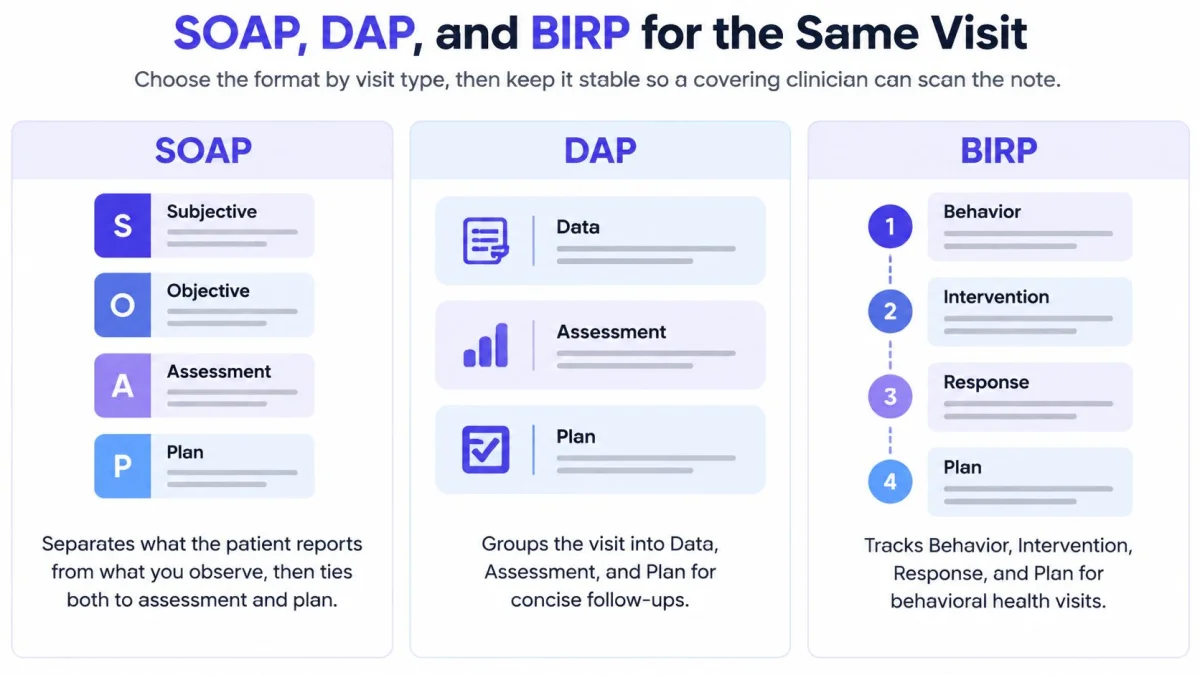
SOAP separates the patient's report (Subjective) from the clinician's observation (Objective), then ties Assessment and Plan to both. It suits medication management and combined visits because the exam stays clearly apart from what the patient says about it. DAP groups report and observation under Data, which many therapists prefer for a psychotherapy hour, with Assessment and Plan after. BIRP records Behavior, Intervention, Response, and Plan, so the note shows the work done in the session and how the patient took it.
| Format | Blocks | Best fit | Watch-out |
|---|---|---|---|
| SOAP | Subjective, Objective, Assessment, Plan | Medication management and combined visits | Watch that the exam stays separate from what the patient reports |
| DAP | Data, Assessment, Plan | Psychotherapy when report and observation belong together | Fewer headings, so risk still needs its own line |
| BIRP | Behavior, Intervention, Response, Plan | Therapy notes that must show what the clinician did | Medical monitoring is easy to omit unless added |
Whatever the format, the same facts have to be findable: diagnosis, risk, and the next date. A DAP note with no risk line fails even when the therapy paragraph is excellent. A BIRP note with no monitoring misses the medical half of a psychiatric visit.
Copy-forward is the shared failure mode. A pasted paragraph reads as current even when the patient has moved on, and the reader has no way to tell which sentences describe today.
Practical rule: if a sentence would be true of the last three visits, either it belongs in the intake or it needs a date and an observation attached.
Time is the argument for settling on one stable format. The American Medical Association's 2024 national physician comparison report, which collected nearly 18,000 responses from physicians in 43 states, found physicians worked an average of 57.8 hours per week. Of that, 13 hours went to indirect patient care such as documentation and 7.3 hours to administrative work. The same report found 43.2% of physicians reported at least one symptom of burnout in 2024. A template that already knows its own order removes the rebuild at the end of every visit.
Whichever format the practice adopts, the clinician reviews and signs the note before it enters the record. For a closer look at the two most common formats in therapy work, see this guide to DAP notes vs SOAP notes.
Suicide Risk as a Decision Record
Risk documentation explains the disposition. A note that says only "denies SI" and sends the patient home on the usual interval gives the next clinician no way to see whether the question was asked carefully or once, in passing.
The VA/DoD 2024 clinical practice guideline for suicide risk identifies the domains a complete assessment covers: suicidal or self-directed-violence thoughts and behaviors, psychiatric symptoms and diagnoses, prior treatment, social determinants and adverse life events, physical-health conditions, access to lethal means, and protective factors. The guideline frames documentation as the record of the data behind the assigned risk level, the required level of care, and the treatment plan.
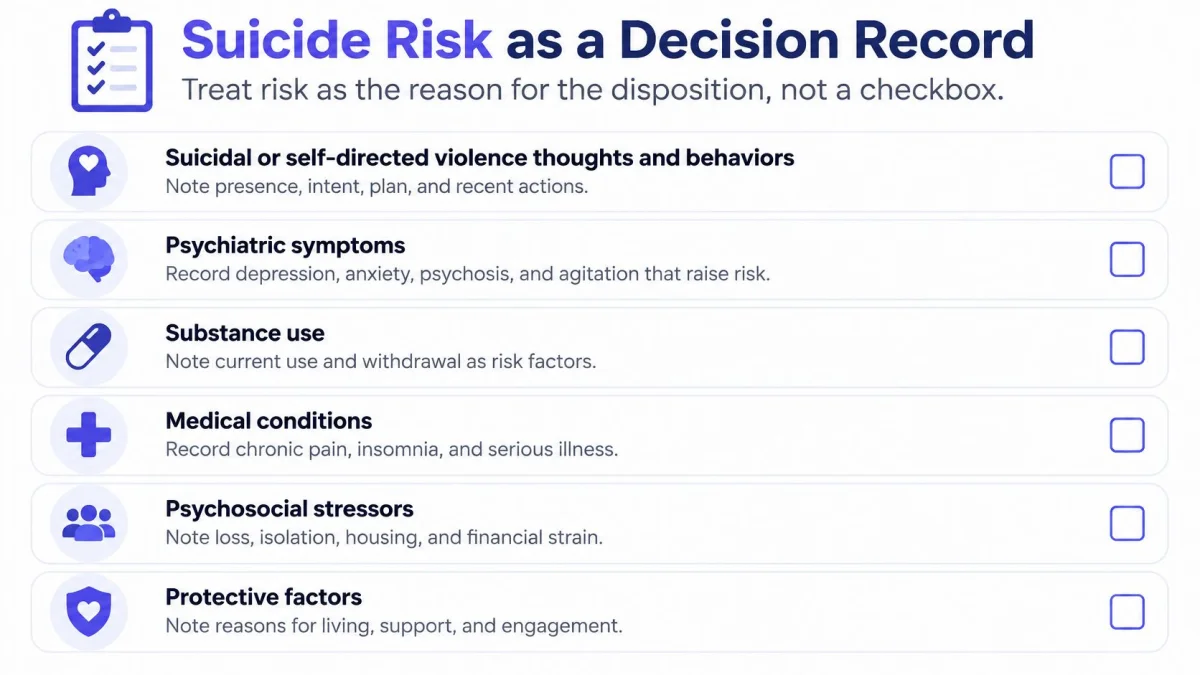
Separate the findings before assigning a level
- Current ideation. Present or absent, with frequency and intensity when present.
- Intent. Whether the patient wants to act, and how strongly.
- Plan. What it is and how specific.
- Recent behavior. Preparatory acts, rehearsal, or anything already done.
- Access to means. Firearms, stockpiled medication, other lethal means, and who controls them.
- Past attempts. Number, method, and what happened afterward.
- Acute stressors. The losses and events that moved risk this week.
- Protective factors. Reasons for living, support, engagement in care.
- Risk level and disposition. The clinician's stated level, the level of care, and the next contact.
A missing domain makes the level hard to defend at handoff. If access to means was never recorded, no reader can tell whether the risk level accounted for it.
The consistency test: the risk level, the level of care, and the next contact interval must point to the same findings. If any of the three disagrees with the others, the note isn't finished.
Record the intervention with its rationale, not just the assessment. Safety planning, means-restriction counseling, collateral contact, emergency referral, increased monitoring, or routine outpatient follow-up each belong in the note with the finding that triggered it. Homicidal ideation gets the same structure when it's relevant, and self-harm without suicidal intent deserves its own line rather than being folded into a suicide question.
Conditional blocks make this workable. Set the risk section to expand when ideation, self-harm, or a psychiatric emergency is present, so a routine visit stays short and a crisis visit gets the full structure. Keep acute risk and chronic risk as separate statements, because a patient can have chronically high risk and be acutely stable on the same day.
For adolescent patients, safety planning often reaches beyond the household. When the plan names adults outside it or a family asks where to read more, a resource such as California Teen Center teen suicide support can be handed over in writing and noted in the plan.
Turning Scale Scores Into a Plan
A PHQ-9 of 9 means little by itself. A PHQ-9 of 9 that fell from 14, in a patient who has taken every dose and returned to work three days a week, means partial response, continue treatment, review in four weeks. The number is identical in both cases. The decision record is not.
Behavioral health documentation guidance for progress notes, such as this progress notes procedure, lists standardized tools including the PHQ-9, GAD-7, and C-SSRS and requires the instrument, the score, and a clinical interpretation. Mania, suicide-risk, and substance-use measures follow the same pattern.
The minimum record is short: instrument, administration date, raw score, prior score with direction of change, and the decision that change produced. Add the severity band when the instrument has one, and keep patient-reported symptoms visibly separate from clinician observation so a reader can see which is which.
What to write when the score changes
| What changed | What the note should say | Decision word |
|---|---|---|
| Score and function both improved | Name both sources and the size of the change | Continue |
| Score flat and doses taken | State adherence and the symptoms that remain | Augment, switch, or add therapy |
| Score flat and doses missed | Separate missed doses from lack of effect | Address the barrier, then reassess |
| Score worse with a safety concern | Say the scale did not replace the risk review | Shorter interval or a higher level of care |
| Score and interview disagree | State which source you weighted and why | Document the conflict rather than averaging it |
The fifth row is where notes go soft. A patient who scores high but describes full days at work may be under-reporting, or the score may be catching distress the interview missed. Write which source you weighted and the reason. Averaging the two loses the information the reader needs.
A decision word the note can defend is continue, augment, switch, refer, or monitor, with the evidence sitting next to it. "Discussed medication" is not a decision. "Continue sertraline, adherence confirmed, sleep still broken, review in four weeks" is.
A score never replaces judgment, and a measurement block never replaces the risk record. The two sit side by side, each with its own findings. Name the next reassessment date in the same paragraph, so the next score has a place to land.
For scoring mechanics, the PHQ-9 depression scale calculator applies the instrument's own rules rather than a rough mental tally. Screening also continues outside the visit, and when a parent asks what a score means and how to raise it at home, hand over a plain-language resource such as Children Psych's advice for worried parents instead of explaining the same band twice in one week.
Two Follow-Up Notes Written Out
Two de-identified notes show the shape. Read each one for the single sentence that carries the decision, because that sentence is what makes the note usable months later.
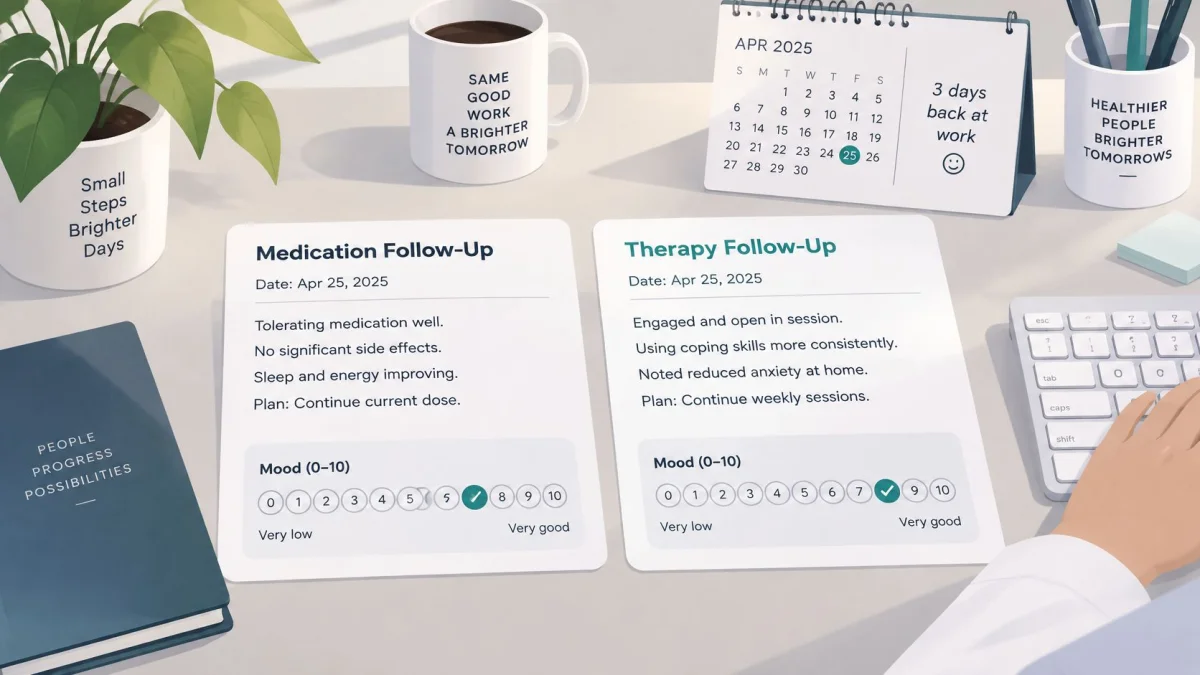
Medication follow-up, major depression. Seen five weeks ago, sertraline started. Interval: low mood most days but back at work three days this week; sleep still broken with two wakings a night; appetite improved. PHQ-9 9 today, 14 at last visit. Sertraline 50 mg daily, no missed doses, mild nausea in week one that has faded. Mental status: calm, coherent, normal speech rate, mood "better," affect brighter, no psychosis, insight fair. Risk: ideation, intent, plan, and means assessed and absent; one past attempt years ago; protective factors are work and a sibling; acute risk low, chronic risk low; safety plan on file and reviewed today. Assessment: major depressive disorder, partial response. Plan: continue sertraline 50 mg, no dose change, review sleep next visit, follow up in four weeks.
The decision sentence is continue sertraline 50 mg, no dose change, and it carries its own reason (partial response with adherence confirmed) plus the date. A reader can disagree with it, which is exactly the point.
Therapy follow-up, generalized anxiety. Weekly sessions. Interval: job lost 10 days ago, sleep worse, used the breathing skill before two meetings and stayed at work both days. GAD-7 12 today, 8 at last visit. No missed sessions. Mental status: anxious, coherent, mood "stretched," affect congruent, no psychosis, insight good. Risk: ideation, intent, plan, and means assessed and absent; no past attempts; protective factors are a partner, an active job search, and engagement; acute risk low. Assessment: generalized anxiety disorder, worse with an acute stressor, skill use intact. Plan: keep the same therapy target, add problem solving around the job search, no risk upgrade, next visit in two weeks rather than one.
Here the score worsened and the note says why: the stressor moved, the skill didn't fail. Function was weighted over the single score, the therapy target stays, and the interval shortens. Nothing about that reasoning is obvious from "GAD-7 12."
Both notes share four things. Change appears as a number with its prior value. Evidence appears as adherence, sleep, and days at work. The decision occupies one sentence with a reason attached. The date closes the plan, so the next visit has a purpose before it starts.
Consent, Participants, and What to Leave Out
A clinical template rarely carries a consent line. In psychiatry it should, because the record can hold trauma histories, sexual and substance-use information, psychotic beliefs, suicidal thoughts, and facts about people who were never in the room.
Guidance on AI-assisted psychiatric documentation recommends obtaining and documenting patient consent, checking the recording laws that apply, using privacy-compliant systems, and reviewing generated notes before they become part of the record. Data minimization and clear explanations of how information is stored and used sit alongside those steps.
The safe-use line, in order
- Consent. Whether recording was requested, the wording the patient heard, and whether they agreed.
- Refusal. If they declined, write that the visit was not recorded and the note came from the clinician's own record.
- Participants. Patient, family member, guardian, or interpreter present in the room.
- Collateral. Who supplied information from outside the visit, with third-party private detail left out of the chart.
- Minimization. Omit graphic detail that changes neither risk nor treatment, and don't paste a raw transcript where a structured note will do.
- Verification. The clinician reviewed and edited any generated text before signing.
For US practices, HIPAA adds a vendor layer. The HHS guidance on business associate agreement provisions says a covered entity generally must obtain satisfactory written assurances that protected health information will be appropriately safeguarded. The agreement must describe permitted and required uses and disclosures, prohibit uses outside it or applicable law, and require appropriate safeguards and breach reporting. A signed agreement is the start of that review, not the end of it.
Recording and privacy rules differ by state and between the US and UK. UK practices work to their own confidentiality and data-protection guidance, so check the GMC's confidentiality guidance and the ICO's material on recording and lawful processing before a recorder is switched on. This is practical guidance for building the line into a template, not legal advice.
Review the Note Before It Enters the Chart
Signing is the last clinical act of the visit, and it takes about a minute when the note is built as a decision record. A fast review works because the note already says what changed, what was decided, and when the patient returns. Run it the same way every time:
- Find the interval sentence and confirm it names a real change since the last visit, not history pasted forward.
- Read the mental status exam for leftover phrases, like a finding from a prior note that this visit never produced.
- Match the risk level to the safety action and the next contact; all three must tell one story.
- Check that each score has a prior value and a decision word, so the number explains what you did.
- Read the plan for a medication or therapy action, a monitoring step, and a return date.
- Edit any generated text before signing; once signed, the draft is your note.
That last check is required. The American Psychological Association's guidance on evaluating AI scribes emphasizes that generated documentation must be reviewed for clinical accuracy before signature, because a fluent draft can carry a wrong dose or a risk line the visit never supported.
PatientNotes handles the drafting step for psychiatry follow-ups: it records the encounter and writes the note to the clinician's own template and language, leaving the review, edit, and export to the record with the clinician. The documentation audit checklist applies the same review at practice level before a template change is adopted.
A note that shows what changed, what was decided, and when the patient returns takes a fraction of the writing time of one rebuilt from memory at 8 p.m. PatientNotes drafts the psychiatry follow-up note in your own template and language, from interval history through risk and plan, and leaves the clinical judgment with you. The 7-day free trial needs no credit card, so the next follow-up is a fair test. Visit PatientNotes to start.