The patient has agreed to think about a crown, but the next patient is already waiting. The chart still needs to show why the crown was offered, what else was discussed, and whether the patient understood the choice. A procedure name and an estimated fee won't capture that conversation.
A useful dental treatment plan template gives each part of that decision a place in the record. It separates clinical recommendations from financial estimates and makes room for the patient's explanation, questions, and decision, including a decision to wait.
Dental Treatment Plan Template Fields
The American Dental Association defines a treatment plan as a sequential guide for care determined by the dentist's diagnosis to restore or maintain oral health in its current policies. That makes the plan more than a booking list. It should explain the connection between a finding, a recommendation, and a patient decision.
The ADA's patient-record documentation guidance supports recording diagnosis, relevant examination findings, proposed treatment, benefits, risks, alternatives, and discussions about no treatment. The following fields translate those documentation principles into a copyable chart structure.
Copyable clinical fields
| Field | What to record | Example |
|---|---|---|
| Identifiers and history review | Name, date of birth, and date history, medications, and allergies were checked | Adult patient; identifiers confirmed; history reviewed today; penicillin allergy |
| Tooth or site | Numbering system plus tooth, sextant, or arch | Universal tooth 30; FDI 46 if that is the chart standard |
| Findings and tests | Clinical findings and dated radiographs or other tests | Distal caries into dentin; bitewing dated today |
| Diagnosis | Diagnosis by tooth or condition, not only the procedure name | Caries, tooth 30, distal |
| Proposed procedure | Plain-language procedure and material if relevant | Crown after caries removal, or a large filling if the tooth can be restored |
| Phase and sequence | Phase, visit order, and any prerequisite | Phase 2 after caries control; no crown until the tooth is stable |
| Benefits, risks, prognosis | Expected benefit, material risks, and limits of the forecast | Protects the tooth; risks include sensitivity, fracture, and possible root canal treatment; prognosis subject to remaining tooth structure |
| Alternatives | Reasonable options, including no treatment and its likely course | Filling, crown, extraction, or no treatment with risk of fracture or pain |
| Estimate | Total charge, estimated patient share, assumptions, and exclusions | Estimate only; lab fee included; root canal treatment would be a separate visit and fee |
| Decision and consent | Option chosen, consent, refusal, or deferral, plus questions | Patient defers crown; timing questions recorded; no treatment started |
| Patient questions | Questions asked and the clinician's response | Patient asks whether treatment can wait until after travel |
| Clinician authentication | Clinician name, entry date, and signature or electronic authentication | Treating dentist identified; entry dated and authenticated |
These examples illustrate documentation, not treatment recommendations. The clinician supplies the actual findings, individualized risks, and reasonable options.
Using the fields at the chair
Each proposed item should remain editable and tied to the finding that supports it. A radiograph reference should identify the relevant image and date, rather than leave another clinician searching through an attachment list.
For periodontal findings, the practice can pair the plan with a consistent periodontal charting structure. Detailed measurements belong in the examination record, while the plan identifies which findings support the proposed intervention.
A patient who remains uncertain may benefit from an independent discussion. Inspire Dental Group's Vancouver guide to dental second opinions offers a patient-facing resource for that situation.
Practical rule: A recommendation should remain understandable even when the patient hasn't accepted it.
The phase, clinical example, understanding check, and financial discussion each need their own space. Combining them into a single procedure-and-fee line makes important distinctions harder to see.
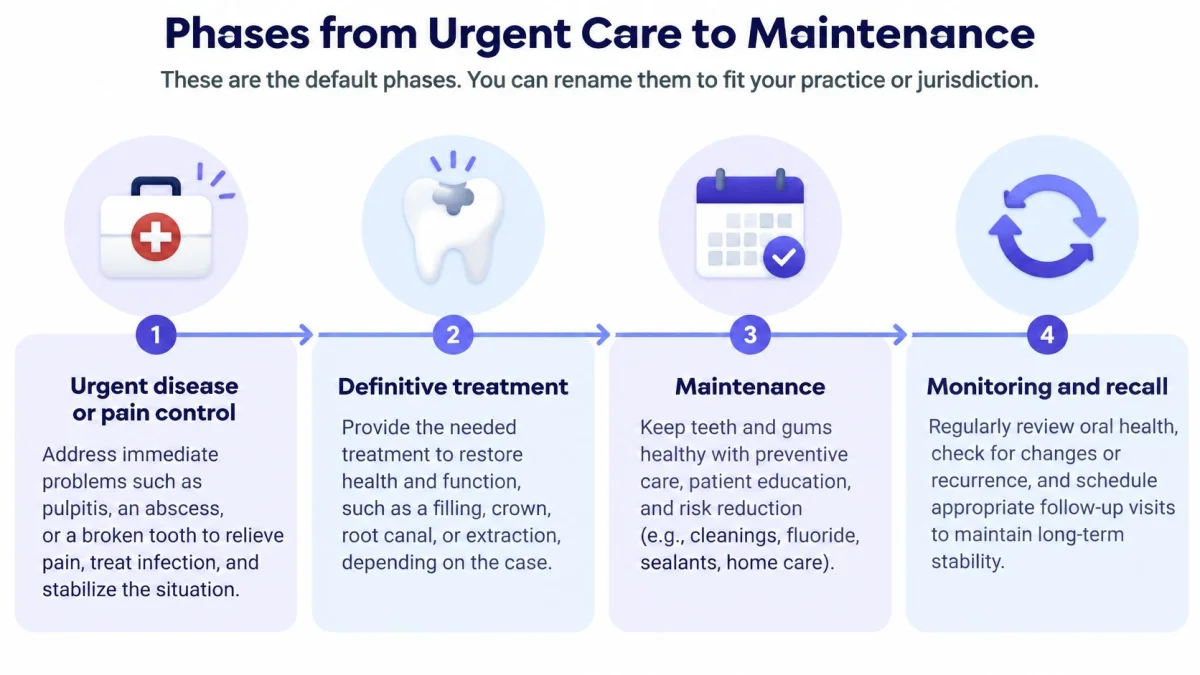
Phases from Urgent Care to Maintenance
A procedure list doesn't explain what must happen first. A phased plan names the immediate problem, the intended result, and the conditions that must be met before further work begins.
The DC Health Standards for Oral Health Services call for measurable objectives, action steps, required services, responsible individuals, and start and target dates, developed collaboratively with the patient and documented in the record. Those elements provide a practical framework for sequencing care.
Configurable phases
The clinician can rename phases for the practice or jurisdiction. These categories are documentation defaults, not a requirement to place every patient into the same sequence.
| Phase | Goal | Typical work | Move on when |
|---|---|---|---|
| 1. Urgent disease or pain control | Stop pain, infection, or trauma | Extraction, pulp treatment, drainage, temporary restoration | Pain and acute infection are controlled |
| 2. Definitive restorative or surgical care | Treat the diagnosed disease | Restorations, endodontic treatment, periodontal surgery | The diagnosis is complete and active disease is treated |
| 3. Replacement or rehabilitation | Restore function and appearance | Crowns, bridges, dentures, implants | Prerequisites and healing intervals are done |
| 4. Preventive or periodontal maintenance | Keep the result | Recall, periodontal maintenance, fluoride, home-care review | A dated recall or reassessment is set |
The timeline provides a visual overview of movement from urgent care toward ongoing monitoring. Its labels can be adapted to the practice's more detailed phase names.
Put dependencies beside the work
Consider a hypothetical multi-tooth plan: address pain associated with Universal tooth 3 this week, complete planned periodontal therapy, then reassess teeth 18 and 19 before deciding on crowns. The note should identify the responsible provider for each action and the finding that will determine the next step.
A useful entry contains:
- Problem and objective: The current concern and an observable result, such as reassessment of reported pain.
- Action and owner: The planned intervention and named clinician or referral recipient.
- Dependency and timing: Diagnostic completion, periodontal stabilization, or a clinician-selected healing interval.
- Review trigger: A new symptom, reassessment result, missed prerequisite, or change in health history.
Healing intervals belong beside the procedure that creates the dependency. A generic instruction to return later doesn't tell the team whether the next appointment is for assessment, treatment, or a decision.
Maintenance also needs an explanation the patient can use. The Dental Retreat's gum care guidance for Katy patients is a patient-facing resource when discussing periodontal maintenance versus routine cleaning.
A billing code doesn't determine the clinical order. The dentist remains responsible for selecting the sequence and verifying the associated documentation and coding.
One Molar Plan Filled In
The following adult case is an illustration of chart structure, not a directive to crown every deep lesion. The proposed treatment remains conditional on a complete clinical assessment and the amount of restorable tooth structure.
The patient reports cold sensitivity associated with Universal tooth 30 that stops when the stimulus stops. A bitewing obtained on the visit date shows distal caries extending into dentin. The same-day history review records no anticoagulant use and a documented penicillin allergy.
From finding to conditional recommendation
The finding and diagnosis entries remain separate. The finding describes what was reported or observed; the diagnosis records the clinician's assessment and any uncertainty.
| Chart element | Illustrative entry |
|---|---|
| Site and numbering | Universal tooth 30, distal |
| Supporting evidence | Clinical examination and bitewing dated the day of the visit |
| Symptoms | Cold sensitivity stops when the stimulus stops |
| History review | Reviewed today; no anticoagulant; penicillin allergy documented |
| Working diagnosis | Distal caries, tooth 30; pulp considered likely vital, subject to clinical assessment |
| Proposed care | Caries removal; crown if remaining tooth structure requires full coverage |
| Sequence | After management of other active caries and confirmation of readiness for definitive restoration |
The proposed-care wording avoids turning an uncertain restorative requirement into a settled outcome. It also leaves space for the clinician to document additional tests and the reasoning behind the final choice.
The alternatives entry records a direct restoration if enough suitable tooth structure remains, extraction where clinically reasonable, or no treatment. In this example, the clinician explains that untreated disease could progress to a larger cavity, pain, or fracture, with the patient-specific discussion entered in the note.
Record the conversation, not just the proposal
The benefits entry describes the intended preservation of the tooth and restoration of function. The individualized discussion includes possible sensitivity, fracture, and a future need for root canal treatment. Prognosis remains conditional rather than expressed as a guarantee.
The separate estimate identifies the described restorative work and includes the lab fee. Root canal treatment is excluded from that estimate, so the patient won't confuse an unplanned additional procedure with an included service.
The patient asks whether the crown can be done after a work trip. The clinician documents the question, the response about timing and uncertainty, and the patient's decision to defer.
- Decision: Crown proposal deferred because of work travel.
- Treatment delivered: No restorative procedure started at this visit.
- Follow-up: Review at the next visit, with earlier contact instructions individualized by the clinician.
- Review trigger: Reassess symptoms, findings, restorability, and the selected option before proceeding.
A conditional recommendation shouldn't become an unconditional procedure merely because the template contains a crown field.
The entry closes with the treating clinician's name, the actual visit date, and authentication. In the live chart, actual dates replace relative wording such as today or next visit.
Status Labels for Proposed and Completed Care
A plan becomes difficult to interpret when a recommendation, a booking, and delivered treatment look identical. Status labels make those differences visible without requiring another clinician to reconstruct the entire conversation.
The labels below are a practical charting convention. Their purpose is to preserve the patient's decision and the sequence of changes, not to replace the underlying narrative.
A shared status vocabulary
| Status | Meaning | What to keep visible |
|---|---|---|
| Proposed | Recommended and not yet decided | The recommendation and its date |
| Accepted | Patient chose it and consent is current | The selected option and consent note |
| Scheduled | A visit is booked | The planned visit timing |
| Completed | The work was done | The completion date |
| Declined | Patient refused that option | The refusal, not a blank line |
| Deferred | Delayed, with a reason and review date | The original proposal plus the reason |
| Superseded | A newer plan replaced it | The old wording |
| Needs review | New finding, health change, or consent no longer current | The trigger for review |
These labels answer different questions. Accepted records a decision, while scheduled records an administrative event. A booked appointment shouldn't be treated as evidence that all clinical and consent checks are complete.
Completed belongs to work delivered. If the procedure changes during care, the completed entry should describe what occurred rather than automatically reproduce the original proposal.
Preserve the change rather than overwrite it
For the molar example, the crown first appears as proposed. After the travel discussion, a dated update changes its status to deferred and records the reason and review date.
The original proposal stays visible. Deleting it would remove the history of what was offered and why the later discussion occurred.
- Original entry: Conditional crown recommendation linked to the documented tooth findings.
- Updated entry: Deferred following the patient's question about treatment after travel.
- Next action: Named team member to arrange or confirm the review.
- Completion field: Left unmarked because no procedure was performed.
Before a later procedure, the clinician confirms that health history, medications, allergies, diagnosis, the selected option, and consent remain current. A changed medication list or new finding may move an accepted item to needs review rather than directly to completed.
A paper chart can use separate proposed and completed areas. Software can use clearly labeled sections or views. Color alone isn't enough, because printed records and copied text may lose that distinction.
The team should also avoid treating deferred as forgotten. A reason without a review date leaves the next clinician uncertain whether the patient intended a short delay, an indefinite pause, or another discussion.
How to Check the Patient Understood
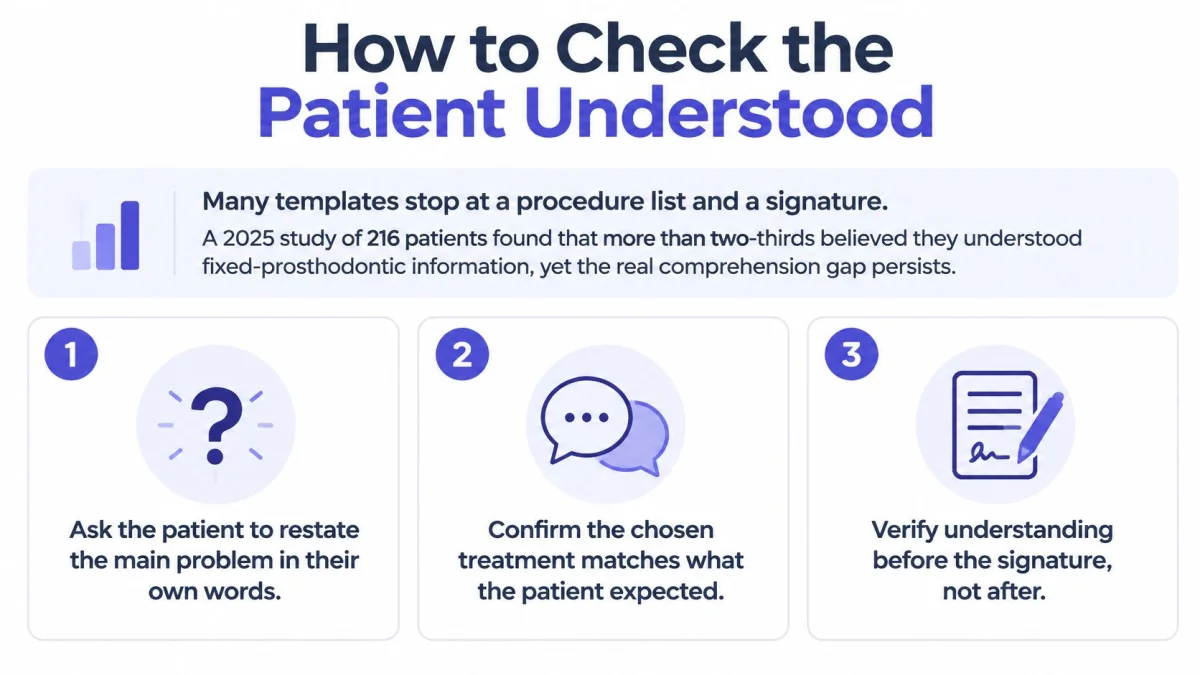
Only 13.4% of patients demonstrated adequate objective understanding in a 2025 fixed-prosthodontic study of 216 patients, although more than two-thirds believed they understood the information. Procedures and alternatives were the hardest elements; in the same study, 48.4% reported not being informed about possible risks and 22.2% about alternatives.
Those findings concern a specific treatment setting, not every dental consultation. They nevertheless illustrate why a procedure list and signature shouldn't be treated as evidence that the patient can explain the decision.
The visual checklist places the understanding check before the signature.
Add fields that reveal understanding
A useful template gives the clinician somewhere to record more than information delivered. It captures what mattered to the patient and what the patient understood after the explanation.
- Plain-language diagnosis: The problem described without relying on dental shorthand.
- Patient goal: Chewing comfortably, preserving appearance, keeping a tooth, or avoiding a lengthy visit.
- Options and consequences: The proposed approach, reasonable alternatives, and the likely course without treatment.
- Teach-back response: The patient's explanation of the problem and choices.
- Remaining uncertainty: A question, misunderstanding, or issue needing further discussion.
For the molar scenario, the clinician might record that the patient understood a crown was conditional on the remaining tooth structure, not already inevitable. If the patient instead believes a crown guarantees that root canal treatment can never be needed, that misunderstanding needs correction before the decision is finalized.
A short prompt can cover the essential distinctions. The clinician asks the patient to describe what treatment is proposed, what else could be done, and what might happen if nothing is done.
Document the answer and the clarification
The entry should paraphrase the patient's actual response accurately. A checked box labeled understood doesn't show whether the patient confused a crown with a filling or missed an important alternative.
An example entry might read:
Understanding check: Patient describes the choice between a filling and possible full coverage, recognizes that the final recommendation depends on remaining tooth structure, and asks whether travel changes the timing decision.
That wording is appropriate only if the conversation supports it. The clinician shouldn't fill the field with a standard response that the patient never gave.
Limited consultation time and variable health literacy favor short explanations, familiar words, and a written copy. Recent periodontal work also describes improved understanding and reduced uncertainty with structured conversations and visual decision aids, but that doesn't establish a universal method for every procedure.
A patient who needs another explanation hasn't failed a test. The clinician can narrow the discussion to the misunderstood point, explain it differently, and document the clarification.
Documented consent still matters. It records a decision and the associated discussion, not a test score or a guarantee of perfect recall.
Cost Fields That Are Estimates Not Promises
A clinical recommendation and a payment estimate answer different questions. The diagnosis explains the problem; the estimate explains the anticipated financial commitment under stated assumptions.
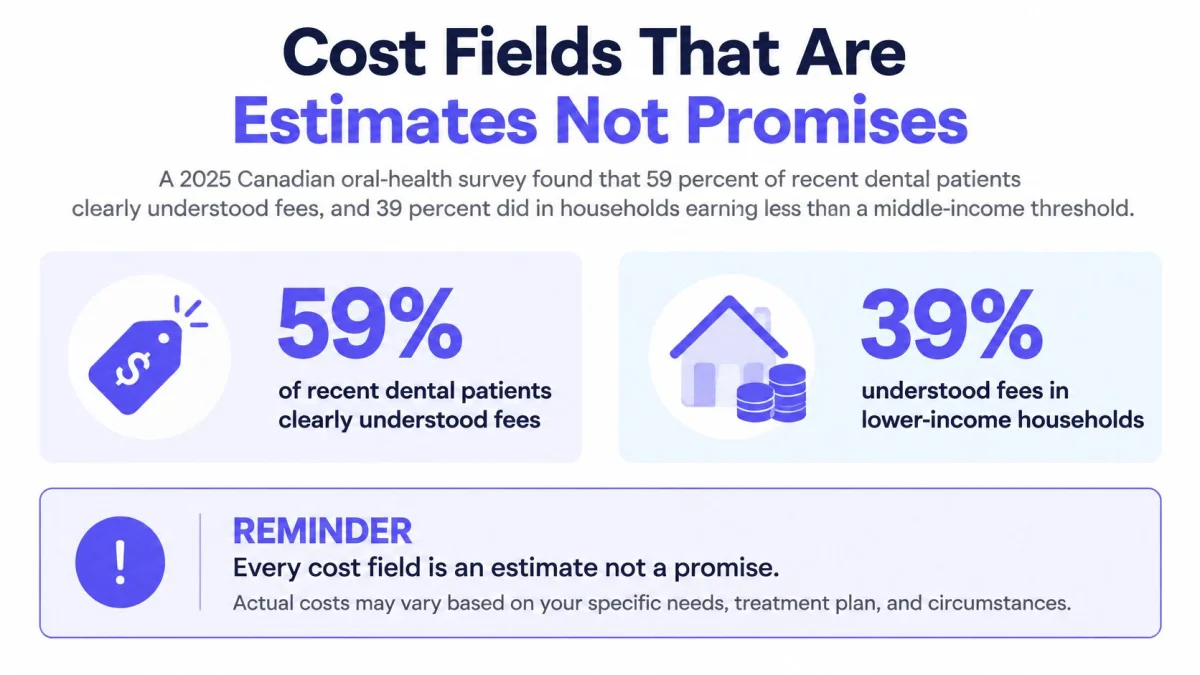
In a 2025 Canadian oral-health survey, 59% of recent dental patients clearly understood treatment or procedure fees, falling to 39% among households earning under $40,000. US evidence summarized alongside the cost-conversation findings linked higher-quality cost discussions with satisfaction, with an adjusted odds ratio of 4.371, with a 95% confidence interval of 2.598 to 7.355.
The fee-transparency visual highlights why a separate financial explanation deserves space in the workflow.
Keep financial assumptions visible
Total charges and estimated patient responsibility belong on different lines. Otherwise, a patient may mistake the practice's fee for the expected personal payment, or mistake an anticipated insurance contribution for confirmed coverage.
| Line | What it answers | What it must not say |
|---|---|---|
| Total estimated charges | What the practice expects to charge for the described care | That this is the final amount |
| Estimated patient responsibility | The expected share after stated assumptions | A guaranteed out-of-pocket balance |
| Assumptions | Network status, plan limits, lab fees, and visit count | That benefits have been verified if they haven't |
| Exclusions | Care not in this estimate, such as root canal treatment or sedation | That excluded care will never be needed |
| Contingency | A likely change if a new finding appears | A hidden fee with no clinical reason |
| Phased or lower-cost alternative | A clinically appropriate way to stage or reduce cost | A lesser option presented as equal when it isn't |
| Affordability preference | What the patient asked to delay or stage | A reason to drop the diagnosis |
For a hypothetical crown estimate, the assumptions might include the lab fee and the described visits. Exclusions might identify root canal treatment, sedation, or a separately applicable missed-visit charge. A contingency might explain that a crack discovered after removal of an old restoration could require a new clinical discussion and revised estimate.
The accompanying video offers another format for considering the treatment-plan conversation.
Record affordability without changing the diagnosis
In a US workflow, the financial entry can distinguish verified information from unresolved insurance assumptions. In a UK workflow, it can identify an item as NHS or private where applicable, without implying that US coverage terminology applies.
A clinically appropriate phased or lower-cost option should include its limitations. It shouldn't be presented as equivalent merely because it costs less.
For patients seeking a plain-language starting point for payment questions, Prosth & Co.’s payment guidance for Manhattan dental patients provides a supplementary resource. Practice-specific terms still belong in the actual financial discussion.
The note can record a preference to spread treatment across phases while preserving the diagnosis and recommendation. The figure is an estimate, not a guaranteed patient balance, and the fee shouldn't determine the diagnosis.
Links Between Findings Consent and Codes
A crown proposed for tooth 30 can look clear inside the software and still read as ambiguous on a printed plan. A reviewer should be able to follow the reasoning without guessing which image, conversation, or decision belongs to a procedure. Clear labels keep that chain intact when the plan moves between systems.
The durable cross-references are clinical: tooth number, finding date, decision date, status, and clinician.
A traceable record chain
Each relationship should remain explicit:
- Procedure to diagnosis: The planned intervention names the condition it addresses.
- Diagnosis to evidence: The assessment names the examination findings and the radiograph or test dates behind them.
- Phase to prerequisite: The planned work names what must be completed or reassessed first.
- Selected option to alternatives: The decision entry names the choices discussed and the reason the patient accepted one.
- Decision to conversation: Consent, refusal, or deferral names the date, clinician, communication method, and how understanding was checked, such as the patient explaining the chosen option in their own words.
- Conversation to attachment: Any signed form stays associated with the relevant entry.
A telephone discussion belongs in that chain just as an office conversation does. The entry should make clear who spoke with the patient and whether the conversation changed the selected option or only clarified an existing plan.
An informed-consent documentation structure can help organize those relationships. A form should remain linked to the specific decision instead of sitting in the record as an unexplained attachment.
Keep the billing label separate
The ADA maintains the Code on Dental Procedures and Nomenclature, commonly called CDT, for reporting dental procedures. CDT guidance treats the code as a separate label beside the procedure, tooth or site, rationale, estimate, and decision.
The code labels a service for a claim. The diagnosis explains the clinical need. The treating dentist and billing staff should review any suggested code against the documented service and applicable payer rules so a code suggestion does not reshape the treatment description.
PatientNotes can suggest CDT codes after the note for review. Those suggestions apply to US billing only; UK NHS or private claims sit outside that scope.
Preserve meaning through copy and paste
Mixed documentation workflows are common. In a historical Dental Practice-Based Research Network survey of 991 practitioner-investigators, 74% of US solo practitioners and 78.7% of US group practitioners used computers to manage clinical information, while only 14.3% and 15.9%, respectively, described their practices as paperless; treatment plans were stored electronically by 73% of respondents.
Those figures describe the surveyed practices at that time, not current adoption. Their practical relevance is the difference between using a computer somewhere in the workflow and keeping every step electronic.
For a copied plan, labels such as finding date, decision date, status, and clinician should travel with the text. A printout should still distinguish a proposed crown from a completed restoration.
A useful final check is to read the copied entry without opening the originating system. If its clinical rationale or decision history becomes unclear, the exported wording needs revision.
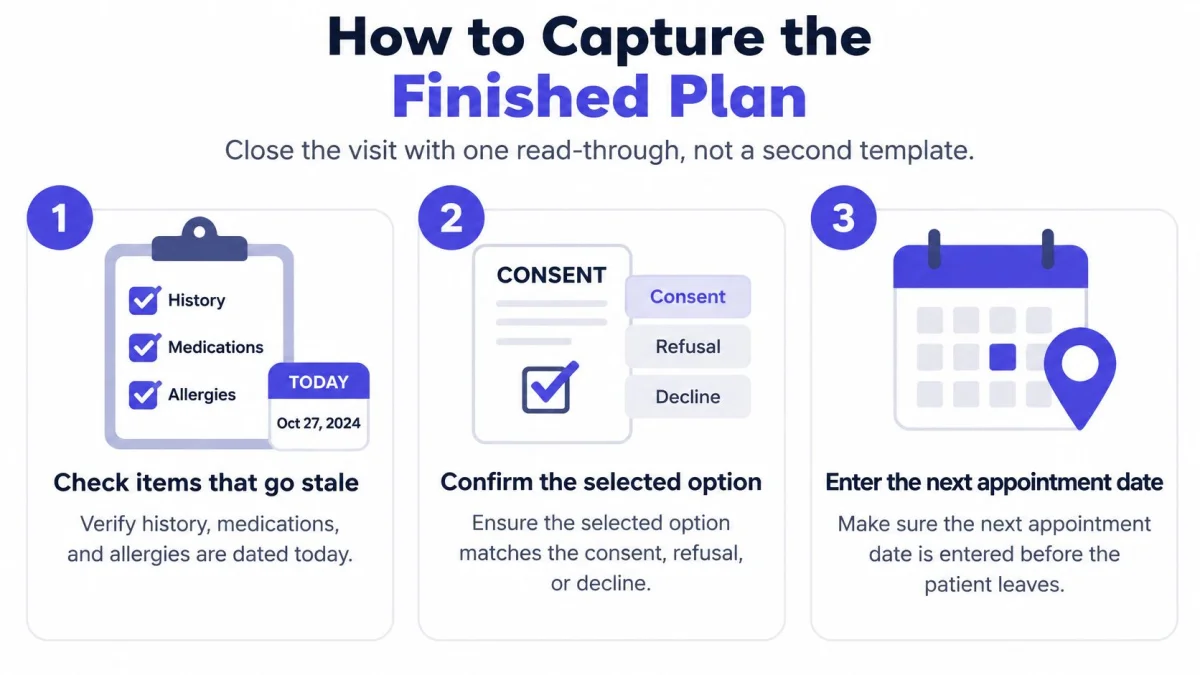
How to Capture the Finished Plan
The finished molar note should require a review, not a second round of chart creation. The clinician checks whether the documented recommendation, patient response, and next action agree.
The same headings can remain useful on paper or in software. Consistency matters more than decorative formatting, especially when another team member must locate the decision quickly.
Close with a focused read-through
The final check concentrates on information that can become stale or drift during editing:
- Current history: History, medications, and allergies carry the actual review date.
- Matching decision: The selected option agrees with the consent, refusal, or deferral entry.
- Financial wording: Charges and patient responsibility remain labeled as estimates.
- Next action: A review date, appointment, or assigned follow-up is recorded.
- Authentication: The clinician reviews and authenticates the final version.
The closing checklist offers a compact reminder before the record is stored.
A practice using a SOAP structure can retain the plan within its existing note format. The dental SOAP notes guide provides a complementary documentation layout without requiring a duplicate clinical record.
Capture support and practical limits
PatientNotes, built by a London-based company, turns consultations into structured dentistry or periodontics notes, with suggested follow-ups and plain-language patient instructions. It includes templates for 37 specialties, an AI template builder, and a native iOS app with offline recording; notes and tasks can use the clinician's own language.
PatientNotes is HIPAA compliant, with a BAA included at no extra cost on every plan and the free trial. For US practices, HHS business associate guidance explains the written-agreement requirements when a service handles protected health information on the practice's behalf; an agreement doesn't replace the practice's own privacy and security procedures.
ICD-10, CPT, and CDT suggestions apply to US billing only. Semble is the only EHR integration; every other EHR uses copy and paste.
Pricing is $70 per user per month billed monthly or $50 per user per month billed annually. There's a 7-day free trial with no credit card, a 14-day money-back guarantee, no enterprise tier, and no sales call.
Further details are available through the pricing page, specialty directory, workflow comparison information, and documentation resources. The clinician still reviews the captured plan, confirms its accuracy, and authenticates the record.
PatientNotes offers structured dental notes, suggested follow-ups, and patient instructions that support a treatment plan with separate clinical, understanding, and estimate fields. Clinicians can visit PatientNotes to try the workflow with a representative consultation and review how the finished note fits their practice's charting process.