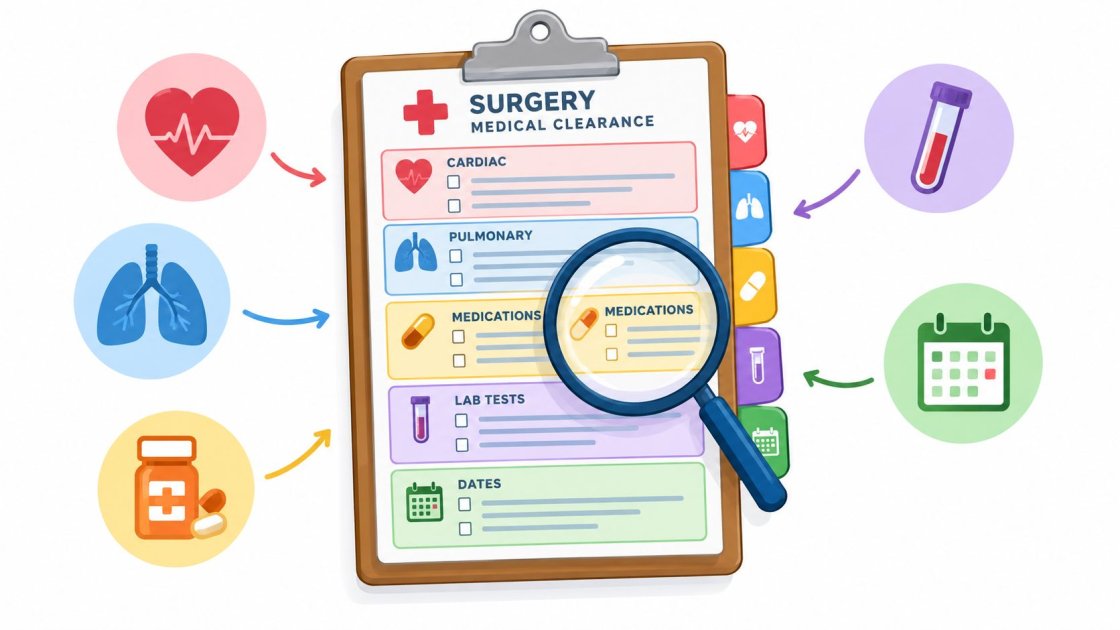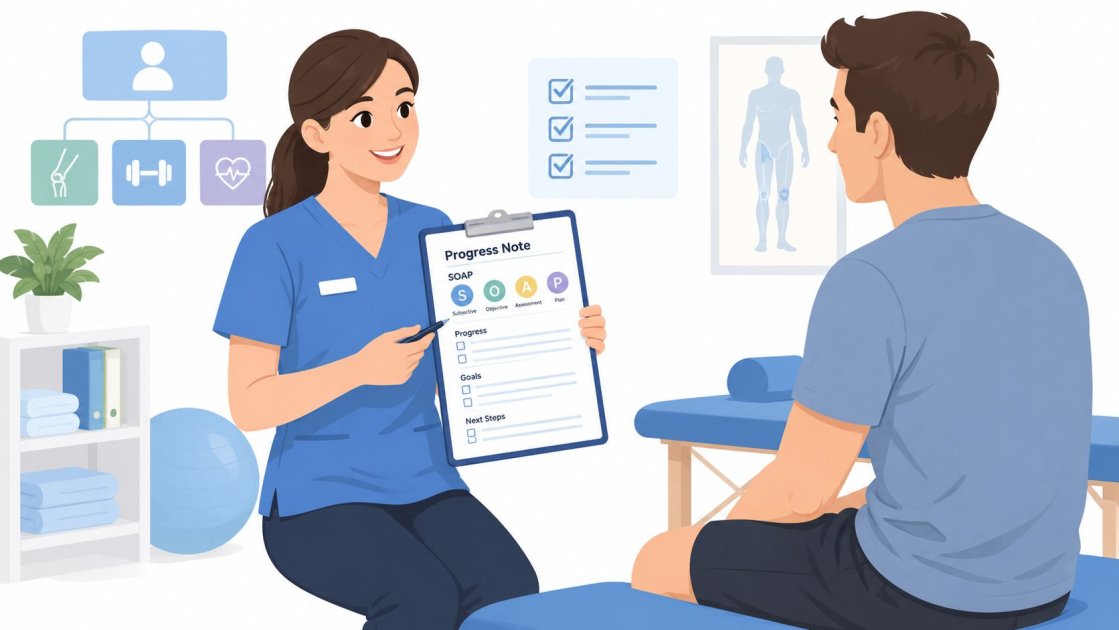
A clinician finishes the last treatment of the day, opens the chart, and sees yesterday's note waiting beside a new blank page. The patient reported less pain, moved more freely, and tolerated a progressed exercise, but those facts are difficult to reconstruct after a full clinic schedule. The note gets written quickly, often with familiar phrases such as “doing well” or “tolerated treatment.”
That workflow creates risk. A physical therapy progress note must show what changed, why skilled care was necessary, how the patient responded, and what happens next. A well-built physical therapy progress note template reduces typing, but its more important job is to prevent missing evidence.
The Real Purpose of a PT Progress Note
A treatment log records activity. A defensible clinical record explains the clinical reason for that activity. Those are not the same thing.
The American Physical Therapy Association states that documentation is required for every visit or encounter. Each note should be dated, authenticated, and connected to the plan of care. Daily or progress notes should record changes in status, interventions delivered, and the plan for the next visit. APTA documentation guidance treats the note as part of the patient's longitudinal record, not as a billing receipt added after treatment.
A payer reviewing a claim can't observe the session. The record must show that the clinician assessed the patient, selected appropriate interventions, applied skilled judgment, and evaluated the response. A note that lists exercises without explaining the patient's functional limitation or the therapist's reasoning leaves the most important question unanswered: why did this patient need skilled physical therapy today?
Templates should prompt decisions
A blank text box depends on memory and discipline. A structured template asks for the evidence at the point of care:
- Status change: What is different from the prior visit or established baseline?
- Objective finding: Which reproducible measurement supports that change?
- Functional effect: How does the finding affect walking, transfers, stairs, work, self-care, or another stated goal?
- Skilled intervention: What did the therapist do that required professional judgment?
- Plan update: What will continue, change, or stop because of the assessment?
This structure also helps the next clinician understand the episode without reconstructing it from scattered treatment entries. World Physiotherapy standards reinforce the need for accurate, complete, timely, dated, and authenticated documentation covering examination, diagnosis, prognosis, intervention, response, changes in status, re-examination, and discharge or discontinuation.
Practical rule: A progress note should allow another qualified clinician to understand the patient's current status and the reason for the next clinical decision without asking the original therapist to explain it verbally.
Speed still matters. A template that takes so long to complete that clinicians postpone notes until the end of the day won't protect care consistently. The useful design is short for routine fields and demanding where clinical reasoning matters.
Required Elements in a Defensible SOAP Structure
SOAP remains a practical structure because it separates the patient's report, measured findings, professional interpretation, and next steps. The format itself isn't the safeguard. The quality and specificity of each section are.
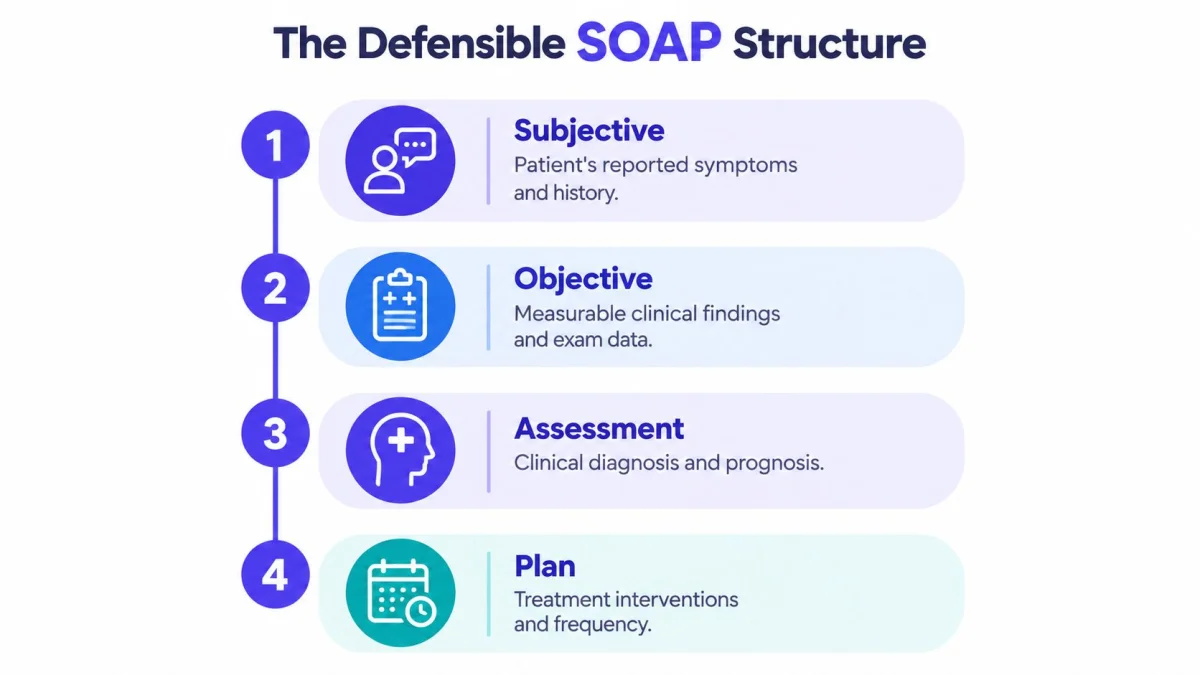
Subjective must establish the patient's current experience
The Subjective section records the patient's or caregiver's report. It should capture symptoms, relevant events since the last visit, adherence to the home program when clinically relevant, and functional changes described by the patient.
“Feels better” is a starting point, not a complete entry. A stronger note records what the patient can now do, what remains difficult, and whether symptoms changed during a particular activity. The patient's report should support, not replace, objective examination.
Objective must contain reproducible findings
The Objective section should show what the clinician observed, measured, or performed. The APTA identifies examples such as range of motion, edema circumferential measurements, and the 6-minute walk test. It also expects treatment details such as frequency, intensity, time, duration, and the level of assistance provided. APTA visit documentation elements provides the basis for building fields around these details.
Useful prompts include:
- Measurement and units
- Testing position or method when needed for repeatability
- Assistance level, cues, resistance, or device used
- Intervention parameters
- Patient response during and after treatment
The template should make vague entries inconvenient. A field labelled “strength improved” invites unsupported conclusions. A field asking for the measure, prior value, current value, and functional relevance produces a more useful record.
Assessment must show clinical judgment
Assessment is where the therapist interprets the information. It should state whether the patient is improving, unchanged, or regressing, identify remaining impairments, explain the response to treatment, and connect findings to functional goals.
This section should also explain why continued skilled care is appropriate. The explanation may involve progression of an intervention, modification of the home program, need for manual assistance, safety concerns, or a response that requires clinical adjustment. A list of performed exercises belongs in Objective. The reason those exercises were selected belongs in Assessment.
Plan must be specific enough to guide the next encounter
The Plan should identify the next interventions, progression or regression criteria, home program changes, planned reassessment, communication needs, and discharge direction where relevant. World Physiotherapy also emphasizes outcome measures where possible and requires documentation to remain accurate, complete, legible, timely, dated, and authenticated.
The final check is continuity. The Subjective report should relate to the Objective findings, the Assessment should interpret both, and the Plan should follow logically from the Assessment. If those connections are missing, a technically complete SOAP note can still be clinically weak.
Documentation Failures That Trigger Claim Denials
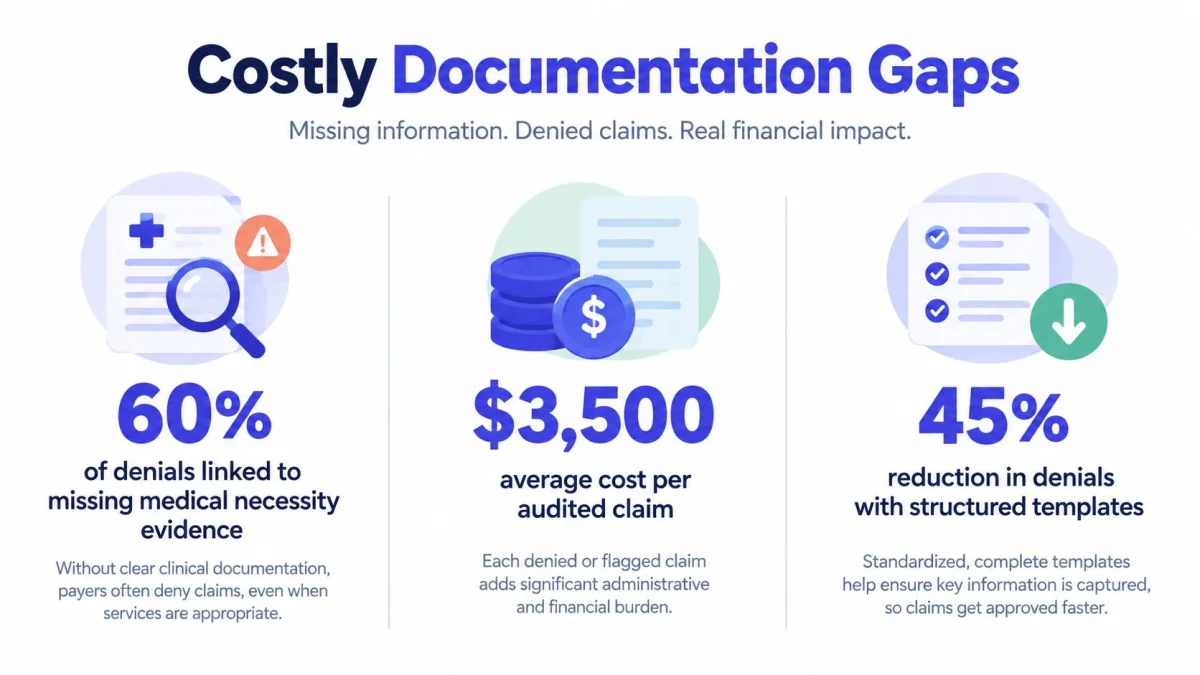
The common failure isn't an absent note. It's a note that contains activity without evidence.
One industry analysis reports that inadequate documentation accounts for 40-60% of physical therapy claim denials, with 45% connected to failure to demonstrate medical necessity, 30% to missing skilled-service documentation, 15% to inadequate progress documentation, and 10% to missing elements such as unsigned or incomplete SOAP sections. These figures are reported in an outpatient therapy documentation audit analysis, and they point to a practical design issue. A template must force the clinician to document the reason for care, not merely the fact that care occurred.
A separate Medicare audit cited by HHS found that 61% of reviewed outpatient physical therapy claims didn't comply with Medicare medical-necessity, coding, or other requirements, as reported in the same audit-focused resource. The result is payment risk, additional review, and time spent defending records that should have been clearer at the point of treatment.
Copy-forward creates a false sense of completeness
Copying the prior note can preserve useful history, but it becomes dangerous when current findings remain unchanged by default. Repeated text may suggest that the therapist didn't reassess the patient, even when a meaningful reassessment occurred.
A safer template separates persistent information from visit-specific evidence. It can carry forward the diagnosis and long-term goals, but it should require new entries for:
- Functional delta: What changed since the relevant comparison point?
- Goal status: Which goals improved, remained limited, or were revised?
- Skilled-service rationale: Why did today's intervention require a therapist's judgment?
- Patient response: What response influenced the next decision?
- Plan change: What will be progressed, modified, or continued?
Templates that let clinicians complete a note without entering a new measurement or current assessment are fast only at the moment of signing. They shift the burden to an audit later.
A complete note lists what happened. A defensible note shows what changed and why the clinician acted on it.
Clinics can use a documentation audit checklist for physical therapy to review whether their current fields capture these safeguards. The review should sample real notes, not just inspect the template screen.
A Copyable Physical Therapy Progress Note Template
A useful template should work for both routine visits and formal progress reporting. Medicare doesn't require one fixed format, but it does require an assessment of improvement or lack of progress toward each goal, plans for continuing treatment, and changes to goals or the plan of care at least once in each progress-report period. That period is every 10 treatment days or 30 calendar days, whichever is less, according to CMS outpatient therapy documentation requirements.
The following structure can be adapted inside an EHR or word processor:
Patient and encounter
- Patient identifier:
- Date of service:
- Treating clinician and credentials:
- Diagnosis or treatment condition:
- Visit type:
- Reporting period, if applicable:
Subjective
- Patient or caregiver report since the previous visit:
- Current symptoms and relevant functional limitations:
- Changes in home-program performance or daily activity:
- Patient priorities or concerns:
Objective
- Vital or safety findings, when clinically relevant:
- Range of motion, strength, edema, gait, balance, or standardized test results:
- Comparison with prior measurement or baseline:
- Assistance level, cues, device, position, and test conditions:
- Skilled interventions delivered, including frequency, intensity, time, duration, and assistance:
- Patient response during and after intervention:
Assessment
- Current clinical status:
- Improvement, lack of progress, or regression toward each goal:
- Objective evidence supporting the conclusion:
- Remaining impairments and functional consequences:
- Medical-necessity and skilled-care rationale:
- Response to treatment and clinical reasoning:
Plan
- Continue, progress, regress, or stop:
- Interventions planned for the next visit:
- Home program changes:
- Updated frequency, duration, or plan-of-care elements:
- Goal changes and discharge direction:
- Communication or certification needs:
- Clinician authentication:
The template should make the comparison point explicit. “Range of motion improved” is weaker than a current measure paired with the prior measure and an explanation of how that change affects a stated function.
For additional formatting ideas, clinicians can review Cartwright Fitness documentation templates and adapt the structure to local payer and clinic requirements. A practical physical therapy notes resource can also help a small practice standardize prompts without forcing every patient into identical clinical language.
Automating Notes with AI Scribes and Specialty Templates
Manual templates solve the blank-page problem, but they don't remove all typing. The clinician still has to remember the session, enter measurements, describe interventions, and connect those findings to the plan.
An AI scribe changes the sequence. During an in-person, telephone, or telehealth consultation, the system records the conversation, separates speakers, and produces a draft in the clinician's selected structure. The clinician remains responsible for checking the draft, correcting omissions, confirming measurements, and authenticating the final record. Automation creates a review task, not an excuse to sign without reading.

Specialty structure matters
A generic medical note may capture symptoms but miss the details that matter in rehabilitation. A physiotherapy template can prompt for objective measures, functional status, response to intervention, home exercise planning, and discharge direction. An AI template builder can also turn a dictation, chat, or uploaded document into a clinic-specific format.
PatientNotes offers templates across 37 specialties, including physiotherapy and physical medicine and rehabilitation, along with SOAP, progress, discharge, procedure, and consultation formats. Its native iOS app supports offline recording and continues recording with the screen locked. Notes and extracted tasks can be produced in the clinician's own language. The specialty template library describes those available formats.
For US practices, the system suggests ICD-10, CPT, and CDT codes, but those suggestions apply to US billing only and require clinician review. It has a Semble EHR integration. Every other EHR works through copy and paste, so practices needing deep health-system integration should assess that limitation before adopting it.
The service is $70 per user per month billed monthly or $50 per user per month billed annually, with annual billing listed as $600 per year. It includes a 7-day free trial without a credit card and a 14-day money-back guarantee, with no enterprise tier and no sales call, as detailed on the PatientNotes pricing page. The platform is HIPAA compliant, and a BAA is included at no extra cost.
For a broader framework for reviewing AI scribe workflows, clinicians can use this AI scribe documentation resource. The essential control remains the same: every generated note must be checked against the actual encounter and the objective record.
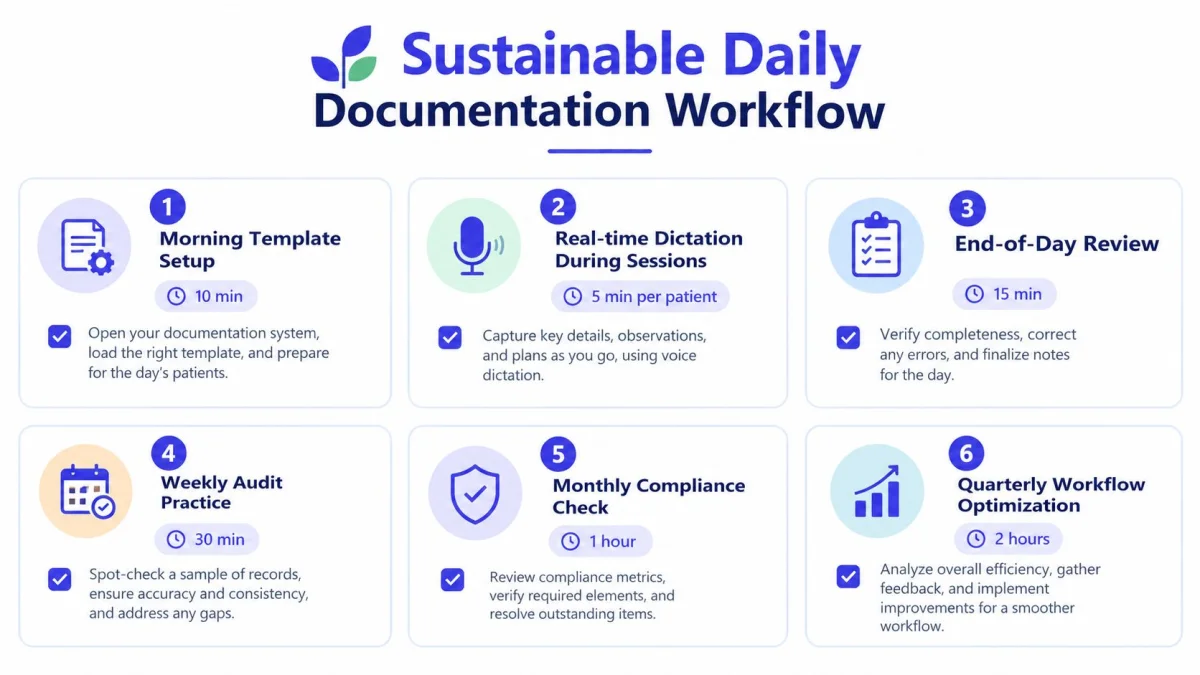
Building a Sustainable Documentation Workflow
A compliant template won't help if clinicians avoid using it. The workflow has to fit the clinic's pace while preserving the fields that defend medical necessity.
A small practice can establish a simple operating rhythm:
- Before treatment: Open the correct specialty and episode template, confirm the plan of care, and identify the measures that need reassessment.
- During treatment: Capture measurements and intervention parameters while they're available. Use dictation when typing would interrupt patient care.
- Immediately afterward: Complete the assessment while the clinical reasoning is fresh, then update the plan and authenticate the note.
- At review time: Check for missing signatures, unsupported progress statements, unchanged copy-forward text, and goals without current status.
The practice should also run periodic chart reviews. Select real notes and ask whether a reviewer can identify the functional problem, the objective change, the skilled intervention, the response, and the next decision. If any answer requires a verbal explanation from the therapist, the template or workflow needs adjustment.
Speed and defensibility can coexist
The wrong shortcut removes clinical reasoning. The right shortcut removes repeated formatting, predictable phrasing, and manual transfer between systems. Practices that handle scanned forms, referrals, or signed records can also use a service to convert healthcare documents into workable digital files, provided privacy and internal retention requirements are addressed.
The final test is consistency. A strong physical therapy progress note template makes objective change, skilled care, goal status, and plan updates visible without turning every note into a long narrative. Clinics should revise the template when audits, peer reviews, or clinician feedback reveal a recurring omission.
PatientNotes records consultations in person, by phone, or by telehealth, then drafts structured notes, follow-up tasks, patient instructions, and reviewable US billing-code suggestions in the clinician's chosen language. Start the free trial without a credit card and visit PatientNotes to assess whether its physiotherapy templates and copy-and-paste workflow fit the clinic's documentation process.