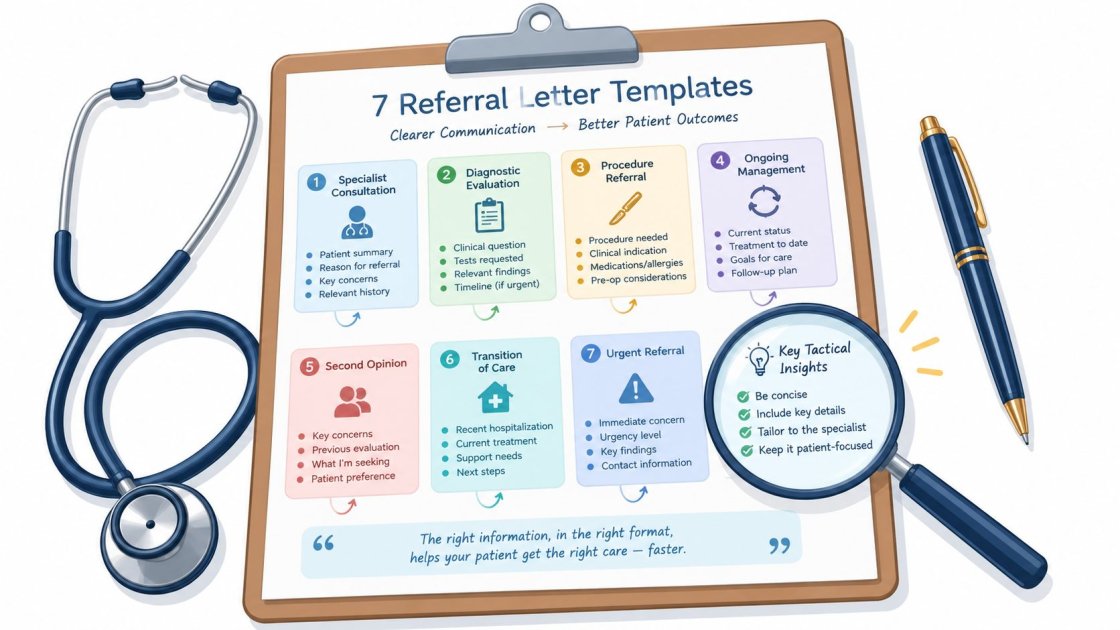
The strongest referral letters make the clinical question, urgency, relevant findings, treatment history, and requested action easy to find. Only 44% of referral letters met research-based quality criteria before a referral-management intervention, even though general practitioners in England write more than 10 million elective referral letters each year according to the cited study.
A referral can contain many facts and still fail at the handoff. The receiving clinician needs to identify why the patient is being referred, how quickly the case needs attention, what has already been done, and what decision or action is requested. A reliable letter usually brings together patient identifiers, consent where applicable, focused history, examination findings, dated investigations, medications, allergies, relevant risks, urgency, and a specific clinical question. Those elements must still be checked against current local requirements and the receiving service's pathway.
The seven referral letters examples below show how those details change by specialty. They focus on triage, preparation, and action rather than polished prose. PatientNotes can organize consultation details into templates across 37 specialties, but every generated note still needs clinician review. Practices that transmit letters by fax should also check whether a suitable medical fax cover sheet resource fits their local workflow.
1. Primary Care to Cardiology Referral
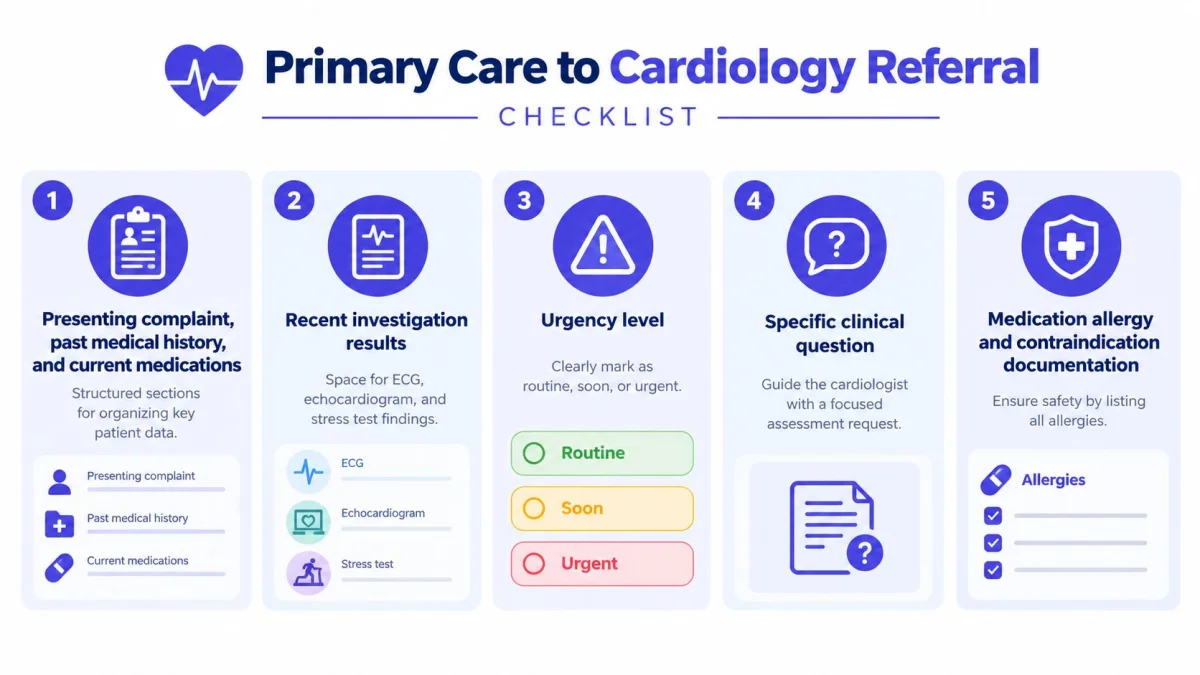
Cardiology referrals become useful when symptoms, objective findings, and the requested decision appear together. A letter for a 58-year-old with new exertional chest pain, elevated troponin, and ST changes on ECG should state the urgency and request urgent coronary angiography, subject to the local pathway and the clinician's assessment.
A different case needs a different question. For a 72-year-old with atrial fibrillation and stroke risk factors, the request might be rate-control optimization and an anticoagulation review. The letter should distinguish an established diagnosis from a suspected one and say whether the cardiologist is being asked to investigate, adjust treatment, or advise primary care.
What cardiology needs to triage
Document the symptom's onset, character, radiation, severity, triggers, and progression. Include recent vital signs, especially blood pressure when hypertension management is the reason for referral. Add the ECG date and findings, troponin result and date, lipid results, relevant examination findings, medication doses, allergies, and prior cardiac history.
The referral should also say whether lifestyle counseling has already occurred or whether this is the first discussion. That detail prevents the receiving clinician from assuming that a prior intervention happened when it did not.
Practical rule: A cardiology referral should end with a question that can be answered, not a diagnosis list that leaves the specialist to infer the task.
A specialty template can help extract investigation results and medication lists from the consultation recording. PatientNotes provides a cardiology specialty template, while the clinician remains responsible for checking every field and deciding what belongs in the final letter.
2. Mental Health Referral to Psychiatry or Psychology
Mental health referrals need a clear account of risk, time course, mental status, and the service being requested. Consider a 34-year-old with major depressive disorder that hasn't responded to two SSRIs at adequate doses and now has increased suicidal ideation. The letter should request medication optimization and possible combination treatment, while clearly documenting the current safety assessment and action already taken.
A 16-year-old with first-episode psychosis, auditory hallucinations, and paranoia requires a different level of urgency and a more explicit account of safeguarding, family or caregiver involvement where relevant, and the immediate plan. Diagnostic uncertainty should be stated plainly rather than hidden behind a definitive label.
Separate symptoms from risk
Record when symptoms began and whether they are worsening, episodic, or longstanding. Include mood and cognitive observations, prior psychiatric diagnoses, medication trials and responses, substance use, current psychosocial stressors, significant recent events, support systems, and any relevant medical contributors.
A structured suicide risk framework, such as the Columbia-Suicide Severity Rating Scale framework, can help organize safety documentation. It doesn't replace clinical judgment or emergency action when the situation requires it.
The letter should specify whether the request concerns diagnostic clarification, medication management, psychotherapy, crisis stabilization, or ongoing shared care. It should also identify whether the patient knows about the referral and what safety-net instructions were given.
PatientNotes offers psychiatry specialty templates that can structure mood descriptors, risk statements, and medication history from a consultation. The clinician must verify the transcription, remove irrelevant material, and confirm that the final letter reflects the patient's actual presentation.
3. Orthopedic Referral for Joint or Spine Pathology
Orthopedic referrals work best when they connect the mechanism, anatomy, function, examination, imaging, and treatment response. A 52-year-old with six months of left knee pain, morning stiffness, a positive Lachman test, and MRI evidence of an ACL tear with a medial meniscal tear needs a surgical evaluation request, not a generic statement that the knee hurts.
For a 68-year-old with progressive cervical myelopathy, hand weakness, gait instability, and MRI evidence of spinal cord compression at C5-C6, the letter should make the concerning progression and urgent surgical consultation request prominent.
Use anatomical precision
Name the exact injury mechanism when one exists. State whether pain is at the medial joint line, patellofemoral region, or another specific location. Record which maneuvers reproduce symptoms, such as the Lachman test, McMurray sign, or straight leg raise, and include relevant neurological findings for spine referrals.
Imaging should include the modality, date, body region, and specific finding. “Abnormal MRI” isn't useful enough. A stronger entry would identify an MRI date and describe the relevant tear, compression, or degenerative change in the report's terms.

The receiving surgeon also needs the non-operative history. Include physical therapy sessions, injections, analgesics, activity modification, and the patient's response. PatientNotes orthopedic templates can structure injury mechanism, functional limitations, examination findings, imaging dates, and key findings from the consultation.
The video below can support staff education on organizing orthopedic referral information, but it isn't a substitute for the receiving service's requirements.
4. Dermatology Referral for Skin Lesion Evaluation
Dermatology referrals often fail because “changing mole” contains too little visual and temporal information. A 61-year-old with a 1.2 cm upper-back lesion, irregular borders, mixed brown and black coloration, and growth over three months needs a referral for evaluation of suspected melanoma, with the lesion's location and change made obvious.
The same structure can support a medical rather than lesion-focused referral. A 38-year-old with extensive psoriasis involving more than 30% of body surface area that hasn't responded to topical corticosteroids should be referred for consideration of systemic or biologic therapy, with treatment history and disease burden clearly documented.
Describe what the dermatologist can't infer
Use the ABCDE framework for pigmented lesions. State the exact size in centimeters, the duration, the timeline of change, and whether trauma, ulceration, crusting, or bleeding occurred. If a photograph is attached, include the date taken and identify the body site.
Skin type and sun exposure history can add context, particularly when they are relevant to the clinician's assessment. The letter should also distinguish a lesion that changed recently from one that has been stable for years.
A useful referral doesn't pretend to diagnose the lesion from a description. It presents observable features, relevant history, and a focused request. It should say whether the purpose is diagnosis, biopsy consideration, treatment planning, or management of a chronic inflammatory condition.
PatientNotes dermatology templates can capture lesion location, size, and ABCDE descriptors from the consultation. The clinician should compare the generated content with the lesion and the record before sending it, especially when the referral depends on a visual description.
5. Physical Therapy or Rehabilitation Referral
A rehabilitation referral must tell the therapist what the patient can do now, what restrictions apply, and what outcome the treatment should pursue. For a 68-year-old four weeks after total knee arthroplasty with active range of motion from 0 to 95 degrees, the request might focus on range of motion and strengthening, with a goal of full extension and 120-degree flexion if that goal is clinically appropriate.
A 52-year-old after rotator cuff repair involving the supraspinatus, infraspinatus, and teres minor on January 15, 2024 needs a different plan. The letter should identify the procedure, state non-weight-bearing restrictions for six weeks, and describe the planned progression afterward.
Put precautions before goals
Include the surgery or injury date, exact procedure, weight-bearing status, range-of-motion limits, brace requirements, and any surgeon-directed precautions. Add current pain, aggravating activities, baseline mobility, and relevant imaging or operative findings.
Goals should be concrete and patient-centered. Examples include independent stair climbing, returning to golf by a chosen date, or reducing pain from 7/10 to 3/10. The referral shouldn't impose a rehabilitation plan that conflicts with the surgeon's instructions.
PatientNotes can structure functional limitations, surgical history, precautions, baseline measurements, and rehabilitation goals in a referral-letter workflow. The therapist still needs the actual operative restrictions and should be able to contact the referring team when information is missing.
A referral to rehabilitation is partly a safety document. A missing restriction can matter more than an elegant summary.
6. Otolaryngology Referral for Hearing or Voice Concerns
ENT referrals need careful attention to onset, laterality, associated symptoms, and red flags. A 58-year-old with six weeks of progressive right-sided sensorineural hearing loss and tinnitus, with normal otoscopy, may need urgent audiometry and MRI to evaluate for retrocochlear pathology, depending on the clinician's assessment and local pathway.
A 72-year-old with three months of progressive hoarseness and dysphagia who smokes needs a referral for laryngoscopy and evaluation of possible laryngeal pathology. The referral should not bury those features beneath a long general medical history.
Make the time course visible
State whether hearing loss is sudden or progressive, unilateral or bilateral, and associated with vertigo, dizziness, otalgia, or neurological symptoms. If audiometry has been completed, include the actual findings, such as the air-bone gap and speech discrimination, rather than writing only “hearing loss.”
For voice symptoms, document onset, progression, voice use or trauma, smoking, reflux history, dysphagia, weight loss, neck nodes, and referred ear pain when present. These details help the receiving clinician judge the next assessment.
The letter should distinguish a diagnostic request from a request for treatment or surveillance. It should also identify tests already completed and attach reports rather than referring to results without dates.
PatientNotes ENT templates can organize onset, laterality, associated symptoms, investigations, and red-flag documentation from the consultation. The clinician should verify that any urgent concern is communicated through the correct local channel rather than relying on the letter alone.
7. Specialty Medical Referral for Complex Disease
Subspecialty referrals need trends, treatment context, complications, and a defined decision. Consider a 61-year-old with type 2 diabetes for 12 years, an HbA1c of 8.2%, metformin and glipizide treatment, and an estimated glomerular filtration rate of 38 mL/min. The request could ask endocrinology to optimize medication and assess the safety of GLP-1 receptor agonist or SGLT2 inhibitor treatment in the context of nephropathy.
A rheumatology referral may instead concern a 45-year-old newly diagnosed with systemic lupus erythematosus, positive ANA and anti-dsDNA, low complement, and lupus nephritis on renal biopsy. The request should focus on immunosuppressive therapy optimization and include the biopsy information, current treatment, organ involvement, and relevant risks.
Trends matter more than isolated values
State disease duration, medication names, doses, start dates, prior failures, and treatment barriers. For diabetes, include HbA1c trends over the relevant period, renal results, eye examination information, urine albumin, foot examination findings, cardiovascular risks, and prior events when available.
The letter should explain practical barriers without judgment. Cost-related adherence difficulty, limited food access, transport problems, or language needs may affect the specialist's recommendations and follow-up plan.
Useful distinction: The referral should separate documented findings, clinical interpretation, and the question for the subspecialist. Those are related, but they aren't interchangeable.
PatientNotes includes templates for endocrinology, rheumatology, and nephrology. Its AI template builder can create a structure from a dictation, chat, or uploaded document, while the clinician checks medication lists, laboratory trends, complication status, and the requested action before transmission.
7 Referral Letter Examples, Quick Comparison
| Referral Type | Implementation Complexity | Resource Requirements | Expected Outcomes | Ideal Use Cases | Key Advantages |
|---|---|---|---|---|---|
| Primary Care to Cardiology Referral | Moderate, structured clinical data, clear clinical question, urgency designation | Vitals, ECG, troponin, lipid results, medication list, recent investigations | Timely triage and diagnosis; faster management of ACS, arrhythmias, hypertension | Chest pain, new arrhythmia, uncontrolled hypertension, suspected cardiac disease | Reduces duplicate tests, expedites consults, improves urgent triage |
| Mental Health Referral (Psychiatry/Psychology) | High, detailed symptom timeline, risk assessment, prior treatment documentation | Psychiatric history, medication trials/doses, suicidality risk tools, social context | Rapid risk stratification and treatment planning; improved safety management | Severe depression with suicidality, first-episode psychosis, refractory anxiety or ADHD | Communicates safety concerns, saves history-taking time, informs targeted therapy |
| Orthopedic Referral for Joint/Spine Pathology | Moderate, precise anatomy, mechanism of injury, functional assessment | X-ray/MRI, mechanism/timeline, physical exam findings, prior conservative therapy notes | Better surgical vs conservative triage; fewer repeat imaging orders; timely operative planning | Acute fractures, ligament tears, progressive myelopathy, refractory joint pain | Clarifies urgency and functional impairment; streamlines surgical prioritization |
| Dermatology Referral for Skin Lesion Evaluation | Low–Moderate, structured lesion description (ABCDE), photos recommended | Lesion size/location, ABCDE descriptors, photographs, prior biopsies/skin history | Prioritized evaluation of high-risk lesions; faster biopsy and diagnosis for malignancy | Suspicious pigmented lesions, rapidly changing lesions, extensive refractory dermatitis | Enables urgent melanoma workup; standardizes lesion risk descriptors |
| Physical Therapy / Rehabilitation Referral | Low–Moderate, clear functional goals, precautions, baseline status | Surgical dates, weight-bearing/RoM restrictions, baseline function, relevant imaging | Faster initiation of appropriate rehab; measurable functional recovery | Post-operative rehab, chronic pain rehabilitation, mobility or ADL deficits | Communicates restrictions and goals; enables targeted therapy from first visit |
| Otolaryngology (ENT) Referral for Hearing/Voice Concerns | Moderate, laterality, red-flag screening, audiometric/imaging data helpful | Audiometry (PTA, speech scores), CT/MRI if indicated, otoscopy findings, symptom chronology | Early detection of sudden SNHL or head/neck pathology; focused ENT evaluation | Sudden hearing loss, unilateral symptoms, progressive hoarseness or dysphagia | Identifies urgent presentations, provides baseline audiometry, documents red flags |
| Specialty Medical Referral (Endocrinology/Rheum/Nephrology) | High, disease trends, complication screening, medication history and barriers | Lab trends (HbA1c, eGFR), medication doses/dates, complication screening results, adherence/context | Informed escalation of therapy; prevention and early management of complications | Poorly controlled diabetes, complex autoimmune disease, progressive CKD | Conveys disease trajectory and prior trials, prevents repeat failed therapies, aids shared decision-making |
Turn Clinical Details Into a Clear Handoff
A strong referral can usually survive a short quality check. First, identify the purpose in one sentence. Then add the urgency as an assessment supported by the clinical facts, rather than implying a triage rule that hasn't been verified. Add dated findings, treatment history, relevant risks, restrictions, and the specific decision or action requested.
The best length depends on the service. NHS England guidance says referral content should be appropriate but not excessive, and asks referrers to check service-specific requirements and attach relevant pro formas in its e-Referral Service guidance. A study of 2,304 referral letters found completeness ranging from 46.0% to 97.7%, with an average of 71.8%, and found that forms with many variables were often less complete than shorter locally designed forms as reported in the cited study. More fields don't automatically create better clinical information.
A practical final pass
- Write for the receiving specialty: Put the information that affects triage, preparation, and action near the top.
- Separate facts from interpretation: Identify examination findings, test results, and the clinician's working assessment distinctly.
- Update time-sensitive results: Check dates, medications, symptoms, and urgency before sending.
- Check primary-source guidance: Confirm local pathway, consent, documentation, and service requirements against current guidance.
The letter should also support patient communication. UK guidance says patients should be told whom they're being referred to, why the referral is being made, and what happens next according to Royal College of General Practitioners guidance. NHS England describes referral communication as a workflow that can include queries, acceptance, booking instructions, waiting-list updates, missed appointments, and discharge in its referring-patient guidance.
- Don't copy unverified AI output: Review every generated field against the record and the patient encounter.
- Don't bury the clinical question: A receiving clinician shouldn't need to search the final paragraph for the requested action.
- Don't include irrelevant history: Add context that changes interpretation, risk, treatment, or triage.
- Don't treat a template as clinical judgment: A template structures information, but the clinician decides what is accurate and clinically relevant.
For US Medicare-related referrals, CMS says documentation should connect the patient's signs, symptoms, diagnoses, clinical rationale, ordered service, location, and level of care in its documentation guidance. CMS also requires records to identify the ordering or referring professional through the appropriate NPI where permitted and to support medical necessity when requested in its medical-record requirements. A referral letter should therefore remain traceable in the record, with related assessments and correspondence retained.
PatientNotes offers specialty templates and an AI template builder for individual clinicians and small practices. It is HIPAA compliant, includes a BAA at no extra cost, works with Semble through its integration, and works with other EHRs by copy and paste. Its notes and tasks can be produced in the clinician's own language. ICD-10, CPT, and CDT suggestions apply to US billing only. Details may change, so clinicians should review the current specialty template library and clinical resources.
PatientNotes can record consultations in person, by phone, or through telehealth, then structure the clinical details into specialty notes and referral letters for review. Visit PatientNotes to explore the referral workflow, specialty templates, and the current options for individual clinicians and small practices.