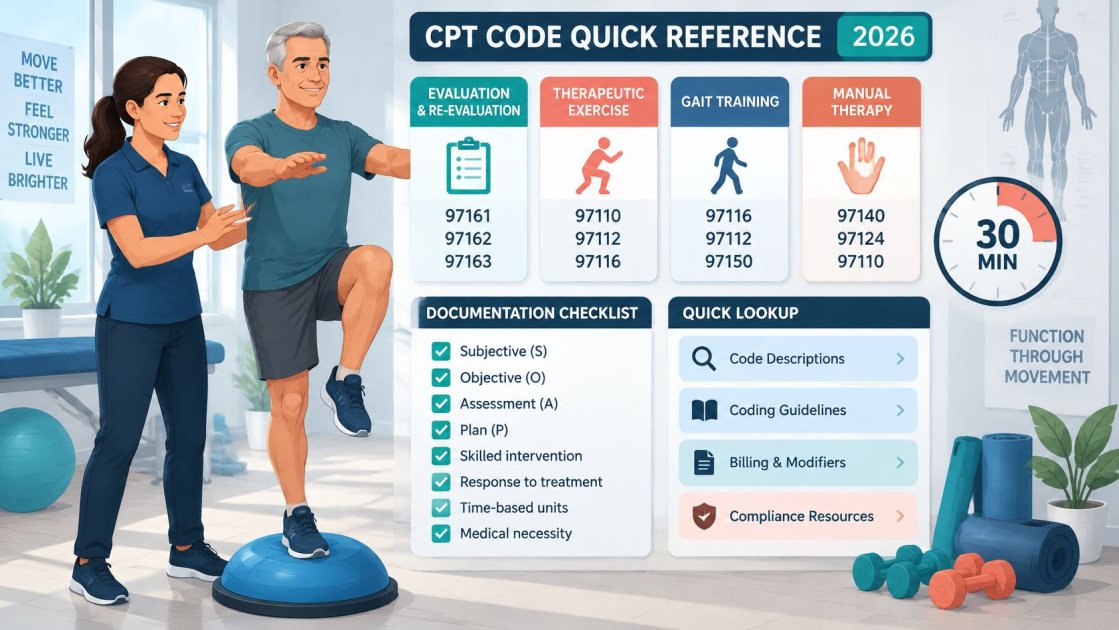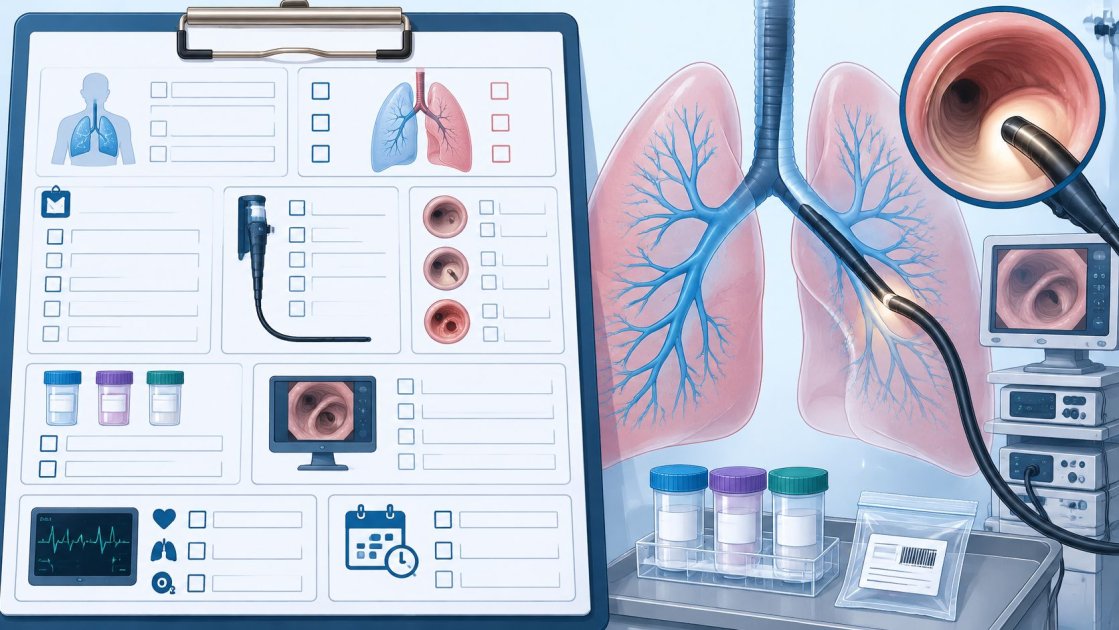
The usual advice is to describe what the bronchoscope saw. That's necessary, but it isn't enough. A useful bronchoscopy procedure note also lets another clinician trace every sample, understand every safety event, and identify who will act on results that haven't returned.
The strongest record isn't the longest narrative. It's the record that connects the indication, procedure, specimens, recovery, and follow-up without leaving the covering clinician to reconstruct what happened.
Bronchoscopy Procedure Note Template at a Glance
A bronchoscopy procedure note should work without the operator standing beside it. Another clinician should be able to understand why the procedure happened, what was performed, what remains pending, and who has responsibility for the next action.
The British Thoracic Society guidance on Local Safety Standards for Invasive Procedures for bronchoscopy and pleural procedures supports structured documentation of assessment, technique, medications, findings, specimens, complications, and disposition. Separate fields make omissions visible and support handoff, coding review, quality audit, and adverse-event review.
Bronchoscopy procedure note fields in writing order
These entries illustrate wording, not completed documentation for an actual patient.
| Field | What to record | Example entry |
|---|---|---|
| Indication | Clinical question the procedure answers | Persistent right upper lobe opacity; tissue diagnosis needed |
| Pre-procedure assessment | Abnormal findings, imaging reviewed, oxygenation, anticoagulant use | Baseline oxygen saturation and imaging reviewed; anticoagulant hold plan recorded |
| Consent | Who consented, risks discussed, questions answered | Written consent; bleeding, pneumothorax, and infection discussed |
| Time-out | Identity, procedure, laterality, checklist confirmation | Name and date of birth confirmed; right side confirmed |
| Procedure and laterality | Named procedure with left, right, or bilateral | Flexible bronchoscopy, right middle lobe |
| Scope type and size | Rigid or flexible, model, size | Flexible bronchoscope; actual model and size entered from equipment log |
| Sedation and anesthesia | Drug, dose, route, time for each agent | Each agent entered in administration order |
| Airway findings | Anatomy, secretions, lesions; observation separate from interpretation | Friable lesion at right middle lobe orifice; no active bleeding |
| Sampling performed | Each method and target | Right middle lobe lavage; lesion brushing |
| Specimens and destination | Each sample, container, receiving laboratory | Separate lavage aliquots labeled for cytology and microbiology |
| Estimated blood loss | Volume or minimal, with hemostasis | Minimal; bleeding resolved with cold saline |
| Complications | Event, time, treatment, outcome, or none | None observed |
| Patient tolerance and outcome | Tolerance, oxygen need, recovery status | Tolerated well; room air at discharge |
| Post-procedure plan | Pending results, owner, review date | Pathology pending; named proceduralist reviews at scheduled follow-up |
| Teaching and discharge instructions | Instructions, red flags, contact route | Written instructions given; breathing-difficulty escalation explained |
A completion rule for every field
Every field should contain what happened, not performed, or not applicable with a reason. Unknown information should be identified as unknown and resolved, not replaced with a default normal finding.
Three omissions deserve a deliberate check: laterality, specimen destination, and pending-result ownership. A practical first step is to copy this field list into the practice template and test it against a recent note.
Indication, Consent and Time-Out Entries
Persistent right upper lobe opacity requiring tissue diagnosis explains the clinical question. Bronchoscopy alone merely names the procedure. The indication should tell the covering clinician what uncertainty the team intended to resolve.
The UCSF standardized bronchoscopy protocol.pdf) identifies pretreatment evaluation, abnormal findings, medications, procedure details, imaging, and aftercare as documentation elements. That makes the opening assessment more than a statement that the patient was suitable.
Record the agreement before insertion
- Assessment: Identify abnormal findings, imaging reviewed, baseline oxygenation, relevant cardiac or lung disease, and anticoagulant or antiplatelet use. Record the actual medication plan rather than assuming a hold occurred.
- Consent: Identify who gave consent and document the discussion that occurred, including relevant risks such as bleeding, pneumothorax, hypoxemia, and infection. Questions and their answers belong in the record when material to the decision.
- Time-out: Record confirmation of patient name and date of birth, the named procedure, explicit laterality, and checklist completion.
A structured informed-consent documentation aid can help organize the entry, but it can't establish that a discussion occurred. A prefilled risk list must be checked against the actual conversation.
The BTS guideline for advanced diagnostic and therapeutic flexible bronchoscopy in adults supports records of indication, outcome, and complications, with the completed safety checklist entered into the clinical record by a registered team member.
Handoff test: The opening lines should explain why the patient was scoped and show that the team agreed on the patient, side, procedure, and plan.
An entry such as anticoagulants checked doesn't communicate the decision. The record should identify the medication status and the agreed management, including any unresolved issue that changed the procedure.
Scope, Technique and Navigation Entries
A finished look through the airways can still leave the next reader unable to say who reached the lesion, which tool proved the position, or why sampling stopped. That route is a traceability record. Each localization finding and each limitation needs a named method and a named operator, or a later nondiagnostic result has nothing to attach to.
The multicenter AQuIRE Registry study published in 2016 reported that among 581 patients undergoing bronchoscopy for peripheral lung lesions, overall diagnostic yield was 53.7%, with yield of 63.7% when neither radial endobronchial ultrasound nor electromagnetic navigation was used, 57.0% with radial ultrasound alone, 38.5% with electromagnetic navigation alone, and 47.1% with both technologies combined. These observational comparisons show why technique must stay attached to the result, not which method to choose for each patient.
Document the route to the target
Write the technical entry so another clinician can replay the approach:
- Instrument and access: Rigid or flexible scope, model, size, and route of insertion, with the operator who advanced it.
- Target: Side, lobe, segment, and lesion characteristics that affected access.
- Localization: Whether radial ultrasound, electromagnetic navigation, or fluoroscopy was used, what it showed, and who confirmed that image matched the planned site.
- Sampling relationship: Which instrument sampled which target, and whether access or positioning limited the attempt.
- Reason for approach: The operator's documented rationale, written at the time, not reconstructed after the pathology returns.
“Procedure completed” fails this test when the laboratory result is nondiagnostic. Successful airway inspection, successful localization, and adequate tissue acquisition are separate events. A note that names the gap is usable. One version might say the target was not directly visible, navigation reached the planned segment, and sampling stopped because the scope could not hold position. That line tells the next clinician what was tried and what blocked it. “Biopsies were taken” does not.
Keep completion and diagnosis separate
Technical completion, specimen adequacy, and diagnostic outcome are different findings. At the end of the procedure the operator may know samples left the room and still not know whether they establish a diagnosis. Do not mark a nondiagnostic result as technical failure unless the note also states the target, the method, and the limitation. The closing check is simple: could another reader name the method used, the person who confirmed localization, and the documented reason the lesion might not have been sampled adequately?
Specimen Entries and Tracking Each Sample
Every specimen needs its own traceable entry. The specimen log, procedure note, container label, and laboratory request should agree on the source and intended examination.
The Vanderbilt bronchoscopy standard operating procedure supports documenting sampling location, lavage volumes, instruments, passes, specimen destination, and limitations. Those details allow the receiving team to interpret the material rather than guess what was collected.
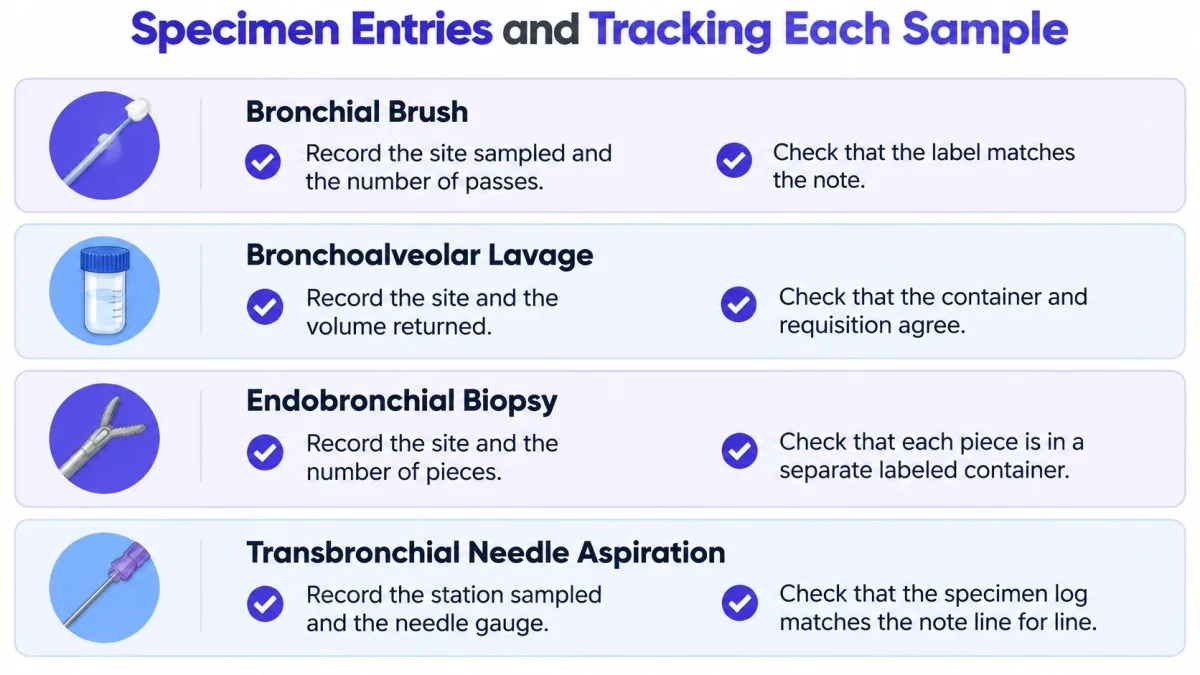
Sampling methods and what each specimen line must record
| Sampling method | What to record | Check before signing |
|---|---|---|
| Bronchoalveolar lavage | Lobe or segment, wedge position, aliquot count, volumes instilled and recovered, fluid appearance | Recovered volume and appearance match the log |
| Brushing | Exact airway or lesion, instrument, number of passes, specimen type | Each brush links to its slide or container |
| Endobronchial biopsy | Site, forceps type, number and sequence of passes | Container identifies patient and site |
| Transbronchial biopsy | Segment, guidance used, passes, post-biopsy radiograph when obtained or indicated | Imaging status and available result are explicit |
| Transbronchial needle aspiration | Lesion or station, needle specification, passes, rapid on-site evaluation status | On-site assessment recorded, or marked unavailable/not used |
Separate collection from destination
A lavage sent for cytology and microbiology needs distinct destination entries, even when both originate from the same collection. Each entry should identify the receiving service and container or accession identifier available at the time.
The BTS flexible bronchoscopy safety checklist requires confirmation that specimens are labeled, including the patient's name, and that procedure details have been recorded. Site-level labeling adds the connection needed to reconcile the note with the specimen log.
Contamination, poor return, interrupted sampling, or another technical limitation should be stated plainly. A negative result from a limited sample isn't equivalent to an unrestricted sampling attempt.
The traceability endpoint is a sample that can be followed from a specific airway site to an identified container, receiving laboratory, and result reviewer.
Container preparation and whether tissue pieces are combined or separated should follow the receiving laboratory's protocol. A diagram or template must never override specimen-handling instructions.
Sedation, Monitoring and Recovery Entries
A single set of observations can't show whether the patient deteriorated and recovered. The BTS guideline for diagnostic flexible bronchoscopy in adults recommends repeated recording of heart rate, respiratory rate, blood pressure, and oxygen saturation before, during, and after bronchoscopy.
The note should distinguish those phases and connect abnormalities to the team's actions. Sedation documentation should remain chronological, with each medication linked to its dose, route, and administration time.
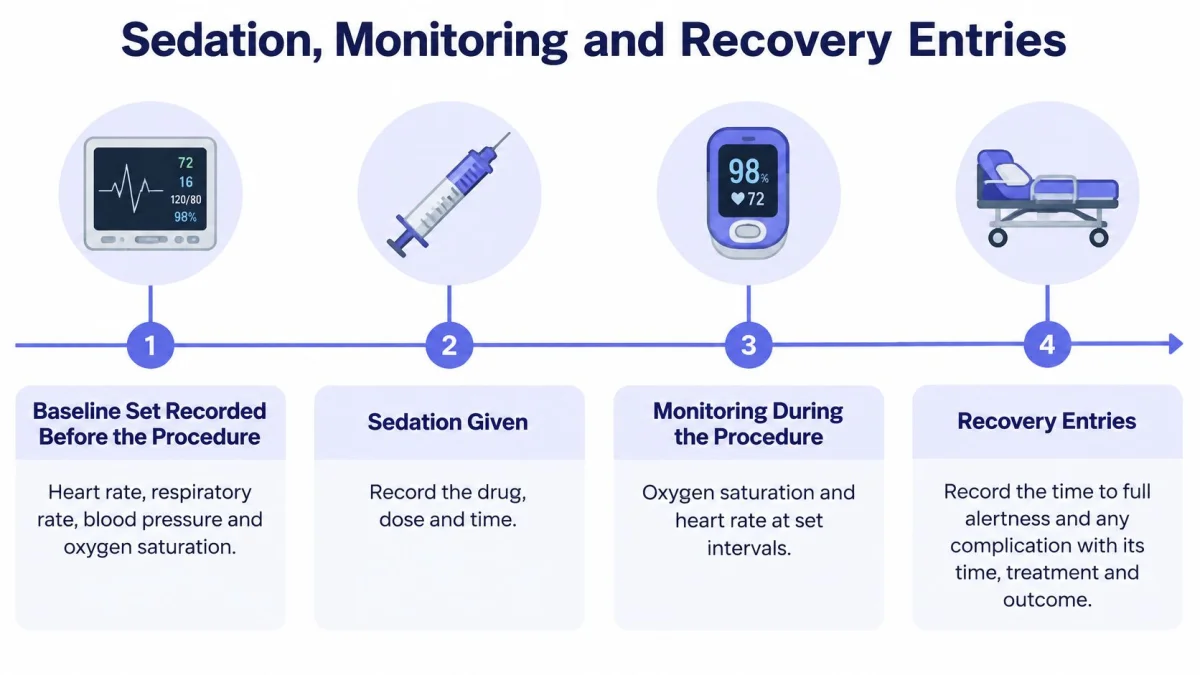
Monitoring observations by procedure phase
| Phase | Observations to record | What to note when abnormal |
|---|---|---|
| Baseline, before sedation | Heart rate, respiratory rate, blood pressure, oxygen saturation, mental status | Abnormal value and decision to proceed or defer |
| During procedure | Continuous oxygen saturation and ECG; blood pressure at the protocol-required interval; sedation doses and times | Desaturation, hemodynamic change, distress, and team response |
| Immediately after | Oxygen requirement, protective airway reflexes, pain, cyanosis, mental status | Intervention, reassessment, and time to resolution |
| Discharge or transfer | Final heart rate, respiratory rate, blood pressure, oxygen saturation, oxygen support | Reason for delayed discharge or continued monitoring |
Make the response visible
The monitoring workflow should include continuous pulse oximetry and ECG, with blood-pressure recording according to the approved procedural protocol. A time-stamped monitoring chart can hold the detailed observations; the procedure note should identify that record and summarize clinically meaningful changes.
For example, transient desaturation isn't a complete entry. The record needs the observed change, oxygen delivery at the time, intervention, reassessment, and whether sampling was interrupted.
Similarly, tolerated well should be supported by recovery findings. The recovery entry should identify mental status, oxygen requirement, relevant symptoms, protective airway reflexes when applicable, and discharge or transfer time.
Return to baseline must describe the patient's actual baseline. A patient who normally requires supplemental oxygen shouldn't receive a default room-air discharge statement. Before signing, the clinician should be able to follow any departure from baseline through intervention and reassessment.
Complications, Outcome and Patient Instructions
The Merck Manual bronchoscopy review describes minor bleeding and fever as occurring in fewer than 15% of cases and notes that pneumothorax may appear within the first hour or be delayed for up to 24 hours. These general figures don't establish an individual patient's discharge risk.
The proceduralist should record each complication with its time, treatment, and outcome. When none occurred, none observed is clearer than an empty field, but it describes the observation period rather than guaranteeing that no delayed event will occur.
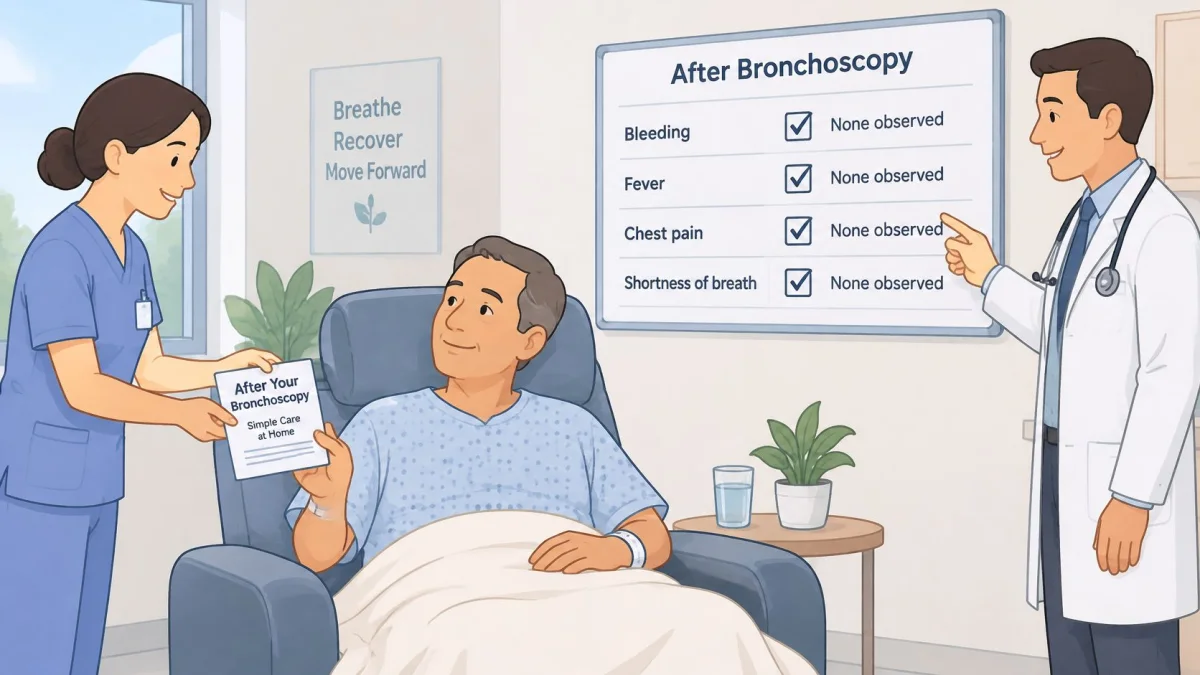
Symptoms to document and explain at discharge
The following is a documentation checklist. The treating team should supply the patient-specific thresholds and approved escalation instructions.
| Symptom | When it can appear | What the patient is told |
|---|---|---|
| Breathing difficulty | During recovery or after discharge | Seek urgent assessment; severe symptoms require emergency help |
| Chest pain | Onset must be assessed, not assumed | Contact the clinical team promptly; severe symptoms require emergency help |
| Coughing up blood (hemoptysis) | During recovery or after discharge | Report bleeding using the written escalation instructions |
| Persistent hoarseness or sore throat | Persistence after discharge requires review | Contact the team if persistent or worsening |
| Painful swallowing | Record actual onset | Contact the team for advice |
| Fever | During recovery or after discharge | Follow the written temperature and duration thresholds |
| Minor bleeding | May follow sampling | Record expected limits and explicit escalation criteria |
Tailor the handoff
Sampling type, lung disease, impaired gas exchange, cardiac disease, and anticoagulant use belong in the individualized monitoring decision. The note should identify which factors affected observation, imaging, or disposition rather than relying on generic low-risk wording.
A discharge-summary structure can organize the handoff around interventions, recovery status, pending results, and escalation. It shouldn't replace approved local patient information or clinical judgment.
The instructions should include the team's actual contact route, out-of-hours arrangements, and responsibility for reviewing pending pathology or microbiology. Patient informed is too vague to show what was explained.
Before discharge: The record should identify the red flags explained to this patient and the clinician responsible for the outstanding results.
Documentation Gaps That Cause Errors
After a templated diagnostic-bronchoscopy note was introduced in June 2023, incorrectly documented patients fell from approximately 40% to less than 10%, according to Cleveland Clinic's 2024 account of its standardization program. That local result supports standardization, not an assumption that any template will produce the same improvement.
A template still fails when it allows vague defaults to pass as completed documentation. The clinician must verify the contents, not merely populate the screen.
Recognizable failure patterns
| Weak entry | What remains unresolved |
|---|---|
| Right-sided procedure implied by imaging | Actual side and target performed |
| Samples sent | Site, specimen type, container, destination |
| Findings as before | What was observed during this procedure |
| Routine recovery | Oxygen requirement and recovery observations |
| Uneventful | Whether an event occurred and how recovery was assessed |
| Cancer seen | Whether this is an observation, suspicion, or established diagnosis |
An endobronchial lesion at the right upper lobe orifice is an observation. Suspected malignancy is an interpretation. The note should label the interpretation and retain the observed finding rather than presenting an unconfirmed diagnosis as established.
For a broader record-review framework, clinicians can examine how RevGuard tightens clinical documentation. The useful application here is a focused check for missing detail, ambiguous wording, and unsupported conclusions.
Required fields can prevent silent omissions. Fixed laterality options and specimen categories can reduce inconsistent wording, provided they allow accurate exceptions and don't preselect normal findings.
A small-practice audit can start with recent notes. The reviewer should count blank fields, vague phrases, and unresolved specimen destinations, then revise the template around the gaps found.
Cross-References to Pathology, Discharge and Coding
A bronchoscopy note that describes what the scope saw still fails if a pending result has no named owner. Pathology, the discharge summary, the patient instructions, and the claim each take a different slice of the same encounter. The procedure note is the trace those copies should point back to.
Start with one sample, not the whole chart. Take a right-upper-lobe brushing. In the procedure note, name the clinician who will receive that result, the date that person will review it, and the action the review is meant to trigger. The discharge record should carry that same name and date forward. A line that only says results are pending leaves the covering clinician without a task. Patient instructions should say, in plain language, how the patient will hear about the result and what to do if that contact does not arrive by the stated time.
Follow one result to its owner
- Pending-results entry: name the clinician responsible and the planned review date.
- Discharge record: repeat that owner and date, and any interim precaution the patient must follow until the result returns.
- Patient instructions: state how results will be communicated and the fallback if the expected contact does not occur.
- Billing review: describe the procedure that was performed, including sampling method, site, and guidance used, not the name on the schedule.
Fix a mismatch among those four lines before anyone signs. If the chart never names who acts on an abnormal cytology report, the result can sit unread after the patient has gone home.
The procedural record should already state sampling methods, sites, guidance used, and specimens obtained. This article does not assign codes or decide which combinations are reportable. Those decisions belong to current coding references and the payer rules that apply to the claim.
A CPT and HCPCS review aid can sit beside that review. It is not a substitute for the governing code guidance. ICD-10, CPT, and CDT suggestions in PatientNotes apply to US billing only. UK practices should use their applicable coding framework rather than importing US suggestions.
Worked Example of One Complete Note
The following fictional case shows how the entries connect. It isn't a signable clinical record: actual medication details, scope specifications, sampling measurements, monitoring observations, dates, and staff identifiers must replace the descriptive prompts.
Illustrative case record
Patient and indication: A 64-year-old with persistent right upper lobe opacity; tissue diagnosis required.
Assessment: No anticoagulant use. Baseline oxygen saturation 96% on room air; chest radiograph reviewed. Antiplatelet status and management plan documented in the medication assessment.
Consent and time-out: Written consent obtained; bleeding and pneumothorax discussed. Patient name, date of birth, planned procedure, and right side confirmed; checklist completed.
Procedure: Flexible bronchoscopy targeting the right upper lobe. Actual scope model and size transcribed from the equipment log.
Sedation: Each administered agent entered with drug, dose, route, and time, linked to the medication record.
Findings: Friable lesion at the right upper lobe orifice. Diagnostic interpretation deferred.
| Specimen | Source and destination |
|---|---|
| Lavage | Right upper lobe; labeled microbiology container; collection and recovery details recorded |
| Brushing | Right upper lobe lesion; labeled cytology preparation; passes recorded |
Blood loss and complications: Minimal bleeding, resolved with cold saline. No complications observed.
Recovery: Tolerated procedure; monitoring reviewed; room air at discharge.
Follow-up: Cytology and microbiology pending. Dr. Patel owns review; an actual review date and patient-contact plan are entered.
Discharge and signature: Written red flags and contact route supplied; understanding checked. Operator signs after reconciliation.
The final check is whether a covering clinician could act without contacting the operator for missing information.
Build Your Bronchoscopy Procedure Note Template
A usable bronchoscopy template is a traceability record. Every specimen, every complication, and every pending result is tied to a named owner, rather than left inside a paragraph about what the scope saw. One starting template covers every case. Technique-specific fields are added only when that case uses them. The same order lets the operator, the assisting nurse, recovery staff, and a covering clinician find laterality, samples, and follow-up without hunting.
Write the fields in the order they must be completed, and copy that list as the template's skeleton. Laterality, specimen destination, and result ownership are required before finalization. A combined "samples sent" field fails this test. It does not show which container went where, or who must chase the report. Create a separate entry for each sample, with source, label, destination, and the clinician who owns the result.
Test the template against recent notes before anyone relies on it. Read for omissions, unsupported defaults, and vague language. "Tolerated well" and "routine specimens" do not tell recovery what was done, and they do not tell the covering clinician who calls the patient. If the time-out checklist lives on a paper form or in another system, the template still has to record how completion enters the clinical record. Review that path with the procedural team and lock it before the next list is used on a real case.
PatientNotes is a documentation tool that can hold this procedure-note template: the clinician reviews and edits the note, then copies it into the EHR. Set indication, laterality, and a separate specimen line with a named result owner at PatientNotes before testing the template on a case.