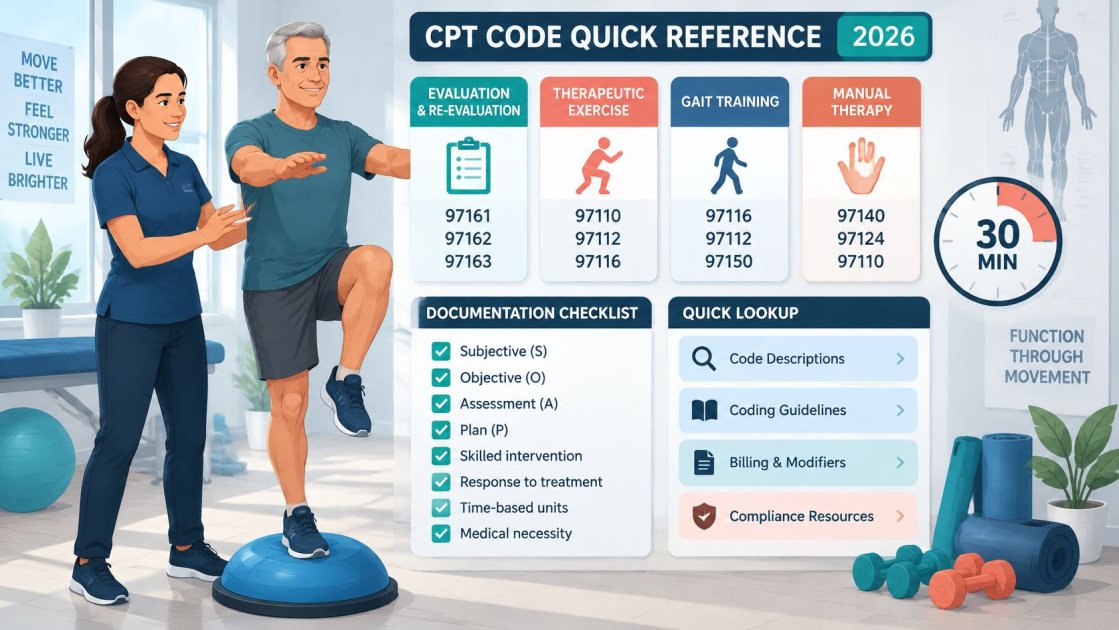
The usual advice to write a standard visit note and add a telehealth modifier is incomplete. A clinical summary can describe the patient's problem accurately while leaving unanswered questions about location, consent, examination limits, or a failed connection. Telehealth documentation requirements concern the conditions of the encounter as well as its clinical content.
For individual clinicians and small practices, the practical solution is a structured encounter record, not a longer transcript. The template should make missing facts visible before signature, while leaving clinical judgments, licensing decisions, and code selection with the clinician.
What a Telehealth Note Must Show in the US and UK
A telehealth note records who received care, who delivered it, how the encounter happened, what was concluded, and what follow-up was planned. A global scoping review of telehealth regulation identified recurring requirements for patient and provider identification, consultation date and time, the chief complaint, assessment, treatment plan, and consent documentation. The clinical core is similar across jurisdictions, but the surrounding legal and billing rules aren't interchangeable.
Required telehealth note elements by country
| Element | US (HHS and CMS) | UK (NHS England) |
|---|---|---|
| Patient identity | Confirm and document identity at the start, following HHS guidance | Confirm the identification procedure under the service's current policy; the NHS guidance discussed here doesn't specify a method |
| Modality (video, audio-only or phone) | Document telehealth use and the applicable billing code or modifier, following HHS guidance | Record that the consultation took place by video |
| Participants and relationship to patient | Document everyone present, following HHS guidance | Record who was present and their relationship to the patient |
| Chaperone status | Check applicable state, professional, and practice requirements; no universal US rule is established here | Record whether a chaperone was offered and declined, or present |
| Consent | Obtain applicable consent and document it, following HHS guidance | Document verbal consent to examination by video |
| Patient location | Verify before the appointment; document location relevant to licensure and emergency planning | Check the service's location and emergency-planning policy; the NHS guidance discussed here doesn't prescribe a field |
| Assessment, plan and orders | Keep records supporting medical necessity, following CMS requirements | Make a contemporaneous record of assessment and decisions |
| Recording decision | Obtain consent in advance if recording, following HHS guidance | Document the discussion and decision in the clinical record |
| Retention | Apply the CMS medical-record maintenance period discussed below | Check current NHS retention requirements for the record type and setting |
The named HHS, CMS, and NHS guidance supporting these entries is linked alongside the detailed workflows below. Where the table calls for a local policy check, that isn't permission to leave the field blank. It means the cited guidance doesn't establish a universal rule for that setting.
Separate encounter facts from clinical findings
The encounter header should hold patient identity, clinician identity and role, date, time, modality, and relevant locations. Participant names, relationships, consent, and the recording decision belong alongside those facts, rather than buried inside the assessment.
The clinical portion should then explain the presenting problem, relevant findings, assessment, plan, and orders. A transcript can help draft this material, but it doesn't distinguish reliably between a patient's description, a clinician's observation, and a finding that couldn't be assessed remotely.
Practical rule: A template should expose uncertainty, not replace it with a normal examination statement.
This distinction also matters when patients evaluate remote services. For example, patients seeking to compare virtual HRT programs through ProMD Health can consider how a service handles assessment and follow-up, not just appointment access. Within the practice, the note should make those decisions traceable without assuming that every remote encounter follows the same pathway.
Recording Participants, Locations and Chaperones

Consider a US patient attending a video visit while traveling in another state. The address already stored in the chart doesn't establish where the patient is sitting during the call. HHS guidance on licensing across state lines advises verifying the patient's location before the appointment and checking the authority needed to practice there, such as a full license, temporary authority, reciprocity, compact participation, or telehealth registration.
Location and participant tracking require distinct fields, even when both are collected during intake.
Document the decision, not just the address
Write the practice decision next to the locations. Record the clinician's location, the licensing basis relied on, and whether care was allowed to proceed. If authority hasn't been established, a finished clinical note doesn't fix it. Pause or transfer the visit, and enter that outcome in the encounter record. I treat a missing licensing basis as an incomplete note, even when the address fields look full.
Participants need equally clear identification. Under NHS England's principles of safe video consulting, contemporaneous records should identify who was present and their relationship to the patient, describe the examination's nature and extent, and document verbal consent to examination by video. If someone joins or leaves mid-call, update who was present for each part of the encounter.
For a relevant chaperone entry, capture:
- Offer and response: Whether a chaperone was offered and declined, or was present.
- Identity and role: The chaperone's name and designation.
- Location and involvement: Where the chaperone was and the extent of the assessment witnessed.
The video below shows how those entries sit in the note: who joined, where each person was, and what a chaperone witnessed.
A relative who only holds the camera is a helper. Name the function performed when a caregiver, interpreter, or chaperone is also on the call. Vendor storage doesn't remove the practice's responsibility to keep these encounter facts retrievable.
How to Record Consent for a Telehealth Visit
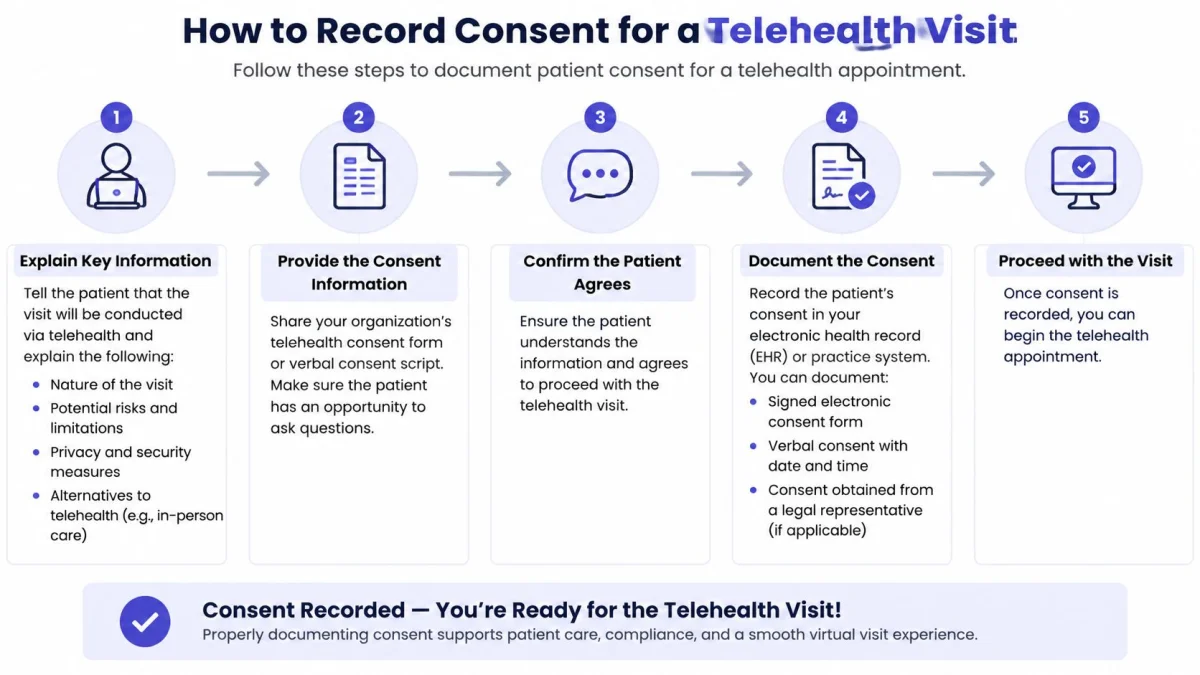
Consent to remote care and consent to recording are separate decisions. A single checkbox labeled consent can conceal which discussion happened and what the patient agreed to.
HHS guidance on informed consent for telebehavioral health recommends confirming patient identity, documenting everyone present, identifying telehealth use, and obtaining advance consent for recording. It also recognizes written, electronic, or verbal consent at the beginning of behavioral-health sessions, subject to applicable state rules.
Use a repeatable consent routine
Verify physical location before the appointment. Use the patient's current location, not an assumed home address. Leaving this field for later can delay a licensing or emergency-planning decision until after care has begun.
The visual summarizes the main consent checkpoints; the written routine also addresses connection changes.
Add jurisdiction-specific details
Texas adopted rules following a September 2025 statutory change require standardized consent records for treatment, data collection, and data sharing, including audio-only encounters; verbal consent must include the date, and consent records generally must be retained for at least seven years. That is a Texas requirement, not a nationwide consent rule.
For UK video visits, NHS England's video-consultation guidance also asks clinicians to confirm and record whether the patient is happy to use video again. State and service-specific checks should remain part of template maintenance.
A hypothetical completed entry could read: Patient identity confirmed against registration details. Patient at the location documented in the encounter header; clinician location also recorded. Patient alone, with adequate privacy reported. Video limitations explained; verbal telehealth consent obtained before assessment on the encounter date. No recording authorized or made. Connection remained adequate throughout. Patient willing to use video again.
Recording Telehealth Sessions Within Consent Rules
A patient asks to keep an audio copy of a complex treatment discussion held by video. Treat that request as an exception. NHS England's guidance on supporting high-quality video consultations advises against recording audio or video unless there is a justifiable reason and informed consent. The practical test is whether the clinician would record the same encounter face to face.
Convenience fails that test. A recording adds a sensitive file. Who may open it, where it is held, and when it is deleted belong in the encounter record with modality, locations, and any interruption. The clinical note still needs its own review before anyone signs the chart.
Write the exception into the chart
If recording proceeds, the entry should describe the file, not merely note that one exists. Purpose states why the recording supports this patient's care. Access names who may listen or view. Storage states where the file is held and how it is protected. Retention states how long it stays. Further use states that a new purpose needs the patient's express permission.
Mark when capture starts and stops, and name the secure location. In US settings, the working expectation is agreement in advance, then protected storage and transmission of the file.
The recording file is one of the encounter conditions: purpose, access, storage, retention, and the moment capture began.
For the patient who asked to record the treatment discussion, the entry explains the request, why recording met the face-to-face test, the agreed access and retention, and the storage location. If the patient declines, record that decision. Refusal of a recording leaves the consultation itself intact.
Tie the file to the practice storage rules
Operational guidance on maintaining an enterprise data protection policy from Freeform Company can help practices assign responsibility for access, storage, and deletion. Healthcare consent rules and local legal review still govern the decision. A medical recording app workflow should be checked against those decisions before capture becomes routine.
Audio-only visits use the same standard. Without a video image, the clinician still needs a justifiable reason, informed consent, and a record of what was kept.
Billing Codes and Retention Periods for US Telehealth
Start with the patient's location when selecting the Medicare place-of-service code. The CMS telehealth FAQ specifies 10 for telehealth in the patient's home and 02 for telehealth somewhere other than home; it also states that Medicare home telehealth services have been paid at the non-facility rate since January 1, 2024.
Place-of-service codes for telehealth
Telehealth location Place-of-service code Documentation note Patient's home 10 Use for telehealth delivered in the patient's home Any location other than the patient's home 02 Use for telehealth delivered somewhere other than the patient's home The location field should support the selected code. A statement that the visit occurred remotely doesn't establish whether the patient was at home, at work, or elsewhere.
Match the claim to the service furnished
The clinical record should make the service, medical necessity, assessment, and plan clear enough for billing review. Modality and any connection change should remain visible so the billing team doesn't infer uninterrupted video from a generic telehealth label.
Code eligibility also needs a separate check. A code's appearance in a telehealth-related quality-measure value set doesn't, by itself, establish that the particular service is eligible for telehealth billing. Commercial payer contracts and current payer guidance should be checked rather than treated as identical to Medicare policy.
Separate medical-record retention from HIPAA documentation
CMS medical-record maintenance requirements and HIPAA documentation requirements address different obligations. The CMS maintenance document discussed below sets the relevant Medicare record period and preserves the clinician's production responsibility even when another organization stores the file.
The HIPAA documentation period concerns documentation required under the Privacy Rule, not a universal retention period for every clinical chart. A practice shouldn't use that obligation as a shortcut for deciding when to delete medical records.
Archive check: The practice should be able to reproduce the final signed note and its supporting documents, not merely open an editable draft.
A workable retention schedule identifies record categories, applicable rules, the responsible owner, and the archive location. Where obligations overlap, the schedule should preserve records for the applicable longer period rather than applying a single deletion date indiscriminately.
The medical-record retention guide can support that operational review. Controls should include restricted access, auditability, reliable archiving, and a tested retrieval process. For UK records, the NHS guidance cited here doesn't establish a retention period; the practice must check current requirements for its setting and record type.
Common Documentation Gaps and How to Fix Them
A polished note can still fail to explain why the service was needed. Under CMS medical-record maintenance and access requirements, Medicare providers must retain records supporting the billed service, maintain medical records for seven years from the date of service, and remain responsible for producing them when a telehealth group or vendor holds them.
Medical necessity needs more than a diagnosis label. The note should connect the problem addressed to the clinician's assessment, reasoning, and plan. Adding video visit to an otherwise unsupported narrative doesn't repair that missing connection.
Keep the reasoning and supporting records together
Orders, prescriptions, referrals, and relevant correspondence should remain associated with the encounter. A referral mentioned in the plan but unavailable during retrieval leaves the reviewer with an incomplete record.
Telehealth documentation gaps, risks and fixes
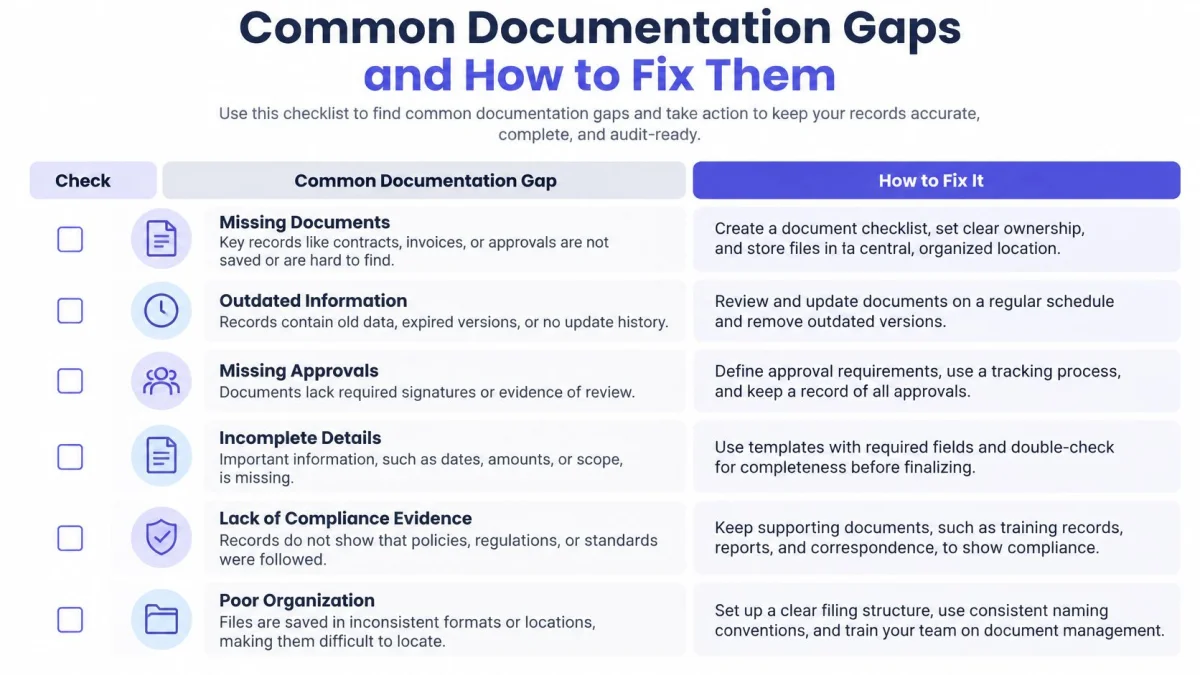
Documentation gap Risk Fix No modality recorded Visit reads like an in-person visit and the billing code may not match Name the modality and any change, such as video to phone No patient location recorded Licensure and emergency planning cannot be shown Record the patient's location at the start of the visit Connection failure not logged The record of what was assessed has unexplained gaps Note the interruption time and whether the visit was completed, converted, or rescheduled Recording without documented consent Consent to recording cannot be shown Document the discussion and decision before recording starts Polished narrative without reasoning Medical necessity cannot be shown on audit Record the problem, assessment, plan, and orders; retain supporting documents Chaperone status missing The examination record is incomplete State whether a chaperone was offered, declined, or present, and record the role The checklist makes useful template fields visible without suggesting that every field carries the same legal rule in every setting.
Replace generic reassurance with encounter-specific reasoning
A weak hypothetical entry might say: Follow-up by telehealth. Patient doing well. Continue treatment.
A stronger version for the same hypothetical medication follow-up would identify the condition being reviewed, the response and adverse effects discussed, and why the clinician chose to continue treatment. It would distinguish patient-reported information from remote observations, then record the follow-up plan and any orders made.
The stronger entry isn't better because it's longer. It lets another clinician understand the decision without reconstructing the conversation. It also avoids filling the examination with normal findings that weren't obtained.
Audio-only encounters need the same precision about what occurred. When video changes to telephone, preserve the original modality and the transition rather than replacing both with telehealth. The change doesn't establish a billing outcome on its own; the clinician and billing team still need to assess the applicable service and payer requirements.
A practice manager can use a documentation audit checklist to review the template, identify missing fields, and assign corrections. The clinician should then use those fields at sign-off rather than relying on an occasional retrospective audit to catch omissions.
Confirm Each Telehealth Note Before You Sign It
The clinician confirms the final record, including any automated draft, before signing. A tidy note can still misstate the visit. Read it as the record of the encounter's conditions, including modality, locations, consent, and interruptions, together with the assessment and plan. Your signature means you accept those statements as what happened.
Before you sign, apply the checks already set for modality and any change during the visit, locations and licensing authority, participants and consent, the recording decision, the clinical record, US code suggestions, and where the signed chart can be retrieved. The licensing determination stays with the clinician or the practice. If a required fact is missing, correct the template or the workflow for the next encounter. Do not add a retrospective line you cannot establish from the record.
Drafting stays separate from approval. PatientNotes records the visit and returns a structured note moments after recording stops, so you can review it, edit it, and copy it into the EHR. You confirm what that draft captured before the chart is signed. Suggested ICD-10, CPT, and CDT codes apply to US billing and stay suggestions until you accept them. The tool does not make clinical, coding, or licensing decisions.
Pull one telehealth note from last week. Read it once for the conditions of the visit and once for the plan, orders, and time. Anything you could not defend from the record is the change to make next time.
PatientNotes, built by a London-based company, includes a native iOS app with offline recording, notes and tasks in the clinician's own language, templates across 37 specialties, and an AI template builder. Semble is the only direct EHR integration; every other EHR uses copy and paste. It is HIPAA compliant and includes a BAA at no extra cost. Pricing is $70 per user per month billed monthly, or $50 per user per month billed annually, with a 7-day free trial that needs no credit card and a 14-day money-back guarantee. There is no enterprise tier and no sales call. Pricing details are on the pricing page, and templates are in the resources library.
Visit PatientNotes to try a template that prompts for location, modality, consent, and interruptions, while final review and signature stay with the clinician.