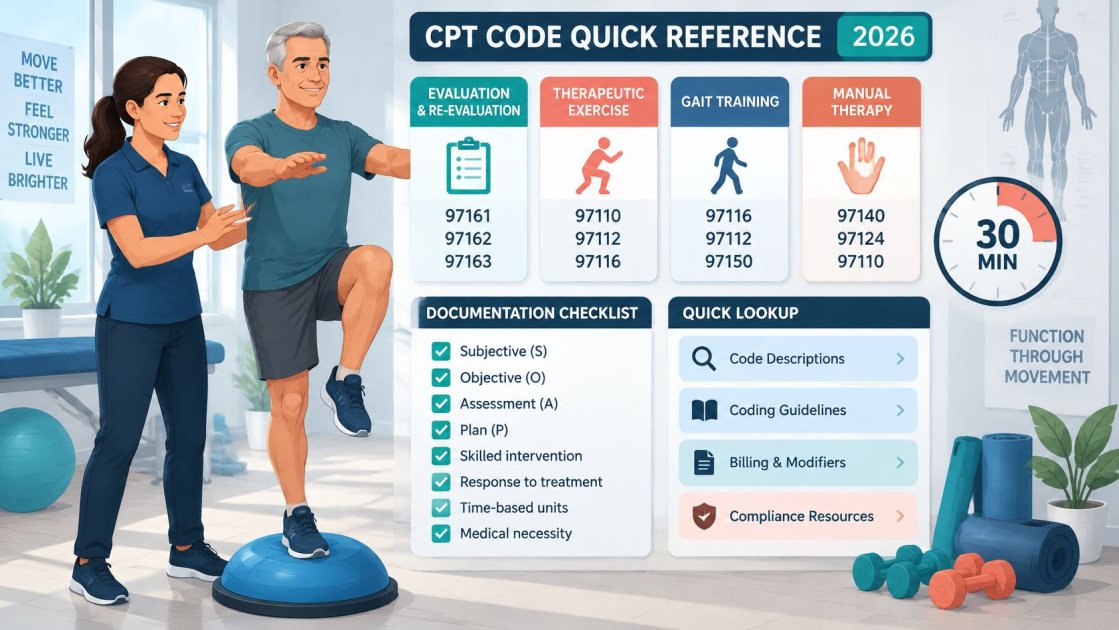
Four treatment codes did most of the work in Medicare physical therapy in 2024. Therapeutic exercise (97110), therapeutic activities (97530), neuromuscular re-education (97112), and manual therapy (97140) accounted for 88.1% of all Medicare physical therapy services, according to Arete Healthcare's analysis of 2024 Medicare physical therapy services. That concentration changes the priority for a small practice. Mastering CPT codes for physical therapy doesn't start with memorizing every code. It starts with documenting those four services, plus evaluations, so the minutes, provider identity, and plan of care in the note support every unit on the claim.
Common CPT Codes for Physical Therapy at a Glance
CPT is the code set maintained by the American Medical Association to describe medical services. A CPT code tells a payer what service was performed. It doesn't by itself determine payment. Diagnosis, authorization, modifiers, place of service, and documentation also matter.
The Timing column below is the practical divide. Untimed codes don't use minutes to create units. Timed codes do, so the note must record direct treatment minutes for each service.
| Code | Service | Timing | Typical use |
|---|---|---|---|
| 97161 | PT evaluation, low complexity | Untimed | New patient with a stable, low-complexity presentation |
| 97162 | PT evaluation, moderate complexity | Untimed | New patient with an evolving presentation or some comorbidities |
| 97163 | PT evaluation, high complexity | Untimed | New patient with an unstable or complex presentation |
| 97164 | PT re-evaluation | Untimed | Reassessment when the plan of care changes or needs updating |
| 97110 | Therapeutic exercise | Timed, 15-minute units | Strength, range of motion and endurance work |
| 97112 | Neuromuscular re-education | Timed, 15-minute units | Balance, coordination and proprioception training |
| 97116 | Gait training | Timed, 15-minute units | Walking, stairs and assistive device training |
| 97140 | Manual therapy | Timed, 15-minute units | Joint mobilization and soft tissue techniques |
| 97530 | Therapeutic activities | Timed, 15-minute units | Functional tasks such as lifting, reaching and transfers |
| 97535 | Self-care and home management training | Timed, 15-minute units | Teaching daily routines and home programs |
| 97032 | Attended electrical stimulation | Timed, 15-minute units | Stimulation with the clinician in direct attendance |
| 97035 | Ultrasound | Timed, 15-minute units | Ultrasound therapy with direct clinician attendance |
How to Read This Table
For 97110, the note should name the exercise, resistance or progression, and direct-contact minutes. A general statement about exercise isn't enough to show skilled work. Clinicians who want patient-facing background on the distinction between exercise and general activity can use the Aspen Falls Wellness therapeutic exercise guide as a plain-language starting point, then document the specific intervention delivered.
Unattended electrical stimulation is also untimed and is reported differently by payer, so it shouldn't be treated like 97032. A practice should verify the current descriptor and payer rule before adding any modality to a claim. A quick check against a CPT and HCPCS code lookup helps confirm the code family, but the current AMA CPT book and payer policy control the final choice.
Practical rule: If a code is timed, the note needs minutes. If the minutes aren't recorded, the unit isn't ready to bill.
Evaluation Codes and the Plan of Care They Start
Evaluation complexity isn't chosen by visit length. The choice among 97161, 97162, and 97163 rests on four components that must be visible in the note.
The Four Complexity Components
- History: Relevant medical history, prior function, comorbidities, and personal factors that affect care.
- Examination: Body structures, functions, activity limits, and objective tests and measures.
- Clinical presentation: Whether the presentation is stable, evolving, or unstable and changing.
- Clinical decision making: The reasoning that connects findings to diagnoses, prognosis, and treatment choices.
97161 fits a stable presentation with few personal factors or comorbidities. 97162 fits an evolving presentation or a patient whose comorbidities affect the plan. 97163 fits an unstable or changing presentation with several comorbidities or significant personal factors. If the note lists a high-complexity code but shows a brief history and one simple test, the code and documentation don't match.
97164 covers re-evaluation. It's for a reassessment when the patient's status or plan of care changes enough to require updated examination and revised goals. It isn't a routine code for every visit, and it shouldn't be scheduled by calendar alone. The note needs to state what changed, what was re-measured, and how the plan changed as a result.
The Plan of Care Check
The evaluation should produce a usable plan of care, not a vague statement that therapy will continue. Under CMS guidance tied to the Medicare therapy benefit, a Medicare physical therapy plan of care must contain, at minimum, the patient's diagnoses, long-term treatment goals, and the type, amount, duration, and frequency of therapy services.
Before the first timed code is billed, the plan should answer six questions:
- Diagnoses: Which conditions are being treated?
- Long-term goals: What functional outcome is expected?
- Type: Which services will be provided?
- Amount: How much treatment is planned per visit?
- Duration: How long is the episode expected to continue?
- Frequency: How often will services occur each week?
This level of specificity also helps when care involves more than one discipline or setting. For example, background on physician-guided recovery for active adults shows why goals and treatment roles need to be explicit when recovery is coordinated. In a PT claim, the same clarity matters for a different reason. Every timed service on later claims should be traceable to a service type and goal in the plan. If manual therapy appears on a claim but never appears in the plan, the practice has created an avoidable justification problem.
An evaluation code describes complexity. The plan of care proves what that complexity led to.
How the 8-Minute Rule Turns Minutes Into Timed Units
Timed codes are billed in 15-minute units, and Medicare adds the minutes across all timed codes furnished on the same day before it assigns units. That single sentence prevents the most common unit error. Minutes aren't rounded up separately for each code.
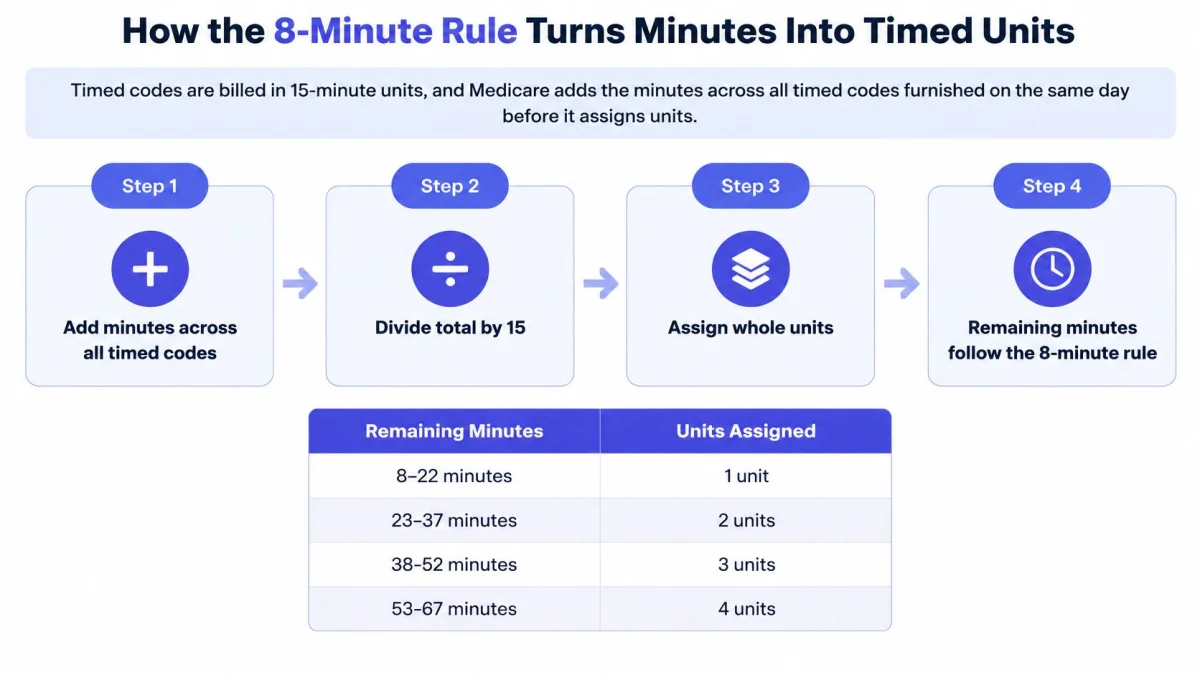
Under the ranges in CMS guidance on outpatient therapy billing, 8 to 22 minutes support 1 unit, 23 to 37 minutes support 2 units, 38 to 52 minutes support 3 units, 53 to 67 minutes support 4 units, 68 to 82 minutes support 5 units, and 83 to 97 minutes support 6 units.
| Total timed minutes | Billable units | Example |
|---|---|---|
| Under 8 | 0 | 7 minutes of 97110 is not billable as a timed unit |
| 8-22 | 1 | 10 minutes of 97110 |
| 23-37 | 2 | 30 minutes across 97110 and 97140 |
| 38-52 | 3 | 40 minutes across 97110 and 97140 |
| 53-67 | 4 | 60 minutes across four timed codes |
| 68-82 | 5 | 75 minutes across four timed codes |
| 83-97 | 6 | 90 minutes across five timed codes |
A Worked Calculation
Say a visit includes 22 minutes of 97110 and 18 minutes of 97140. The total is 40 timed minutes, so the visit supports 3 units in total. It doesn't support two units for each code because each service passed eight minutes. The total controls the ceiling.
Use this sequence before units are entered:
- Record minutes per code: Write the direct-contact minutes beside each timed service.
- Add the timed minutes: Total all timed services for that date.
- Find the unit range: Match the total to the table.
- Allocate units: Assign units to the codes under the payer's allocation rules.
- Check payer policy: Confirm whether the payer follows Medicare's method or a different timed-code rule.
Those ranges are Medicare rules. Commercial payers can use different thresholds or allocation methods, so a Medicare-correct claim isn't automatically correct for every payer. The record should therefore preserve the underlying facts, per-code minutes and the session timed total, rather than only storing final units. Units can be recalculated for a payer. Missing minutes can't be reconstructed reliably after the visit.
Documenting Timed Minutes and Total Treatment Time
Two time fields do different jobs, and a compliant note needs both. Timed Code Treatment Minutes support the units billed. Total Treatment Time records the full treatment duration.
CMS Medicare coverage guidance on therapy documentation states that the record must clearly identify both "Timed Code Treatment Minutes" and "Total Treatment Time" to support the units reported. A note that records only a general visit duration may not provide the specific detail needed to justify timed CPT units under Medicare policy.
What Each Timed Entry Should Show
Each timed service should be documented as a discrete line with four elements:
- Service and code: The intervention name and CPT code, such as therapeutic exercise, 97110.
- Direct minutes: Actual skilled, one-on-one contact time, not an automatic 15-minute entry.
- Timing status: Whether the service is timed or untimed.
- Rendering clinician: The PT or PTA who performed that service.
Separate CMS guidance on timed and untimed therapy services advises recording actual treatment time rather than automatically rounding each service to 15 minutes, with exact or sufficiently precise times in the medical record. That distinction matters during review. A note showing four services at exactly 15 minutes each, every visit, looks templated rather than measured.
Untimed services still belong in total treatment time. They don't create additional timed units. For example, an untimed modality can explain why total treatment time is longer than the timed-minute total. Without that separation, a reviewer sees a mismatch and may question the units.
A Model Note Line
A usable entry is short and specific:
97110 therapeutic exercise, 22 minutes of direct contact, performed by the PT. Total treatment time 55 minutes.
That line gives the biller the code, minutes, and provider. It also separates timed work from the full session. A structured physical therapy progress note template can prompt those fields during the visit, which is safer than asking clinicians to recall minutes later.
The final reconciliation is simple. Add the per-code minutes. Confirm that they equal the timed-minute total. Confirm that the total supports the billed units. If any number disagrees, resolve it from the clinical record before submission. Don't adjust minutes to make the arithmetic look cleaner.
Combining PT and PTA Minutes on One Visit
Eight minutes doesn't always mean a PT-only unit. That assumption breaks when a physical therapist assistant provides part of a multi-unit visit. Total minutes determine how many units the visit can support, but provider identity can determine how the final unit is reported.
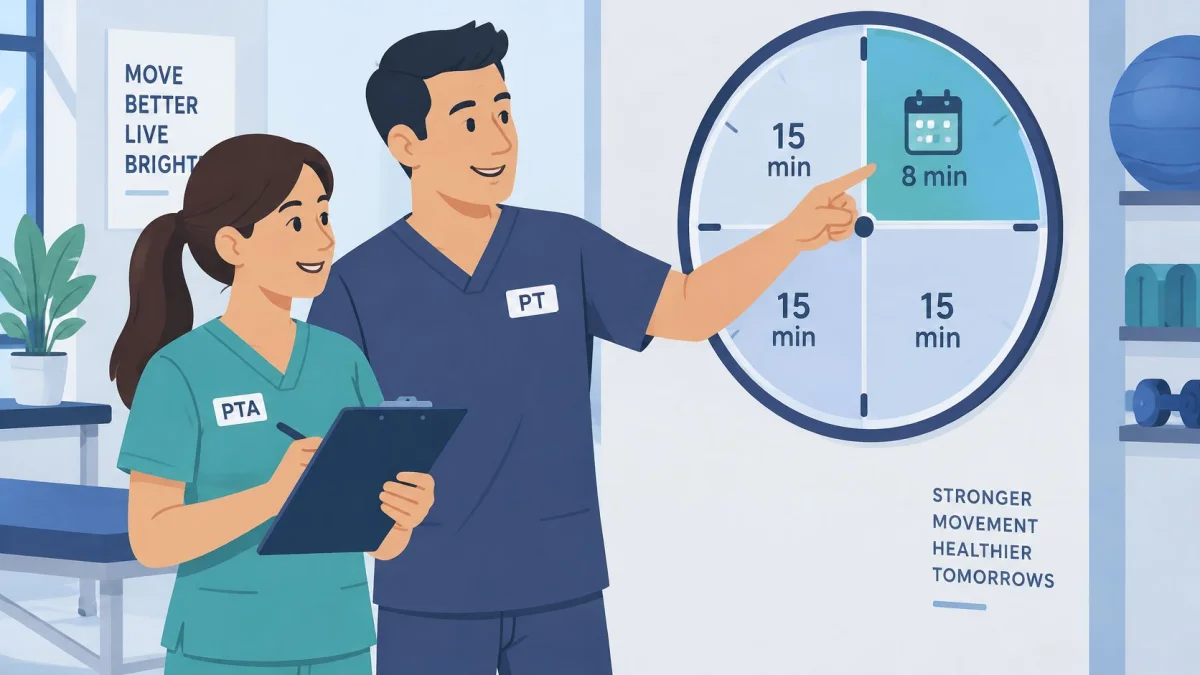
In certain multiple-unit scenarios described in CMS billing examples for services furnished in whole or in part by PTAs and OTAs, the PT must independently provide at least 8 minutes of the final 15-minute unit before that unit can be billed without the CQ modifier. PTA minutes count toward the visit total, but they don't count toward that specific PT threshold.
Where the Counterintuitive Result Appears
Say a visit contains 45 combined timed minutes. The total falls in the three-unit range. The PT personally delivered 30 minutes, and the PTA delivered 15 minutes. The visit has enough total time for three units, yet the final unit depends substantially on PTA time. Depending on the exact allocation, that final unit may require CQ or may not be billable as a PT-only unit.
A clearer clinic example shows the documentation fix:
- 97110 therapeutic exercise: 20 minutes, PT.
- 97116 gait training: 15 minutes, PTA.
- 97140 manual therapy: 10 minutes, PT.
- Total timed minutes: 45 minutes.
That note lets a biller see both dimensions, minutes by code and minutes by clinician. A narrative stating "45 minutes of therapy provided" doesn't. It leaves the biller to guess who furnished gait training and whether the PT met the final-unit threshold. Guessing is where modifier errors start.
Small clinics that alternate PT and PTA work are exposed because schedules change during the day. A PT may start manual therapy, hand gait training to a PTA, then return for exercise instruction. The note should follow that actual sequence. Provider initials beside each intervention are enough if the record defines them clearly.
Medicare's CQ examples are detailed, and commercial payer treatment of PTA services can differ. Allocation should be verified against the applicable payer policy before submission, especially when the final unit crosses providers. The safe operational rule is narrow: record the rendering clinician and minutes for every code. A claim system can apply a rule only if the note gives it separable PT and PTA minutes.
Modifiers and Claim Checks Before You Submit
Modifiers explain who furnished a service and under what kind of plan. They're not decorative codes added by billing software. Each one should be supported by provider and plan information in the record.
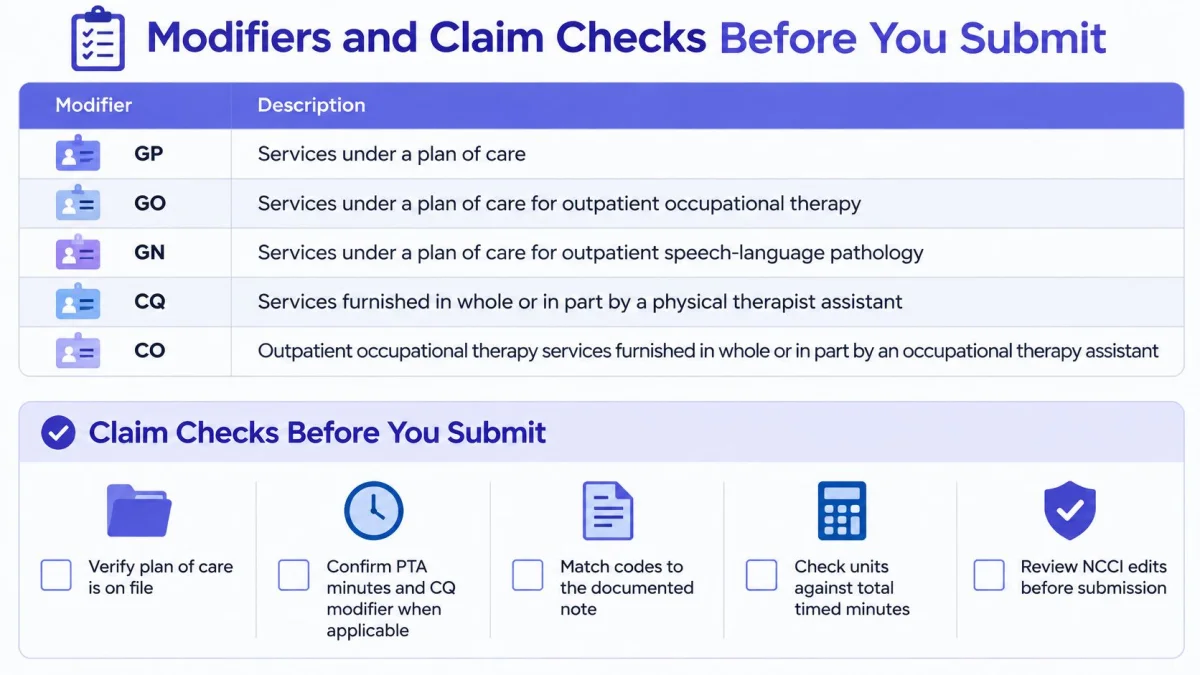
| Modifier | Applies when | Source to verify |
|---|---|---|
| GP | Therapy services furnished under a therapy plan of care | CMS therapy services guidance |
| GO | Occupational therapy services furnished under a therapy plan of care | CMS therapy services guidance |
| GN | Speech-language pathology services furnished under a therapy plan of care | CMS therapy services guidance |
| CQ | Medicare PT service furnished in whole or in part by a PTA | CMS billing examples for CQ and CO |
| CO | Medicare OT service furnished in whole or in part by an OTA | CMS billing examples for CQ and CO |
For Medicare, CMS therapy services guidance requires the CQ modifier for outpatient PT services provided in whole or in part by a physical therapist assistant, alongside the GP modifier, for applicable dates of service beginning January 1, 2020.
The short video below is useful as a visual refresher before the final claim review.
Seven Checks Before Submission
- Diagnosis support: The diagnosis on the claim supports each CPT code.
- Unit math: Billed units match the total timed minutes.
- Plan status: A current therapy plan of care is in place.
- Rendering clinician: The claim clinician matches the note for each service.
- Assistant modifier: PTA services carry CQ when Medicare rules require it.
- Evaluation match: The evaluation code matches documented complexity.
- Payer rules: Commercial payer requirements have been checked separately from Medicare.
If a check fails, correct the claim to match the note. Don't edit the note to fit a preferred code. That's the line between claim correction and unsupported documentation.
Remote Therapeutic Monitoring Codes Added in 2026
A new code doesn't make a digital encounter billable. That's the point clinicians need to understand before adding remote therapeutic monitoring, or RTM, to a therapy workflow.
The CMS 2026 therapy code list update designates 98979, 98984, and 98985 as "sometimes therapy" services beginning January 1, 2026. The update includes musculoskeletal-system data transmission through 98985 and requires therapy-related RTM services to be furnished under a therapy plan of care with the appropriate GP, GO, or GN modifier.
Documentation That Connects Monitoring to Care
An RTM note should do more than state that app data was received. It should support:
- Patient consent: Agreement to monitoring and data transmission.
- Data reviewed: The device or app data, dates, and monitoring interval.
- Interactive communication: What was discussed with the patient and when.
- Management time: Time spent reviewing data and managing treatment.
- Clinical interpretation: What the data showed about symptoms, function, or adherence.
- Plan change: Any exercise, activity, or visit-frequency change that followed.
RTM is therefore a workflow problem. A clinic needs a weekly place to log transmitted data, review dates, patient contact, and treatment decisions. A list of codes taped to a wall won't create that record. If monitoring data doesn't influence interpretation or management, the documentation may not support the code's service definition.
Payer requirements also need checking before the first RTM claim. Medicare designation as sometimes therapy doesn't mean every payer covers the service on the same terms. The therapist still has to meet the exact code definition, furnish the service under a therapy plan of care, and apply the correct therapy modifier. Review the CMS 2026 therapy code list for each code before reporting it.
Validating AI-Suggested Codes Against the Note
An AI-suggested CPT code is a draft, not a claim entry. PatientNotes suggests ICD-10, CPT and CDT codes with each note for clinician review. Those suggestions apply to US billing only. UK clinicians should follow their local coding rules and shouldn't treat a US CPT suggestion as a UK coding instruction.

Six AI-Specific Checks
- Trace the code to a sentence: Reject any suggestion that can't be traced to actual wording in the note, even if a template field selected it.
- Confirm the service is named in words: The narrative should describe therapeutic exercise, gait training, or another service. A checked box alone is thin support.
- Compare extracted minutes: Check minutes for each timed code and the session total against the source note.
- Verify rendering clinician: Confirm that the PT or PTA named by the system delivered that service.
- Review flags without delegating judgment: Useful flags include a timed code without minutes, an unrecorded PT and PTA split, unsupported evaluation complexity, or a missing plan of care. The system flags. The clinician decides.
- Correct incompletely: If a service was documented incompletely, add only what the clinician did as a dated late entry. Never add time that wasn't spent.
A common failure looks harmless. The note says balance exercises were performed, and the software suggests 97112. If the note doesn't show neuromuscular re-education content, direct minutes, and the rendering clinician, the suggestion isn't ready. Another failure involves copied template language that names manual therapy when the visit consisted of exercise instruction. Accepting that code would misdescribe the encounter.
Practices building a review routine can use guidance on medical coding errors to separate extraction errors from documentation gaps. After these AI-specific checks, the claim still needs the full pre-submission review for diagnoses, units, modifiers, and payer rules. The clinician remains responsible for every code submitted.
Validate Your Next PT Claim Before You Submit
Start with claims already produced. They show whether the documentation system works under real clinic pressure.
- Check five recent claims: Mark any timed code with no minutes in the note and any unit total that doesn't match the timed total.
- Run one note through the claim checklist: Verify diagnosis support, rendering clinician, modifiers, evaluation complexity, and payer policy.
- Audit active plans: Confirm that each plan lists diagnoses, long-term goals, and the type, amount, duration, and frequency of services.
PatientNotes can be used as the place to run that review. Notes include suggested ICD-10 and CPT codes for US billing, with CDT suggestions where applicable. It's HIPAA compliant, and a Business Associate Agreement is included at no extra cost. Clinicians can record on a native iOS app with offline recording or on the web, and notes and tasks are produced in the clinician's own language.
Specialty templates cover 37 specialties, with an AI template builder included. Semble is the only EHR integration. Every other EHR works by copy and paste. Pricing is $70 per user per month billed monthly or $50 per user per month billed annually, shown at PatientNotes pricing. The 7-day free trial needs no credit card, a 14-day money-back guarantee applies, and there's no enterprise tier and no sales call.
Test the workflow on one PT visit and check whether the suggested codes trace cleanly to the documented minutes, clinician, and plan of care. Start the free trial at PatientNotes and validate the next claim before it leaves the practice.