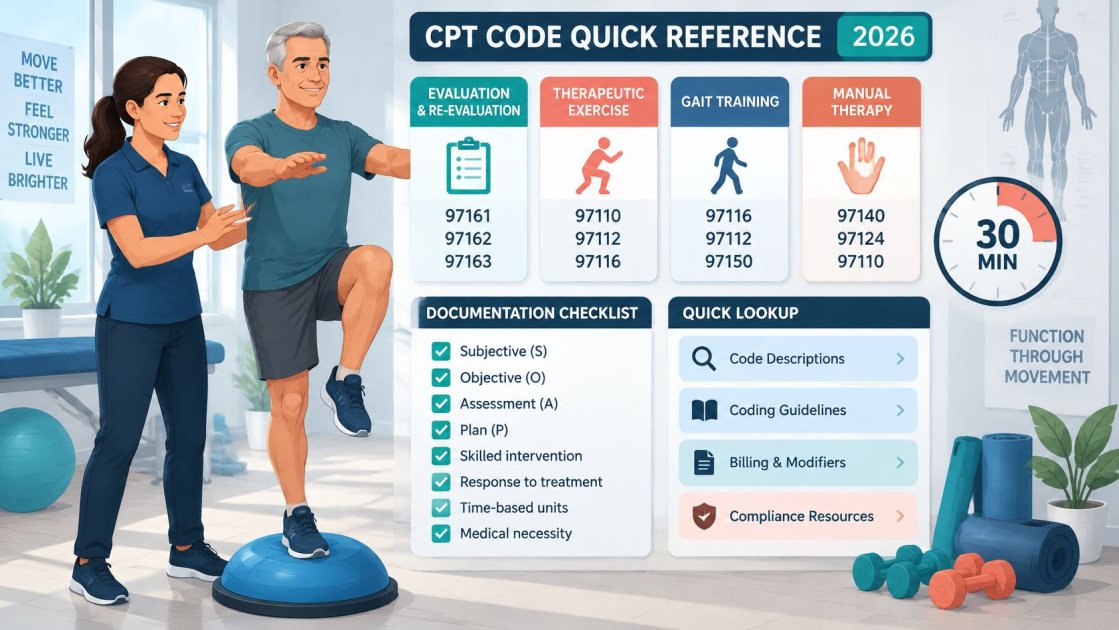
A 2023 review of physical therapy documentation in an electronic health record found that only 14 of 56 encounters, or 25.0 percent, included an assessment, and only 12 encounters, or 21.4 percent, included a plan (the 2023 EHR documentation study). Those are the two fields a reviewer reads first, and they're the two most often missing.
A physical therapy evaluation template is the fixed set of fields that turns an initial examination into a record of impairment, function, goals and treatment logic. Treat it that way and the note starts to defend itself. Each field should separate what the patient reported from what the clinician observed and what was measured, so a colleague picking up the case, or an auditor reading it cold, can follow the reasoning without guessing.
Template Sections at a Glance
The APTA guidelines for documentation of patient and client management identify seven core domains for an initial examination and evaluation: history, physical examination, tests and measures, diagnosis, prognosis, management plan and plan of care. A workable template maps one field group to each domain and stops there. Extra sections tend to go blank.
| Template section | What to record | Example entry |
|---|---|---|
| Patient history | Chief complaint, onset, prior episodes, comorbidities | Low back pain, onset 3 weeks ago after lifting |
| Review of systems | Systems screened and red flags | Cardiopulmonary screen negative; no bowel or bladder change |
| Physical examination | Body structures, function, gait, balance | Lumbar flexion limited to 40 degrees |
| Tests and measures | Named outcome measures with baseline scores | Timed Up and Go in seconds, with device and assistance noted |
| Diagnosis and prognosis | Therapist diagnosis and expected course | Impaired lumbar mobility; prognosis fair for return to work |
| Goals | Measurable short-term and long-term goals | Walk 400 meters without a cane within six weeks |
| Plan of care | Interventions, frequency, duration and signature | Therapeutic exercise twice weekly for eight weeks, signed and dated |
Read the table as one record with seven faces, not seven forms. History sets the context for the examination, the examination produces the measures, the measures anchor the goals, and the plan of care states what will be done to reach them. Break that chain and each section has to be invented from scratch at every visit.
No single format is mandatory. What is mandatory is that the record demonstrate the clinical reasoning behind the selected evaluation complexity (APTA documentation elements guidance). The same guidance puts authentication in the template itself, because the therapist who performed the service documents, dates and signs the examination, evaluation, diagnosis, prognosis and plan of care.
The sections that follow take each row in turn. One job at a time.
History Fields That Set Up the Whole Note
History fields belong in the order a clinician asks them, and each one should earn its place by changing what gets tested next.
Chief complaint in the patient's words. Not a diagnosis. "It catches when I stand up from the sofa" describes a loading pattern; "lumbar radiculopathy" describes a conclusion the patient probably didn't reach alone. The phrasing also gives you the goal sentence later.
Onset, date and mechanism. Sudden onset with a clear incident reads one way, gradual onset with no trigger reads another. The date matters to the reasoning and to the payer.
The 24-hour pattern. Pain that is worst on waking and eases with movement behaves differently from pain that builds through the afternoon or wakes the patient at night. Two short fields carry this: what aggravates, what eases.
Prior episodes and outcomes. What was tried, what helped, what was abandoned. A patient who stopped a previous course of therapy after three visits is telling you something about the plan.
Medications and allergies. The allergy line earns its place in a hands-on session. Adhesive allergy gets recorded before anyone reaches for tape or an electrode pad.
Comorbidities and personal factors, each as its own entry with an impact line. APTA links these factors directly to participation and treatment progression, so a bare list is not documentation. Diabetes, a shift-work schedule and a fear of falling each need a sentence on how they change the plan.
Where the intake ends and the history begins
Occupation, daily activities, living situation, stairs at the home and any assistive device in use all belong here. Home setup is clinical data. A patient managing four steps to reach a bathroom, or a shower with no rail, has a participation problem the plan has to address, and this home safety assessment checklist works as a prompt list for that field.
PatientNotes publishes a free, print-ready General Patient Intake Form template covering demographics, insurance and basic history, so the therapist's history field can be spent on clinical content instead of repeating the clipboard.
Add a precautions line for any red flag that needs physician review before treatment continues, with the decision recorded rather than implied.
The test for every history line: it should trace back to a question the clinician asked and an answer the patient gave. Text carried over from an old chart is not history, it's an assumption with a date on it.
Examination and Outcome Measure Fields
Objective findings need their own block, separate from patient-reported information. CMS guidance expects therapy assessment methods to measure function objectively, with results recorded in the clinical record. Its examples include walking, stair climbing, dressing, toileting, assistive-device use, and relevant cognitive factors (CMS therapy requirements fact sheet). A note should show what was tested and what the result means for function. If the record lacks a measure, it cannot support medical necessity.
What every measure field needs
Use the same fields each time a measure is recorded. Consistent entries let a later clinician compare results rather than guess whether the test was performed the same way.
- Instrument and version, written in full. A short form and full form of the same questionnaire are not interchangeable.
- Baseline score and date, so the starting point is clear.
- Affected side or task, such as left side or stair descent rather than level walking.
- Units, such as points, seconds, meters, or a percentage.
- Assistance level and device, because a time recorded with a rolling walker cannot be compared directly with an unassisted time.
- Test conditions, including surface, footwear, and rest breaks. Most intake templates have no field for these conditions, though they affect interpretation.
- Goal threshold, the value the plan is aiming for.
- Reassessment field linked to the prior value, making change visible in the record.
- Interpretation, stating whether the change is clinically meaningful and how it affects the plan.
| Problem | Outcome measure | Score range | Use it for |
|---|---|---|---|
| Low back pain | Oswestry Disability Index | 0-100 percent | Disability level and change over care |
| Neck pain | Neck Disability Index | 0-100 percent | Neck-related disability and change |
| Upper extremity | QuickDASH | 0-100 | Arm, shoulder and hand function |
| Balance and fall risk | Berg Balance Scale | 0-56 points | Static and dynamic balance |
| Gait and mobility | 10-meter walk test | Seconds (speed in m/s) | Walking speed |
| Mobility and transfers | Timed Up and Go | Seconds | Functional mobility and fall risk |
| Knee osteoarthritis | KOOS | 0-100 | Pain, symptoms and function |
Record score direction alongside interpretation. Higher scores indicate worse status on the Oswestry, Neck Disability Index, and QuickDASH, but better status on the Berg and KOOS. A progress note that reverses the direction can make improvement look like decline, or the reverse, and create questions about the episode of care.
A 2025 U.S. survey of 514 physical therapists found 97 percent used performance-based tests and 83 percent used self-report surveys, yet fewer than half believed the measures were administered in a standardized manner (PLOS ONE survey of physical therapists). Clinicians use these tests, but inconsistent recording makes results difficult to compare. A field labeled “functional assessment” alone does not preserve the score, conditions, or method.
For Medicare-covered therapy, progress documentation is generally expected when treatment exceeds 10 treatment days or 30 calendar days, whichever comes sooner, and should compare current findings with prior measurements (CMS therapy requirements fact sheet). Include the comparison field in the template so the change can be documented when required.
If a measure is dropped or modified, record a concise reason. Pain may limit standing tolerance, cognition may make a two-stage instruction unreliable, or the treatment room may lack a clear 10-meter path. For dressing or toileting, describe the task in the patient's own home context. The daily living guide from Life Senior Placement provides plain-language examples of these activities. Keep observed performance distinct from interpretation, so another clinician can see what happened and why the finding shaped the plan.
Complexity Fields That Justify the Evaluation Level
A rationale such as “moderate complexity due to pain” may not explain why the evaluation level fits. Record the factors, examination scope, presentation stability, and decision-making complexity that support the choice. In the United States, evaluation coding has three levels, and the documentation should address the criteria described in the CMS Medicare Learning Network compliance guidance for physical therapy.
| Evaluation code | Complexity | Personal factors or comorbidities | Exam elements | Presentation and typical face-to-face time |
|---|---|---|---|---|
| 97161 | Low | None that affect the plan | 1-2 elements | Stable or uncomplicated, about 20 minutes |
| 97162 | Moderate | 1-2 relevant factors | At least 3 elements | Evolving, about 30 minutes |
| 97163 | High | 3 or more relevant factors | At least 4 elements | Unstable or unpredictable, about 45 minutes |
Use a checklist for the four criteria, followed by a concise rationale. In two sentences, state which factors were present, how many elements were examined, and why the selected level fits better than the level below or above it. Keep observed findings distinct from the interpretation used to choose the level.
Counting examination elements
The examination scope depends on the body-system or functional elements addressed, not the body region named. The APTA evaluation codes pocket guide distinguishes categories by the number of elements examined. Make the count visible in the note. Depending on what was assessed, elements may include range of motion, strength, gait, balance, transfers, respiratory or cardiovascular findings, skin integrity, cognition, and communication.
Set the stability field to one of three options: stable or uncomplicated, evolving, or unstable or unpredictable. Then document the clinical findings that support the selection. A label without a reason does not show how the presentation affected the evaluation.
Coding rules and payer policies govern the claim, so confirm current CPT descriptors and local requirements before billing. For a closer look at CPT codes for physical therapy, review how the coding criteria relate to the evaluation record. The note should make the reasoning legible to a colleague or reviewer who was not present: each conclusion should follow from the factors and examination findings recorded.
Assessment and Clinical Reasoning Fields
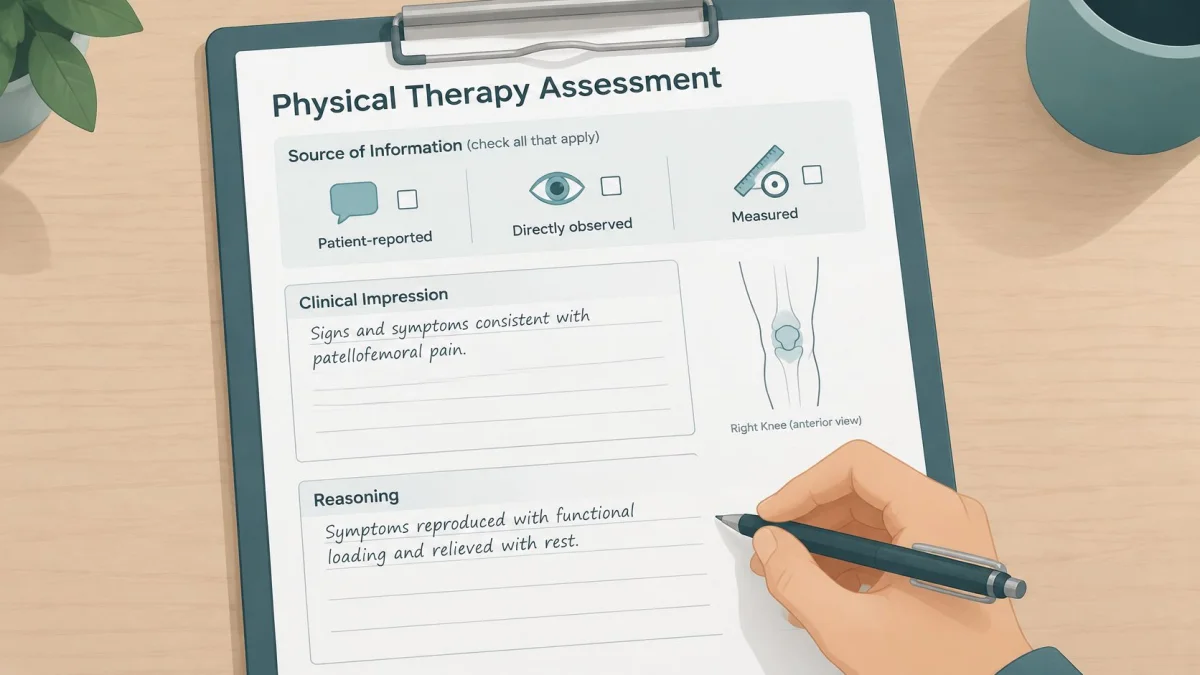
An assessment should read as a record of clinical reasoning, not a collection of conclusions. Separate what the patient reported, what you observed, and what you measured. That distinction lets a reviewer trace each interpretation back to its evidence.
For example, “Knee pain limits stair descent” is patient-reported. “Descends stairs with a valgus thrust” describes an observed movement. A baseline Knee Outcome Survey score is a measurement. Label each source clearly, and avoid presenting an inference as an objective finding.
The reasoning fields should show what is known, what remains uncertain, and what needs follow-up. Include limitations of examination, with the test not completed and the reason. State the clinical hypothesis as a working explanation, not a confirmed diagnosis. Add differential considerations and referral triggers when another cause needs to be considered or the patient may need referral.
Then connect each impairment to a specific functional limitation. Record the prognosis and the factors that could change the expected course. A clinician confirmation field should flag details that need checking, such as laterality, onset, red flags, measured values, assistive-device use, or wording drafted by software.
The distinction matters when documentation is assisted by AI. A 2025 study of generative AI in rehabilitation documentation reported lower time pressure and better documentation quality, but no faster documentation (2025 study of generative AI in rehabilitation documentation). The finding supports a practical standard: assess the note for accuracy and completeness, not just how quickly a draft appears.
Mark unverified statements for review. Keep speculative explanations separate from confirmed findings, and confirm any software-generated wording against the examination before signing. A polished sentence still needs clinical support.
A standard SOAP structure can help keep reported information, objective findings, and clinical interpretation distinct. This SOAP note example for physical therapy shows how those parts fit together.
Writing Goals and the Plan of Care
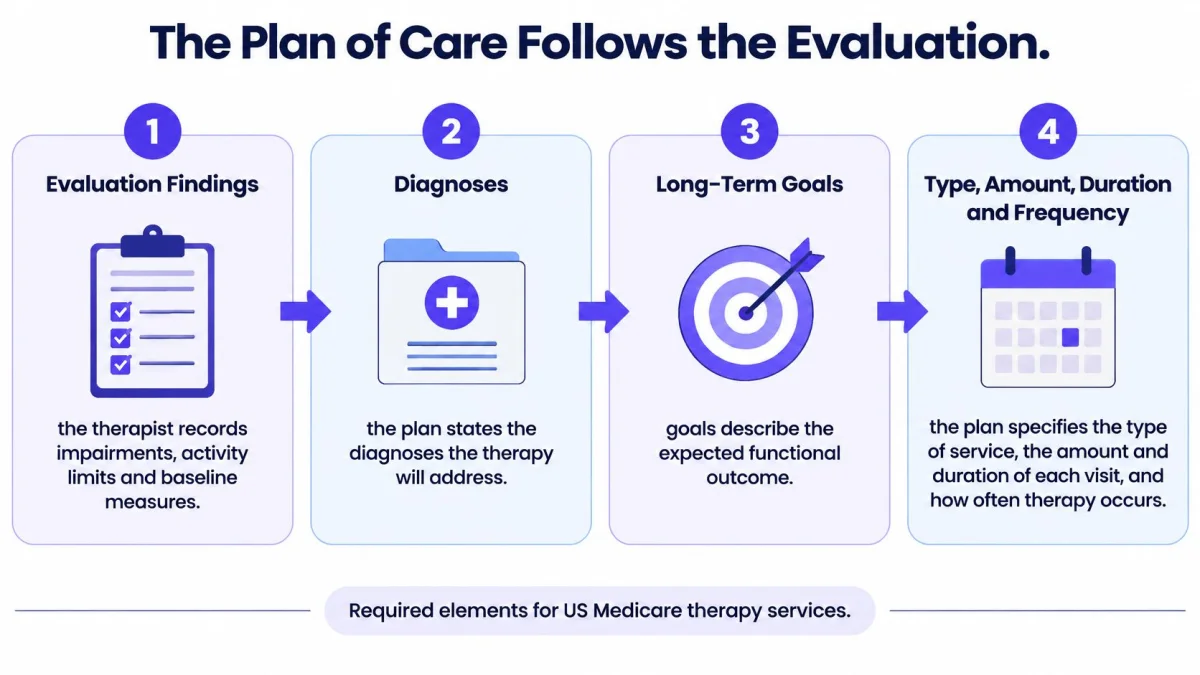
For US Medicare therapy services, the plan of care must state the diagnoses, long-term treatment goals, and the type, amount, duration, and frequency of therapy services. CMS identifies these as minimum requirements under the applicable regulations (CMS transmittal R88BP). Give each item its own field so the clinical rationale is clear and reviewers can locate required information.
Include the diagnoses being treated, long- and short-term goals, intervention type, amount or units, expected duration, frequency, and certification with signature and date. The plan should read as a record of reasoning: distinguish what the examination measured from what the therapist concludes those findings mean for function.
A worked example
A patient six weeks after total knee replacement walks 400 meters with a cane before stopping. A useful goal connects that observed baseline to a measurable functional target: 800 meters without an assistive device at eight weeks, measured with the six-minute walk test. Schedule reassessment for week four. The target, method, and timing let another clinician judge progress without having been present for the evaluation.
Build the plan from the impairment to the activity:
- Connect each functional limitation to its baseline score.
- State each goal with a measure, target, and date.
- Select interventions that address a named impairment.
- Specify frequency and duration.
- Set the reassessment date and identify the test.
- Sign and date the plan.
Interventions need a documented link to the impairment. Leg press and quad sets, for example, should address a stated finding such as quadriceps strength measured against the other side. A generic exercise list does not show why each intervention was selected. A modality without a linked impairment may be challenged by a reviewer.
Payer and setting requirements vary by episode. When measures have not changed, document why continued treatment remains appropriate and connect that decision to the patient's function and examination findings.
Carrying the Evaluation Forward Through Re-Evaluation and Discharge
The initial evaluation sets a baseline that every later note is measured against, and the template should make the pairings obvious before the first follow-up.
APTA's standards expect documentation of the initial examination and evaluation, diagnosis, prognosis, plan of care, intervention, responses to intervention, changes in patient status relative to intervention, reexamination and an episode-of-care summary (APTA standards of practice for physical therapy). Those headings translate into repeatable visit fields: what was delivered, how the patient responded, which objective values were rechecked, and whether the plan changed.
Trace one measure and the design becomes clear. A Timed Up and Go recorded at baseline pairs with the same test at reassessment, same device, same surface, same instructions. A long-term goal pairs with a progress entry that states the current value. A diagnosis carries through to the discharge summary. An intervention pairs with a documented response.
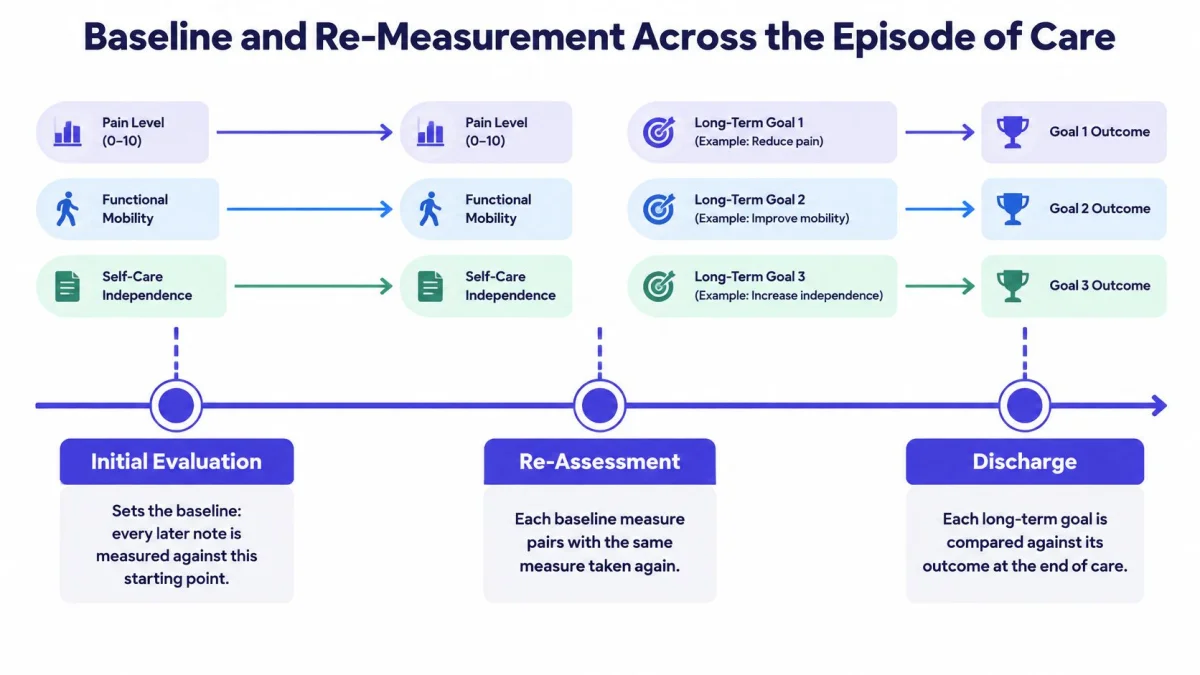
Keeping the same measure, the same version and the same test conditions across the episode is what makes scores compare directly. Switching from a full questionnaire to a short form mid-episode produces two numbers that can't be subtracted from each other, and the note is weaker for it. For the note structure that carries these pairings visit by visit, this physical therapy progress note template covers the recurring fields.
One discipline closes the loop. Any field carried forward from a previous note gets marked as carried forward and then confirmed against today's findings. A goal restated without confirmation isn't progress, it's a copy.
Gaps to Close Before You Sign
The last review should test whether each statement has a clear basis and whether the record distinguishes observation from interpretation. A concise note can still be difficult to defend when a reader cannot tell who reported a fact, what the therapist measured, or why a decision was made.
Close the gaps that change how the note reads
Use the table as a final audit. These checks focus on whether key information is connected, rather than repeating the full field-by-field review of measures, examination findings, goals, and clinical reasoning addressed earlier.
| Gap | Where it appears | Template fix |
|---|---|---|
| Comorbidity listed without a link | History and assessment | Tie the factor to a finding or to the complexity rationale |
| No assessment or plan | Visit notes | Require separate assessment and plan fields |
| Red flag not recorded | Review of systems | Include a precautions field and the referral decision |
| Measure omitted or modified without a reason | Physical examination | Add a field for the reason |
A comorbidity on its own does not explain its relevance to the evaluation. State the connection to the patient's findings or to the complexity rationale. If a red flag changes the plan, record the referral decision so a colleague can follow the reasoning.
A skipped measure needs a one-sentence reason written down. Pain, fatigue, cognition, a language barrier, fall risk, or a room too small for a 10-meter walk may affect test selection. Document the specific limitation and whether the measure was modified or omitted. One measure per problem can be appropriate when the reason for choosing it is clear.
Before signing, check the remaining record-level details: the patient's chief complaint and onset are documented in their own words, and precautions are addressed. Confirm that the diagnosis and prognosis are explicit, interventions and visit parameters are recorded, and the complexity rationale is stated. Then clear any items requiring clinician confirmation, including laterality, onset, red flags, objective values, assistive-device use, or a software-generated draft. Finish with the signature and date.
The closing test is simple: can a colleague distinguish what the patient reported, what the therapist observed or measured, and what the therapist concluded? If the basis for a statement is unclear, revise it before signing. If a statement has no clinical basis, remove it.
Build the Template and Test It on One Patient
A template should capture clinical reasoning, not just collect fields. Each entry needs to distinguish what the patient reported, what you observed, and what you concluded. Build a draft, then test whether those distinctions remain clear during a real evaluation.
- Choose outcome measures that fit common problems in the practice.
- Arrange fields in the same order as the evaluation.
- Complete the draft during one evaluation before sharing it.
- Record fields that take too long or are left blank.
- Revise the template after one week.
- Share the revision across the practice.
Pay close attention to blank fields. A field left empty across multiple notes may be unclear or unnecessary. If clinicians cannot complete it in the time available, they may guess. Rewrite the prompt so it asks for a specific observation, patient report, or clinical interpretation.
PatientNotes offers built-in templates for 37 specialties, including physiotherapy, and an AI template builder for creating templates from a dictation, chat, or uploaded document. Custom templates can be set up for different visit types and workflows, then shared across a practice.
The template should make required fields easy to find, but payer and setting policies determine what a signed evaluation must contain. Check those requirements before using the template. Then confirm that each field captures evidence or reasoning, rather than inviting a conclusion without support.
PatientNotes can record an evaluation and draft it into a physiotherapy initial evaluation template, including history, systems review, range of motion, strength, outcome measures, clinical impression, prognosis, goals, and plan of care. Review and edit the note before signing. The service costs $70 per user per month billed monthly or $50 per user per month billed annually. It includes a 7-day free trial with no credit card required and a 14-day money-back guarantee. Start at PatientNotes to see whether its workflow fits your evaluations.