A patient leaves the emergency department with a practical problem: work or school needs proof of the visit, but the clinician shouldn't disclose a diagnosis, test result, or sensitive history that the recipient doesn't need. At the same time, the clinical record must support care, handoff, billing, and the legal record of the encounter. Those are related documents, but they aren't interchangeable.
This guide follows the path from an ER visit to a usable absence note. It covers seven resources, including CMS documentation guidance, ACEP standards, US coding references, privacy safeguards, SOAP and H&P structures, handoff documentation, and follow-up instructions. Short examples show how an employer or school note differs from the full clinical record. PatientNotes can reduce drafting work, but clinician review remains essential. Legal, coding, privacy, and clinical requirements change, so practices in the US and UK should verify current guidance against primary sources. Clinicians building an efficient workflow can also boost accuracy with this guide.
1. CMS Documentation Guidelines for Emergency Medicine
An employer note usually needs only the patient's identity, the date of the encounter, and any work or school restrictions the clinician is prepared to certify. The ER record needs much more. It must show what the patient reported, what the clinician found, what was considered, what was done, and why the patient was discharged, admitted, or transferred.
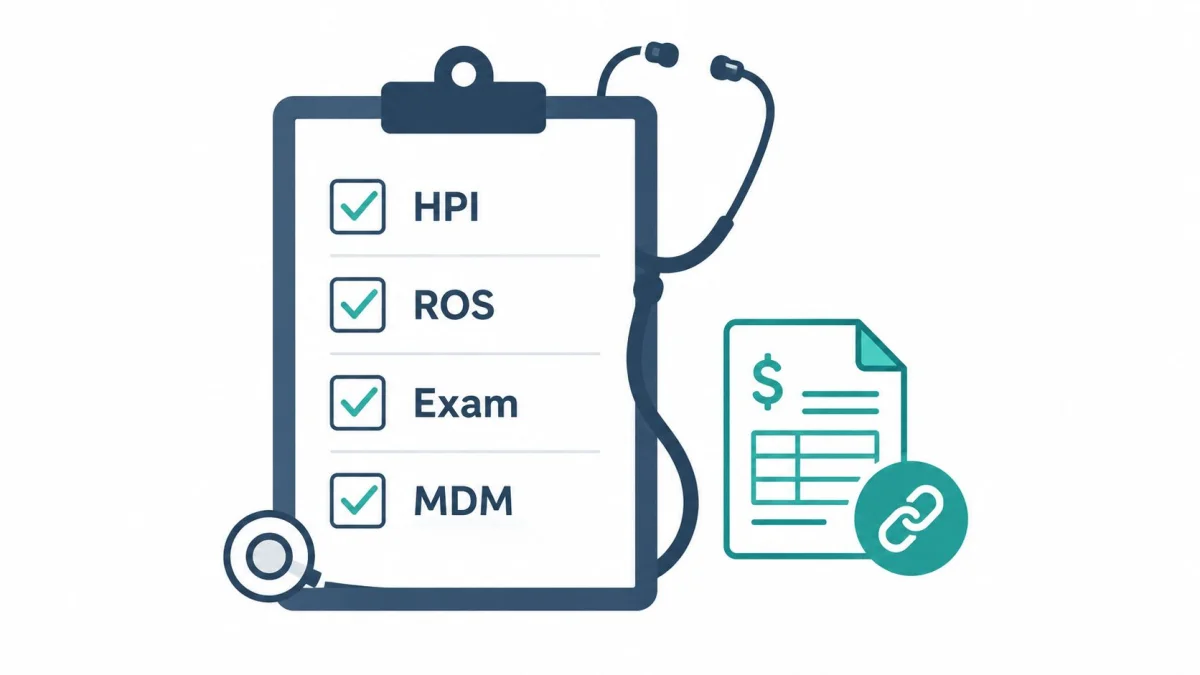
CMS documentation and coding materials connect the documented history, examination, and medical decision-making to the level of service billed. The CMS emergency department evaluation and management guidance should be checked against the current year's rules because coding requirements can change.
A practical ER template should prompt the clinician to record the relevant history of present illness, review of systems, examination findings, assessment, plan, and disposition. It shouldn't force irrelevant fields into every encounter. A chest pain visit and a minor laceration visit need different prompts.
Keep the clinical record separate
The absence letter can say that the patient was evaluated in the emergency department and should be excused from work or school for specified dates. It usually shouldn't copy the full HPI, medication list, imaging report, or differential diagnosis.
The clinical record should still explain the reasoning behind the disposition. A brief example might state that the patient was evaluated for ankle pain, imaging was reviewed, a fracture wasn't identified, pain control was discussed, and follow-up or return precautions were provided. The absence note might state that the patient was evaluated and list the permitted dates away from work.
Practical rule: Build the full clinical record first. Generate the employer or school letter as a controlled, minimal disclosure from that record.
Templates help only when clinicians treat them as prompts rather than proof that an element occurred. A prefilled normal examination copied into a note can create a more serious accuracy problem than a short, honest examination statement. Teams should audit templates against current CMS requirements and local compliance policy.
2. ACEP Clinical Policy on Documentation Standards
Emergency medicine documentation has to show more than a sequence of events. It should make the clinician's reasoning understandable to another clinician who wasn't present. That matters when a patient is discharged after testing, when a serious diagnosis was considered but not supported, or when the patient's condition changes during observation.
ACEP's documentation resources for emergency medicine provide a useful professional reference for concise, complete records. The exact policy or resource should be matched to the issue being addressed. ACEP guidance doesn't replace local policy, payer rules, or the clinician's judgment.
A strong note makes several decisions visible:
- Diagnostic rationale: State why a test, consultation, or treatment was ordered, especially when the urgency or risk isn't obvious from the chief complaint.
- Risk assessment: Record the factors that supported discharge, observation, admission, or transfer.
- Reassessment: Include meaningful changes after treatment, testing, or observation.
- Safety netting: Document the return precautions and follow-up instructions given to the patient.
Consider a patient with dizziness whose initial examination is reassuring. A weak note records only “dizziness, discharged.” A stronger record describes the relevant history, examination, testing, reassessment, clinical reasoning, and the specific symptoms that require an immediate return.
Don't let the absence note carry the burden
The work or school letter shouldn't become a compressed substitute for the clinical record. It can state that the patient was evaluated, identify the dates covered, and describe functional restrictions such as avoiding lifting or returning after a specified date, if the clinician has a basis for doing so.
Patient-facing wording should avoid unnecessary diagnoses. The recipient may need to know whether the patient should be absent, not whether the patient had a sensitive condition or which tests were performed.
“A useful absence note answers the recipient's administrative question without exposing the patient's entire encounter.”
A structured ED template can prompt for disposition and safety-netting while keeping those details in the clinical record. The final letter should be generated separately, reviewed, signed, and released through the practice's approved process.
3. ICD-10 and CPT Code Selection for ER Visits
Coding belongs to the clinical and billing record, not to a generic employer letter. In the US, ICD-10-CM describes diagnoses, while CPT describes services. The code must match the documented encounter. A code suggestion can help a clinician or coder find candidates, but it can't establish that a diagnosis was made or that a service was performed.
The official ICD-10-CM guidelines and current CMS evaluation and management resources should govern US coding decisions. UK practices need to follow the coding and reimbursement framework applicable to their service rather than importing US rules.
Specificity matters when the record supports it. An ankle injury note should identify the side, encounter context, and documented injury details when applicable. A respiratory visit should distinguish a confirmed condition from a symptom when the clinician has established a diagnosis. A code shouldn't be selected because it sounds more precise.
Use suggestions as a review queue
PatientNotes provides ICD-10, CPT, and CDT code suggestions for US billing only. Those suggestions should be checked against the signed note, the current coding guidance, payer requirements, and the clinician's actual assessment. They shouldn't be accepted automatically.
A safe review sequence is straightforward:
- Confirm the diagnosis: Check that the assessment supports the proposed ICD-10-CM code.
- Confirm the service: Check that the documented work supports the CPT selection.
- Confirm jurisdiction: Don't use US billing suggestions as a substitute for UK coding rules.
- Confirm the letter boundary: Keep billing codes out of an employer or school note unless a specific authorized form requires them.
For example, a patient may leave with a letter stating that an ED evaluation occurred and that rest is advised. The billing record may contain the clinical diagnosis and service codes. These outputs serve different readers and should remain distinct.
The PatientNotes emergency medicine coding guide can help a practice define a review workflow, but current primary coding sources remain controlling.
4. HIPAA Compliance and Documentation Security in the ER
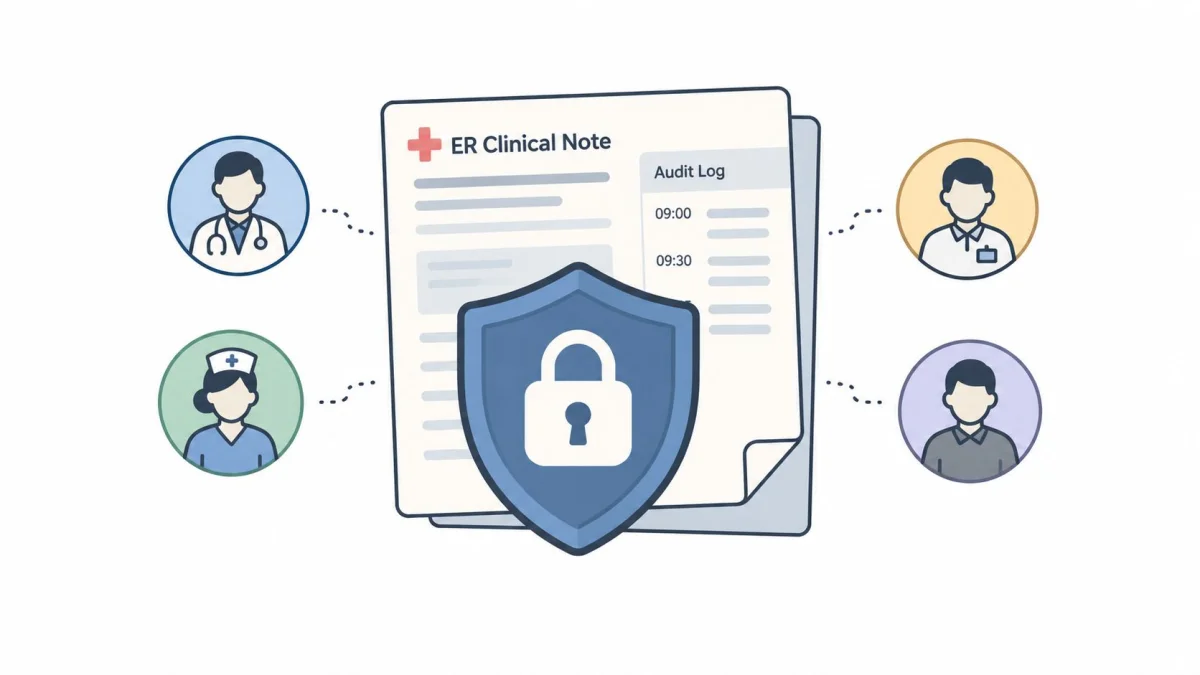
An ER note can contain far more information than an employer or school needs. Security therefore has two parts: protect the clinical record, and control what leaves the practice. HIPAA compliance isn't established by a product label alone. The covered entity needs an appropriate workflow, access controls, staff training, and agreements with vendors that handle protected health information.
The HHS HIPAA Privacy Rule guidance and Security Rule guidance provide the primary US references. UK practices must also assess UK GDPR and applicable NHS or professional requirements.
A documentation tool used with patient data should have a signed Business Associate Agreement where HIPAA requires one. Access should be limited to the people who need it, and the practice should understand how notes, recordings, transcripts, exports, and deleted sessions are handled.
Protect the handoff and the letter
A common failure is not a complex cyberattack. It's a screen left visible during a handoff, a letter sent to the wrong address, or a full discharge summary forwarded when a short attendance confirmation would have been enough. The minimum necessary principle should shape every release.
PatientNotes states that it is HIPAA compliant, includes a BAA at no extra cost, and uses encryption in transit and at rest with audit logs. Those features support evaluation, but the practice still controls identity verification, permissions, recipient checks, and release decisions. The PatientNotes HIPAA documentation guide can support that assessment. Practices can also review this HIPAA answering guide from Recepta.ai as supplementary operational reading.
Before releasing an ER doctors note, staff should verify the patient, the encounter, the destination, and the exact information being disclosed. A signed letter with dates and restrictions may be appropriate. A copied clinical note usually isn't.
5. SOAP and H&P Templates for ER Documentation
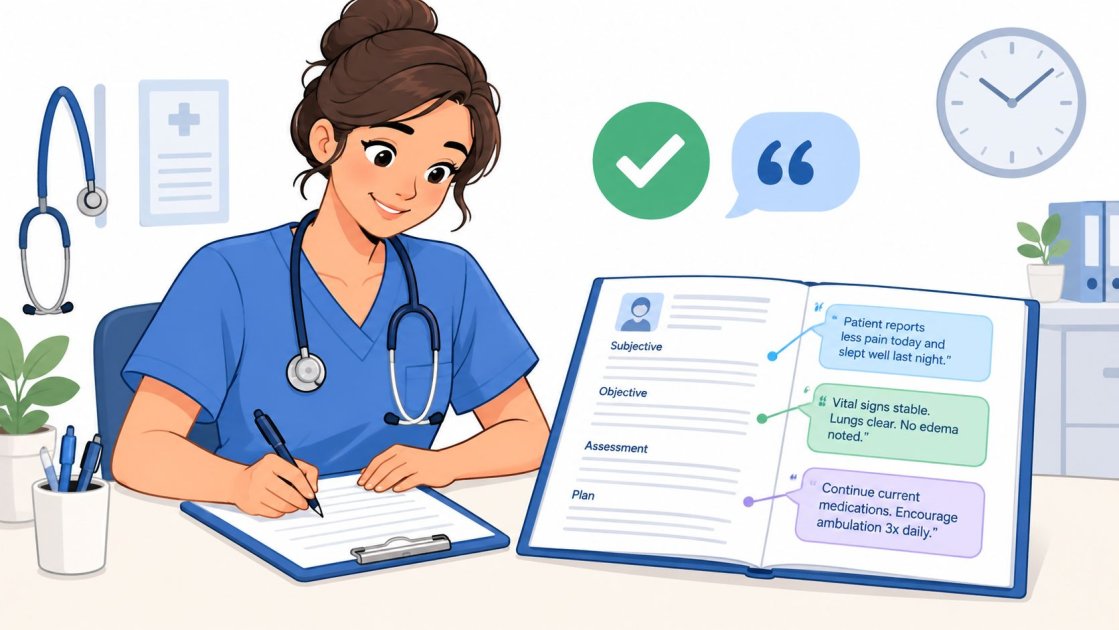
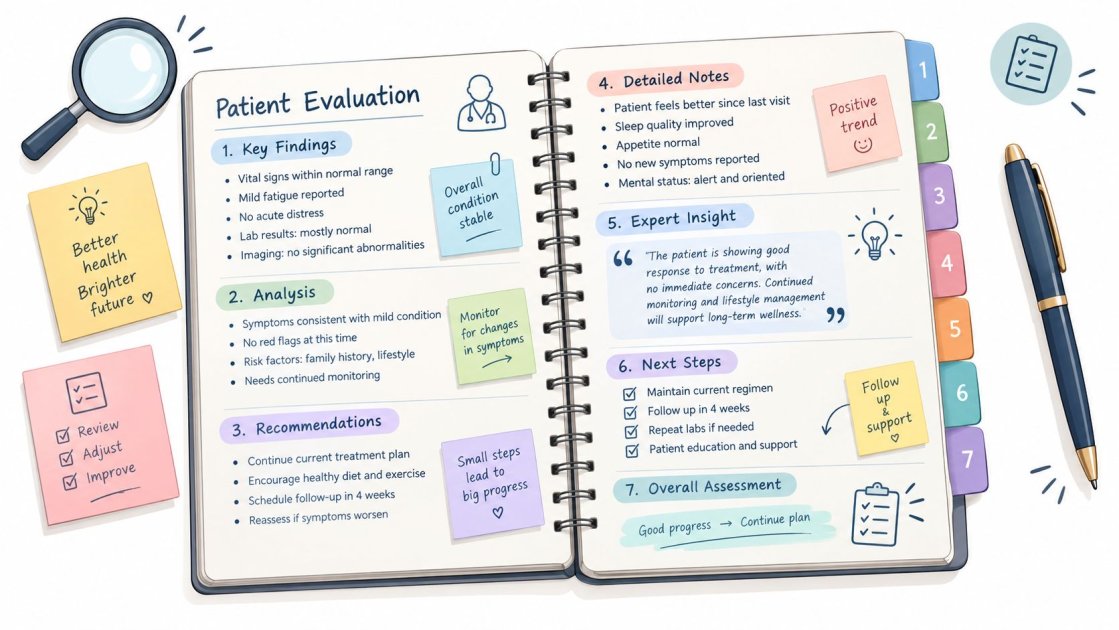
SOAP and H&P templates give clinicians a repeatable structure while leaving room for the facts of each emergency visit. SOAP organizes the patient's report, objective findings, assessment, and plan. H&P provides a broader history and physical framework. Both require deliberate configuration because a populated field does not prove that the examination, reasoning, or reassessment occurred.
A chest pain template may prompt for symptom history, ECG findings, troponin results, examination, risk assessment, treatment, reassessment, and disposition. An abdominal pain template may cover location, character, radiation, severity, associated symptoms, examination, testing, and return precautions. A head injury template may ask about the mechanism, loss of consciousness, confusion, examination findings, imaging, and discharge plan. These structures support the clinical record. A work or school note should remain a separate, focused absence document.
Customize before deploying
Fixed templates can create clutter and encourage copy-forward errors. Conditional fields are more useful. A laceration pathway should not display every chest pain prompt, and a pediatric encounter may need different history and safety-net fields from an adult visit. Review each template against local documentation policy before staff use it.
PatientNotes offers SOAP and H&P templates, plus progress, procedure, consultation, discharge, and letter formats. Its AI template builder can turn a clinician's dictation, chat, or uploaded document into a reusable template. For a small practice, that may reduce drafting work when adapting a general structure to recurring chief complaints. Clinician review remains necessary.
The PatientNotes SOAP notes template resource can help a practice begin with an organized format instead of building one from a blank page. The resulting note still needs editing. A template cannot determine whether an examination occurred, whether the diagnosis is supported, or whether discharge is safe.
Mobile documentation also requires a connectivity plan. PatientNotes' iOS page says clinicians can record visits without WiFi, with audio syncing after reconnection. The Tandem Health App Store listing describes a similar offline recording and synchronization pattern. Offline capture may reduce interruptions when connectivity is poor, but staff must follow the practice's device, consent, and privacy controls.
6. Patient Safety and Handoff Documentation Standards
A handoff note serves a different reader from an employer letter. The receiving clinician needs to know the patient's current state, active treatment, pending results, unresolved risks, and what should happen next. A concise absence note cannot carry that information safely.
For an ED shift change, a useful sign-out might say that a chest pain evaluation is still in progress, identify the pending troponin, summarize the current ECG and symptoms, record treatment already given, and state the condition for discharge. The wording should reflect the actual patient record, not a generic example copied from a template.
The AHRQ TeamSTEPPS handoff resources support structured communication approaches. The Joint Commission's handoff communication resources are another primary reference for organizations developing policy.
Make pending work visible
A dedicated sign-out area can reduce the chance that pending results disappear inside a long narrative. It should identify ownership and timing. “Repeat lab pending” is less useful than “clinician on evening shift to review the pending result and contact the patient if the treatment plan changes,” provided that assignment matches local policy.
A structured format such as SBAR can help teams organize the conversation:
- Situation: State why the patient remains under care.
- Background: Include the relevant history and treatment.
- Assessment: Describe the current status and unresolved concern.
- Recommendation: State the next action, deadline, and escalation trigger.
High-risk features deserve explicit attention. Recurrent syncope, worsening respiratory symptoms, an incomplete infection workup, or a patient awaiting a consultant should not be hidden in a generic paragraph.
PatientNotes can extract follow-up tasks from a consultation, but task extraction doesn't replace verbal handoff, closed-loop communication, or confirmation that the receiving clinician understood the plan. The absence note should remain a separate, minimal document.
7. Follow-up Tasks and Patient Instructions in ER Documentation
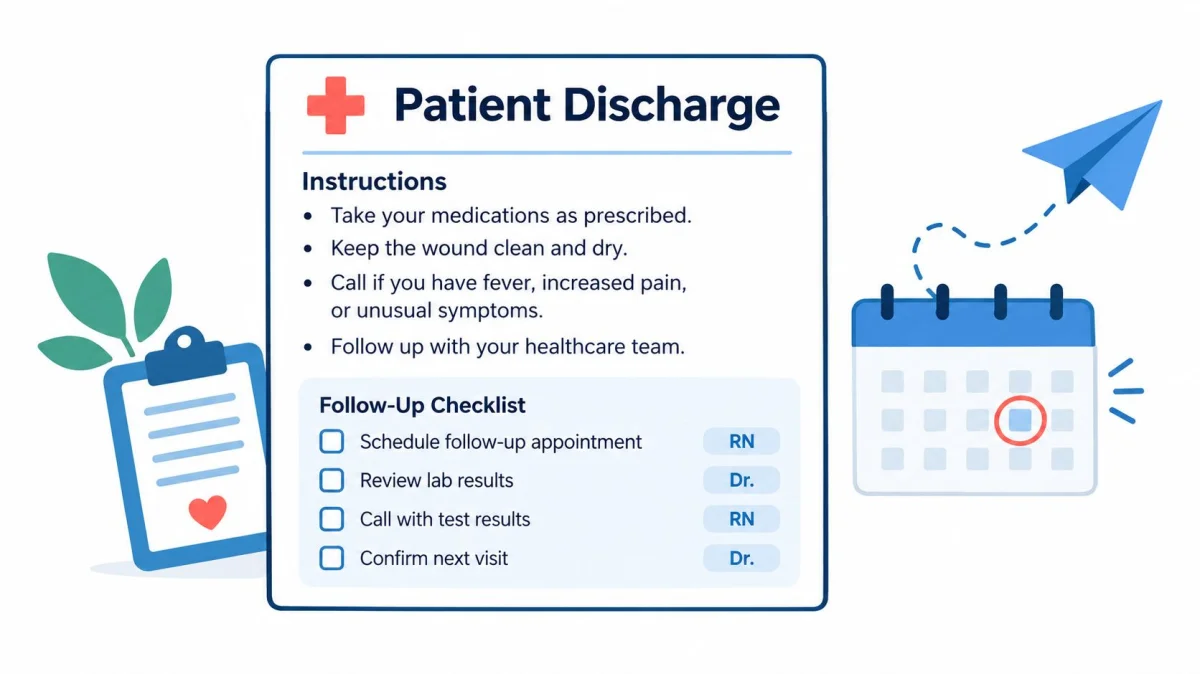
Discharge isn't the end of the workflow. The team may need to review a pending culture, arrange imaging, contact the patient, send a prescription, or direct the patient back for reassessment. The patient also needs instructions that are clear enough to use after leaving a stressful environment.
A task should name the action, owner, and timing. “Review results” leaves too much unresolved. “The assigned clinician reviews the pending culture and contacts the patient if the result changes treatment” gives the team a workable starting point, subject to local policy.
Patient instructions should explain what to do, what to avoid, when to follow up, and which symptoms require urgent reassessment. For an ankle injury, that might include the prescribed pain plan, ice or support instructions, activity limits, follow-up arrangements, and a clear warning to return if symptoms worsen or weight-bearing becomes difficult. The instructions must reflect the clinician's actual recommendations.
Write for the patient, not the chart
Technical language can be accurate and still fail at discharge. Short sentences, active verbs, translated materials, and a clear separation between routine care and emergency warning signs improve usability. The American College of Emergency Physicians patient education resources can help practices review emergency communication policies, while local clinical governance should set the final standard.
PatientNotes states that it extracts follow-up tasks and writes plain-language patient instructions after the note. It also produces notes and tasks in the clinician's chosen language. That can reduce drafting work, but the clinician must confirm medication directions, dates, escalation advice, and translation quality before release.
A final review can ask:
- Task ownership: Does each follow-up action have a responsible person or team?
- Timing: Is the deadline or expected review point clear?
- Patient wording: Can the patient understand the instructions without interpreting clinical shorthand?
- Return precautions: Are the specific warning symptoms consistent with the encounter?
- Letter separation: Does the employer or school note omit details that belong only in the clinical record?
ER Doctors Note: 7-Point Documentation Comparison
| Documentation Item | Core focus / key elements | Clinical impact (quality & compliance) | Implementation & workflow burden | How PatientNotes helps |
|---|---|---|---|---|
| CMS Documentation Guidelines for Emergency Medicine | 99281–99285 criteria; HPI, ROS, exam, MDM elements; examples of compliant notes | Drives Medicare reimbursement; reduces audit risk when followed | Complex, detailed, requires staff training and updates | Templates aligned to CMS elements; templated notes and AI-assisted suggestions; supports documentation linkage to MDM (code suggestions US-only) |
| ACEP Clinical Policy on Documentation Standards | Evidence-based ER note structure; documenting uncertainty, time-sensitive decisions, disposition | Captures clinical reasoning; offers medicolegal protection; improves risk stratification | May exceed minimum regs; can add documentation time | Structured templates and prompts for risk assessment; specialty templates and conditional fields to capture ACEP elements |
| ICD-10 and CPT Code Selection for ER Visits | ICD-10 specificity (laterality, encounter), CPT 99281–99285, modifiers, ED rules | Direct effect on revenue, denials, and audit defensibility | Requires continuous education; coder variability; yearly updates | AI suggests ICD-10, CPT, CDT codes for clinician review (US billing only); helps link documented findings to codes |
| HIPAA Compliance and Documentation Security in the ER | Encryption, audit logs, role-based access, BAA, patient authorization | Mandatory legal protection of PHI; reduces liability and breach risk | Technical/admin overhead; vendor BAA checks; staff compliance required | HIPAA-compliant platform with BAA included, encryption in transit & at rest, audit logs; UK/GDPR-aware support |
| SOAP and H&P Templates for ER Documentation | SOAP/H&P structure, specialty variations, conditional sections for chief complaints | Improves completeness, supports coding and handoffs, standardises notes | Can feel rigid; risk of over-templating and copy-paste errors; needs training | Library of SOAP, H&P and 37 specialty templates; AI template builder converts dictation/chat/docs into custom templates |
| Patient Safety and Handoff Documentation Standards | SBAR sign-out, pending results, safety concerns, chronological course | Reduces handoff errors and adverse events; supports continuity and QA | Adds time to shift changes; needs discipline and verification | Templates with handoff sections, session archive & restore, team roles and invites to ensure clear sign-out documentation |
| Follow-up Tasks and Patient Instructions in ER Documentation | Structured task lists (assignee/deadline), plain‑language discharge instructions, translations | Lowers missed follow-ups/readmissions; improves adherence and patient satisfaction | Time to create/assign tasks; monitoring required; EHR task integration varies | Automatically extracts follow-up tasks and writes plain‑language patient instructions in clinician's language; printable/exportable instructions; integrates via Semble or copy-paste |
| (General) Documentation Security & Vendor Selection | Vendor BAAs, auditability, encryption, access controls | Ensures compliance and risk management across tools | Vendor vetting and policies add admin steps | Transparent BAA at no extra cost, personal UK-based support, audit logs, GDPR-aware practices |
Choose the Right Note for the Workflow
An ER encounter can produce at least three distinct outputs. The clinical ER record documents assessment, examination, medical decision-making, treatment, testing, reassessment, and disposition. The employer or school absence note confirms the visit and states only the dates, restrictions, or return information the recipient needs. The internal follow-up or handoff record assigns pending work, communicates risk, and supports continuity between clinicians.
A reliable workflow starts by verifying the patient's identity and visit details. The practice then selects the correct document type, limits disclosure to the recipient's legitimate need, records dates and restrictions clearly, and routes the document for clinician review and signature. Staff should avoid copying the full discharge summary into an absence letter because the information is available.
PatientNotes can support this separation with SOAP, H&P, discharge, letter, and specialty templates across 37 specialties, plus an AI template builder. It can record consultations in person, by phone, or by telehealth, transcribe with speaker separation, structure the note, extract follow-up tasks, suggest US billing codes for review, and write plain-language instructions. Notes and tasks are produced in the clinician's own language.
For mobile work, PatientNotes offers a native iOS app with offline recording. Its iOS page says audio syncs after reconnection, which is relevant in clinical settings with unreliable connectivity. A practice should still confirm its consent, device, retention, and access procedures before recording patient conversations.
Check the operational fit
PatientNotes works with any EHR by copy and paste. Semble is the only EHR integration. There is no Chrome extension, and the product isn't designed for health systems that need deep Epic integration. Those limits matter more than a feature list when a practice depends on enterprise interoperability or complex health-system workflows.
The product is HIPAA compliant and includes a BAA at no extra cost. Its pricing is $70 per user per month billed monthly or $50 per user per month billed annually, with a 7-day free trial requiring no credit card and a 14-day money-back guarantee. There is no enterprise tier and no sales call. Practices can review the current details on the PatientNotes pricing page, compare workflows on the comparison page, and inspect specialty coverage on the specialties page.
Software can reduce repetitive drafting and improve consistency. It can't replace the clinician's review of the diagnosis, code, disposition, patient instructions, handoff, or absence letter. Current legal, clinical, privacy, and coding requirements should always be checked against primary US or UK sources before a practice changes policy.
PatientNotes gives individual clinicians and small practices emergency medicine, SOAP, H&P, discharge, letter, and specialty templates, with offline iOS recording, task extraction, plain-language instructions, and copy-and-paste use with any EHR. Visit PatientNotes to review the workflow, start the 7-day free trial without a credit card, and test whether it reduces ER note and absence-letter drafting time.