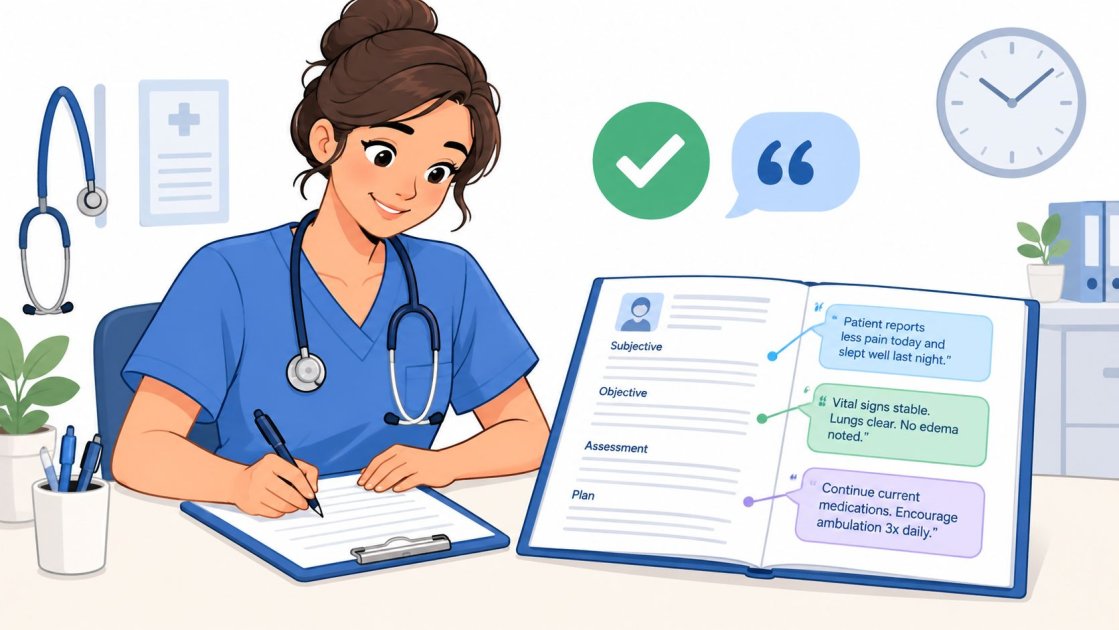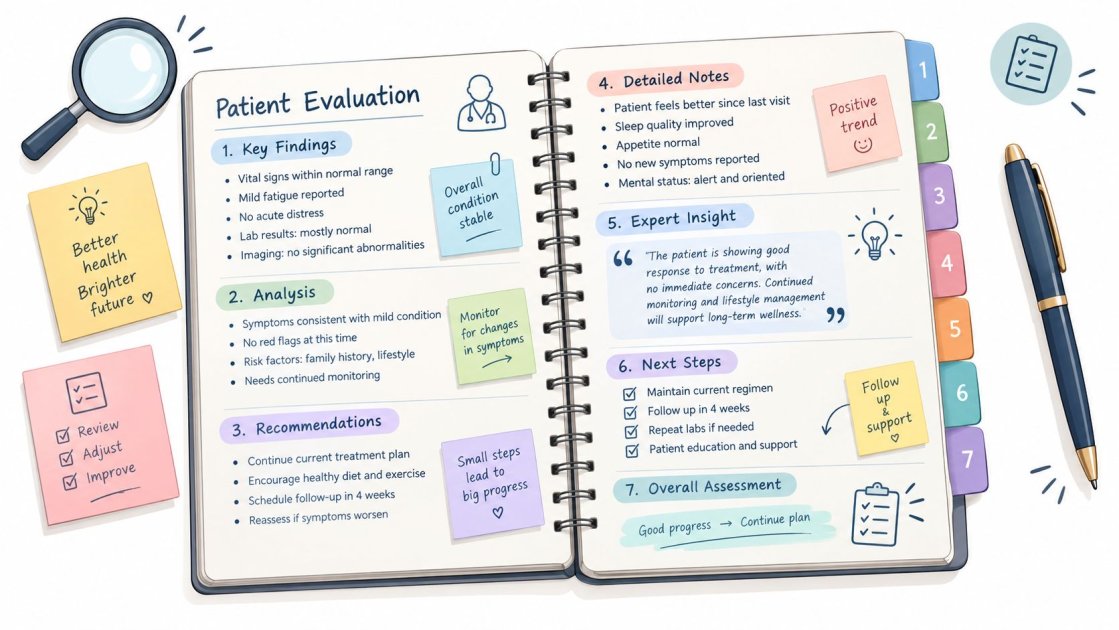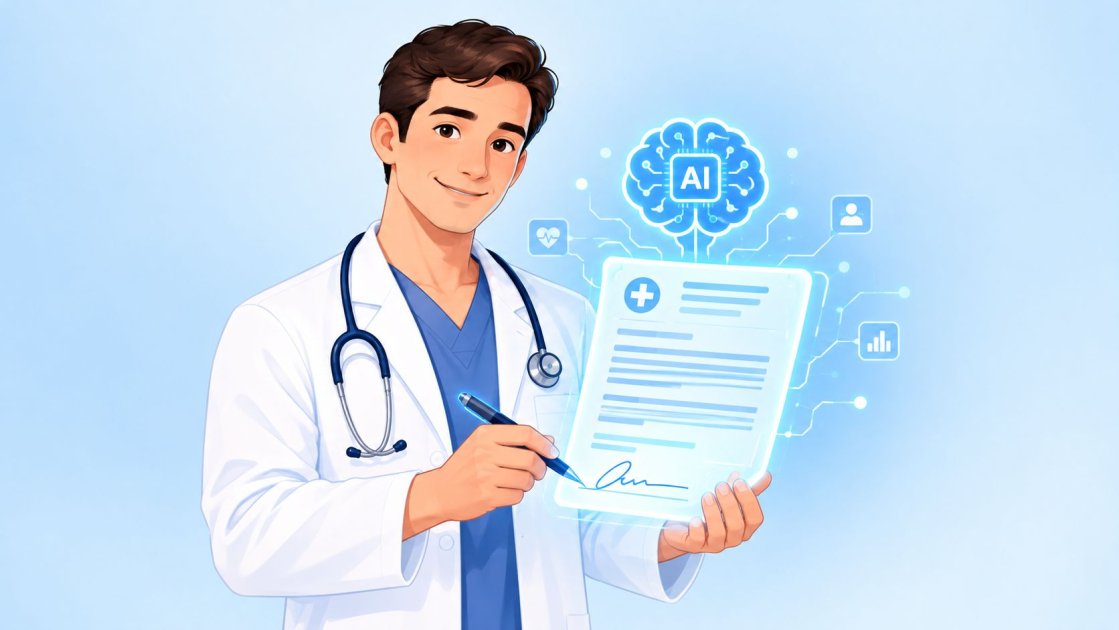
The last chart is still open when the waiting room has gone quiet. The day felt full, but the note pile says otherwise, and the work follows the clinician home unless something changes in the workflow. For many small practices, that is the real reason the AI doctors note matters, not because it sounds futuristic, but because it gives a way to turn a finished conversation into a draft that can be checked, corrected, and signed before the evening disappears.
The End-of-Day Note Pile and Why It Exists
A clinician finishes the final visit, closes the door, and still has unsigned notes waiting on another screen. Some are half-written. Some need medication cleanup. Some only exist as memory and a promise to return later. That pattern is common because documentation has become part of the job, not an afterthought.
The scale of that burden is not theoretical. An analysis of nationally representative 2019 data found that office-based physicians spent an average of 1.77 hours per day on documentation outside regular office hours, with a 95% confidence interval of 1.67 to 1.87 hours. Using a five-day workweek and a 47-week year, researchers estimated approximately 125 million hours of after-hours documentation in the US in 2019. The work included note composition, record review, documentation requirements, and related electronic health record tasks, which is why many clinicians feel charting never quite ends. The documentation burden analysis captures that pressure well, and the broader pattern is easy to recognize in physician burnout and documentation.
A note system is useful only if it reduces the work that still has to be checked later.
The rise of ambient documentation makes sense in that context. The point is not to replace clinical judgment or erase charting. The point is to shift the first draft away from manual transcription and toward review, which is a better use of limited time when a practice is already stretched thin.
What an AI Doctors Note Actually Is
An AI doctors note is a draft clinical note generated from a recorded or live encounter. It listens to the conversation, separates speakers, pulls out the clinically relevant details, and organizes them into a template that a clinician can review. It is closer to a structured draft than a finished record.
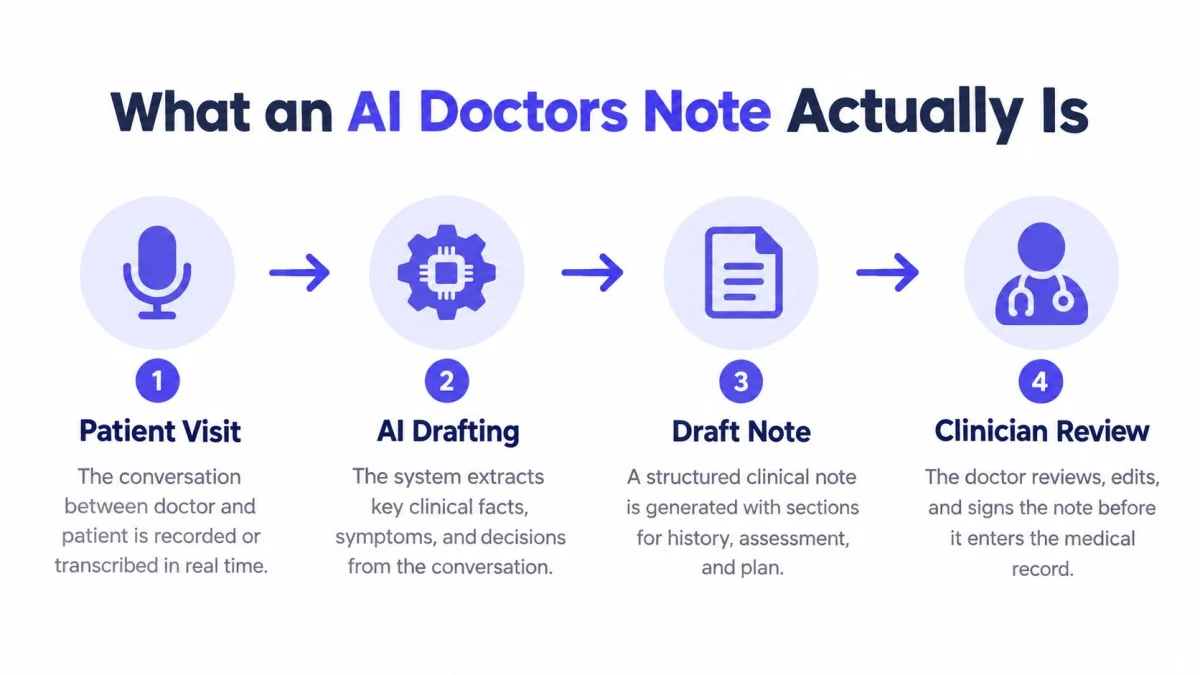
The basic flow is simple. First, the visit is captured in person, by phone, or by telehealth. Then the system drafts the note from the encounter. After that, the clinician edits what matters and signs only after the content matches the visit.
A straightforward way to think about it is through a follow-up for type 2 diabetes. The patient mentions home glucose readings, a refill request, a diet change, and a foot check. The system should turn that conversation into a note with history, assessment, plan, and tasks, then leave the clinician to verify the details, correct wording, and decide whether the follow-up instructions are complete. Chimehill has a plain explanation of this draft-to-sign workflow that can help a team compare how the room conversation becomes chart text.
The difference from older dictation is important. Dictation records what the clinician says, often as a near-verbatim transcript. An AI doctors note tries to extract meaning and format it into a usable clinical document, which is why speaker separation, templates, and review matter more than raw transcription alone. The same logic applies to coding suggestions and patient instructions, which should be treated as output to check, not output to trust.
What the Evidence Says About Time, Burnout, and Error
The case for ambient documentation starts with time. In a 2025 quality-improvement study in JAMA Network Open, mean time spent in clinical notes per appointment fell from 6.2 minutes before implementation to 5.3 minutes afterward, a reduction of 0.9 minutes per visit with statistical significance at P < .001. The same study reported drops in perceived workload, including mental demand, rushed pace, and effort required on NASA-TLX measures. The JAMA Network Open study also found that 33 of 38 clinicians, or 85.8%, reported improved overall work satisfaction in primary care.
That kind of change is incremental, not miraculous. The best reading of the evidence is that AI-generated notes can shave time at the margins while making the end of the day more manageable, which is often exactly what a small practice needs. A separate survey study across two academic medical-center systems found reported burnout at one site fell from 50.6% to 29.4% after 42 days and from 52.6% to 30.7% after 84 days among measured respondents, showing that the effect can reach beyond the note itself when the workflow is stable. A managed IT team that understands clinical systems can help with rollout, governance, and support, which is why practices often need operational help as much as documentation help, as discussed in elevating care with managed IT.
The caution is just as important. In a paired evaluation of 97 encounters producing 194 notes, ambient AI notes scored 4.20/5 overall versus 4.25/5 for clinician-authored reference notes. The AI notes were more thorough and better organized, but they also showed hallucinations in 31% of ambient notes compared with 20% of reference notes, with p = 0.01. That means the technology can help, but it still needs a professional to catch the mistakes that matter before the chart is finalized.
What is medical scribing is only part of the story. The evidence supports ambient drafting as a workload tool, not as an autonomous decision-maker.
Why Accuracy Alone Is Not a Buying Metric
A polished note can still be wrong in ways that are hard to spot at a glance. An allergy can be inserted where none was mentioned. A negated symptom can become a positive finding. A follow-up task can disappear because the prose reads cleanly and the clinician's eye moves on. The problem is not just machine error, it is the human tendency to trust fluent text too quickly.
Practical rule: a note that reads well is not the same thing as a note that is safe to sign.
That is where automation bias shows up. The clinician sees a professional-looking draft, assumes the system probably captured the encounter, and skips the slow check that would catch a laterality error or a swapped speaker. Busy clinicians are most exposed because they are also the ones who benefit most from time savings, which creates a real trade-off between speed and verification.
The safest approach is to recheck the fields that carry the most clinical weight. Those usually include these items:
- Medications and allergies: Confirm names, doses, and any changes match the conversation.
- Negated symptoms and laterality: Verify that “no chest pain” did not become “chest pain,” and right versus left is correct.
- Assessment and plan: Read for omissions, muddled priorities, and follow-up steps that need to be explicit.
- Speaker attribution: Make sure the patient, clinician, and family member were labeled correctly.
- Measurements and instructions: Compare the draft against the encounter details before anything is filed.
Accuracy is part of the purchase decision, but it cannot be the only one. The better question is whether the workflow makes it easy to catch the wrong allergy, the missed instruction, or the hallucinated detail before the signature goes on the chart.
A Practical Review and Sign-Off Protocol
A good review pass does not need to take long if the order is fixed. The point is to check the same fields every time, in the same sequence, so the clinician is less likely to miss a consequential error hidden in a readable draft. That consistency matters more than speed when the note is headed into the medical record.
Start with identity, then clinical content
The first check is the patient identifier and the visit context. After that, the clinician should read the assessment and plan, then scan medications, allergies, laterality, negatives, and follow-up instructions. Billing-code suggestions come last because they should never distract from the clinical record itself.
| Field to verify | What to look for |
|---|---|
| Patient identity | Correct patient, correct date, correct encounter |
| Assessment and plan | No missing problems, no invented conclusions |
| Medications and allergies | Correct names, doses, and changes |
| Negatives and laterality | No flipped findings, no wrong side |
| Follow-up tasks | Clear next steps, referrals, return precautions |
| Billing suggestions | Advisory only, tied to the actual encounter |
Review the draft like a chart that could be audited later, because it can be.
There is also a difference between editing inside the documentation tool and fixing text after copy-paste into the EHR. Editing where the draft is created preserves the original structure and makes it easier to track what changed. If the note has to be pasted elsewhere, the original transcript or encounter record should still be kept so an error discovered later can be traced and corrected without guesswork.
The final rule is simple. The clinician signs, not the software. A reliable review protocol makes that signature defensible because it shows the note was checked for content, not just accepted because it looked finished.
Legal and Ethical Considerations for Small Practices
The legal baseline starts with HIPAA. If a clinician uses a vendor to create, receive, maintain, or transmit protected health information, a written business associate agreement is generally required. HHS says the agreement must define the vendor's permitted and required uses and disclosures, prohibit uses outside the agreement or legal requirements, and require appropriate safeguards, including breach reporting duties. HHS guidance on business associate agreements makes clear that “HIPAA compliant” is not enough on its own.
That distinction matters for any small practice buying an AI documentation service. The vendor should be able to sign a BAA that covers recording, transcription, storage, and note generation, not just the marketing claim that the product is secure. PatientNotes states that it is HIPAA compliant and includes a BAA at no extra cost, which still needs to be checked against the practice's own policies and vendor review process. The same source is also useful for understanding how the product handles the clinician workflow, while HIPAA BAA requirements spells out the practical contract issue in plain language.
CMS adds a second layer of caution around coding. CPT is a five-character numeric code set maintained by the American Medical Association, and ICD-10-PCS is a procedure-code system for hospital inpatient settings. That is why a coding suggestion from an AI note must stay advisory. The tool can help surface likely codes, but the clinician still has to match the record, the service performed, the payer rules, and the right code set before anything is billed.
For UK users, the warning is even simpler. US billing suggestions are not UK billing guidance, and ambient scribing should be treated as documentation support, not a decision-maker. Clinician responsibility stays with the practice, which means a defensible chart needs a documented review, a signed note, and a clear trail of corrections when something changes after signing.
Consent, Refusal, and Sensitive Visits
Consent should sound like a conversation, not a checkbox. A plain script can be short. “This visit can be recorded so a draft note can be created. The recording is used to help write the note, and the clinician still reviews it before it goes into the chart. If you do not want recording, care continues without it.”
That script should also answer the practical questions. Patients deserve to know whether raw audio is retained, who can access it, and how refusing recording changes the visit. When the setting is sensitive, the explanation needs more care, especially for minors, interpreters, psychiatric visits, sexual health, domestic-abuse disclosures, and patients with limited capacity.
A fallback matters because consent should never feel like a condition of treatment. If a patient declines, the clinician needs a non-recording workflow that still protects the relationship and keeps the visit moving. NHS Wales's 2025 interim position on ambient voice technologies treats them as support for consultation summarisation, not as a basis for diagnosis or treatment decisions outside approved testing, which is a useful reminder that governance has to come before convenience. The legal risks of AI voices is useful background when a team is comparing voice capture with wider privacy concerns.
Evidence from recent syntheses suggests the consent issue is already familiar in practice, with about 92% of clinicians obtaining explicit patient consent and about 15% still concerned about data security and liability for AI-generated documentation errors. That concern is reasonable. Consent, like review, works best as a recurring professional habit rather than a form that gets collected once and forgotten.
Putting It Together and Choosing What to Do This Week
The safest way to use an AI doctors note is to treat it as a draft, not a verdict. Run a fixed review protocol, keep the original transcript or recording for audit, verify the clinical details that can cause harm if they are wrong, and treat coding suggestions as advisory only. Do not file a draft that has not been read, do not assume HIPAA compliance removes the duty to review, and do not use US code suggestions as if they were UK billing guidance.
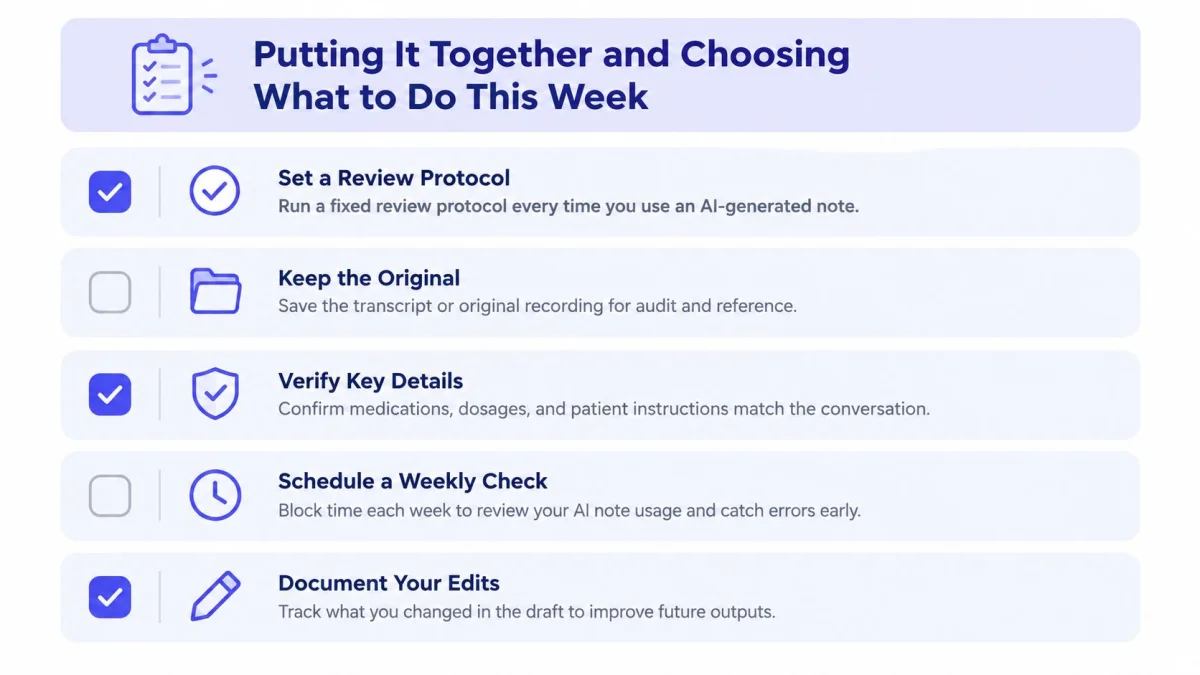
Three steps are worth taking this week. Audit the last ten signed AI-generated notes for omissions, write or revise the consent script so it fits sensitive visits, and confirm that a signed BAA is on file with the vendor before any more recordings happen.
PatientNotes gives individual clinicians and small practices a structured way to record visits, draft notes, extract tasks, and suggest US billing codes for review, with pricing and setup that stay simple. If a practice wants to see how that fits into a real workflow, PatientNotes is the place to start.