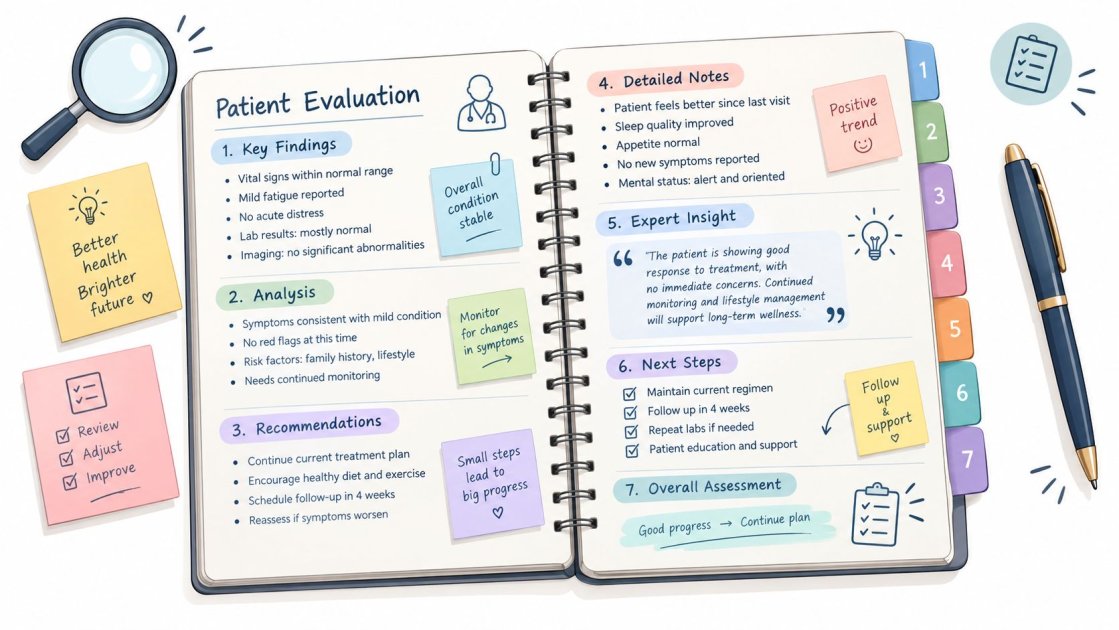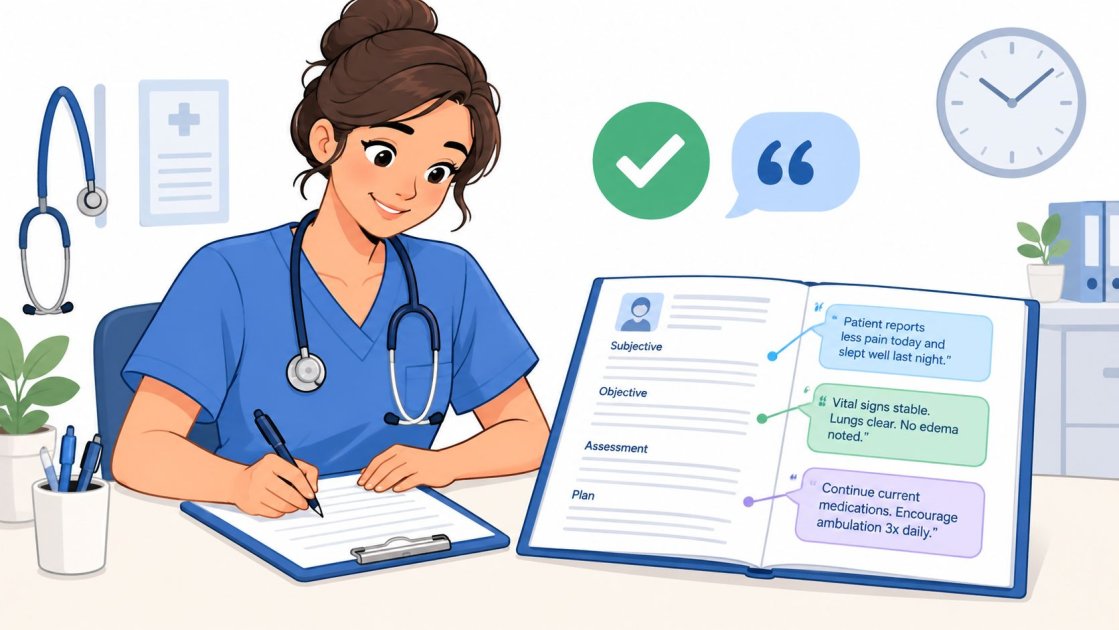
It's 7:12 at the end of a rough shift, and the chart still has one gap that matters. The vitals are in the right place, the meds are signed, but the patient's change in condition still needs a clear story. That's where narrative nurses notes earn their keep, because the note has to say what changed, what was done, and what happened next without burying the reader in noise.
A strong narrative note is not a diary. It's a short clinical record that connects the dots between observation, action, response, and handoff. The best ones help the next nurse, the provider, and the auditor understand the shift without hunting through duplicated fields or vague prose.
What Narrative Nurses Notes Do Best
The strongest narrative nurses notes capture the part of care that checkboxes miss. A flowsheet can hold routine values, but a narrative note carries the context around them, the reason the nurse acted, the patient's words, and the follow-up that closes the loop. In practice, that's the difference between “documented” and “understood.”
In a coronary ICU documentation analysis, nurses used narrative entries mainly for patient status summaries, which made up 25.2% of entries, followed by report received at 15.4%, refer to flow sheet at 9.6%, and intervention at 5.9% (PMC analysis of narrative ICU documentation). That pattern matters because it shows what free text does best, it carries handoff content, summarizing language, and clinical judgment that structured fields often can't hold cleanly.
What belongs in the story
A narrative note works best when the shift includes a change, a refusal, an escalation, or a response that needs explanation. If the patient is stable and the structured fields already show the routine care, prose can often stop there. If the note is only repeating what the flowsheet already says, it's probably too long.
Practical rule: write narrative when the reader needs the “why,” not just the “what.”
That filter helps keep charting lean. It also protects the chart from becoming a pile of duplicate statements that hide the important event. The goal is not to write more, it's to write the part of the story that can't be understood from the fields alone.
Building a Clear and Complete Entry
A clean narrative entry starts with timing and context, then moves in the same order a nurse would explain the shift aloud. The record should open with when the event happened, who the patient is in the moment, and what triggered the note. From there, the entry should move to focused assessment, the action taken, the patient's response, and any escalation or follow-up.
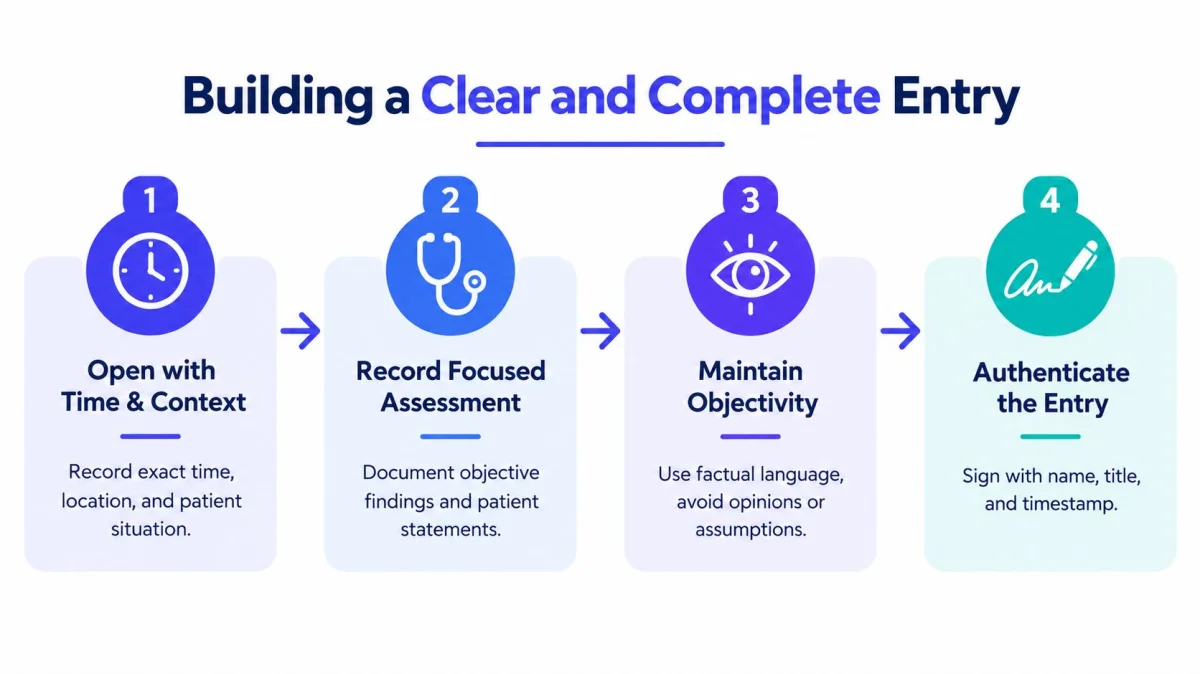
The clearest notes stay objective. In a review of intensive-care narrative coding, three experienced reviewers agreed on 81.7% of classifications, with pairwise agreement reaching 97.8%, which shows that disciplined phrase-by-phrase documentation can be reviewed consistently when the language is focused and factual (PubMed study on narrative nursing documentation). That kind of clarity comes from phrasing, not from length.
The core sentence pattern
A useful note usually follows this rhythm:
Time and situation. Patient's status, symptom, or change is stated first.
Assessment. What the nurse saw, measured, or heard is written without opinion.
Action. The intervention is described plainly, including notification if needed.
Response. The patient's reaction or the next step is documented.
A short quote from the patient belongs in the entry when it adds meaning. Put it in quotation marks and keep it exact, especially when the patient's words show pain, refusal, confusion, or improvement. If the statement came from family, another clinician, or a handoff report, attribute it clearly so the chart doesn't blur observation with hearsay.
The signature matters too. Date, time, name, and title anchor the note to the person who wrote it. For a practical template that helps shape that structure, a clinician can use the template for progress notes as a reference point, then adapt it to the unit's workflow.
Real World Examples You Can Adapt
A good narrative note sounds like a shift report that got trimmed down to only what matters. It keeps the sequence tight, and it doesn't wander into background that already lives elsewhere in the chart. The examples below show the rhythm, not a script to copy.

Start with a pain reassessment. The first line can tell the reader what changed and why the nurse returned to the room. Then add the intervention and the result.
A useful version might read, “1400, patient reports incisional pain and appears guarded with movement. Analgesic given per order, patient repositioned for comfort. At follow-up, patient reports improved comfort and is resting without distress.” What should stay out is the extra commentary about how the patient was “being dramatic” or “doing better than expected,” because opinion weakens the note.
A fall-risk change needs the same discipline. If the patient becomes unsteady, the note should show the observation, the action taken, and the update to safety measures. If the patient refused a medication, the chart should reflect the refusal and the patient's own reason, without arguing with the patient in the note.
For a handoff after deterioration, keep the story narrow. Document the change, the assessment, the notification, and the escalation. Then stop once the next responsible clinician has been told and the chart has an accurate timeline.
A simple reminder helps:
- Write the trigger. State what changed or what prompted the note.
- Write the response. Include what the patient said or did after care.
- Leave out the filler. Skip routine details already captured in the MAR, vitals, or care plan.
For more examples of how structured narrative can fit into a daily workflow, the nursing notes resource is useful as a reference for format and phrasing.
Knowing When Narrative Beats the Flowsheet
The hardest part isn't writing a narrative note. It's deciding when the note needs prose at all. A nurse can save a lot of time by asking one question before typing, “Does the reader need a short story here, or is the structured field enough?”
That decision gets easier when the information is routine, repetitive, or already captured in the correct section of the chart. Narrative fits best when the event is unusual, when there's a refusal, when the response matters, or when the nurse needs to show clinical reasoning that doesn't belong in a checkbox.
| Situation | Chart in narrative | Chart in structured field |
|---|---|---|
| New symptom or change in condition | Yes, if the nurse needs to explain what was seen, what was done, and what happened next | No, not as a replacement for the story |
| Routine vitals with no change | Usually no, unless there's an abnormal trend that needs context | Yes |
| Medication given as scheduled | Usually no, if the MAR already captures it | Yes |
| Refusal of care | Yes, especially if the patient's words or reason matter | Sometimes, if there's a separate refusal field |
| Reassessment after intervention | Yes, when the response closes the loop | Sometimes, if only the result is being logged |
| Handoff about escalation | Yes, because chronology matters | Only if the system has a dedicated handoff field |
A narrative note should not retype the flowsheet. If the vitals, medication record, or care plan already hold the raw data, the prose can refer to them instead of repeating them. That keeps the chart cleaner and makes the meaningful event easier to spot later.
Practical rule: use structured fields for repeatable facts, use narrative for change, context, and clinical judgment.
The risk of over-narrating is real. Long prose can hide the critical sentence under layers of duplication, and that makes the chart harder to audit. Short, purposeful narrative is easier to scan and easier to defend.
Legal Safe Phrasing Late Entries and Corrections
A lot of nurses still think a note is safest when it sounds polished. That's backwards. A note is safest when it is transparent, dated, objective, and easy to follow after the fact.
The legal value of the record comes from authorship and sequence. A 2026 nursing documentation guideline says narrative charting records interventions and outcomes chronologically, and additions or alterations should be dated, timed, and signed while keeping the original entry readable (NZNO documentation guideline, 2026). That's the standard to keep in mind when a shift runs late, a detail was missed, or a correction is needed.
Late entries should preserve the original timeline, not rewrite it. The safest wording states what is being added, when it should have been documented, and why it belongs in the record now. Corrections should keep the original entry visible in whatever way the system allows, with the addendum making the new information clear without erasing the history.
For nurses handling refusals, incidents, or handoffs, objective language matters more than polished language. Record what was offered, what was declined, what the patient said, who was notified, and whether read-back happened. Avoid moral language, emotional language, or any line that sounds like blame.
When teams think about documentation access and accountability, the same principle applies as in secure file sharing trade-offs, where control, traceability, and the right level of access matter more than convenience alone. Clinical notes need that same balance, because the record has to be readable, auditable, and limited to what belongs in the chart.
Practical rule: if the note would look careless under review, it usually needs more precision, not more prose.
This matters in both US and UK settings. The exact form differs by policy and system, but the core habit stays the same, preserve the record, state the facts, and make the sequence easy to verify.
Finishing Shifts With Faster Better Notes
The end-of-shift habit that helps most is simple. Check whether the note duplicates something already in the structured chart, whether the response is documented, and whether any carried-forward text still matches the patient's current status. If the answer is no, tighten the entry before signing.
A 2016 analysis of 135,406,873 structured coded nursing narratives across 231,494 admissions found a median of 6.0 documents per day, 4.4 narratives per document, and 28.0 nursing narratives per day (PMC study on narrative volume and workload). That volume is exactly why a short audit routine helps. It keeps the chart usable when the pace is heavy and the handoff is moving fast.
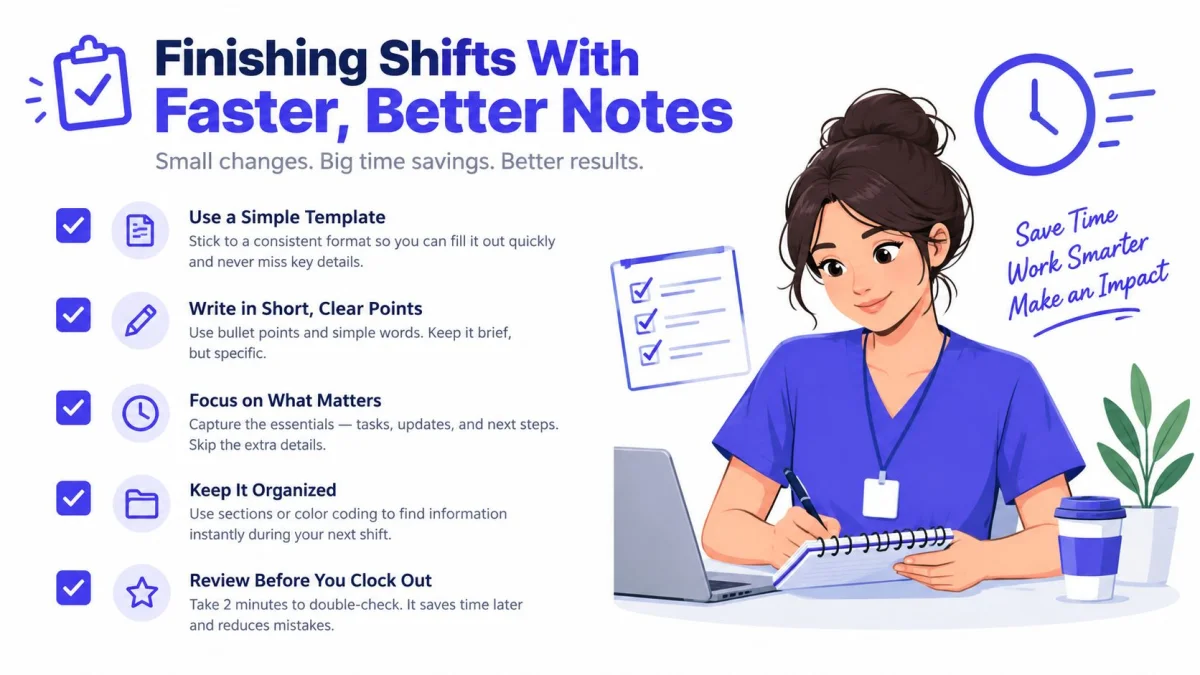
A quick end-of-shift check
- Confirm the trigger. The note should show why it exists.
- Verify the response. Every intervention should end with a patient outcome or follow-up.
- Remove carryover text. Old findings that no longer fit the current shift should not stay by default.
- Check the handoff value. The next nurse should be able to read the note and know what changed.
A second useful benchmark is time burden. Documentation studies cited in acute and critical care settings place narrative writing at about 21.4–38.2 minutes per day on average (PMC workflow benchmark). That makes efficiency a safety issue, not just a convenience issue, because rushed charting invites omissions.
For teams that want a practical sheet to support handoff discipline, the nursing report sheet template can help organize what needs to be carried forward and what should stay in the narrative note. The main habit stays the same, document the minimum complete story, then stop.
PatientNotes gives individual clinicians and small practices a way to capture notes and tasks in the clinician's own language, with structured templates and a workflow that can be adapted to narrative documentation. It includes a free trial and per-seat pricing, and it can help reduce after-hours charting when the note still needs to be clear and complete. Visit PatientNotes to see how it fits into a busy documentation routine.