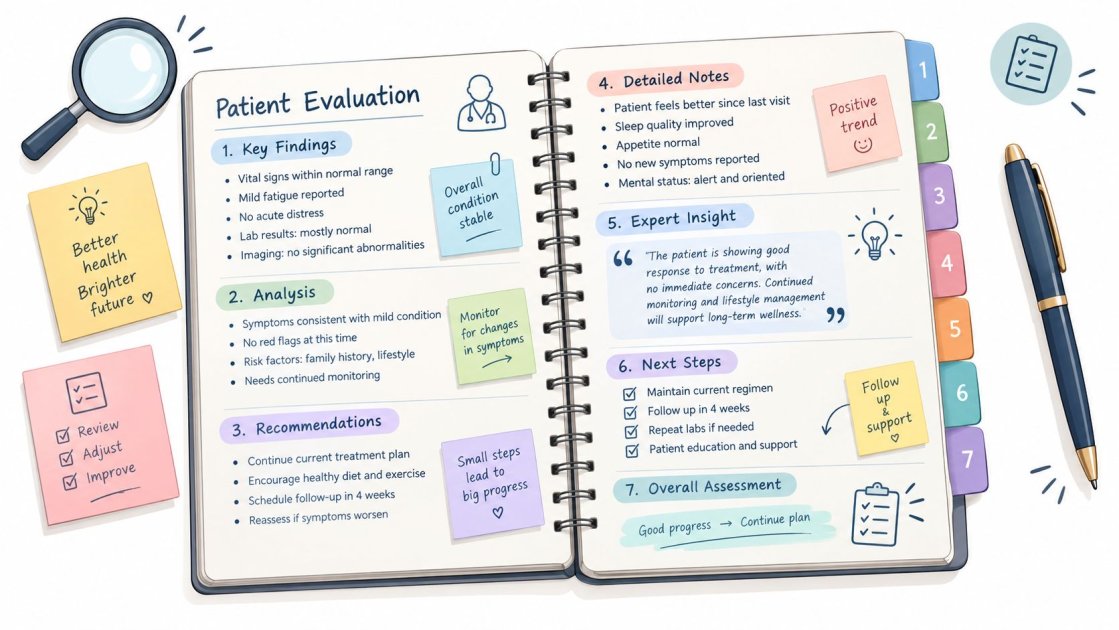
It's late, the last new-patient chart is still open, and the visit is already fading into the blur of the day. The history is clear in your head, but the mental status exam, the risk section, and the plan still need wording that a reviewer, a covering clinician, or a payer will accept. A strong psychiatric evaluation example doesn't just list symptoms, it shows why the diagnosis fits, what was observed directly, and what needs follow-up. Diagnostic criteria follow the DSM-5-TR, and the note works best when the language is structured enough that another clinician can pick it up without guessing. For a broader overview of the evaluation itself, see psychiatric evaluations explained.
1. Outpatient Adult Psychiatric Diagnostic Evaluation
A first outpatient psychiatric note has to do two jobs at once. It needs to capture the patient's story clearly and show how the diagnosis was reached. A practical sequence is HPI, past psychiatric history, substance use, medical history, medications, family history, social history, MSE, risk, diagnosis, and plan. That order fits CMS guidance that psychiatric diagnostic evaluation is an integrated biopsychosocial assessment covering the chief complaint, referral source, history, mental status, strengths and liabilities, diagnostic impression, and treatment plan (CMS psychiatric diagnostic evaluation documentation).
Start with the patient's words. “I can't shut my mind off at night” gives the note a clinical anchor, then the rest of the history should show how sleep loss, low mood, poor appetite, and reduced function fit a depressive picture. If the referral question is anxiety after job loss, keep that question separate from the differential diagnosis. That separation matters because it shows what was observed, what was inferred, and what still needs follow-up.
Practical rule: write the chief complaint in the patient's own words, then make the MSE a direct observation, not a template default.
Billing also needs to be supported by the note. CMS states that psychiatric diagnostic evaluation with medical services may be reported with CPT 90792 or an appropriate evaluation and management code, and the documentation has to support the code used (CMS billing documentation guidance). In practice, that means the risk section stays distinct, the diagnosis is explained, and the plan is specific enough for another clinician to carry forward.
End the impression with reasoning, not just a label. “Meets criteria for major depressive disorder, single episode, moderate, based on duration, sleep change, appetite change, and functional decline” tells the next clinician what was seen and how it was interpreted.
Standardizing the observational language across domains is easier with a structured tool. The MSE builder keeps those domains consistent from note to note.
2. Psychiatric Admission History and Physical
An admission note answers a different question than a clinic intake. It has to show why this patient is in the hospital now, under what legal status, and what medical issues could change the psychiatric plan. The inpatient chart also needs the physical history and exam that support safe admission, along with the psychiatric formulation.
Start with legal status. Voluntary admission, involuntary hold, and any later change should be clear in the first lines. Medication reconciliation needs a source, too. Pharmacy records, the patient, family, and prior charts do not carry the same reliability, and the note should show where the list came from.
Practical rule: if the patient came from the emergency department, state the reason for admission, the change from baseline, and the source of the medication history.
Timing matters. Under 42 CFR 482.22, the history and physical must be completed no more than 30 days before or 24 hours after admission. That is a hospital requirement, not a style choice. In the UK, the admission note should also record legal status and section numbers under the Mental Health Act 1983, as amended in 2007.
A good example is a patient admitted after mania with psychotic features and several days of reduced sleep. The note should separate what was directly observed from what the patient reported, then state why inpatient care was necessary. Another common case is delirium with suicidal ideation after a fall. In that setting, the psychiatric note has to sit beside the medical workup, not replace it.
The clearest records keep the psychiatric formulation separate from the physical findings. That makes the admission note easier for psychiatry, nursing, medicine, and utilization review to use.
3. Geriatric Psychiatric Evaluation with Cognitive Screen
A geriatric interview often goes off course when memory complaints are treated as one thing. The note works better when it separates depression, delirium, dementia, and medication effect. That usually means a cognitive screen, collateral history, and a medication review. The Montreal Cognitive Assessment is a 30-point screen, and Nasreddine et al. reported that a score of 26 or higher is the traditional cutoff for normal cognition, although performance varies by education and population (Nasreddine et al., 2005).
That cutoff only helps if the note also records the version, the language used, and whether hearing or vision limited the result. If the patient wore glasses or hearing aids, say so. If a family member gave the timeline for forgetfulness or behavior change, name that informant and the relationship in the collateral section.
Medication review carries real weight in older adults because anticholinergic and sedating effects can mimic cognitive decline. A new antipsychotic, a sleep aid, or a recent dose change may explain the presentation better than dementia. A geriatric evaluation should follow the timeline before it labels the problem.
Practical rule: record the test version, the language used, and the informant source every time. Without those three details, the score is easy to misread later.
A useful example is a 74-year-old referred for new depression and forgetfulness, with a MoCA of 22 and a plan for labs, neuroimaging, and neurology review. Another is an 81-year-old who became agitated after a new prescription, then improved after the medication changed. Both notes should show what was known, what remained uncertain, and why the diagnosis stayed provisional.
A strong geriatric note names what is still unknown and schedules the reassessment that will resolve it.
4. Substance Use-Focused Psychiatric Evaluation
A substance use note should start with the facts that change care. Pattern, route, frequency, last use, and consequences belong near the top, before the diagnosis is named. The AUDIT was developed by the World Health Organization, has 10 items, and ranges from 0 to 40, with a score of 8 or more commonly used as a cutoff for hazardous or harmful drinking (WHO AUDIT overview).
Withdrawal history, prior treatment, overdose history, and co-occurring psychiatric or medical conditions come next. A line like “denies substance use” rarely supports withdrawal planning or relapse care. The better note says what was used, how much, when, and what happened next.
A strong addiction-focused note often reads differently from a general psychiatric intake. A patient may report daily drinking, a high AUDIT score, and prior withdrawal seizures. That combination points toward medically supervised detox. Another patient may be starting buprenorphine, and the note should record naloxone supply and counseling on fentanyl test strips if that was discussed in the encounter.
Practical rule: always document the largest amount used in one day, not just the usual amount. Withdrawal risk often follows the peak, not the routine.
The source of each history item matters too. Patient self-report, family report, and a state prescription monitoring program may not agree, and the discrepancy itself is clinically useful. The note should say where each part came from instead of blending everything into one paragraph.
When substance use and mood disorders present together, a dual diagnosis IOP is one structured pathway to reference in the plan. For UK practice, the note should align with NICE guidance on alcohol and drug use disorders and the local service pathway. For US practice, the record should stay specific enough to support the treatment plan and any medically necessary monitoring.
5. Child and Adolescent Psychiatric Evaluation
A child or adolescent psychiatric note lives on more than one account. The young person's story matters, but so do the parent, guardian, school, and, when available, the teacher. The clearest note shows where each detail came from. Children and adolescents often describe the same problem differently depending on who is in the room. The AACAP practice parameter for the psychiatric assessment of children and adolescents supports that multi-informant approach.
A pediatric evaluation usually covers developmental history, school functioning, family structure, trauma and adversity, peer and online life, and sleep. Document the young person's account separately from the parent's account. That split matters when the adolescent shares something confidential, especially about mood, self-harm, or substance use.
Part of the visit should happen alone with the young person. If it did not, say why. Record who gave consent and what confidentiality limits were explained to each informant, especially when school ratings or caregiver reports are part of the note. For remote visits, these telehealth tips for evaluations cover how to structure the alone-time portion of the interview.
Practical rule: keep screen time and online activity as separate fields. They are easy to miss, and they often explain sleep, mood, and irritability better than a generic social history.
A 9-year-old referred for inattention and falling grades is a straightforward example, with teacher rating scales and a parent interview supporting the chart. A 16-year-old with new depression and social withdrawal is different, because a confidential interview and a documented safety screen can change the whole note. The point is not to over-document. It is to show the right source for each claim.
Standardized scales such as Vanderbilt or SDQ help, but the score should sit inside the note, not replace it. The chart still needs the clinical story.
6. Suicide Risk-Focused Psychiatric Evaluation
A suicide-focused note should be blunt and orderly. It needs the severity of ideation, the timing of any behavior, risk factors, protective factors, access to means, the safety plan, and the follow-up level. The Columbia Suicide Severity Rating Scale was developed by Posner et al. and is used to document suicidal thoughts and behavior across settings, but it does not predict suicide for an individual patient (C-SSRS overview).
The note should not stop at a score. The clinical formulation belongs right beside the score because the same scale result can mean something different in different contexts. A patient with passive death wishes, no plan, and strong supports is not the same as someone discharged after an attempt with limited supervision.
This is one place where vague language weakens the record. “Low risk” or “high risk” alone doesn't help the next clinician. The note should explain why that level was assigned and what was done about it.
Practical rule: record the most recent suicidal behavior and its date as its own field. That single detail often matters more than a long risk paragraph.
A good example is a 22-year-old with passive death wishes and no plan or intent, where the note includes a safety plan, lethal-means counseling, and a follow-up visit in one week. Another is a patient discharged after a suicide attempt, where medication limits and same-week follow-up are documented. The note should also state which means-restriction steps were discussed and what the patient agreed to do.
For clinic use, confirm the current C-SSRS version and licensing terms before building it into the template. For a psych-scale workflow that keeps this section organized, the psych scales tool can sit beside the note structure without changing the clinical judgment.
7. Brief Telehealth Psychiatric Intake with Measurement-Based Scales
A telehealth intake still needs the same clinical spine as an in-person note. The difference is that the visit logistics belong in the chart too, because physical location, consent, platform, and who is present can affect licensure, billing, and later review. The PHQ-9 has 9 items scored from 0 to 27, and the GAD-7 has 7 items scored from 0 to 21, with 10 commonly used as a clinical cutoff on each scale, based on the PHQ-9 depression scale calculator and the official PHQ-9 and GAD-7 sources.
Scores can be computed and tracked with the PHQ-9 depression scale calculator so the baseline and follow-up values use the same method. A usable intake note records the patient's physical location at the start of the visit, the clinician's location, consent to telehealth, the platform used, and anyone else on the call. The psychiatric history and mental status exam still belong there. Without them, the scores sit in the chart without clinical meaning.
The template should also make repeat measurement easy. If PHQ-9 and GAD-7 are built into the workflow, they can be collected again at follow-up without relying on memory. That makes change over time easier to see, and it helps answer a simple question: is treatment helping, or is the score moving without a matching clinical gain?
Practical rule: add a fixed item 9 follow-up line. If the answer is above 0, the note should show what happened next.
A good note might describe a 31-year-old seen by video for follow-up, with PHQ-9 falling from 18 to 9 and GAD-7 from 15 to 8 on sertraline. Another might document a phone intake with a PHQ-9 of 14 and a follow-up plan tied to item 9 because self-harm thoughts came up. Those notes work because the scale results, the risk response, and the visit logistics are all in one place.
For US telehealth billing, the CMS Medicare telehealth list and payer rules should be checked for place-of-service codes and modifiers. In the UK, NICE guidance on depression and local NHS Talking Therapies pathways should guide how the scale data is used.
Comparison of 7 Psychiatric Evaluation Types
| Evaluation Type | Implementation complexity | Resource requirements | Expected outcomes | Ideal use cases | Key advantages |
|---|---|---|---|---|---|
| Outpatient Adult Psychiatric Diagnostic Evaluation (DSM-5-TR Structure) | Moderate–High (comprehensive, time-consuming) | Clinician time, DSM-5-TR/ICD-10 coding, optional rating scales | Full diagnostic formulation and numbered treatment plan; billing-ready note | New adult outpatient intakes and general psychiatric presentations | Familiar training format, easy to scan, aligns with CPT codes |
| Psychiatric Admission History and Physical (Inpatient or Hospital) | High (regulated, includes physical exam and legal fields) | Multidisciplinary input, vitals/labs, medication reconciliation, legal documentation | Regulatory-compliant admission record with documented risk and legal status | Hospital or inpatient psychiatric admissions | Meets hospital/CMS requirements; centralizes admission reasoning and safety orders |
| Geriatric Psychiatric Evaluation with Cognitive Screen (MoCA) | Moderate (adds structured cognitive testing and collateral gathering) | MoCA tool/version/licensing, collateral informant, sensory checks, med review | Standardized cognitive baseline (MoCA) and targeted medical workup recommendations | Older adults with cognitive decline, memory complaints or behavioral change | Objective cognitive metric for follow-up; prompts medication and sensory review |
| Substance Use-Focused Psychiatric Evaluation (AUDIT + DSM-5-TR) | Moderate (structured substance assessment and criteria mapping) | AUDIT instrument, collateral or toxicology, withdrawal risk tools, overdose counseling materials | Quantified use patterns, DSM-5 use disorder mapping, withdrawal and treatment plan | Patients with suspected alcohol or drug misuse or withdrawal risk | Comparable metrics (AUDIT), informs detox decisions and naloxone/overdose planning |
| Child and Adolescent Psychiatric Evaluation | High (multi-informant, developmental and consent complexity) | Multiple informants (parents/school), developmental history, rating scales, consent documentation | Developmentally-informed formulation, safety and education-related plans | Children/adolescents with behavioral, developmental, school or mood concerns | Multi-informant clarity; documents consent/confidentiality and school-related issues |
| Suicide Risk-Focused Psychiatric Evaluation (C-SSRS) | Moderate (specialized screening plus safety planning) | C-SSRS tool, trained staff, safety planning templates, means restriction resources | Structured record of ideation/behavior and documented safety/means-restriction plan | Patients presenting with suicidal ideation, behavior, or recent crisis | Standardized capture of ideation/behavior; supports safety planning and follow-up |
| Brief Telehealth Psychiatric Intake with PHQ‑9 and GAD‑7 | Low–Moderate (concise, telehealth-specific fields) | PHQ-9/GAD-7 forms, telehealth platform, consent/location documentation | Rapid baseline symptom scores and repeatable measures; telehealth-compliant note | Remote intakes and brief follow-ups for depression and anxiety | Fast, repeatable measurement; supports telehealth documentation and monitoring |
Build Your Own Note From These Parts
Start with the note type that matches the visit, not the longest one. Copy its section order, then fill the MSE from direct observation and cite the criteria your practice uses. Keep the risk block separate so it's easy to find later, and repeat validated scales at clinically meaningful intervals when measurement-based care is part of the plan (APA adult psychiatric evaluation guidance).
The same discipline helps with consent, privacy, and documentation limits. If a note is audio-recorded, transcribed, or supported by AI, the patient's preference, the data-handling terms, and the human review step should be visible in the chart. That is especially important in mental health, where the record often includes highly sensitive material and where the documentation has to be checked before it becomes part of the legal record (APA AI ethics guidance).
For small practices, consistency is the main gain. A note that follows the same structure every time is easier to sign, easier to review, and easier to hand off. PatientNotes includes psychiatry among its 37 specialty templates, and the template builder can help keep the note structure stable without forcing every visit into one fixed format. The specialty set is at PatientNotes specialties, and the product comparison page is at PatientNotes compare if a practice wants to see how the workflow is organized.
A good psychiatric evaluation example doesn't chase perfect wording. It captures the clinical reasoning, names the uncertainty when it's real, and leaves a chart that another clinician can trust.
If a psychiatric note is still taking too long after the visit, PatientNotes can help turn the encounter into a structured draft with psychiatry-specific templates, follow-up tasks, and reviewable billing suggestions. It supports outpatient, telehealth, and specialty psychiatric documentation in a way that fits small practices. Visit PatientNotes to see how the workflow is organized.