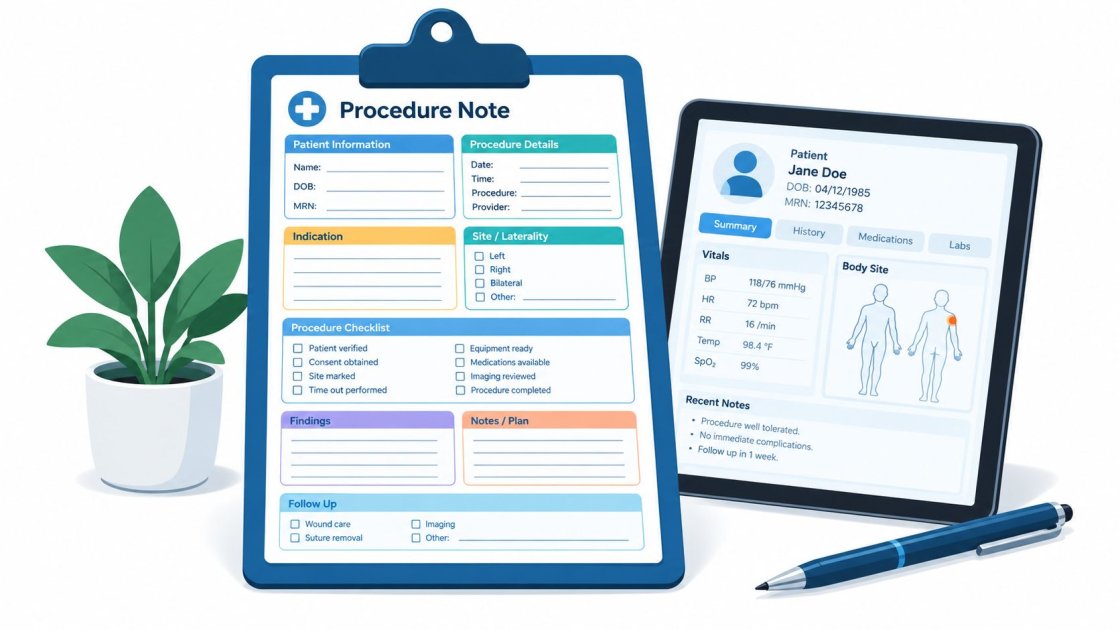
The next patient has arrived, the intake form is incomplete, and the previous note still needs signing. A depression score sits in an attachment, while the follow-up plan sits somewhere in free text. The clinician needs a usable record, not another form to reconcile after clinic.
Pick the right template before the visit starts. Intake, triage, risk assessment, and follow-up serve different purposes. A symptom questionnaire can support an assessment, but it can't replace the interview, formulation, or documented decision about what happens next.
The following mental health assessment templates pair familiar instruments with practical documentation fields for small US and UK practices. The printable examples are note structures, not replacements for the official questionnaires. Scoring should follow the instrument version and the service's approved protocol.
- For intake: Combine symptom measures with history, functional impact, strengths, and patient-defined goals.
- For risk: Keep screening responses separate from clinical formulation and the management plan.
- For follow-up: Preserve the instrument version, administration date, treatment context, and clinician interpretation.
Different assessment questions also require different instruments. For encounters involving suspected post-traumatic amnesia, a practical guide to PTA assessment provides separate background. A general mental health symptom scale shouldn't become a substitute for a condition-specific assessment.
1. PHQ-9 (Patient Health Questionnaire-9)
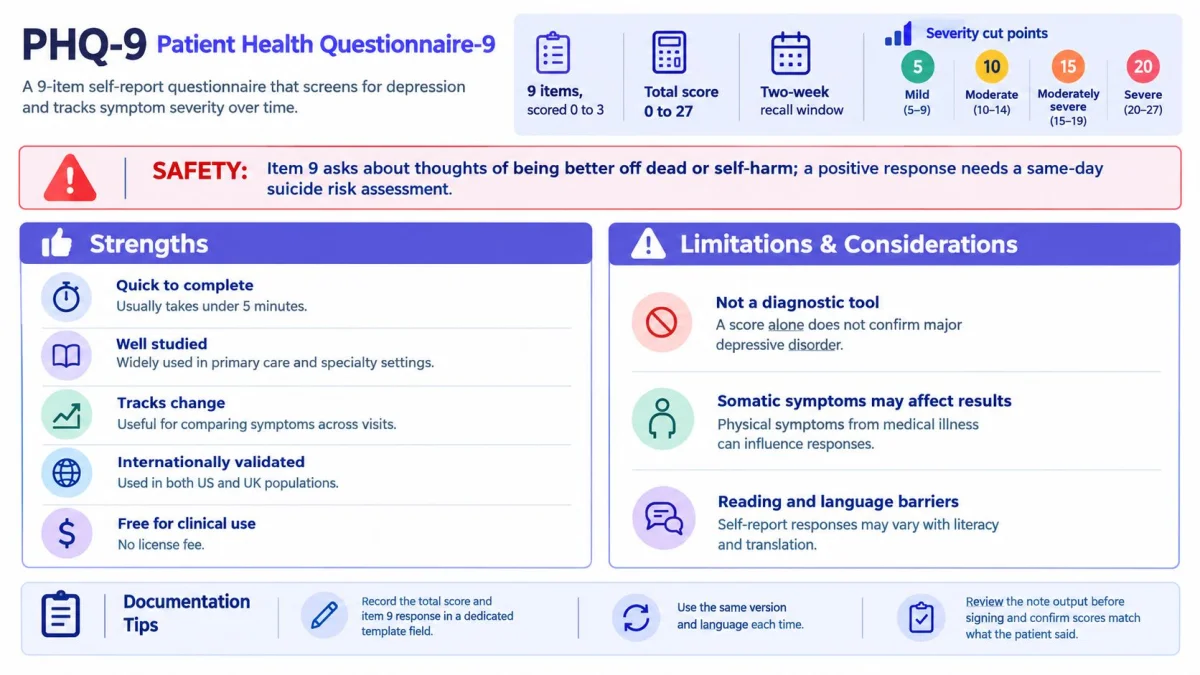
The PHQ-9 works best as a repeatable depression measure within a broader assessment. A practical use case is a primary care follow-up where the clinician needs to compare current symptoms with the previous visit while also discussing function, treatment experience, and safety.
The original validation identified a score of 10 or higher as the optimal threshold for probable major depression, with 88% sensitivity and 88% specificity against the reference diagnostic interview. Those findings support further evaluation, not an automatic diagnosis, as described in the original PHQ-9 validation study.
The visual below summarizes the questionnaire and its documentation role.
Printable Documentation Fields
- Measure details: Official version, language, administration date, item responses, total score, and scoring reference.
- Clinical interpretation: Functional impact, relevant history, alternative explanations, and clinician review.
- Safety and follow-up: Self-harm response, assessment completed, actions taken, and next contact.
A biopsychosocial assessment template provides the surrounding structure when the score needs biological, psychological, and social context. The numerical result should remain easy to locate without pushing the patient's account out of the note.
US billing note: Keep the assessment findings and service documentation separate from any proposed billing code. This template doesn't establish coding eligibility.
UK service context: Add the receiving service, local pathway, and agreed review arrangements. For copy-paste workflows, transfer the date and interpretation with the score, rather than pasting an unexplained number into the EHR.
2. GAD-7 (Generalized Anxiety Disorder-7)
An anxiety follow-up often starts with a familiar problem: the patient reports feeling worse, but the record doesn't clearly show whether symptoms, daily function, or circumstances have changed. A GAD-7 section can organize that discussion without forcing every concern into a score.
Thresholds need context. The supplied validation evidence reports that the commonly used threshold of 10 has approximately 89% sensitivity and 82% specificity for generalized anxiety disorder, while also emphasizing false positives and the need for fuller assessment in different populations. The PHQ-9 and GAD-7 validation paper explains why screening results shouldn't become autonomous diagnoses.
Practical rule: Store the score beside the clinical interpretation, not in place of it.
Keep Anxiety and Depression Fields Together
A combined symptom section is useful when a clinician administers both anxiety and depression measures during the same encounter. Separate labeled fields prevent the totals, dates, and interpretations from becoming confused.
Printable note structure
- Administration: Instrument version, language, date, missing responses, and scoring method.
- Treatment context: Current treatment, recent changes, and the reason for reassessment.
- Interpretation: Anxiety symptoms, functional impact, differential considerations, and patient priorities.
- Plan: Further assessment, agreed actions, responsible clinician, and review date.
For a UK service receiving a referral, include the clinical question rather than sending the score alone. For a US practice, keep billing review outside the screening interpretation; no code is assigned by this template.
Before copying into an EHR, check that the scale name, patient, and encounter date match. A neatly formatted score attached to the wrong visit is still an inaccurate record.
3. Columbia Suicide Severity Rating Scale (C-SSRS)
A suicide screen belongs inside a conversation, not at the end of a completed note. Consider an outpatient encounter in which a patient describes new suicidal thoughts. The documentation needs to show what the clinician explored, what changed, and why the resulting plan fits the circumstances.
The consultation image reflects the interview setting, but the record must preserve more than completed boxes.

Use the service-approved C-SSRS version and its instructions. No universal numerical disposition threshold is supplied here. In self-harm care, NICE recommends risk formulation within every psychosocial assessment, supporting a clear distinction between screening responses and the reasoning behind planned actions.
Document the Reasoning and the Handoff
- Screening record: Version used, responses, timing, and information source.
- Formulation: Presenting circumstances, vulnerabilities, triggers, protective factors, and clinical reasoning.
- Management: Agreed actions, consultations, disposition rationale, responsible professional, and follow-up arrangements.
A mental state exam template can hold relevant observations alongside the interview. It shouldn't replace the dedicated risk formulation.
For practices using video material in staff education, the following is a separate resource rather than a scoring authority.
US billing note: Document the actual assessment and actions without allowing a suggested code to determine the narrative. UK service context: Name the receiving crisis or community team and record whether contact occurred, rather than merely writing “referred.”
Copy the assessment and management plan together. A transferred risk label without its supporting reasoning is an incomplete handoff.
4. AUDIT (Alcohol Use Disorders Identification Test)
An alcohol assessment becomes difficult to interpret when the note says only “drinks socially.” A more useful template preserves the patient's answers, the instrument result, and the discussion that followed.
A practical scenario is a primary care visit where alcohol use emerges during discussion of sleep, mood, or medication. The clinician can use the approved AUDIT form, then document the findings within the broader assessment rather than compressing the encounter into a label.
Scoring boundary: Use the official version's scoring instructions and the practice's approved interpretation pathway. No numerical AUDIT cut point is reproduced here without an accompanying primary scoring source.
Preserve the Answers Before Summarizing
The CMS behavioral health assessment roadmap describes assessment as establishing whether a mental or substance-use disorder is present, exploring readiness for change, identifying strengths and barriers, and involving the person in planning. That provides a useful framework around the questionnaire.
- Reported use: Patient-described amounts, frequency, context, and questionnaire responses.
- Interpretation: Instrument version, score, scoring reference, and clinician assessment.
- Readiness and goals: The patient's concerns, preferred changes, strengths, and practical barriers.
- Plan: Advice discussed, further evaluation, referral arrangements, and review.
US billing note: The copied score isn't a substitute for documenting the service performed. This example makes no claim about reimbursement.
UK service context: Include the local alcohol-service pathway and whether the patient accepted the proposed referral. For copy-paste documentation, retain the units and wording recorded; don't let a summary change the patient's reported amounts.
A polished paragraph is less useful than an accurate account of what the patient reported and what the clinician agreed to do.
5. PCL-5 (PTSD Checklist for DSM-5)
A trauma assessment needs space for the patient's priorities as well as questionnaire findings. In a trauma-focused therapy follow-up, the clinician may want a consistent symptom record while also documenting treatment tolerance, function, and the patient's experience of the assessment.
The image below illustrates a therapy setting, not a completed assessment.

Cut-point handling: Record the threshold from the approved scoring reference used by the service. This template doesn't supply an independently verified PCL-5 threshold or treat a screening result as a confirmed diagnosis.
For broader assessment design, the mhGAP implementation trial describes structured support covering conditions including post-traumatic stress disorder. Its implementation findings reinforce the importance of training, workflow, and local context rather than assuming that a form alone improves recognition.
Build a Trauma Follow-up Record
- Measure: Official version, language, date, item responses, score, and scoring reference.
- Context: Reason for administration, relevant treatment stage, and functional concerns.
- Patient experience: Distress during completion, requested pauses or adjustments, and support provided.
- Clinical synthesis: Interpretation, remaining assessment questions, agreed goals, and next steps.
For a US practice, keep any billing review separate from the questionnaire result. For a UK referral, identify the receiving service and the specific assessment or treatment question.
Copy-paste documentation should retain the reference period and version used. If the clinician records symptom groupings, those labels should match the official instrument rather than categories improvised by a note generator.
The trade-off is straightforward: more structured detail supports comparison, but repeating an extensive trauma narrative at every visit can make the note harder to use.
6. EPDS (Edinburgh Postnatal Depression Scale)
A maternity or postpartum visit can contain competing concerns: recovery, feeding, sleep, relationships, and emotional distress. An EPDS documentation section should make the mental health findings visible without separating them from that context.
A supportive consultation still needs a clear record of the patient's responses and the agreed follow-up.

Scoring and escalation: The template should name the approved EPDS version, local threshold, and applicable maternity or perinatal pathway. No numerical threshold is supplied here because the available primary-source evidence doesn't establish one for this section.
Make Follow-up Ownership Explicit
A proposed small-practice note structure can include the following fields:
- Administration details: Date, language, interpreter involvement, version, responses, and verified total.
- Clinical context: Patient-described concerns, daily function, support, and treatment preferences.
- Safety assessment: Concerns explored, clinical formulation, consultations, and actions taken.
- Coordination: Named clinician or team, referral status, patient communication, and next contact.
Safer Care Victoria's suicide-prevention guidance emphasizes current information, multiple sources, clinical rationale, and accurate transfer between professionals. Those documentation principles are relevant when care crosses maternity, primary care, and mental health services.
US billing note: Record the encounter and assessment performed without treating the scale result as a billing determination. UK service context: Identify the relevant maternity, health visiting, primary care, or perinatal service rather than assuming another team owns follow-up.
For patient-facing background, when to seek postpartum depression support can accompany the discussion. It isn't a substitute for the service's clinical escalation protocol.
7. MDQ (Mood Disorder Questionnaire)
A patient presents with persistent depressive symptoms, but the history raises unanswered questions about previous changes in mood, activity, and functioning. A useful MDQ documentation template keeps the screening result separate from the longitudinal account.
A positive screen shouldn't become a diagnosis through copy and paste. The proposed template should preserve the patient's descriptions, episode chronology, functional consequences, treatment history, and information still needed for a clinical conclusion.
No numeric MDQ threshold is reproduced here. The clinician should enter the scoring rule from the official version used and retain that reference with the result.
Documentation safeguard: A patient's description, a screening interpretation, and a clinician's diagnostic conclusion belong in separate fields.
Give the History Enough Room
A narrative-first structure works better than a score-only box for this scenario.
- Reason for screening: The clinical question that prompted the questionnaire.
- Patient account: Reported mood changes, associated experiences, timing, duration, and effects on daily life.
- Additional history: Previous treatment, relevant family history, collateral information, and unresolved discrepancies.
- Conclusion and plan: Screen interpretation, diagnostic uncertainty, further evaluation, and follow-up responsibility.
NICE's assessment guidance for people with mental health problems and learning disabilities offers a useful formulation model within that population: explain the problem, precipitating and maintaining factors, protective factors, required adjustments, and treatment implications. It isn't an MDQ scoring source.
US billing note: This template makes no code assignment. UK service context: A referral should state the unresolved diagnostic question, not attach a positive screening label.
Before transferring the note, check that reported experiences haven't been rewritten as established episodes or confirmed diagnoses. Clear uncertainty is more useful than unsupported certainty.
8. DASS-21 (Depression Anxiety Stress Scales-21)
Keep depression, anxiety, and stress findings distinct. In a counseling follow-up, a clinician may want to discuss several areas of distress without reducing the patient's experience to a single summary label.
A practical example is a student returning during an examination period. The documentation can record the measure findings alongside sleep, attendance, relationships, patient priorities, and the agreed treatment focus, without inventing a diagnosis from the score.
Scoring boundary: Use the official DASS scoring instructions and record the method applied. This example doesn't reproduce severity bands or conversion rules without a primary scoring reference.
Use a Consistent Results Block
- Instrument details: Version, administration date, language, response completeness, and scoring reference.
- Separate findings: Labeled depression, anxiety, and stress results using the approved scoring method.
- Clinical meaning: Functional impact, relevant circumstances, clinician interpretation, and remaining questions.
- Plan: Patient-defined goals, agreed actions, reassessment arrangements, and responsible clinician.
The psychological scales resource can sit alongside the practice's approved assessment materials. Each template still needs a checked scoring reference rather than an assumed interpretation.
For broader safety documentation, NICE's comprehensive assessment recommendations cover risk to self and others, maintaining factors, environmental effects, and protective factors. A distress-measure section shouldn't crowd those domains out of a relevant assessment.
US billing note: No reimbursement conclusion follows from these results alone. UK service context: Record the service's chosen outcome-measure protocol and the clinical purpose of repeat administration.
For copy-paste workflows, preserve the separate result labels and scoring method. If the template changes, the practice should check whether earlier and current records remain meaningfully comparable before describing a trend.
Mental Health Assessment Templates: Comparison of 8 Tools
| Assessment Tool | Primary Focus | Format and Scoring | Main Strength | Key Consideration | Cost and US Billing Note |
|---|---|---|---|---|---|
| PHQ-9 | Depression symptoms and severity | 9 items; 0–27; 2-week recall | Brief and useful for tracking change | Screening tool, not a diagnosis; positive item 9 needs same-day suicide risk assessment | Free; CPT 96127 may apply |
| GAD-7 | Anxiety symptoms | 7 items; 0–21; 2-week recall | Brief, with good primary care screening accuracy | Does not identify a specific anxiety disorder | Free; CPT 96127 may apply |
| C-SSRS | Suicidal ideation and behavior | Structured screener or full interview | Standardizes suicide risk documentation | Informs, but does not predict, risk; training recommended | Free for clinical use; no specific CPT code |
| AUDIT | Hazardous or harmful alcohol use | 10 items; 0–40; includes consumption, dependence, and harm | Supports screening and brief intervention | Self-report may understate use; does not screen for other substances | Free; CPT 99408 or 99409 may apply |
| PCL-5 | PTSD symptoms | 20 items; 0–80; past-month recall | Tracks symptoms across DSM-5 clusters | Cut point is provisional; not a substitute for a clinical interview | Free; CPT 96127 may apply |
| EPDS | Depression during pregnancy and the first year after birth | 10 items; 0–30 | Designed for perinatal screening | Cut points vary; positive item 10 needs immediate follow-up | Free; CPT 96127 may apply |
| MDQ | Possible bipolar spectrum disorder | 15 yes/no items plus 2 follow-up questions | Can prompt further evaluation before antidepressant treatment | Positive results require clinical assessment; false positives can occur | Free; CPT 96127 may apply |
| DASS-21 | Depression, anxiety, and stress | 21 items; three 7-item subscales; past-week recall | Measures three dimensions of distress together | Interpret subscales clinically; less common in US and UK guidelines | Free with attribution; CPT 96127 may apply |
Document Faster Without Missing Risk
A small practice doesn't need every questionnaire in every encounter. A workable starting set is an intake structure, a dedicated risk formulation, and a follow-up note with consistent measure fields. Scores should stay in the same place, with interpretation and action close by.
The strongest mental health assessment templates leave room for disagreement and uncertainty. They distinguish patient report from observation, screening from diagnosis, and a proposed referral from a completed handoff. The peer-reviewed study of clinicians' attitudes toward standardized tools supports a practical implementation lesson: usability matters when clinicians decide whether to adopt structured measures.
Keep Clinical Review in the Workflow
- Before signing: Verify responses, scores, instrument versions, and any statements about safety.
- Before transfer: Keep the formulation, disposition rationale, and management plan together.
- After referral: Record who owns the next contact and whether the receiving service accepted the handoff.
A completed form doesn't demonstrate that risk has been understood. The VA/DoD guideline synopsis describes assessment across psychiatric history, self-directed violence, social circumstances, physical health, and access to lethal means, while identifying limitations in the evidence for screening programs alone. Family communication also deserves explicit documentation; discharge planning guidance for families can support preparation without replacing the clinical discharge plan.
PatientNotes is one documentation option for individual clinicians and small practices. Built by a London-based company, it records consultations, produces structured notes, and extracts follow-up tasks for review. Its specialty library covers 37 specialties, and its AI template builder can add clinician-defined assessment sections; notes and tasks are produced in the clinician's own language.
Semble is the only EHR integration. Every other EHR uses copy and paste, so clinicians should check the transferred note before signing. The native iOS app supports offline recording, and ICD-10, CPT, and CDT suggestions apply to US billing only and require review.
PatientNotes pricing is $70 per user per month billed monthly, or $50 per user per month billed annually. The same pricing page details a 7-day free trial with no credit card and a 14-day money-back guarantee. There's no enterprise tier or sales call; PatientNotes states that it is HIPAA compliant, with a BAA included at no extra cost.
PatientNotes offers specialty templates and an AI template builder for structured mental health documentation, with follow-up tasks available for clinician review. Clinicians can visit PatientNotes to try an assessment workflow and check how its notes fit their practice's scoring, risk documentation, and EHR transfer process.