A rushed handover is where small omissions become active risks. The incoming nurse needs more than a diagnosis and a medication list. They need the patient's identifiers, current condition, abnormal results, pending work, risks, and the tasks that must happen before the next report. Structured handover guidance from NICE highlights these elements because a handoff should help the next clinician act without guessing.
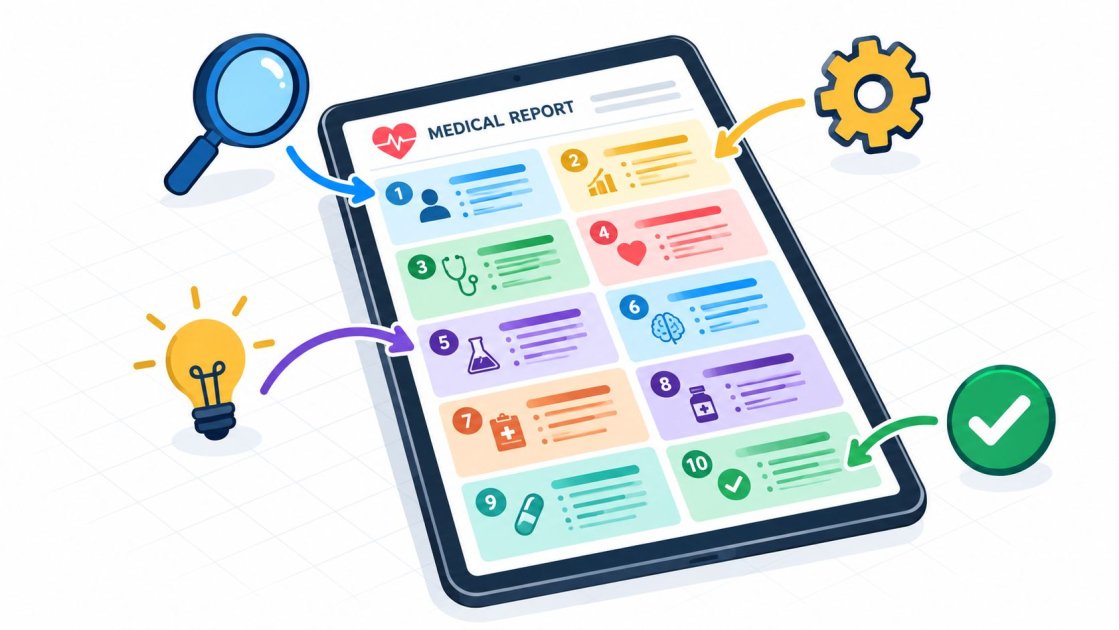
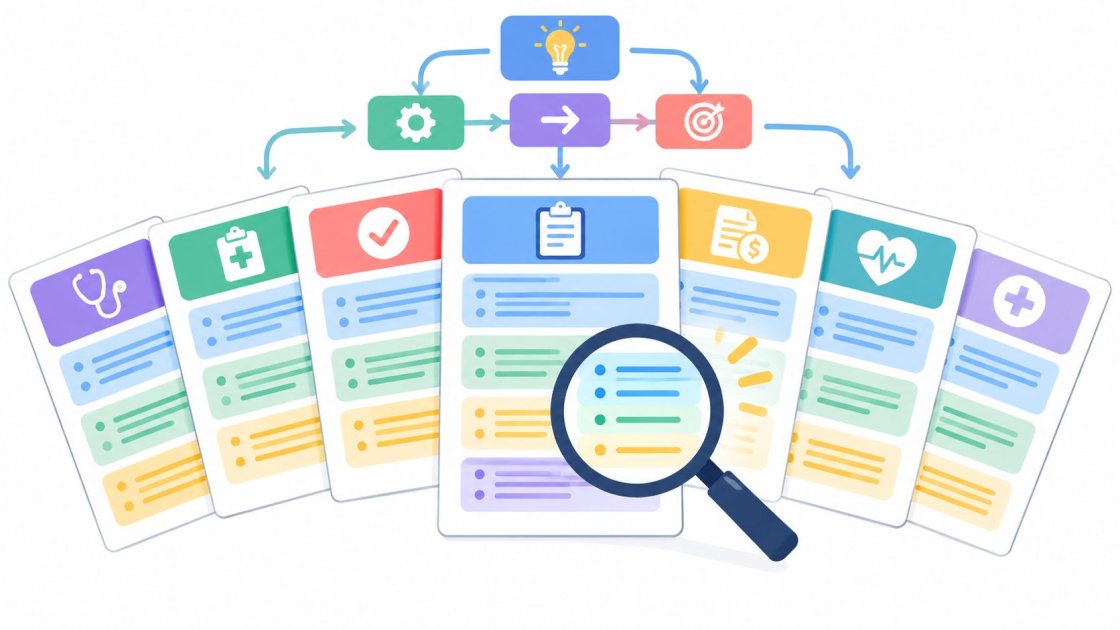
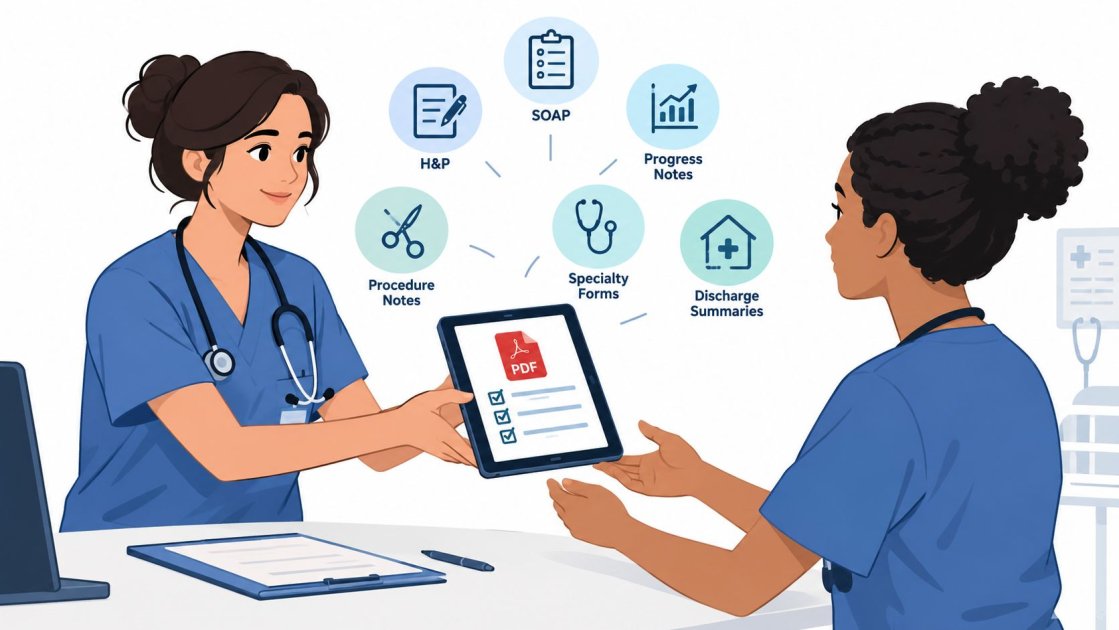
This guide reviews seven reusable nursing report sheet PDF formats and editable templates: SOAP, H&P, progress note, procedure note, specialty-specific, discharge letter, and an AI-built custom template. Each format supports a different point in the care cycle. Some work well for a focused shift note. Others become too long for a fast bedside report. Free resources are noted where available, along with the practical trade-offs between a printable page and an editable workflow.
1. SOAP Note Template for Nursing Documentation
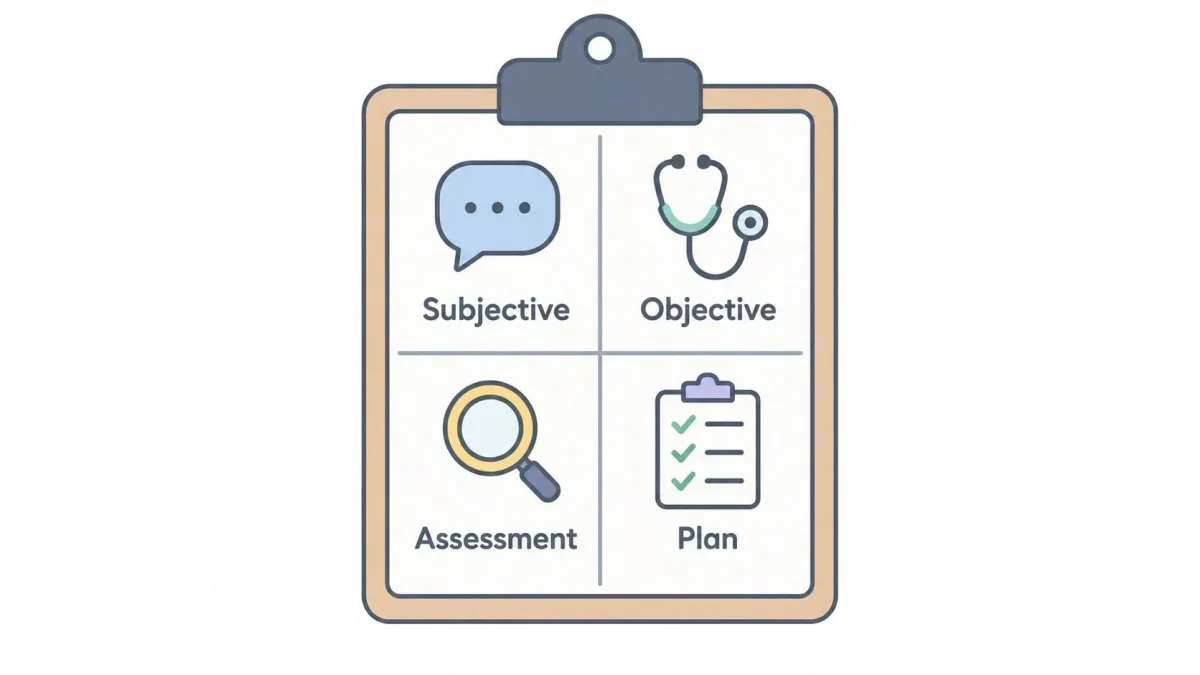
SOAP remains one of the most recognizable structures in clinical documentation. Its four sections create a clear path from what the patient reports to what the clinician observes, concludes, and plans. That makes a SOAP nursing report sheet PDF useful when the incoming clinician needs a concise explanation of both the patient's current state and the reasoning behind the next action.
The structure is simple:
- Subjective: Record symptoms, concerns, and relevant statements from the patient or caregiver.
- Objective: Add observed findings, vital signs, test results, and other measurable information.
- Assessment: State the current clinical interpretation and active problems.
- Plan: Record treatments, monitoring, education, escalation, and follow-up tasks.
The format separates patient-reported information from clinical observations. That distinction helps the next nurse understand whether a change came from a new complaint, a measured finding, or both. It also supports documentation across acute and chronic conditions because the same four headings can be adapted to different specialties.
Where SOAP works and where it strains
SOAP is fast once the team uses the headings consistently. It also makes handoff easier because the receiving clinician can scan the assessment and plan without sorting through a continuous narrative. A SOAP note examples PDF can help clinicians compare concise documentation with a version that contains unnecessary detail.
The main weakness is discipline. A SOAP note can become lengthy when every observation is copied into the objective section. Complex patients may also need separate fields for allergies, code status, lines, drains, risk flags, and pending tests.
Practical rule: Use SOAP for focused clinical updates, but add a compact handoff strip for identifiers, risks, pending work, and the next shift's tasks.
2. History and Physical Examination Template
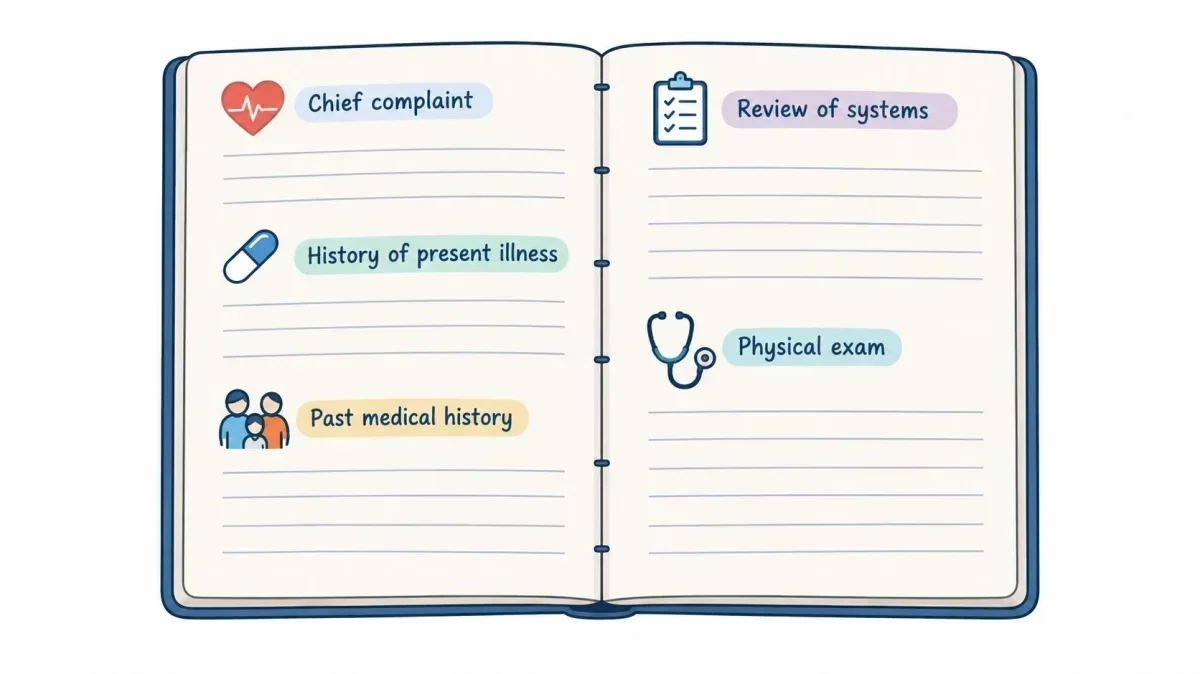
An H&P template is built for the beginning of an episode of care. It suits hospital admission, a new patient evaluation, or a complex assessment where the receiving clinician needs a thorough baseline. Unlike a short brain sheet, it preserves the context behind the patient's current problems.
A useful H&P nursing report sheet PDF should make the following information easy to locate:
- Presenting problem: Chief complaint and history of the present illness.
- Relevant history: Past medical and surgical history, medications, allergies, and social history.
- Systems review: Symptoms organized by body system.
- Examination: Physical findings arranged in a predictable order.
- Clinical direction: Initial assessment, differential considerations, diagnostic work, and early treatment planning.
The strength of this layout is completeness. It reduces the need for every member of the care team to repeat the same history and gives later progress notes a reliable starting point. It can also support a thorough review of the patient's risks before the first shift change.
The cost of capturing everything
H&P documentation takes longer than a focused handoff. It can also bury urgent information when a complex history occupies most of the page. A history and physical template works best when the full assessment is required, not when a nurse needs a quick view of a changing assignment.
The practical answer is to separate baseline information from active-shift information. Keep the H&P as the detailed reference. Add a shorter handoff panel that shows current vital-sign trends, abnormal results, medication timing, precautions, pending orders, and immediate tasks.
That approach respects the purpose of each document. An H&P explains how the patient arrived and what was known at the start. A handoff sheet explains what the next clinician must do now.
3. Progress Note Template for Ongoing Patient Care
A progress note is the better fit after the initial assessment has already been completed. It records what changed, how the patient responded, and what happens next. For routine follow-up, it gives the next clinician a shorter route through the chart than an H&P.
The most useful fields include:
- Time anchor: Date and time of the encounter or update.
- Current status: Presenting concern, condition, and meaningful interval changes.
- Focused findings: Examination results related to the active problem.
- Medication changes: New medicines, stopped medicines, dose changes, and relevant administration details.
- Problem-based plan: A separate next step for each active problem.
- Education and follow-up: Teaching completed, patient response, referrals, and outstanding work.
A strong progress note shows trajectory. It answers whether the patient is improving, deteriorating, or staying stable. It also gives the next nurse a place to find unresolved tasks rather than forcing a search through several earlier notes.
Preventing copy-forward drift
Progress notes are concise, but repetition creates risk. Copying an old assessment or medication list without checking it can leave incorrect information in the current record. The template should prompt the clinician to update the date, interval history, active problems, medication changes, and plan instead of encouraging a full copy of the prior note.
This format also needs a clear handoff area. A progress note may explain the patient's course, yet still fail to tell the incoming nurse that a test is pending, a dressing change is due, or a reassessment must occur. Those operational details belong in a visible task section.
Documentation burden affects clinicians beyond the scheduled encounter. An AMIA survey reported that 77.42% of respondents finished work later than desired or worked at home because of documentation tasks, while 74.38% said documentation time impeded patient care. A concise progress template can't solve every workload problem, but it can reduce avoidable repetition.
4. Procedure Note Template
Procedure notes need precision. A shift report may summarize a procedure, but the procedure note must preserve what happened, what was found, and how the patient tolerated it. That information matters to the next clinician managing recovery, monitoring for complications, or preparing follow-up care.
A practical procedure template should include:
- Procedure identity: Name, date, time, and location.
- Reason and authorization: Indication and informed-consent documentation or reference.
- Preparation: Pre-procedure assessment, vital signs, anesthesia or sedation, and relevant precautions.
- Technical record: Steps performed and specific anatomical findings.
- Materials and findings: Specimens, handling instructions, unexpected findings, and estimated blood loss when relevant.
- Outcome: Complications, immediate post-procedure status, patient tolerance, and follow-up instructions.
The template prevents a common handoff failure. A receiving nurse shouldn't have to infer whether a specimen was collected, whether an unusual finding was documented, or which restrictions apply after the procedure.
Detail without delay
Procedure notes should be completed promptly, while details remain clear. A sparse note can leave clinical, billing, and legal gaps. An overly elaborate template can slow completion and encourage clinicians to skip fields.
The best layout uses required prompts with enough room for meaningful detail. It should distinguish routine fields from event-specific narrative. For a minor procedure, the note may be short. For a complex intervention, the same structure should allow additional findings without forcing the clinician to compress important details into a tiny box.
The handoff copy should pull forward only what the next nurse needs: post-procedure observations, monitoring requirements, pain or sedation concerns, wound or site care, specimens, restrictions, and escalation instructions. The full technical note belongs in the formal record. The nursing report sheet PDF should make immediate care safe and visible.
5. Specialty-Specific Documentation Templates
A generic nursing report sheet PDF works until the unit's important information doesn't fit its fields. Specialty templates solve that problem by organizing documentation around the assessments, terminology, risks, and workflows that clinicians use repeatedly in a specific setting.
PatientNotes lists templates across 37 specialties on its specialty templates page, including areas such as psychiatry, cardiology, dermatology, OB/GYN, orthopedics, pediatrics, physiotherapy, and physical medicine and rehabilitation. The value isn't the specialty label alone. It's the reduction in searching, retyping, and deciding which fields matter during a busy shift.
A specialty layout may bring forward:
- Relevant assessments: Specialty-specific symptoms, scales, and findings.
- Common interventions: Procedures, therapies, and monitoring tasks used in that service.
- Risk information: Precautions and warning signs that need prominent placement.
- Coding prompts: Diagnosis and billing suggestions that still require clinician review.
- Local workflow: Fields arranged to match the order of assessment and handoff.
Choose the layout by acuity
A med-surg sheet usually needs a compact multi-patient view with diagnoses, allergies, vital trends, medications, pending tests, discharge barriers, and a to-do list. An ICU sheet needs more room per patient for lines, drains, respiratory support, infusions, laboratory trends, and frequent reassessment. An emergency department sheet needs rapid capture of the presenting problem, tests in progress, changes in status, and disposition.
Specialty templates reduce cognitive load, but they still require review. Fields can become outdated as practice changes. Abbreviations may also mean different things across teams. The template should be tested against real handoffs and edited when clinicians repeatedly write the same information in a blank margin.
The ModMed integration resource may be relevant to practices evaluating specialty documentation workflows, but any integration claim should be checked against the current vendor and EHR configuration before adoption.
6. Discharge Summary and Letter Templates
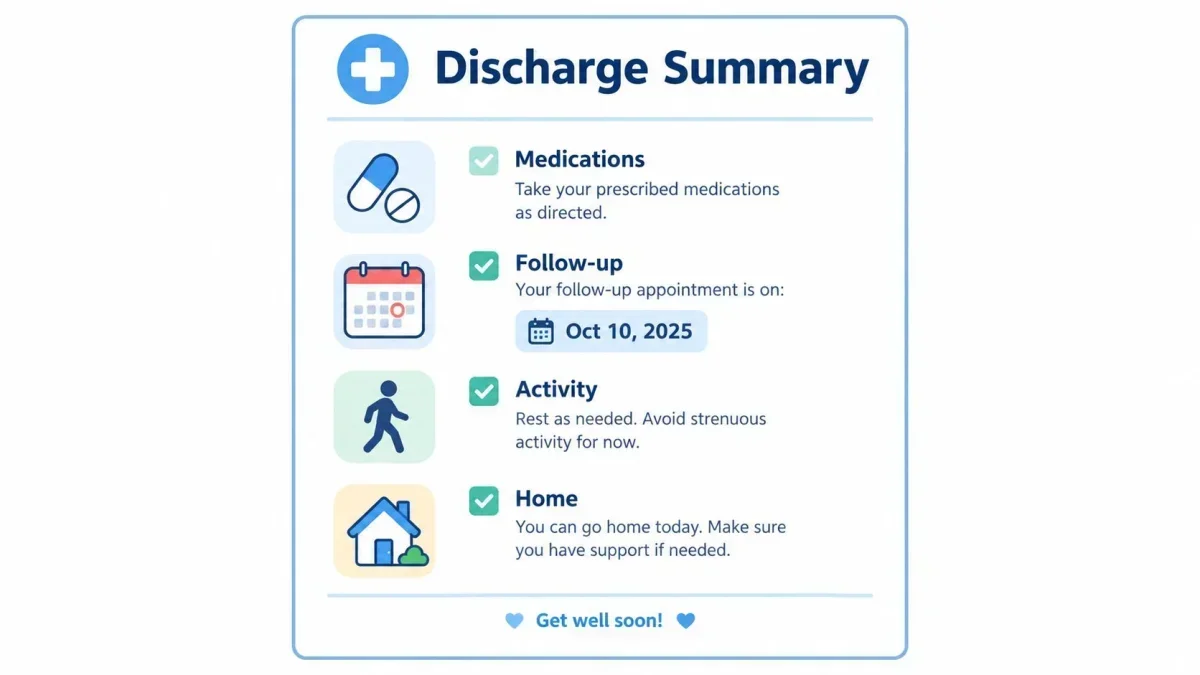
Discharge documentation is a handoff across time and setting. The next clinician may be in primary care, another hospital, a specialist office, or a community service. The patient may also rely on the same document to understand medications, restrictions, follow-up, and warning signs.
A dependable discharge summary or letter should bring together:
- Episode dates: Admission or encounter date and discharge date.
- Reason for care: Referring or admitting diagnosis and the reason for admission or consultation.
- Course and findings: Important events, test results, procedures, and outcomes.
- Final status: Final diagnoses, response to treatment, and current functional status.
- Medication plan: Discharge medicines, indications, dosing, and relevant precautions.
- Next steps: Follow-up appointments, named clinicians, dates, restrictions, education, and symptom-monitoring instructions.
Write for the receiving clinician and the patient
A discharge document can fail in two directions. It may contain enough clinical detail for a professional but leave the patient unsure what to do. Or it may use simple language while omitting the diagnostic findings and treatment response that the next clinician needs.
The layout should separate professional communication from patient-facing instructions without creating contradictions. Medication changes need a clear reason. Follow-up should identify who will act and when. Activity restrictions and symptoms requiring urgent attention should be visible, not hidden in a long narrative.
A discharge translation example guide can help teams think about how discharge information is presented for patients who need translated communication. Translation doesn't replace clinical review. The treating team still needs to confirm that diagnoses, medications, precautions, and follow-up instructions are accurate before release.
A printable PDF remains useful when a patient or receiving service needs a fixed copy. An editable source is safer during drafting because the team can correct changes before exporting the final version.
7. Customizable Templates with an AI Template Builder
Fixed templates are useful starting points. They become less useful when clinicians repeatedly work around them. An AI template builder takes a different approach. It can analyze a dictation, chat, or uploaded document and turn recurring sections into a reusable structure.
The workflow should remain clinician-controlled:
- Provide examples: Use representative documentation samples, not random fragments.
- Review extracted sections: Check whether the proposed headings match the actual encounter.
- Add missing safety fields: Include identifiers, allergies, risks, pending tests, tasks, and follow-up where the workflow requires them.
- Remove clutter: Delete fields that encourage irrelevant copying.
- Test the template: Use it during real documentation and revise it when information is hard to find.
- Create variants: Build separate structures for consultations, progress updates, procedures, and discharge communication.
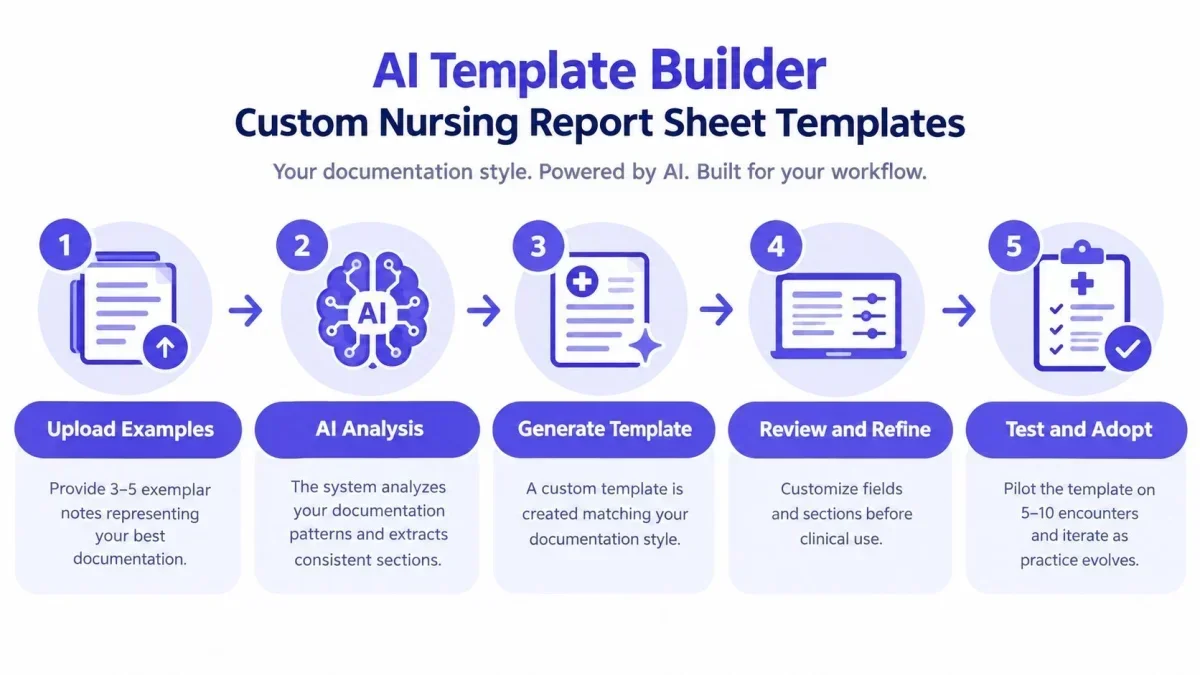
PatientNotes provides an AI template builder for clinical documentation. Its notes and tasks can be produced in the clinician's own language. It also offers an iOS app with offline recording, which is relevant when a clinician needs to capture a consultation with poor signal. Its EHR workflow is direct for most systems, with Semble as the only EHR integration and copy and paste for every other EHR.
AI still needs a safety review
An AI-generated structure is only as good as the examples and review behind it. If exemplar notes omit a risk field, the generated template may omit it too. A polished layout can therefore create false confidence if clinicians treat it as a clinical standard rather than a documentation aid.
PatientNotes offers SOAP, H&P, progress, procedure, discharge, letter, and specialty templates. Its ICD-10, CPT, and CDT code suggestions apply to US billing only, and coding suggestions require review. The service is HIPAA compliant with a BAA included at no extra cost. Under HHS guidance, a vendor's business associate relationship depends on whether it accesses protected health information to provide the service, so practices should review the actual workflow and agreement.
7-Template Nursing Report Sheet Comparison
| Template | Core features | Best for | Main benefit (time & quality) | PatientNotes notes & limits |
|---|---|---|---|---|
| SOAP Note Template for Nursing Documentation | Four-part S/O/A/P structure; separates subjective vs objective | Nurses, primary care, allied health | Standardizes reasoning, fast once learned; good for handoffs | Available as template; transcribed notes map to SOAP; may become lengthy if verbose; ICD/CPT suggestions (US only); $70/mo or $50/mo annual |
| History & Physical (H&P) Template | Chief complaint, HPI, PMH, ROS, full physical exam, assessment & plan | Hospital clinicians, new patient evaluations, specialists | Captures comprehensive baseline for admission and planning | Full H&P templates provided; time-consuming to complete; works by copy/paste to most EHRs (Semble integration available) |
| Progress Note Template for Ongoing Care | Date/time, interval history, focused exam, updated problem list, plan | All clinicians for follow-up visits | Concise tracking of treatment response; supports established-visit billing | Templates reduce repetitive typing; beware copy-forward errors; recorded sessions restoreable from archive |
| Procedure Note Template | Procedure details, indication, consent, anesthesia, findings, complications, post-op plan | Surgeons, proceduralists, dentists, dermatology, orthopedics | Precise medicolegal and billing documentation; supports CPT coding | Procedure templates included; prompts CPT suggestions (US only); must be completed promptly while details fresh |
| Specialty-Specific Documentation Templates | 37+ specialty templates, specialty scales, common procedures, relevant terminology | Specialists across psychiatry, cardiology, derm, OB/GYN, PT, etc. | Reduces documentation time; improves completeness and consistency within specialty | Major differentiator; integrates with AI template builder; needs initial clinician review and occasional updates |
| Discharge Summary & Letter Templates | Admission/discharge dates, hospital course, diagnoses, meds, follow-up, patient instructions | Hospital teams, consultants, surgical services | Improves handoff and continuity; reduces duplicate testing | Discharge templates and plain‑language instructions included; timely completion required; send via copy/paste to EHR |
| Customizable Templates with AI Template Builder | Upload notes/dictations → AI extracts sections → generate editable templates | Individual clinicians & small practices wanting bespoke workflows | Matches your documentation style; faster adoption; adaptable over time | Built-in AI builder; best with 3–5 high-quality examples; quality depends on inputs; no Chrome extension; not for deep Epic integration |
Building a Safer Handover, One Template at a Time
The best nursing report sheet PDF is the one that matches the patient, the unit, and the handoff moment. SOAP suits a focused update. H&P suits a detailed baseline. Progress notes support ongoing care. Procedure notes preserve technical and recovery information. Specialty templates bring high-value fields forward. Discharge documents carry the plan into the next setting. Custom templates help clinicians avoid forcing every encounter into the same shape.
The format still needs a safety core. NICE structured handover guidance identifies patient identifiers, diagnosis, symptoms, abnormal test results, care-plan tasks, scheduled procedures, and risk flags as important handover content. A sheet that looks clean but hides pending work or risks isn't doing its job.
The evidence also supports standardization when teams use it consistently. One shift-report standardization study found nurse satisfaction rose from 60% to 71% after an SBAR-based handoff tool was introduced, with uptake across both morning and evening shifts, as reported in the University of Maryland study record. A separate critical-care change to the reporting sheet improved nurse perception, completion compliance, consistency, and report facilitation, according to the published change project.
Paper remains practical. It works during downtime, can be marked quickly, and gives a nurse an immediate visual map of an assignment. But it can become illegible, outdated, or difficult to revise. Editable documents and device-based tools support changes and reuse, yet they introduce privacy, access, version-control, and workflow questions.
Pick the template that fits the encounter, not the other way around, and edit it until it reads like a clinician handing off to a colleague rather than a form being filled in. The test is simple: could the next nurse or clinician take over without asking the patient a question that could have been answered in writing?
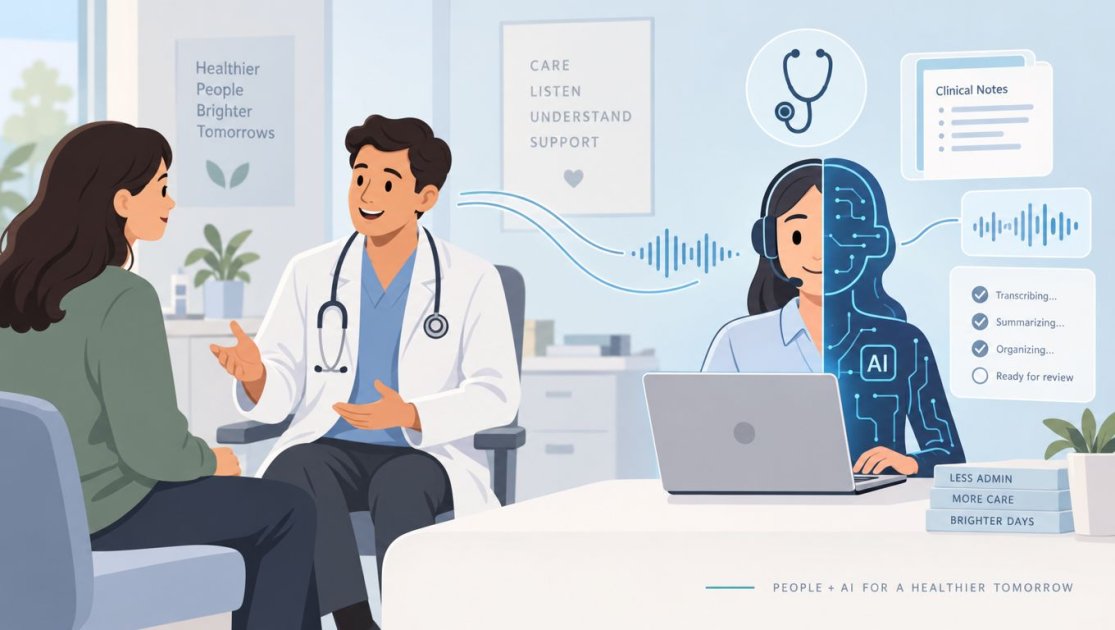
For clinicians who want documentation drafted from the consultation itself, PatientNotes records visits in person, by phone, or through its native iOS app, including offline recording with poor signal, then writes a note to the chosen structure. Pricing is $70 per user per month billed monthly or $50 per user per month billed annually, with a 7-day free trial that doesn't require a credit card and a 14-day money-back guarantee. It has no enterprise tier and no sales call, and it supports individual clinicians and small practices rather than health systems that require deep Epic integration. Practices can review PatientNotes pricing, specialty coverage, and the product comparison page before deciding whether the workflow fits.
PatientNotes records consultations in person, by phone, or on a native iOS app with offline recording, then drafts structured notes, follow-up tasks, patient instructions, and US billing-code suggestions for review. Visit PatientNotes to test a documentation workflow that can support SOAP, H&P, progress, procedure, discharge, letter, and specialty-specific templates.