A knee rehabilitation visit and a vestibular visit don't document the same things, yet many PT notes still rely on one generic SOAP outline. That approach can leave out the findings that explain skilled care, functional change, and the next treatment decision.
A sample physical therapy SOAP note should reflect the case in front of the clinician. An acute ankle injury needs a mechanism, swelling, weight-bearing status, and baseline motion. A vestibular visit needs trigger positions, nystagmus details, balance findings, and response to the maneuver.
This list presents seven case types and seven different notes. Each example shows the structure that matters, what to capture in every SOAP section, and the template and billing points to check. US billing points should be checked against current CMS outpatient therapy guidance, current payer rules, and the relevant professional society guidance. Clinical content should be adapted to the patient, the encounter, and the clinician's scope.
The examples are documentation models, not ready-to-sign records. Measurements, precautions, goals, intervention details, and coding still need to match the actual visit.
1. Acute Musculoskeletal Injury SOAP Note
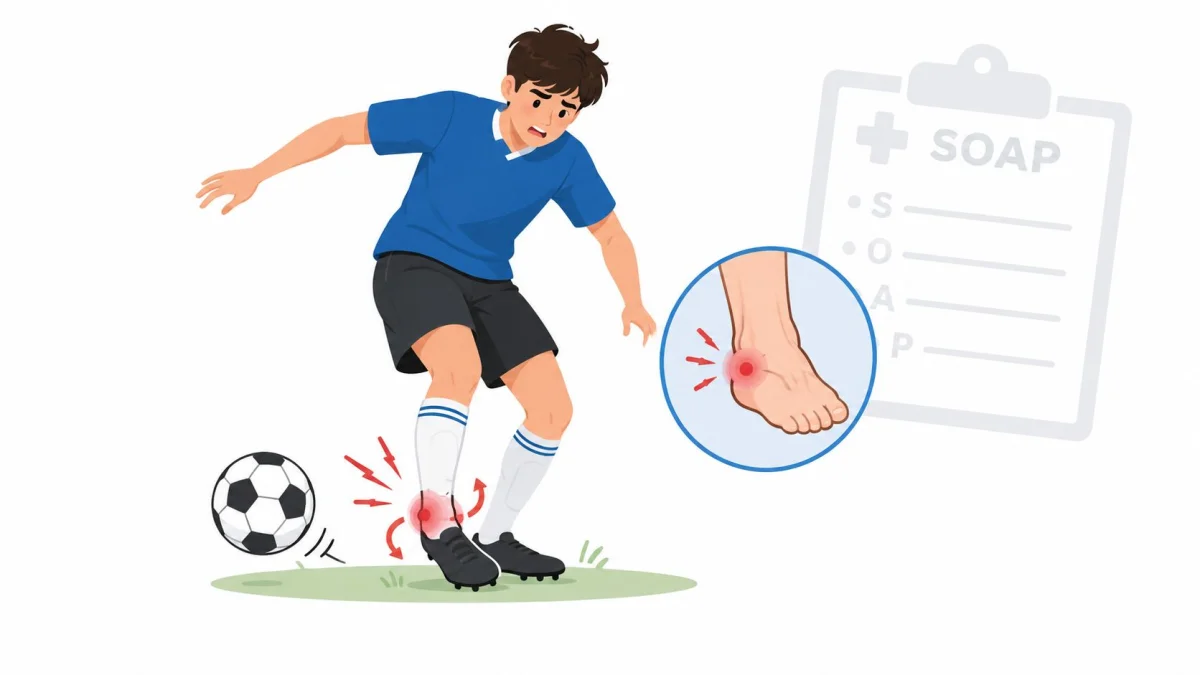
A recent ankle sprain or shoulder strain needs a note that establishes what happened and what the patient can't do now. The initial evaluation should create a baseline for later comparison, not just list exercises.
For a patient three days after an inversion ankle sprain during recreational soccer, the subjective section could state: “Patient reports rolling the right ankle while changing direction during soccer three days ago. Reports lateral ankle pain, difficulty bearing full weight, and increased symptoms on stairs.” The objective section should record swelling location, gait and weight-bearing tolerance, dorsiflexion range, strength, and any relevant functional test. If dorsiflexion measures 5 degrees, that value should be recorded with the method and side.
The assessment must connect those findings to function. A useful entry might explain that lateral ankle swelling, restricted dorsiflexion, and reduced weight-bearing tolerance limit walking and stair use. It should also state why the selected treatment requires skilled judgment, such as selecting a pain-limited loading level and reassessing the response.
A practical note structure
- Subjective: Include the patient's words about timing, mechanism, pain behavior, swelling, sleep, work, sport, and self-care.
- Objective: Record side, location, range of motion, strength, gait, swelling, palpation findings, and treatment dosage. A photograph of swelling or visible deformity may support comparison when taken under appropriate consent and practice policy.
- Assessment: Interpret the findings. Avoid writing only “ankle sprain” or “tolerated treatment well.”
- Plan: State the home program, progression criteria, reassessment point, education, and frequency or duration when required by the plan of care.
For a rotator cuff strain after lifting a heavy box, the note should capture sharp pain with overhead reaching, inability to sleep on the affected side, and external-rotation weakness. The treatment plan may differ from the ankle case, but the same clinical chain remains necessary: impairment, activity limitation, skilled intervention, response, and next decision. The APTA visit documentation guidance supports documenting patient-reported status, observed findings, clinical reasoning, and future services.
PatientNotes' physical therapy SOAP note examples can help clinicians organize these fields. Its physiotherapy specialty template is a starting point, not a substitute for case-specific examination or payer review.
2. Chronic Pain Management and Progress Note
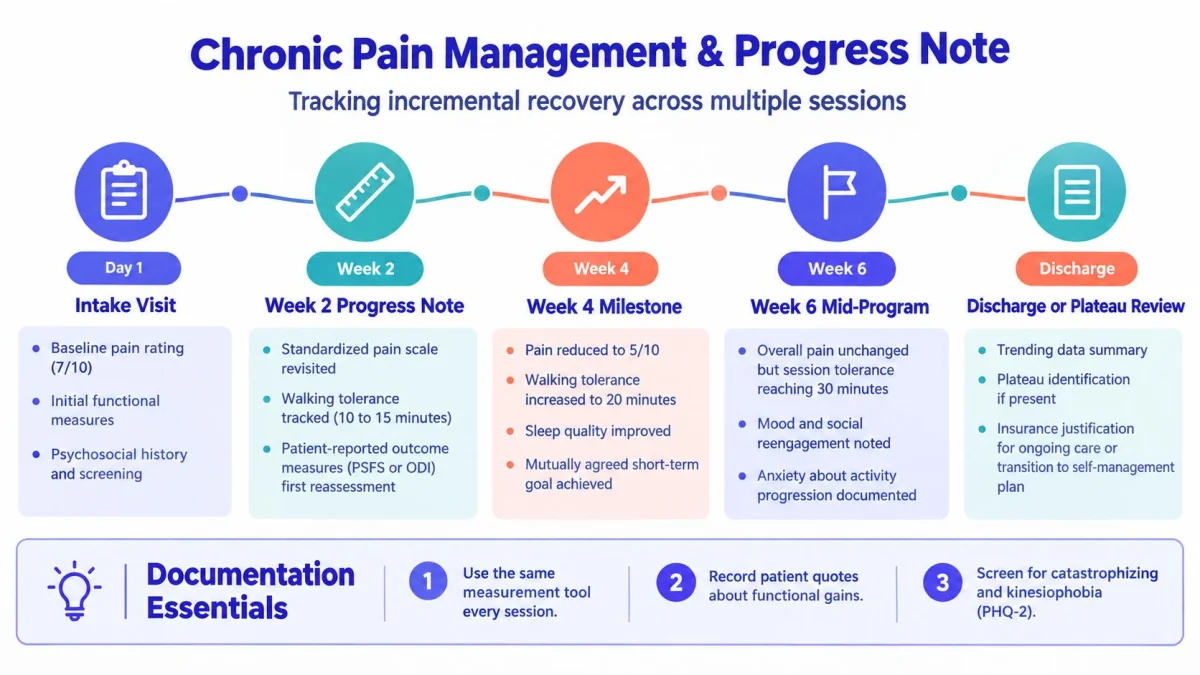
Chronic pain documentation has a different problem. A single pain score rarely shows whether treatment is helping. The note needs consistent measures and a clear account of how symptoms affect activity, participation, sleep, mood, and confidence.
Consider a patient with chronic low back pain who reports pain changing from 7/10 to 5/10 over four weeks, while walking tolerance changes from 10 minutes to 20 minutes. Those figures belong in the subjective or objective section according to how they were obtained, but they shouldn't stand alone. The assessment should explain that walking tolerance and sleep have improved while anxiety about progressing activity remains a barrier.
The patient's own functional language can be more useful than a score. “I walked to the shops without stopping” gives context that a distance value may miss. A fibromyalgia progress note may show no overall pain change, yet document tolerance of 30-minute sessions without post-exercise exacerbation and renewed social activity. That can represent meaningful functional progress even when the symptom rating is stable.
Keep the trend reliable
Use the same outcome measure and collection method across visits. Changing tools makes the trend harder to interpret. The plan should identify a measurable target, such as reducing pain by one point within two weeks, but the target must remain appropriate to the patient's goals and clinical presentation.
The subjective section can include sleep, medication or activity changes, fear, low mood, fatigue, and the patient's description of flare patterns. The objective section should include the selected functional measure, movement findings, exercise dosage, and response. The assessment should explain what changed, what didn't, and why the plan needs to continue, progress, or change.
A progress note also needs more than a new pain rating. APTA documentation guidance emphasizes dated documentation, authenticated records, progress toward goals, and a rationale connecting interventions to impairments and functional restrictions.
PatientNotes can capture the patient's description through ambient recording while the clinician observes movement and exercise tolerance. The clinician still needs to verify the transcript and retain only clinically relevant content. A progress note example may help structure the comparison between baseline, current status, and next targets. For a patient exploring non-clinical comfort options, a clinician may separately share educational material such as information about Thermo Recovery Wear for chronic pain, without presenting it as a treatment recommendation.
3. Post-Surgical Rehabilitation Progress Note
Post-surgical notes must show that rehabilitation remains within the procedure-specific protocol. The exact operation, date, surgeon, precautions, range of motion, swelling, strength, gait, and response all matter.
For an ACL reconstruction at post-operative week four, the subjective section might record pain at 3/10, home-program adherence, confidence with walking, and any change in swelling. The objective section could include passive range of motion from 0 to 90 degrees, active range of motion from 0 to 75 degrees, trace effusion, quadriceps strength of 3/5, and ambulation without crutches on flat ground. The note should identify the measurement method and side.
The assessment needs to explain whether the patient is progressing within the relevant protocol and what remains limited. It should not imply that a patient is ready for a phase advancement merely because pain is low. Persistent weakness, effusion, poor control, or failure to follow precautions may change the treatment decision.
Make precautions visible
Document the exact procedure, surgical date, and surgeon name for reference. Record precautions and the education provided. If the patient is told to avoid pivoting or running, the note should show that instruction in clear clinical language and include the patient's response or demonstrated understanding.
A total knee arthroplasty note may instead focus on weight-bearing status, knee range of motion, swelling, walking duration, stair use, and hip and knee extensor strength. A patient at post-operative week six might be weight-bearing as tolerated, measure 0 to 105 degrees, walk for 15 minutes, and use a rail on stairs. Those facts are useful only when interpreted against the surgical plan and the patient's functional goals.
The plan should state the next progression, home-program changes, monitoring needs, and reassessment. CMS expects records to support both the fact that care occurred on a particular date and the medical necessity of the skilled service. Treatment notes should identify the response to prior care, services delivered, and the plan of care. A physical therapy progress note template can organize those fields, but it can't determine whether a progression is clinically appropriate.
4. Neurological Rehabilitation and Functional Recovery Note
Neurological rehabilitation notes should show more than muscle grades. They need to connect motor control, balance, fatigue, cognition when relevant, tone, gait, and real-world participation.
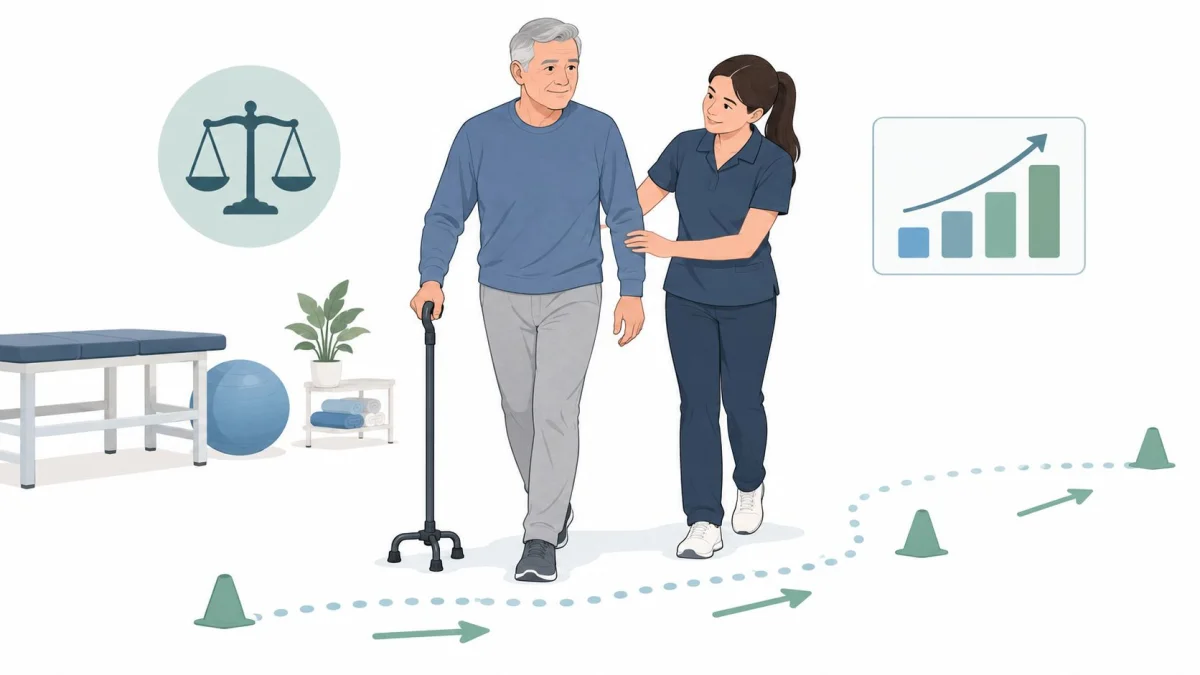
A stroke rehabilitation note for a patient eight weeks after the event might report emerging movement on the previously flaccid right side. The objective section could include a Fugl-Meyer score changing from 28 to 38, a Berg Balance Scale result of 18/56, and walking 30 feet with contact guard and a quad cane. Minimal right ankle dorsiflexion may explain reduced gait quality and the need for the selected intervention.
The assessment should interpret the pattern. Improved motor recovery doesn't remove fall risk if balance remains poor. Fatigue, reduced attention, fear, or mood can affect testing and should be documented when they change the reliability of performance or the safety of a task.
Tie formal measures to daily life
A Parkinson's disease note may document a prominent right-hand tremor, reduced arm swing, slowed walking, near-fall during weight shifting, and increased fall risk. The plan might include movement strategy training, balance progression, supervision recommendations, and environmental changes. The note should distinguish what the patient reports from what the clinician observes.
- Subjective: Record changes the patient or caregiver noticed, fatigue, falls or near-falls, confidence, and activities that remain difficult.
- Objective: Include standardized measures, gait distance, assistance level, balance reactions, tone, motor control, and task conditions.
- Assessment: Explain how impairments affect mobility and participation, and why skilled cueing, guarding, progression, or safety training is needed.
- Plan: State the next functional task, home strategy, fall precautions, caregiver education, and reassessment method.
Video or photographs of movement may help show quality changes when obtained with consent and handled under the practice's privacy policy. APTA's documentation framework supports recording measurable findings, clinical decision-making, progress, remaining restrictions, and precautions. A standardized score should support the narrative, not replace it.
5. Work Conditioning and Functional Capacity Evaluation Note
Work-focused documentation must describe the job, not just the exercise session. A generic strengthening program doesn't establish whether a patient can safely perform the actual duties.
For a construction worker returning after a shoulder dislocation, the subjective section should identify current pain, fatigue, confidence, and the worker's description of overhead tasks. The objective section might show a job demand for overhead lifting of 50 pounds, while the patient tolerates 20 pounds overhead, climbs a ladder with pain at 4/10, and completes 15 repetitions of repetitive reaching before fatigue.
The assessment should compare the demonstrated capacity with the documented job demands. A restriction such as no overhead work over 25 pounds for two weeks needs a clinical rationale, a clear audience, and a planned reassessment. It shouldn't appear as an unsupported administrative statement.
Use the real task
An office worker with chronic low back pain returning after an 8-week leave may need a different analysis. If the job involves 8-hour sitting, occasional 10-pound lifting, and brief walking, the note should record sitting tolerance, position-change needs, lifting ability, walking duration, and symptom response. Tolerating 30 minutes of sitting before needing a position change, lifting 15 pounds, and walking for 10 minutes may support a partial-duty discussion with standing breaks every 30 minutes, subject to the appropriate clinical and occupational review.
- Subjective: Capture the worker's understanding of duties, symptom behavior, fatigue, confidence, and reported barriers.
- Objective: Record load, height, distance, duration, repetitions, assistance, mechanics, pain, and fatigue during job-specific tasks.
- Assessment: Explain the gap between current capacity and job demand, including safety concerns and the skilled reason for simulation or progression.
- Plan: State the next task progression, retest point, communication needs, and any recommendation that requires employer, physician, or payer review.
The record should use plain language for restrictions and accommodations, while avoiding claims beyond the clinician's authority. CMS documentation requirements should be checked for applicable US billing situations. The clinician should also verify payer rules and any jurisdiction-specific requirements before finalizing a work-capacity recommendation.
6. Pediatric Physical Therapy Developmental and Functional Progress Note
Pediatric documentation works best when it describes participation in daily routines. A child's movement during play, dressing, family interaction, or preschool activity may reveal more than a brief isolated test.
For an 18-month-old with suspected cerebral palsy, the subjective section can include the parent's report that the child pulls to stand with hand support, cruises 8 feet along a rail, attempts steps with cueing, and still prefers crawling. The objective section might record increased lower-extremity tone, play participation for 10 minutes before frustration, and the child's response to positioning, transitions, and assisted stepping.
The assessment should connect movement findings to meaningful function. A goal to cruise 15 feet by next month is more useful when paired with the daily activity it supports. The note should also state whether the child's behavior, fatigue, attention, or unfamiliarity affected testing.
Document the family's role
Parent education belongs in the note because carryover depends on what the family can perform safely. If the parent completes positioning and stretching exercises 4 days this week, the subjective section can record that report. The objective section should show the parent's return demonstration, the clinician's corrections, and the child's tolerance.
A four-year-old after clubfoot correction may present with slight foot inversion, impaired single-leg balance, and emerging but asymmetric running. The assessment can describe improving participation in preschool play, while the plan addresses the specific home and community tasks that remain difficult.
- Subjective: Ask the parent what changed at home, including dressing, play, sibling interaction, walking, and tolerance of the home program.
- Objective: Record developmental movement, transitions, balance, play endurance, alignment, tone, assistance, and response to cueing.
- Assessment: Explain how the findings affect participation and why skilled facilitation or caregiver training remains necessary.
- Plan: Include a short home program, caregiver practice, safety advice, and the next functional milestone.
PatientNotes supports notes and tasks in the clinician's chosen language, which can help when a clinician documents family conversations in a multilingual practice. Its specialty library includes pediatric and physiotherapy templates, but the clinician must still adapt fields to the child's age, diagnosis, family goals, and local requirements.
7. Vestibular Dysfunction and Balance Disorder Rehabilitation Note
Vestibular notes need precise symptom descriptions and test findings. “Dizziness present” doesn't tell the next clinician what position triggered it, how long it lasted, whether nystagmus occurred, or how the patient responded to treatment.
For right posterior-canal BPPV, the subjective section should describe the patient's trigger position, onset, duration, nausea, confidence, and activity avoidance. The objective section might record a positive right Dix-Hallpike with rightward nystagmus lasting 8 seconds, the Epley maneuver performed, and post-maneuver fatigability. If a DHI score is used, the note can record 42/100 at intake and compare later results using the same tool.
The assessment should explain whether the findings support the treatment decision and whether symptoms changed after the maneuver. It should also identify anxiety or fear avoidance when those factors affect exposure, home exercises, or compliance.
Record the movement details
A patient with post-viral vestibular neuritis may report disequilibrium rather than spinning vertigo. The objective section could include a positive right Head Impulse Test, narrow-based gait with rightward veering, visual dependence when the eyes close, and tolerance of gaze-stabilization exercises. If the DHI changes from 72 to 58 over three weeks, the assessment should connect that change to functional tolerance and remaining limitations.
- Subjective: Capture exact trigger positions, timing, intensity, nausea, fear, falls, near-falls, and activity restrictions.
- Objective: Describe Dix-Hallpike, Head Impulse, Romberg, Dynamic Gait Index, gait, nystagmus direction, duration, fatigability, and assistance.
- Assessment: Interpret the test pattern, response to repositioning or gaze work, and barriers to progression.
- Plan: State the home program, exposure or balance progression, safety advice, retreat or reassessment timing, and referral needs when indicated.
Practical rule: Record the response to a maneuver, not only the maneuver itself. The post-treatment finding often determines the next clinical decision.
PatientNotes' ambient recording can preserve the patient's description of trigger timing while the clinician performs testing. The final note still requires review, especially for laterality, test names, nystagmus findings, and treatment response.
Vestibular assessment needs skilled examination and interpretation. A template can prompt the right fields, but it can't replace clinical judgment or determine whether a symptom pattern requires referral.
Comparison of 7 Sample Physical Therapy SOAP Notes
| SOAP note type | Implementation complexity | Resource requirements | Expected outcomes | Ideal use cases | Key advantages |
|---|---|---|---|---|---|
| Acute Musculoskeletal Injury SOAP Note | Moderate, focused history, exam, objective measures | Goniometer, strength testing, photography, time for measurements | Clear baseline; short-term pain control and early functional gains | Recent sprains, strains, acute joint/soft-tissue injuries | Mechanism-informed prognosis; objective baseline for tracking and referrals |
| Chronic Pain Management and Progress Note | Moderate–high, longitudinal tracking and psychosocial assessment | Standardized PROMs, consistent measurement tools, time for counseling | Gradual functional improvement; trend data over weeks–months | Chronic low back pain, fibromyalgia, persistent neck pain | Trend analysis, psychosocial capture, justification for ongoing care |
| Post-Surgical Rehabilitation Progress Note | High, protocol-driven monitoring and precaution documentation | Precise ROM tools, strength testing, surgeon communication, protocol charts | Protocol-based progression; early complication detection | ACL/TKA/rotator cuff and other post-op rehab | Clear phase progression, insurance support, complication surveillance |
| Neurological Rehabilitation and Functional Recovery Note | High, complex motor, balance, cognitive assessments | Neuro-specific scales (Fugl‑Meyer, FIM), assistive devices, multidisciplinary input | Variable recovery trajectory; improved motor control and safety milestones | Stroke, TBI, SCI, Parkinson's disease rehabilitation | Tracks movement quality and fall risk; guides intervention modifications |
| Work Conditioning and Functional Capacity Evaluation Note | Moderate, job-specific simulation and tolerance testing | Job descriptions, simulation equipment, endurance and lifting tests | Objective work capacity metrics; return-to-work recommendations | Return-to-work evaluations, physically demanding occupations | Defensible capacity assessments; identifies job-specific deficits and accommodations |
| Pediatric Physical Therapy Developmental and Functional Progress Note | Moderate, play-based assessment and family-centered documentation | Age-appropriate toys/equipment, parent education time, developmental tools | Developmental milestone gains; improved participation in daily routines | Developmental delay, pediatric post-op, motor delay cases | Ecologically valid assessments; parent education and family goals focus |
| Vestibular Dysfunction and Balance Disorder Rehabilitation Note | Moderate–high, vestibular testing and maneuver documentation | Space for maneuvers, vestibular tests (Dix‑Hallpike, HIT), DHI or similar | Reduced dizziness triggers; improved gaze stabilization and balance | BPPV, vestibular neuritis, chronic balance disorders | Precise trigger/nystagmus documentation; guides safe vestibular interventions |
Turn These Samples Into Your Own Templates
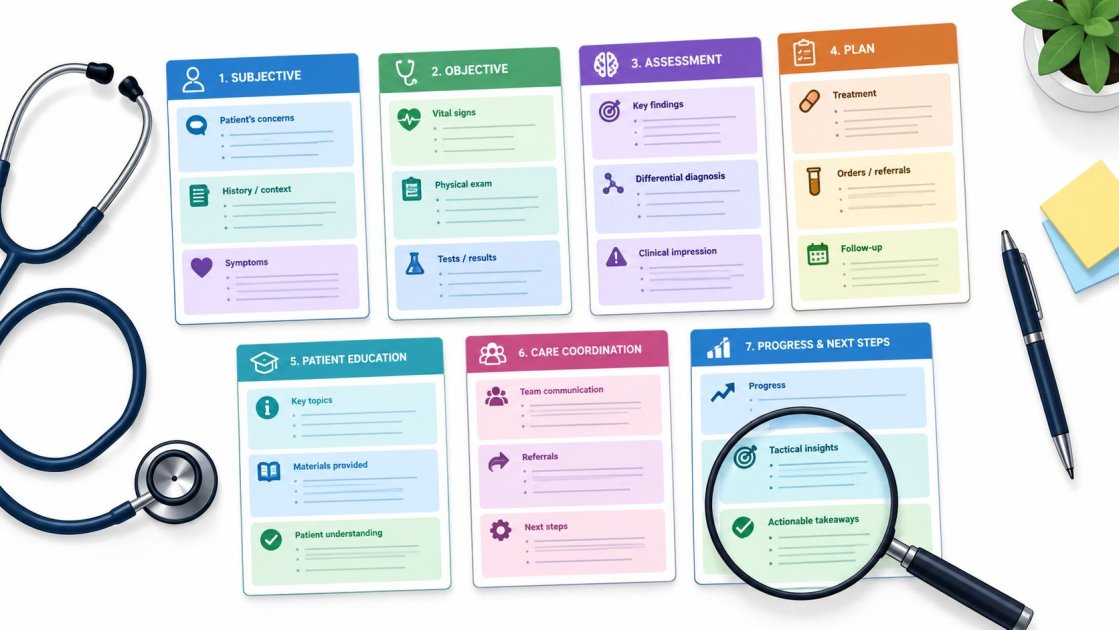
A useful template should make the important fields hard to miss without forcing every patient into the same wording. The four SOAP headings remain familiar, but the prompts beneath them should change with the case.
Start with the two case types seen most often. For acute orthopedic care, the template may prompt mechanism, side, swelling, range of motion, strength, gait, functional limitations, treatment dosage, response, and progression criteria. For vestibular care, it may prompt trigger position, symptom timing, nystagmus direction and duration, standardized tests, balance conditions, maneuver response, safety education, and the next reassessment.
The initial evaluation needs more than four labels. APTA identifies history, review of systems, physical examination, tests and measures, diagnosis, prognosis, management plan, and plan of care as evaluation elements. The selected evaluation code must be supported by the required documentation components, and a clinician should report a lower complexity level when the record doesn't support the selected level. The APTA initial examination guidance explains why the required elements need to be readily apparent to a reviewer.
Build prompts around decisions
A daily note should ask what changed since the last visit, what skilled service occurred, how the patient responded, and what happens next. A progress note should compare dates and goals. A discharge note should explain status, remaining limitations, education, and follow-up needs. A reexamination should show why the plan of care needs continuation, modification, or conclusion.
A strong template can include prompts such as:
- Change since last visit: What did the patient report, and what changed in measured performance?
- Skilled treatment: What intervention was delivered, with what dosage, assistance, progression, or modification?
- Clinical interpretation: Which impairment limits activity or participation, and how did the response affect the decision?
- Next step: What will happen next, who needs education, and when will the relevant measure be checked again?
Avoid turning the template into a transcript. Keep only information relevant to care, goals, safety, medical necessity, and follow-up. APTA's guidance also recommends documenting near the time of care, identifying the note type, limiting unclear abbreviations, recording communications and missed visits, and authenticating the relevant service.
PatientNotes offers specialty templates for 37 specialties and an AI template builder through its specialty template library. The builder can turn a dictation, chat, or uploaded document into a template, but every generated field should be reviewed before clinical use. The platform records consultations in person, by phone, or by telehealth, separates speakers in the transcript, and produces notes and tasks in the clinician's chosen language.
For individual clinicians and small practices, PatientNotes costs $70 per user per month billed monthly or $50 per user per month billed annually, with annual billing totaling $600 per year. It offers a 7-day free trial without a credit card and a 14-day money-back guarantee. It has no enterprise tier and no sales call. PatientNotes is HIPAA compliant, includes a BAA at no extra cost, and provides a native iOS app with offline recording. Semble is the only EHR integration. Other EHRs work through copy and paste. ICD-10, CPT, and CDT suggestions apply to US billing only and require clinician review.
The platform isn't built for health systems that need deep Epic integration, and there is no Chrome extension. Those limits matter when choosing a documentation workflow. A clinician can also review PatientNotes pricing before deciding whether the feature set fits the practice.
For a separate document-format option, a clinician can use this free document template, then adapt the prompts to the cases treated most often. Clinical and billing fields should be checked against the current professional society guidance, CMS requirements, payer rules, and applicable UK requirements before use.
PatientNotes can turn a recorded PT consultation into a structured SOAP note, capture follow-up tasks, and suggest US ICD-10, CPT, and CDT codes for review. Visit PatientNotes to test specialty templates and build a documentation workflow around the case types your practice treats most often.