A patient says, “The pain started a few days ago,” during a busy consultation. One clinician records a clear timeline, relevant associated symptoms, medications, negatives, examination findings, and follow-up tasks. Another captures only “chest pain,” then spends the evening trying to reconstruct what was said. The conversation was similar. The structure changed the value of the note.
The seven patient history taking sample templates below are designed for different documentation purposes. Each gives practical interview phrasing, specialty-relevant prompts, red-flag capture, concise assessment logic, follow-up tasks, and clinician review points. A sample note supports documentation. It doesn't replace clinical judgment, current professional guidance, or local policy. Clinical, coding, and legal decisions should be checked against current primary sources, such as relevant medical societies, SOAP note guidance from the National Center for Biotechnology Information, and applicable CMS or NHS resources. PatientNotes is built by a London-based company, and clinicians can also explore this healthtech engineering partner for healthcare technology work.
1. SOAP Note Template
During a busy visit, a clear SOAP note lets the next clinician identify what the patient reported, what was measured, what the findings may mean, and what happens next. The structure separates the patient's account, measurable findings, clinical interpretation, and next actions. Subjective content commonly covers the chief complaint, history of present illness, onset, location, quality, severity, timing, relevant history, and medications. The SOAP note guide from Wolters Kluwer provides further guidance on the format.
A chest-pain example might read:
Subjective: “Pressure in the center of the chest began while walking uphill this morning. It lasted several minutes and improved with rest. No reported syncope. Medication list reviewed.”
Objective documentation records observable or measurable findings, including vital signs, examination findings, and test results. Assessment should state the clinician's interpretation rather than repeat the symptom list. Plan should assign investigations, treatment, patient instructions, follow-up, and ownership of each task.
Phrasing that keeps the note useful
A physiotherapist may use the same framework while emphasizing function and movement:
- Subjective: “Patient reports knee pain when descending stairs and reduced walking tolerance.”
- Objective: “Knee flexion measured during examination. Antalgic movement pattern observed.”
- Assessment: “Functional limitation appears related to pain during loaded flexion.”
- Plan: “Continue prescribed exercises, review technique, and reassess function at follow-up.”
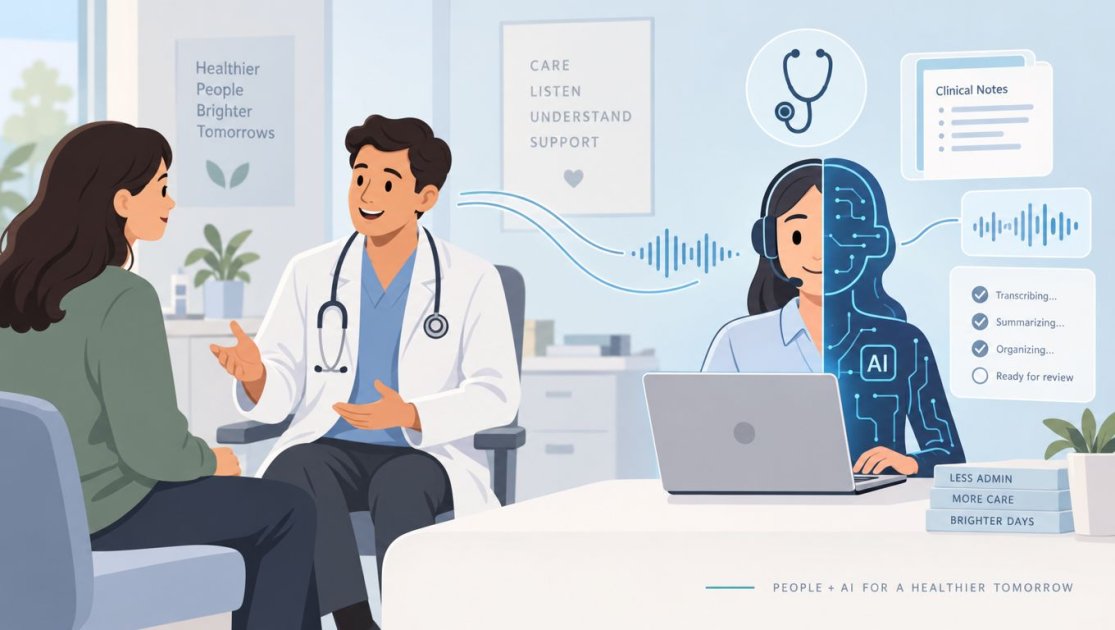
Speaker separation during ambient recording can help distinguish patient statements from clinician observations. A consistent HPI template resource can support the history section, but the clinician must review the generated note, assessment, plan, and any suggested US billing codes before submission. ICD-10 and CPT suggestions apply to US billing only. Documentation structure supports review. Clinical judgment determines what belongs in the final record.
2. History and Physical Template
An H&P is appropriate when a clinician needs a broad baseline, usually during a new patient evaluation or admission. It brings together the chief complaint, HPI, past medical and surgical history, medications, allergies, family history, social history, review of systems, and physical examination.
A new cardiology patient might be documented as follows:
Chief complaint: “Intermittent exertional chest pressure.”
HPI: “Symptoms began recently during brisk walking. Patient describes pressure rather than sharp pain and reports improvement with rest. Exercise tolerance, associated symptoms, prior episodes, and relevant negatives reviewed.”
History: “Past medical and surgical history reviewed. Current prescriptions, over-the-counter products, supplements, and allergies discussed. Family cardiac history and tobacco, alcohol, and substance use reviewed in neutral language.”
The history should be thorough without becoming indiscriminate. A Maryland Department of Health SOAP documentation template describes a chronological complaint narrative, information from other sources when identified, pertinent past history, relevant review of systems, and current medications with daily dosages. That supports a useful distinction: complete doesn't mean every possible question appears in every note.
Build a baseline without burying the signal
An OB/GYN H&P may need menstrual patterns, contraceptive use, obstetric and gynecologic history, STI testing history, and relevant examination findings. A general practice H&P may place more weight on chronic conditions, medication reconciliation, preventive history, and social context.
The PatientNotes HPI builder can help clinicians start with a repeatable structure. Ambient recording with speaker separation can reduce interruption during a long consultation, but generated text should be checked against the patient's actual words. Medication names, doses, allergies, reactions, dates, and information supplied by a family member or other source deserve direct verification.
3. Progress Note Template
A follow-up note shouldn't read like a new-patient intake unless the patient's situation has changed substantially. Its central question is simple: What changed since the last encounter, and what does that change mean for the plan?
For a diabetes follow-up, useful phrasing might look like this:
“Patient returns for glucose review. Home readings discussed. Medication adherence and missed doses reviewed. Diet and activity since the prior visit discussed. Patient reports no new symptoms. Weight trend and relevant examination findings recorded. Current treatment response assessed, and the plan updated.”
That wording leaves room for clinical reasoning without pretending that a template can make the decision. A psychiatry follow-up needs the same discipline, with focused documentation of mood, anxiety, medication tolerability, adherence, therapy progress, and risk screening where clinically indicated.
Make interval change explicit
Weak progress notes use phrases such as “doing well” or “same as before” without defining the comparison. Stronger phrasing identifies direction and evidence:
- Improving: “Fewer episodes since the last visit. No reported adverse effects.”
- Stable: “Symptoms remain at the prior baseline. Treatment adherence unchanged.”
- Worsening: “Episodes are more frequent and now interfere with usual activities.”
A structured documentation study found that medical students recorded 8,943 labeled history items in transcripts but only 5,870 in their reports, with documentation completeness measured at 65.6% versus ground truth and allergies showing only 41.1% overlap in one category, according to the peer-reviewed BMC Health Services Research study. The practical lesson is that a follow-up template should prompt for interval medication changes, side effects, adherence, relevant results, and unresolved tasks rather than relying on memory.
Task extraction can flag items such as “send home monitoring instructions,” “arrange repeat testing,” or “schedule review.” The clinician must confirm that each task is assigned to the correct person and has a realistic timeframe.
4. Procedure Note Template
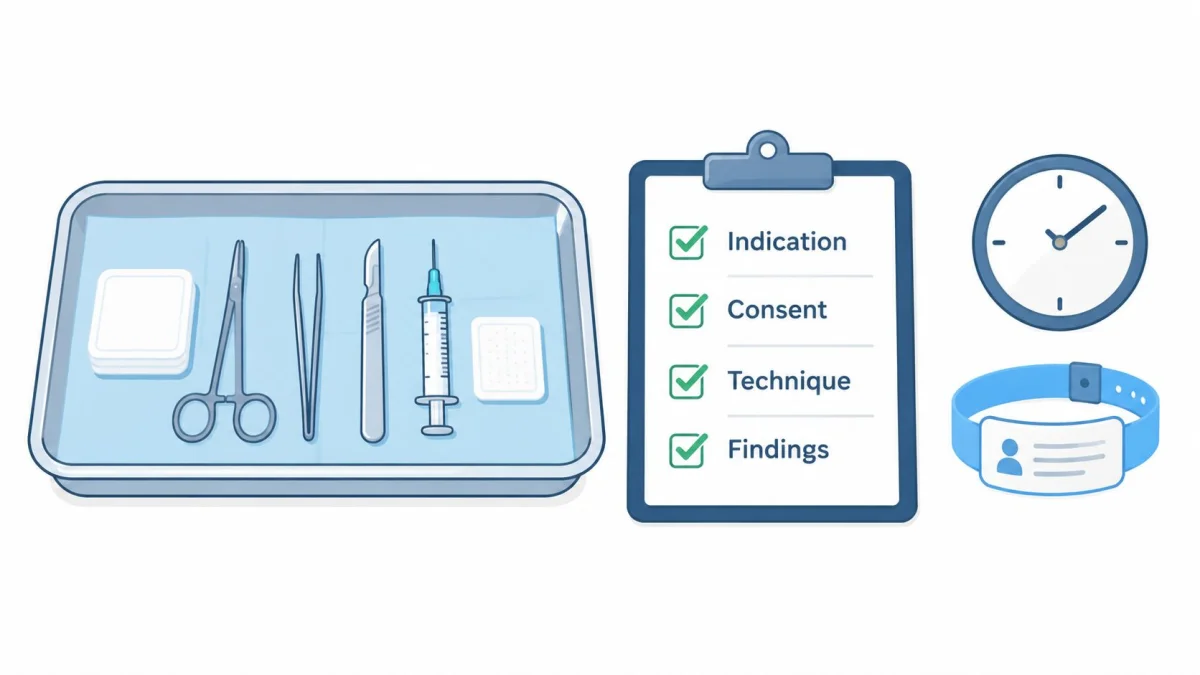
Procedure documentation has a different priority from routine history taking. The note must show why the procedure was performed, what the patient agreed to, how it was carried out, what was found, whether complications occurred, and what happens next.
For a knee injection, a concise sample might include:
“Indication: persistent knee pain affecting function. Consent discussion completed and patient agreed to proceed. Patient positioned comfortably. Site prepared using sterile technique. Local anesthetic and injected medication documented with agent, dose, volume, and route. Guidance method recorded. Patient tolerated the procedure without immediate complication. Post-procedure activity guidance and follow-up instructions provided.”
A dermatology biopsy needs different technical fields. The note should identify the site, anesthetic agent and amount, biopsy method, specimen handling, closure or suture details when applicable, wound care, and the plan for results communication.
Record technical detail at the right time
Dictating during the procedure can preserve details, but it may distract from patient care or sterile technique. Dictating immediately afterward can work well when the workflow includes a deliberate pause to confirm the indication, materials, dose, route, findings, tolerance, and instructions.
Practical rule: A procedure note should let another qualified clinician understand what was done without guessing.
A specialty template can prompt for an orthopedic injection, skin biopsy, or IUD insertion, but it can't determine whether the procedure was clinically appropriate. It also can't validate an omitted dose or infer an undocumented complication. The treating clinician must review every generated field and correct the note before signing.
Patient instructions should be plain and specific. “Keep the dressing clean as directed. Contact the practice if the site develops concerning changes” is more useful when the note also states the actual review plan and restrictions selected by the clinician.
The following video can serve as a general visual reference for procedure documentation workflow:
5. Consultation Note Template
A consultation note should answer the referring clinician's question. It isn't a second full chart, and it shouldn't force the reader to search through unrelated history before reaching the recommendation.
A cardiology consultation for dyspnea could open like this:
“Reason for consultation: Assessment of exertional dyspnea and advice on further evaluation. Prior ECG and echocardiography reviewed. Relevant cardiac and pulmonary history obtained. Examination findings and available test results considered in relation to the referral question. Recommendations follow.”
That opening makes the purpose visible. The specialist can then state the working interpretation, explain important uncertainty, and identify the next action. If the recommendation includes additional testing, medication review, monitoring, or referral, the note should specify who will act and what information should trigger reassessment.
Separate findings from recommendations
A psychiatrist advising on anxiety medication may document current symptoms, medication history, tolerability, adherence, mental state findings, substance use, and risk assessment. The recommendation should then state the proposed treatment approach and safety follow-up in language the referring clinician can use.
- Referral question: What decision or problem requires specialist input?
- Relevant evidence: Which history, examination findings, records, and tests answer that question?
- Interpretation: What does the specialist think the evidence supports, and what remains uncertain?
- Recommendation: What should happen next, and who should coordinate it?
The consultation note should define specialty terms when the recipient may not use them daily. It should also identify urgent findings directly rather than burying them in a long narrative. A request for clarification should be easy to find, and the specialist should state whether follow-up is planned or available if the referring clinician has questions.
The documentation workflow can capture a longer conversation, but the final note needs editorial judgment. Remove duplicated history, preserve clinically relevant negatives, and ensure the recommendation matches the evidence recorded.
6. Discharge Summary Template
A discharge summary is a handoff document. It needs to tell the next clinician and the patient why care occurred, what happened, what changed, what remains active, and what to do next.
For a patient leaving care after an acute heart failure episode, the summary might state:
“Reason for episode: worsening symptoms requiring assessment and treatment. Key findings and treatment delivered are recorded. Current clinical status is documented. Medication reconciliation identifies medications that are new, continued, or stopped. Follow-up with the relevant service and patient instructions are listed, including symptoms that require urgent evaluation.”
The exact clinical details depend on the record and the treating team. The documentation principle is consistent: don't make the receiving clinician reconstruct the episode from scattered progress notes.
Make medication changes unmistakable
A discharge medication list should distinguish new, continued, and stopped medicines. It should include the prescribed directions selected by the clinician and resolve discrepancies before the summary is given to the patient. The summary should also state follow-up ownership, appointment timing or timeframe, restrictions, pending results, and how the patient will receive them.
A psychotherapy episode summary may instead describe the presenting concerns, goals, treatment approach, progress, current status, ongoing support, and circumstances for returning to care. The format changes, but the handoff function remains.
The PatientNotes discharge summary tool can support a structured draft from a recorded encounter. It shouldn't be treated as a substitute for medication reconciliation or patient communication. A clinician needs to confirm that the patient understands the instructions, has the required documents, and knows where to seek help if the condition changes.
Plain language matters. “Seek urgent evaluation for worsening symptoms” is less useful than the specific warning signs selected for that patient and episode. The final note should reflect the clinician's actual instructions, not generic text inserted because a field was left blank.
7. Specialty-Specific Templates Across 37 Specialties
A generic patient history taking sample can provide structure, but repeated workflows often need specialty-specific prompts. PatientNotes offers templates across 37 specialties, including family medicine, cardiology, psychiatry, dentistry, physiotherapy, OB/GYN, pediatrics, orthopedics, and dermatology. The specialty template library shows the available workflows.
The fields should follow how the clinician evaluates the patient.
- Family medicine: Preventive concerns, hypertension screening, lipid review, cancer screening discussion, and vaccination status.
- Cardiology: Angina history, ECG findings, relevant laboratory results, ejection fraction, coronary risk assessment, and medication tolerability.
- Psychiatry: Psychiatric history, mood and anxiety symptoms, suicidal or homicidal ideation screening, substance use, adherence, tolerability, and treatment plan.
- OB/GYN: Gravidity and parity, last menstrual period, contraception, STI screening, intimate partner violence screening, and relevant examination findings.
- Physiotherapy: Functional limitation, range of motion, strength, pain, movement patterns, treatment delivered, and home exercise plan.
A structured benchmark of chest-pain history taking collected 1,030 consultation dialogues from 210 medical students across five scenarios, according to the JMIR Medical Education study. The scenarios included spontaneous pneumothorax, stable angina, aortic dissection, acute pulmonary embolism, and acute pericarditis. For documentation design, the useful lesson is that a limited set of consistent prompts can support comparable encounters while varying the discriminating details.
Customize prompts, then review the output
PatientNotes includes an AI template builder that can create a template from a dictation, chat, or uploaded document. A small practice can start with one high-volume workflow, test it against several real encounters, and remove fields that create noise. Templates should prompt for high-risk items without turning every visit into an unnecessarily long intake.
A psychiatry audit found that structured documentation interventions improved personal history from 30% to 100%, social history from 50% to 100%, past psychiatric history from 80% to 100%, and mental state examination from 70% to 90%, while current medications fell from 30% to 10% and collateral history from 70% to 20%, as reported in the PubMed-indexed audit. The mixed result is important. Templates can improve completeness, but prompts for medications, collateral sources, and risk assessment need explicit placement and review.
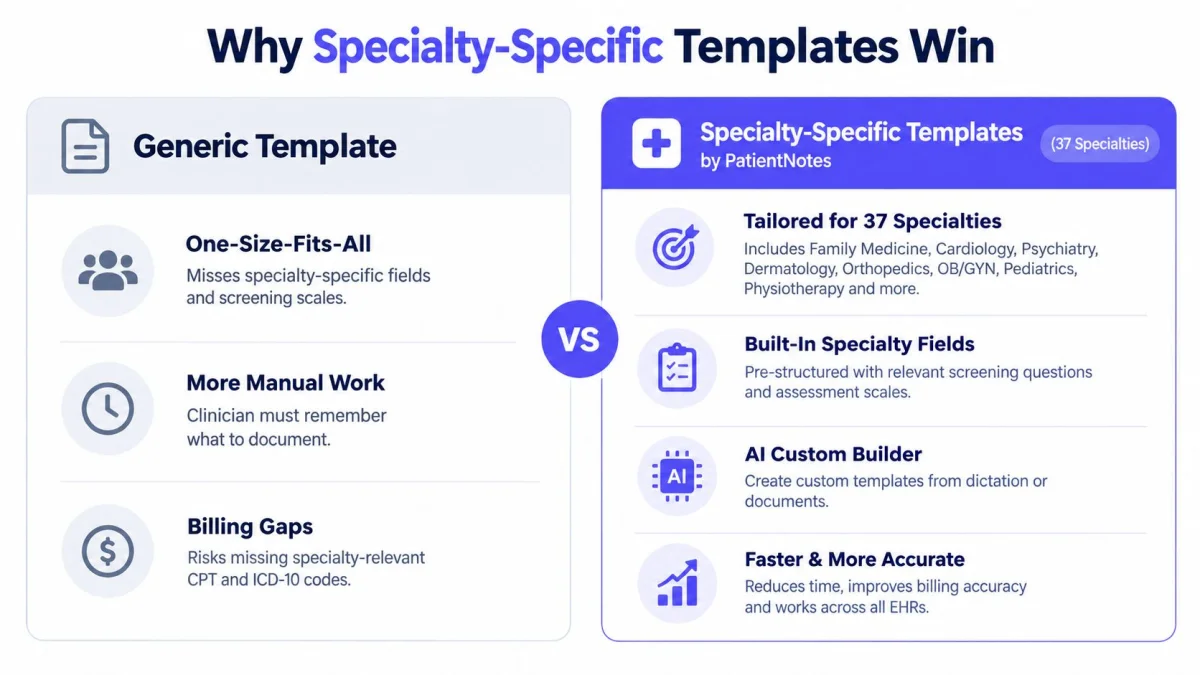
ICD-10, CPT, and CDT suggestions are for US billing only and require clinician verification. PatientNotes works with Semble through an EHR integration. Every other EHR workflow uses copy and paste, so the final note still passes through the practice's normal review and signing process.
7 Patient History Templates Compared
| Template | Implementation complexity | Resource requirements | Expected outcomes | Ideal use cases | Key advantages |
|---|---|---|---|---|---|
| SOAP Note Template | Low–Moderate | Minimal (EHR access, clinician time) | Structured encounter notes, supports billing | Routine visits across specialties | Universally recognized, promotes clear clinical reasoning |
| History and Physical (H&P) Template | High | Significant time, full exam and history, possible tests | Comprehensive baseline record, supports authorizations | New patients, admissions, complex presentations | Thoroughness for continuity and handoffs, insurance-ready |
| Progress Note (Follow-Up Visit) Template | Low | Minimal time, focused exam/history | Concise continuity documentation, tracks treatment response | Follow-ups, chronic disease management | Fast to complete, documents medical necessity and progression |
| Procedure Note Template | High | Time-intensive dictation, technical detail, possible review | Medicolegal record of procedure, supports procedural billing | Injections, biopsies, minor surgeries, interventions | Detailed technique/complication documentation, quality tracking |
| Consultation Note Template | Moderate | Time for record review and focused exam | Specialist assessment and actionable recommendations | Referrals, specialty input, co-management | Focused answers to referral questions, improves care coordination |
| Discharge Summary Template | Moderate–High | Medication reconciliation, multidisciplinary inputs | Clear post-encounter plan, reduces readmission risk | Hospital/ED discharges, episode completions | Consolidates treatment, follow-up, and patient instructions |
| Specialty-Specific Templates (37 specialties) | Moderate (initial setup) | Initial configuration, possible AI template building | Faster, more accurate specialty notes and billing suggestions | Specialty clinics, multi-specialty practices | Tailored fields, reduces documentation burden, improves billing accuracy |
Turn the Sample Into a Safer Daily Workflow
The right template depends on the encounter. SOAP is the flexible default when the clinician needs a clear separation between reported symptoms, observed data, assessment, and plan. H&P fits a complete first evaluation or admission baseline. Progress notes support continuity by making interval change visible. Procedure notes preserve technical detail, consent, materials, findings, tolerance, and aftercare. Consultation notes answer a referral question. Discharge summaries make an episode of care understandable to the next clinician and the patient. Specialty templates support repeated workflows with prompts that match the field.
A small practice doesn't need to redesign every note at once. A workable implementation sequence is:
- Choose one high-volume encounter: Start with the visit type that creates the most repetitive documentation.
- Customize only necessary fields: Keep the template aligned with the clinician's actual reasoning and workflow.
- Test phrasing and red-flag prompts: Use several encounters to find missing questions, distracting fields, and ambiguous language.
- Review every generated note: Confirm patient statements, examination findings, assessment logic, instructions, and follow-up tasks.
- Verify US-only billing suggestions: Check ICD-10, CPT, and CDT suggestions before any relevant billing submission.
- Move the final note into the EHR: PatientNotes integrates with Semble, while other EHRs use copy and paste.
Structured history taking has a strong clinical rationale. A review of classic studies reported that history alone established the diagnosis in 66 of 80 patients, or 82.5%, in one early study, 61 of 80, or 76.3%, in a 1992 replication, and 77 of 98, or 78.6%, in a 2000 study. Across the cited studies, the overall mean was 75.9%, with a 95% confidence interval of 67.9% to 83.9%, according to the Clinical Correlations review of patient history taking. The point for documentation is practical: onset, duration, severity, associated symptoms, and relevant negatives aren't administrative decoration.
Technology can help capture the conversation, but it doesn't remove the need for adaptive interviewing. In difficult encounters, clinicians may need slower speech, alternate descriptors, summarization, prompting, and redirection. The reviewed guidance on challenging history taking also highlights that a linear, question-by-question approach isn't always appropriate for a distressed or suspicious patient.
Patient-generated information creates another review point. The AMA guidance on patient portal optimization describes intake questionnaires and health surveys that can flow into the chart and visit note. Patient-entered information can save time, but the clinician should identify what was supplied before the visit, confirm what remains current, and avoid treating an incomplete questionnaire as a verified history.
PatientNotes is one option for clinicians and small practices that want ambient recording, speaker-separated transcription, structured templates, follow-up task extraction, plain-language patient instructions, notes in the clinician's own language, and an AI template builder. It records through the web and a native iOS app, including offline recording, and is HIPAA compliant with a BAA included at no extra cost. Practices can review the pricing, comparison information, and clinical documentation resources before choosing a workflow.
PatientNotes can turn a recorded consultation into a structured SOAP, H&P, progress, procedure, consultation, discharge, or specialty note while extracting follow-up tasks for review. Visit PatientNotes to test a patient history taking workflow with a 7-day free trial that doesn't require a credit card.