
A business associate agreement is a written HIPAA contract under which an outside vendor that handles protected health information for a clinic agrees to protect it and limit how it is used.
But does a signed agreement explain what happens when that vendor sends a consultation recording to a cloud host or uses it to improve an AI model? Not necessarily. For clinicians asking what is a business associate agreement, the useful answer goes beyond the signature: it identifies who handles patient information, what each party may do with it, and where the clinic still needs written answers.
What a Business Associate Agreement Is
Who decides what a vendor may do with patient information, and what happens when that information passes to another service? A business associate agreement, or BAA, makes the covered entity and business associate's roles clear. HIPAA sets out BAA requirements in 45 C.F.R. § 164.504(e), including permitted uses, disclosure restrictions, and safeguards.
The covered entity is a healthcare provider, health plan, or healthcare clearinghouse. The business associate is an outside organization that performs work involving patient information for the covered entity. These roles help trace responsibility across the data chain: a practice may direct the work, while a vendor handles the information to carry it out.
For example, a practice might hire a transcription company to turn consultation recordings into notes. The practice determines the purpose of the service, and the company processes the information to complete that work. If another service is involved, the practice still needs to understand how information moves and what each party is allowed to do.
The patient-file analogy
Think of an agency worker helping organize patient files. Before access begins, the clinic sets which files may be opened, what work is permitted, and where copies may go. That boundary is the point: access should follow defined instructions.
Protected health information, or PHI, means identifiable health information. In a documentation workflow, it may include consultation notes, recordings, transcripts, appointment information, and billing details associated with a patient.

Practical rule: A BAA sets the work a vendor may perform with PHI and the limits on that work. A signed agreement starts the compliance process; it does not, by itself, show how every downstream service handles information or whether PHI is used to train an AI model.
The agreement can also cover help with patient access and amendment requests, records for compliance investigations, and the handling of PHI when the relationship ends. The clinician's first check is direct: if an outside company handles PHI on the practice's behalf, a BAA is generally needed before that handling begins.
When HIPAA Requires a Business Associate Agreement
When a BAA is required, by vendor situation
| Situation | BAA needed? | Reason |
|---|---|---|
| Cloud EHR host stores patient records | Yes | Maintains PHI for the practice |
| AI scribe records consultations and writes notes | Yes | Creates and receives PHI for the practice |
| Billing company codes and submits claims | Yes | Uses PHI to perform a function for the practice |
| Specialist receives records for treatment | No | Provider-to-provider disclosures for treatment are not a business associate relationship |
| Mail carrier or internet provider only passes data through | No | Conduit exception; no routine access to PHI |
| Patient uses their own app with no provider involved | No | Does not act on behalf of the clinic |
The distinction is acting on behalf of the practice, not encountering patient information. A specialist treating the same patient has a different role from a company hired to store the referring clinic's records.
The conduit example also needs careful reading. A service that only carries information through is different from one that retains recordings, processes their contents, or supplies ongoing storage. A practice shouldn't describe a storage service as a conduit just because information travels through it.
Follow the function, not the label
Vendor names and marketing categories aren't a reliable screening method. An administrative service may receive patient names and appointment details. A support contractor may open a screen containing clinical notes. The clinic should describe what each company does and what information its staff or systems can access.
PatientNotes operates as a Business Associate under HIPAA. It signs a BAA with every customer, including during the free trial, at no extra cost. That makes the documentation relationship explicit, but the practice still needs to review the agreement and its own workflow.
For a small practice organizing that review, the HIPAA compliance guide for small practices provides related operational context. Technology support belongs on the inventory too. The healthcare IT overview from We Fix PC Laptop managed services can help a practice identify support functions to examine, rather than assuming only clinical software handles sensitive information.
A vendor inventory should describe access, not just subscriptions.
A useful inventory records the company, its function, the information involved, and the staff member responsible for the relationship. The immediate action is to list every existing vendor and mark which ones touch PHI. Any unclear entry needs a workflow review before the clinic decides whether a BAA is required.
What Your BAA Should Spell Out
What should you check before signing a BAA? Start with the terms that define what the vendor may do, which information is covered, and what happens when the relationship ends. The agreement allocates responsibilities across the data chain, but a signature alone does not show how those duties work in practice.
Contract terms to check before signing
| Term | What to confirm | Why it matters |
|---|---|---|
| Permitted uses | Named purposes only, such as transcription, note drafting, storage, and support | A BAA is not blanket permission for product improvement |
| Data scope | Which items contain PHI, including audio, transcripts, notes, tasks, and backups | Unclear scope can leave important copies unaddressed |
| Retention and deletion | Storage period for each data type, including backups | Establishes how long the vendor retains patient information |
| Return or destruction | What happens to PHI at termination, where feasible | Defines the exit process and any continuing protections |
| Access controls and audit logs | Who can view PHI and whether access is logged | Helps the clinic investigate how information was handled |
| Incident cooperation | How and when the vendor reports an incident | Gives the clinic information needed to respond |
| De-identified data | Whether it may be retained and how it is created | Clarifies whether separate copies may be reused |
The requirements for business associate contracts in the HIPAA Privacy Rule limit permitted uses and disclosures, require safeguards and subcontractor restrictions, and address what happens at the end of the agreement. A contract cannot authorize a vendor to handle PHI in a way that would be impermissible for the covered entity.
Two terms deserve particular attention: permitted uses and termination. For permitted uses, look for specific activities such as transcription or note drafting. Broad wording about improving a service needs to make clear what information and activities it covers. A BAA does not, by itself, settle whether PHI may be used to train AI models. That question requires a separate, clear answer about the proposed use.
Termination terms should explain what happens to PHI when the clinic leaves, including whether information will be returned or destroyed where feasible. This is different from routine retention during service use. Check that the agreement addresses the end of the relationship rather than leaving the clinic to infer the process.
Other terms should fit the actual workflow. Data scope can include generated outputs, not only audio and final notes. Access provisions should identify who may view PHI and whether access is logged. Incident-cooperation terms should say how the vendor will notify the practice and provide information needed to respond.
Contract language and operational safeguards work together. HIPAA calls for appropriate administrative, physical, and technical safeguards. Before PHI flows, confirm that the written terms match the service's actual handling of information. Questions about retention details, backups, de-identification, and AI training need direct answers, but the agreement's permitted-use language is only one part of that review.
Who Carries Responsibility When Something Goes Wrong
A vendor's BAA doesn't make the practice safe from every compliance failure. The practice remains responsible for its own conduct, while the vendor has obligations of its own.
The shared-responsibility structure is illustrated below.
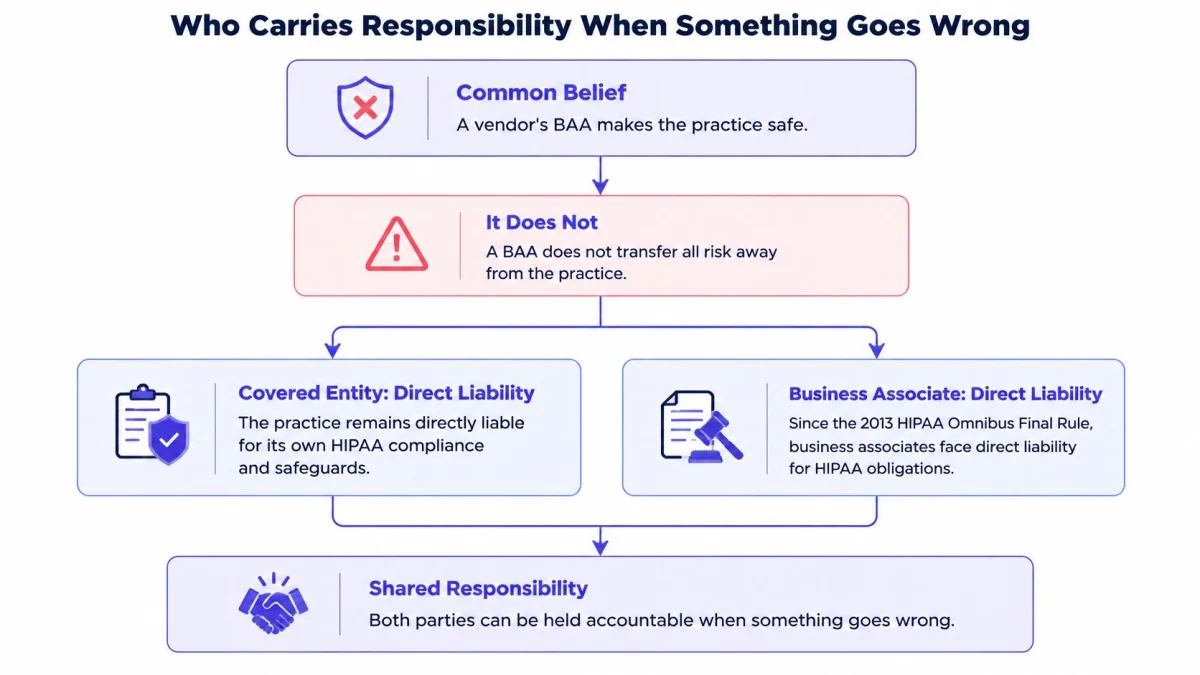
Under HHS's 2013 HIPAA Omnibus Final Rule, business associates became directly liable for specified Privacy, Security, and Breach Notification obligations; a business associate discovering a breach of unsecured PHI must notify the covered entity without unreasonable delay and no later than 60 days after discovery. That outer limit isn't a reason to postpone escalation.
Follow the downstream chain
A possible processing path is clinic → AI scribe → cloud host → support or analytics subprocessor. Not every service follows that exact sequence, so the clinic needs the vendor's actual map.
HHS business associate guidance explains downstream contractual duties, including requiring subcontractors handling PHI to accept equivalent restrictions. It also explains that a covered entity learning of a material breach must take reasonable steps to address it and terminate the relationship if feasible.
Say the cloud host suffers a breach. The host must escalate through its contractual relationship, the scribe must investigate and notify the clinic as required, and the clinic must manage its own response. The contract should identify contacts and cooperation duties before this scenario occurs.
- Identify the chain: Which subprocessors receive PHI, and for what purpose?
- Name the first contact: Who tells the clinic, and through which monitored channel?
- Plan the response: Who supplies logs, explains affected data, and coordinates containment?
The HIPAA compliance guide for healthcare providers provides a broader operational checklist.
The accompanying video offers additional context for the responsibility discussion.
What a BAA Does Not Cover
Can a vendor use patient data to train or improve its AI? The BAA allocates responsibilities across the data chain, but its existence alone does not settle every use of information. Check the agreement alongside any privacy or service terms that define how the vendor may use recordings, transcripts, notes, and feedback.
HIPAA safeguards and restrictions on secondary use address different questions. A vendor may describe how it protects information while separate terms define whether data can be used to improve a model. Read the actual permitted-use language rather than inferring a no-training promise from a compliance statement.
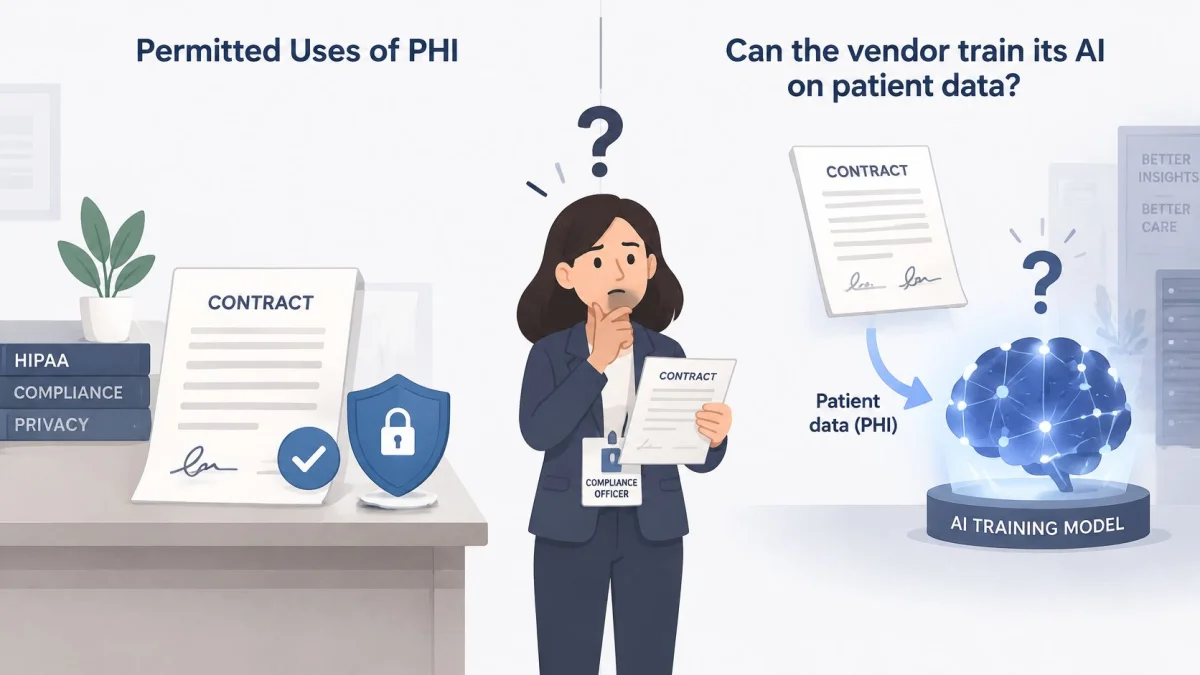
Questions that need separate answers
Focus your review on how information may be used beyond producing the clinical note:
Which data may be used to train or improve models? Ask whether the terms cover audio, transcripts, generated notes, or user feedback, and whether those uses are permitted or prohibited.
Consider a practice whose BAA describes transcription while another policy permits service improvement. If neither document explains whether improvement includes recordings or model training, the practice cannot confidently determine the permitted workflow. It could request a clause stating that patient data will be used only to provide the service and will not be used to train or improve models, unless the practice separately authorizes that use in writing.
A useful distinction: Permission to generate a clinical note does not itself authorize broader model training.
The HIPAA and AI analysis from B.D. Emerson discusses secondary-use questions and proposed cybersecurity changes involving technology inventories, network maps, and attention to AI. Treat proposed changes as proposals, not binding requirements.
A clear answer should identify the data, each permitted use, and which contractual language controls. A signed BAA is a starting point for assigning responsibility, not proof that every AI use has been addressed.
UK Practices and the UK GDPR Processor Contract
A UK practice that uses a service to process patient information needs a processor contract under UK GDPR. A HIPAA BAA does not replace that contract, so the practice should check that both agreements cover the relevant processing.
Article 28 of the UK GDPR requires a binding contract that sets out the subject matter and duration of processing, its nature and purpose, the types of personal data and categories of data subjects, and the controller's rights and obligations. It also covers processor assistance with security, breach obligations, data protection impact assessments, and handling information when the contract ends.
Keep the contracts distinct
A UK clinic generally acts as the controller when it decides why patient information is processed for care and documentation. The processor handles that information on the clinic's behalf and according to its instructions. Those instructions should be described clearly in the contract, alongside the processing itself.
For a plain-language introduction to GDPR terminology, Purple's WiFi glossary GDPR entry offers useful background. It can help staff understand the terms, while the contract must still specify the actual arrangement.
PatientNotes is built by a London-based company. UK users should obtain its UK GDPR processor terms in writing, and US users should confirm the applicable HIPAA BAA. Practices operating across both jurisdictions should assess the obligations that apply to each part of their processing.
Ask any prospective processor:
- Processing locations: Where will patient information be processed and stored?
- Subprocessors: Which organizations receive personal data, and how will the clinic learn about changes?
- Breach response: How will the processor report a breach involving UK personal data, and which clinic contact will receive the report?
The key is to map the clinic's own processing instructions to the contract, so the responsibilities are clear across the data chain. A signed BAA addresses HIPAA obligations, but it does not settle the separate UK GDPR terms.
Check the BAA Before You Sign
A signed BAA allocates responsibilities across the data chain, but it does not by itself show how a service handles every recording, transcript, note, backup, or support request. Before approval, map where PHI goes and who can access it. For broader procurement considerations, use this guide to assessing supplier security and resilience. The guide to HIPAA-compliant AI note-taking connects those questions to clinical documentation workflows.
A workable approval sequence
Obtain the agreement before PHI flows. A trial recording with a real patient is still part of the review.
PatientNotes operates as a Business Associate under HIPAA. Customers who use the Service to process PHI agree to its BAA, incorporated into the Terms by reference. A BAA is included on every plan and during the 7-day free trial, at no extra cost. This establishes contractual responsibilities, while the clinic still needs to assess the service's data handling and its own workflow.
A useful review ends with a clear record of the agreement, the data path, and the people responsible for escalation. Clinicians can visit PatientNotes to review the service and its terms before deciding whether to use it with patient information.