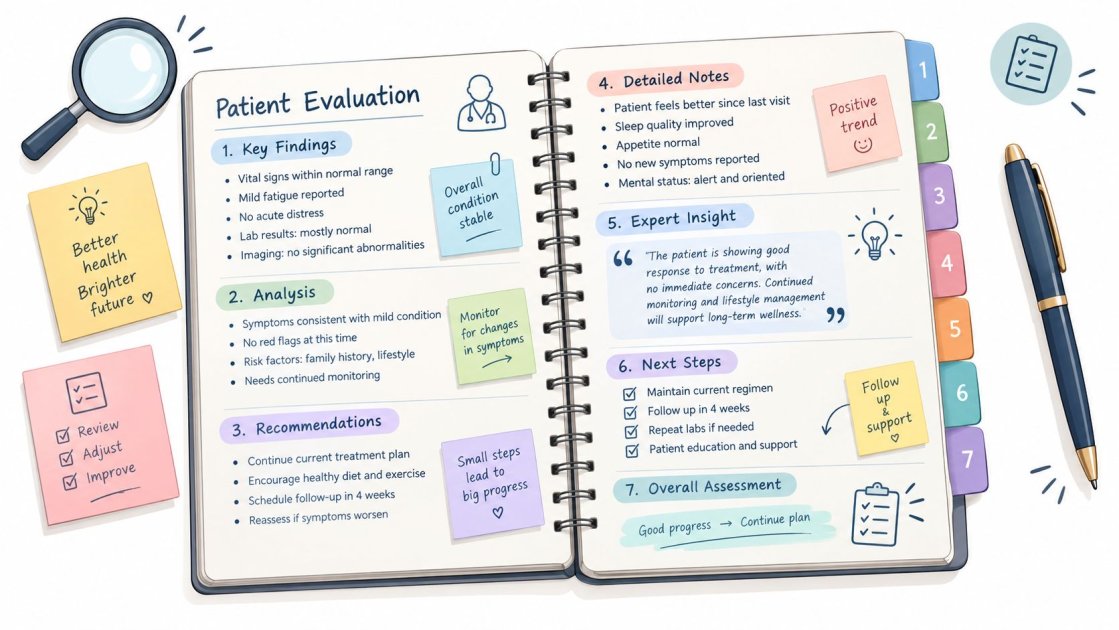
A ROS review of systems is a standardized inventory of body systems used to uncover symptoms a patient may have overlooked, and U.S. E/M guidelines define three documented levels: problem-pertinent, 1 system, extended, 2 to 9 systems, and complete, 10 or more systems. The work becomes defensible only when the clinician documents what was reviewed, including positive and pertinent-negative responses.
A clinician finishes a long clinic day, opens the last chart, and types “all systems negative.” The patient had come in for chest discomfort, the visit ran over, and the note now depends on a phrase that may not show which systems were reviewed or whether the patient was asked the questions at all. That shortcut feels harmless until an auditor asks for the underlying documentation.
What the Review of Systems Actually Is
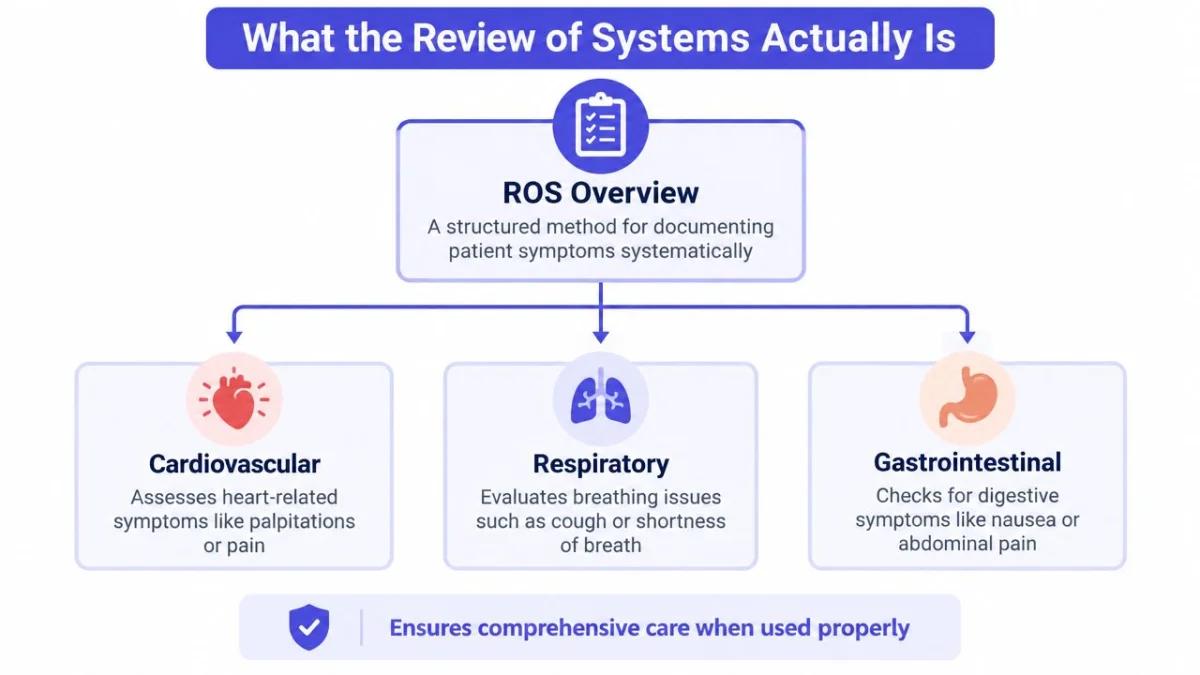
A patient presents with back pain and mentions weakness only after the clinician asks about other symptoms. That answer may change the differential diagnosis and the next step. The review of systems, or ROS, is the structured part of history-taking that makes those questions visible in the record.
The HPI develops the main complaint. ROS checks other systems for symptoms the patient may not volunteer, recognize, or consider relevant. It records what the patient reports, not what the clinician observes.
U.S. E/M documentation recognizes 14 systems:
- Constitutional
- Eyes
- Ears, nose, mouth, and throat
- Cardiovascular
- Respiratory
- Gastrointestinal
- Genitourinary
- Musculoskeletal
- Integumentary
- Neurological
- Psychiatric
- Endocrine
- Hematologic and lymphatic
- Allergic and immunologic
This structure is described in the U.S. E/M ROS documentation guidance. The list supports clinical reasoning and compliance, but it does not justify documenting questions that were never asked. For a patient with back pain, relevant ROS may include weakness, urinary changes, fever, or unexplained fatigue. The note should show the patient's positive symptoms and pertinent negatives clearly enough for another clinician or an auditor to follow.
Why the structure matters
ROS documents patient-reported history. “Lungs clear” belongs to the physical examination. “Denies cough” belongs to ROS. Mixing those statements weakens the record and can make the documented work difficult to verify.
A head to toe assessment guide can orient new staff to broad assessment coverage, but clinicians should record only what they asked and what the patient reported. A dedicated History and Physical template can keep ROS separate from HPI and examination findings, reducing copied observations in the wrong section.
The Three Levels of ROS Documentation
The traditional U.S. documentation framework divides ROS into three levels. The correct choice depends on the encounter, the complaint, and the systems reviewed. It isn't a contest to document the greatest number of systems.
Problem-pertinent ROS
A problem-pertinent ROS covers one system. For a patient presenting with chest pain, the cardiovascular system may be the relevant focus:
Cardiovascular: Reports intermittent pressure with exertion. Denies palpitations and syncope.
That entry identifies the system, records the positive symptom, and adds relevant negatives. It is more useful than “positive chest pain” because the reader can see the scope of the questioning.
Extended ROS
An extended ROS covers 2 to 9 systems. A patient with chest discomfort, fatigue, and dizziness may require cardiovascular, respiratory, constitutional, and neurological review:
- Constitutional: Reports fatigue. Denies fever or chills.
- Cardiovascular: Reports exertional chest pressure. Denies palpitations or leg swelling.
- Respiratory: Denies cough or shortness of breath.
- Neurological: Reports occasional lightheadedness. Denies focal weakness.
The note should name each system reviewed. A list of symptoms without system labels makes the level harder to verify.
Complete ROS
A complete ROS documents 10 or more systems, as described in the E/M key elements guidance. The 14 recognized systems provide the available structure, but a clinician shouldn't populate all 14 from memory or from a copied template unless those systems were reviewed.
For a complete encounter, the note might document detailed positives and pertinent negatives for the relevant systems, then summarize the remaining systems as negative when the applicable guidance permits that approach. The Vanderbilt ROS guidance emphasizes that positive or pertinent-negative responses must be individually recorded, while other systems may be summarized as negative.
The practical burden rises with every added system. Guidance on professional responsibility, including this discussion of duty of care for Australian nurses, reinforces a broader principle that applies across settings: documentation should reflect the care delivered, not an idealized encounter that never occurred.
Why ROS Documentation Quality Affects Your Coding Defensibility
A patient returns with a new symptom, and the chart contains a long copied ROS. During an audit, that volume offers little protection if the note does not show which systems were reviewed or what the patient reported. Defensibility comes from traceable documentation, not from filling space.
Positive and pertinent-negative findings must be documented individually. A phrase such as “all other systems negative” may be insufficient when the note does not identify the systems reviewed or record relevant responses separately. CMS E/M documentation guidance makes that distinction explicit.
What creates audit friction
Several documentation habits repeatedly weaken an otherwise reasonable encounter:
- Vague negation: “Noncontributory” does not identify the symptoms addressed.
- Unidentified systems: A symptom list without system headings leaves the scope unclear.
- HPI duplication: Restating the HPI does not demonstrate review of additional systems.
- Exam contamination: “No respiratory distress” records an observed finding, not a patient-reported respiratory symptom.
- Unverified carry-forward text: A prior ROS may not reflect the current visit.
Auditors look for a clean connection between the question, the patient's response, and the system documented. That connection also helps clinicians distinguish a genuine ROS from copied text that conflicts with the HPI, examination, or assessment.
Audit rule: If the note does not show what was reviewed, it cannot reliably prove that the review occurred.
A documentation audit checklist can help identify templates that obscure this connection. Templates support accurate work only when they reflect the questions asked and the answers given. They do not make unasked questions true.
The Hidden Problem With ROS as a Blanket Checklist
More ROS text doesn't automatically mean better care. A broad checklist can create the appearance of thoroughness while producing little information that changes assessment or management.
One study found a 10.5% positive predictive value when any single positive ROS response made the questionnaire positive, as reported in the Journal of the American Board of Family Medicine study. That finding doesn't make ROS useless. It shows why an unchecked, indiscriminate questionnaire can generate noise.
When breadth becomes noise
A patient with a straightforward follow-up may not benefit from a mechanically repeated 14-system interrogation. A patient with multisystem symptoms, an unclear presentation, or a complex new evaluation may justify broader review. The clinician's task is to match the questions to the clinical problem and document the answers without embellishment.
Overdocumentation creates several risks:
- Clinical noise: Important positives become harder to find among routine negatives.
- Internal contradiction: Copied text may conflict with the HPI, examination, or assessment.
- Patient mistrust: Notes can imply that questions were asked when they weren't.
- Review burden: Longer records take more time to read and reconcile.
A 2015 paper on incorporating the patient's voice into ROS describes an important direction for digital workflows, but automation must remain subordinate to verification. An automated note can organize the conversation. It can't safely invent a denial, infer a symptom that wasn't discussed, or turn an ambiguous statement into a definitive negative.
The video below illustrates the practical documentation problem, but clinicians should treat any generated ROS as a draft requiring review before signature.
The right question isn't “How many systems can be checked?” It is “Which responses matter for this encounter, and can the final note prove that they were obtained?”
How ROS Documentation Burden Fits the Bigger Burnout Picture
ROS is one part of a larger documentation workload. In a national 2019 survey-based study, U.S. physicians reported spending a mean of 1.77 hours per day completing documentation outside office hours, and the authors estimated 125 million hours of after-hours documentation in one year, as reported in this peer-reviewed study of physician documentation burden.
Those hours don't come from one section alone. They accumulate through unfinished histories, duplicated review, copied templates, coding clarification, result messages, and follow-up tasks. ROS becomes a contributor when staff use the same checklist for every visit, regardless of complexity.
The evidence has limits
A 2024 NIH review identified 35 eligible studies and 15 measurement characteristics related to documentation burden, including effort, time, and workflow fragmentation. Only 45.0% of the studies assessed clinician or patient impact, and 40.0% explicitly mentioned burnout, according to the National Library of Medicine review.
That uneven evidence base matters. It supports caution about precise claims, but it doesn't erase the daily experience of late charting. A separate review links increasing documentation burden with job dissatisfaction, stress, and clinician burnout, as discussed in this review of clinician documentation burden.
A shorter, accurate ROS is safer than a longer ROS built from copied text.
Streamlining means selecting the appropriate level, using a system-based template, and reviewing generated content before signing. It doesn't mean removing clinically relevant questions. A focused note that faithfully records the encounter can support care and compliance better than a complete-looking note that contains unsupported negatives.
A practical physician burnout and documentation resource can help practices examine the wider workflow rather than treating ROS as an isolated typing problem.
Writing ROS Notes That Are Complete and Efficient
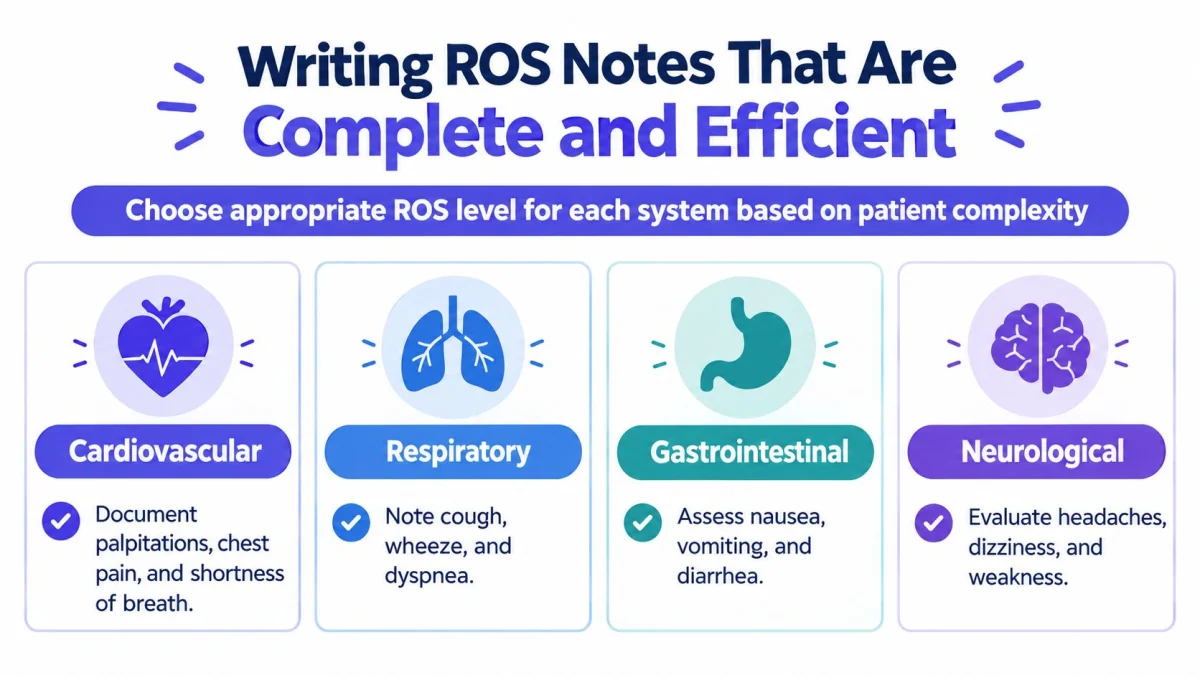
Efficient ROS documentation starts before the clinician opens the template. The visit determines the level. The questions determine the content. The final review confirms that the note says only what happened.
A repeatable workflow
Set the scope. Decide whether the encounter calls for one system, 2 to 9 systems, or at least 10 systems. Don't select complete ROS because the template displays 14 headings.
For a focused follow-up, a concise entry might read: “Musculoskeletal: Persistent right shoulder pain. Denies new weakness or numbness.” An extended review can add cardiovascular and respiratory findings when those systems are relevant to the complaint.
Templates and ambient documentation tools can reduce manual typing, but they must preserve clinician control. PatientNotes, for example, can record a consultation, transcribe speaker-separated dialogue, and produce a structured note in the clinician's chosen template. Its specialty library covers 37 specialties, and its AI template builder can create a template from a dictation, chat, or uploaded document. It also extracts follow-up tasks and offers code suggestions for clinician review. The ICD-10, CPT, and CDT suggestions apply to U.S. billing only. Practices comparing retrieval and documentation workflows may also find Matil's medical records retrieval insights useful.
The clinician remains responsible for checking whether the generated ROS reflects the conversation. No template can replace that step.
Putting It All Together Before You Close the Chart
The final chart review should answer three questions. Was the ROS clinically appropriate for this encounter? Does the note identify the systems reviewed? Are the positive and pertinent-negative responses documented clearly enough for another clinician or an auditor to understand them?
The three traditional levels provide a practical scale:
- Problem-pertinent: one system.
- Extended: 2 to 9 systems.
- Complete: 10 or more systems.
The level should match the encounter. A complete ROS isn't automatically better, and a focused ROS isn't automatically inadequate. The defensible choice is the one that reflects the questions asked and the patient's answers.
A weak entry and a stronger entry
A weak note might read:
ROS: All systems negative.
That phrase doesn't identify the systems reviewed, the source of the information, or the pertinent negatives relevant to the complaint. It also gives no protection if the patient reported a symptom that was omitted from the final note.
A stronger focused entry for chest discomfort might read:
Cardiovascular: Reports intermittent exertional chest pressure. Denies palpitations, syncope, and leg swelling.
Respiratory: Denies cough and shortness of breath.This version is still brief. It identifies the systems, preserves the positive symptom, and records relevant negatives individually. If the encounter required a broader review, the clinician would add the systems discussed rather than allowing a template to fill them automatically.
Before closing the chart, clinicians should also check that ROS remains distinct from HPI and physical examination, that copied content was confirmed, and that the note doesn't claim a review that never occurred. That final pause protects both the patient record and the billing record.
A practical ROS review of systems workflow is deliberate, not decorative. It finds overlooked symptoms when used thoughtfully, supports clinical reasoning, and gives auditors a reliable account of the encounter without forcing clinicians into unnecessary documentation.
PatientNotes records in-person, phone, and telehealth consultations, then creates structured notes with ROS content, follow-up tasks, and clinician-reviewed code suggestions. It includes a native iOS app with offline recording, specialty templates, an AI template builder, HIPAA compliance with a BAA at no extra cost, and copy-and-paste compatibility with every EHR, with Semble as the available integration. Visit PatientNotes to start the 7-day free trial without a credit card, or review pricing at $70 per user monthly or $50 per user monthly when billed annually.