It's 9 PM. The last client has left, and three notes remain open: one session involved panic symptoms, another a medication review, and the third ended when a video connection failed. A single unmodified template forces the clinician to delete irrelevant fields and risks obscuring what mattered in each encounter.
The note should make the encounter easy to follow for another clinician, payer, or auditor. Record what happened, what limited the encounter, and which details support the clinical decisions. A clear record separates the client's report from observed findings, states the clinician's judgment, and identifies the next action.
These sample SOAP notes for mental health encounters offer adaptable fields, not finished records to paste unchanged. Bracketed text marks information to verify before signing.
- Routine care: Document the encounter that occurred, including its limits.
- Special-purpose evaluations: State the referral question and intended audience. For context, review understanding court-ordered mental health evaluations to distinguish these evaluations from ordinary treatment.
1. Standard SOAP Progress Note for Individual Psychotherapy
A weekly CBT session for generalized anxiety needs more than a summary of everything discussed. The useful distinction is between reported panic symptoms, observed behavior, the clinician's interpretation, and the agreed homework.
SOAP grew from Lawrence Weed's problem-oriented medical record, with the familiar sequence documented in his book's PROMIS section, according to this peer-reviewed historical account. That problem-oriented approach suits follow-up work because each encounter can connect symptoms, functioning, and treatment decisions.
Copy-Ready Psychotherapy Fields
- Subjective: Client reports [mood, anxiety, sleep, stressors, functional effects, and progress toward the agreed goal]. Client's safety statements: [actual report].
- Objective: Appearance [finding]; speech [finding]; affect [finding]; thought process [finding]. Intervention delivered: [technique]. Client response: [observable response].
- Assessment: [Diagnostic impression] with [improvement, persistence, or worsening] supported by [specific findings]. Progress toward [treatment goal]. Current risk formulation: [findings, relevant protective factors, and conclusion].
- Plan: [Next intervention], [agreed homework linked to the goal], [safety actions or review], [referrals], and [next appointment date].
For a trauma-focused encounter, an optional measurement field can hold the instrument, administration date, verified score, and comparison with prior results. The Assessment then explains whether that change supports the planned next exposure step.
Audit vulnerability: A repeated statement that therapy continues doesn't explain what the clinician did or how the client responded. A dated risk entry also needs actual findings, not an automatic negative.
Charting choice: Record the intervention delivered separately from the intervention planned. Otherwise, a reviewer may not know which occurred.
A psychotherapy specialty template can supply the headings. Patient-facing material on what to expect from CBT can support homework discussions without replacing documentation of the actual agreement.
2. DAP Note (Data, Assessment, Plan) for Behavioral Health
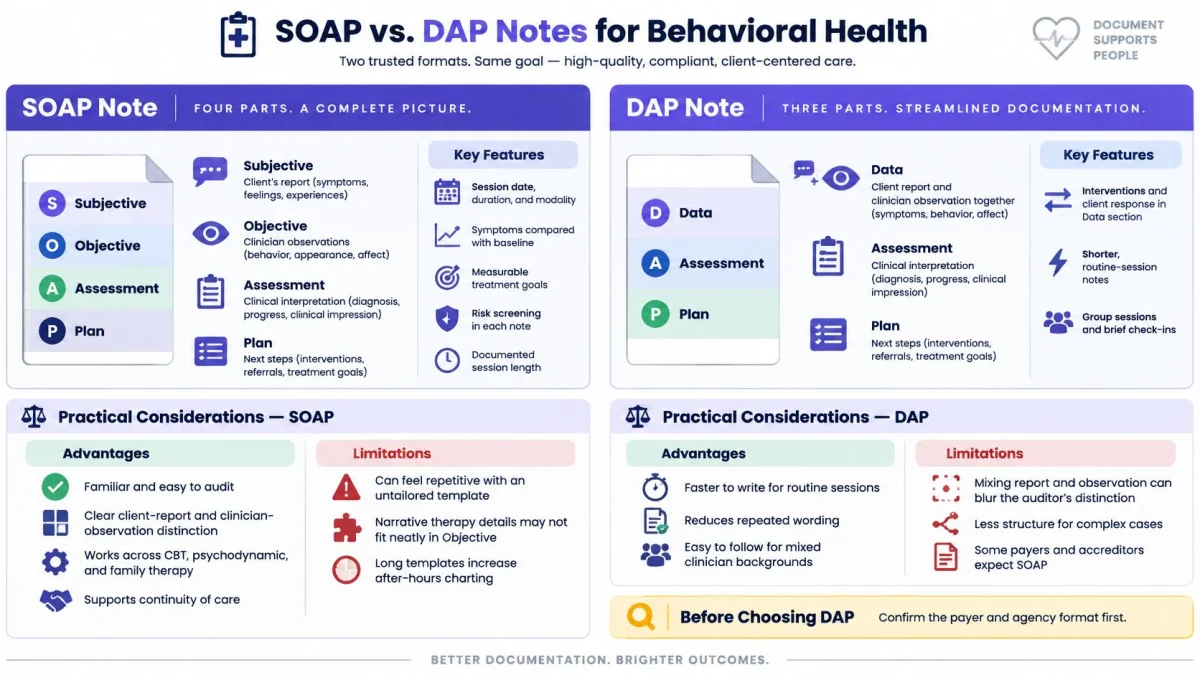
DAP combines client report and clinician observation into Data, followed by Assessment and Plan. It can reduce duplication in a substance-use check-in, but it also makes attribution easier to lose. A statement about cravings shouldn't read like a clinician-observed finding.
Format alone doesn't establish reimbursement compliance. The CMS behavioral-health documentation fact sheet calls for accurate, complete documentation, applicable state Medicaid requirements, appropriate billing, signatures, dates, and time stamps.
The comparison below shows the structural difference.
A Substance-Use Check-In
Data: Client reports [cravings, recent use or abstinence, triggers, and functioning]. Attendance and participation: [observed facts]. Clinician practiced [coping skill] with the client; the client responded by [specific response].
Assessment: [Interpretation of current symptoms, relapse concerns, treatment engagement, progress, and safety findings]. Continued treatment rationale: [connection to the active goal].
Plan: Client will [agreed coping action]. Clinician will [coordination or referral]. Follow-up: [date]. Safety actions: [individualized actions, if applicable].
Audit vulnerability: Combining everything into Data can produce a long narrative with no clinical interpretation. Shortening the note shouldn't remove the reason treatment continues.
- Copy-ready tip: Pair each intervention with the client's response in the same sentence.
- Format decision: Confirm the program's required layout before switching; the DAP versus SOAP comparison helps identify the practical trade-off.
- Observation wording: Resources on interpreting emotional expression in older adults can help refine descriptions, but the entry still needs the clinician's actual observations.
PatientNotes' AI template builder can reproduce a program's fixed DAP layout without forcing the encounter into SOAP.
3. SOAP Note for Psychiatric Medication Management
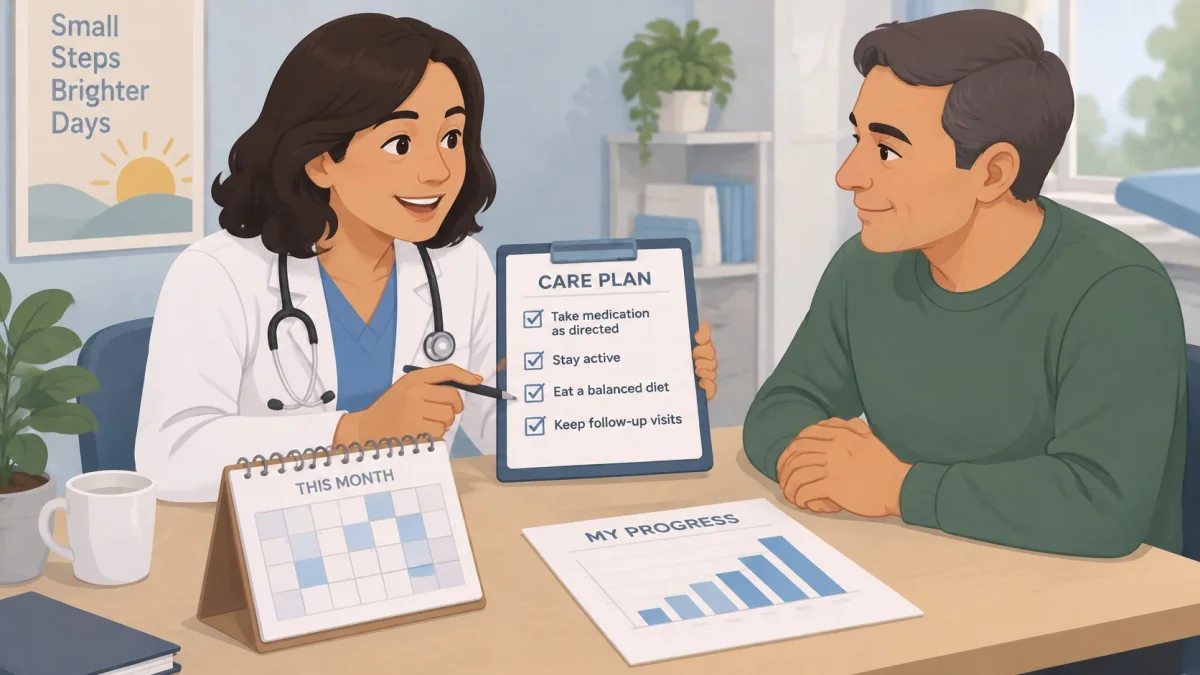
For a patient with established major depressive disorder who reports partial benefit from an SSRI, the note should connect the current symptoms and medication response to the prescriber's decision. Record the current medication list alongside the reason for continuing, changing, or stopping treatment. Include benefit, adverse effects, adherence, residual symptoms, and the chosen action.
Document the Decision, Not Just the Prescription
The fields below help capture the prescriber's decision without implying a particular drug or dose.
- Subjective: Reported benefit [details]; remaining symptoms [details]; adherence [patient report]; adverse effects [report]; safety concerns [findings].
- Objective: Focused mental-status findings [observations]. Vitals [values and date, if obtained]. PHQ-9 or GAD-7 [instrument, date, verified score, and comparison].
- Assessment: [Diagnosis and treatment response]. Rationale for continuing, changing, or stopping medication [individualized reasoning]. Risk formulation [conclusion and supporting findings].
- Plan: [Verified drug, formulation, dose, route, and frequency]. Change [actual order]. Counseling [content]. Monitoring [tests, ordering date, and responsible clinician]. Follow-up [actual date or interval].
A peer-reviewed measurement-based care paper describes integrating repeated measures into treatment decisions. Interpret the verified score in the context of symptoms and response, then document how it informs the plan.
Audit vulnerability: A changed dose without a documented rationale leaves the decision unclear. In an antipsychotic review, specify the metabolic tests ordered and who is responsible for reviewing them.
Copy-ready tip: Pair the medication action with its rationale, relevant symptom findings, and planned monitoring. Name each test and its reviewer so the next clinician can follow the decision.
4. Initial Psychiatric Evaluation in SOAP Format
The intake note establishes the baseline that later progress notes depend on. A longer Subjective section is useful here, but length alone won't resolve conflicting histories or missing information.
For a new patient reporting depression and alcohol use, chronology matters. The note can distinguish symptoms before substance use, symptoms during use, prior treatment response, and information that remains uncertain.
The intake setting below reflects that broader history-taking task.

An Intake Layout With Named Sources
- Subjective: Referral question and chief concern; symptom chronology; psychiatric and medical history; medications; substance use; family and social history. Source beside each contribution: [patient, parent, school report, prior record].
- Objective: Mental-status examination [findings]; relevant physical observations [findings]; testing reviewed [instrument, date, and results]. Unavailable information: [specific gap].
- Assessment: Working diagnosis and differential [reasoning]; DSM-5-TR criteria supported, uncertain, or requiring clarification; formulation [predisposing, precipitating, and maintaining factors].
- Plan: Treatment options discussed [details]; measurable targets [patient-specific targets]; referrals [purpose]; safety actions [details]; follow-up [date].
Dated risk block: Assessment completed [date]. Findings [actual findings]. Relevant protective factors [details]. Clinician conclusion and rationale [individualized formulation]. Actions [documented response].
APA record-keeping guidance emphasizes records that allow another qualified professional to understand and continue services. That favors clearly attributed history over a polished narrative that hides uncertainty.
Audit vulnerability: Parent and child accounts merged into a single statement can obscure disagreement. A prior diagnosis copied as a confirmed current diagnosis creates a similar problem.
The psychiatric evaluation example offers another layout to adapt. PatientNotes can draft history from a recording, but the clinician checks the draft against the speaker and supporting records before signing.
5. Group Therapy SOAP Note
A shared group topic doesn't mean every participant received or responded to treatment identically. For an individual client's chart, the useful record describes that client's contribution, response, progress, and next step.
APA's record-keeping guidelines call for accurate, current, relevant records and describe encounter information such as service type, duration, intervention, and current functioning. Those elements help separate attendance from a documented therapeutic service.
The image shows a group setting; the sample below remains focused on an individual participant.

A DBT Skills Group Example
Subjective: Client reports [difficulty using the target skill outside group] and identifies [personal treatment goal]. Relevant safety statements: [actual report].
Objective: Group format [format]; topic [skill taught]; service duration [actual duration]. Client practiced [exercise], participated by [specific behavior], and responded to coaching with [observable response]. Affect [observation].
Assessment: Client demonstrates [progress or continuing difficulty] with [target skill], supported by [session behavior]. Connection to the individual treatment goal: [reasoning]. Current safety formulation: [findings and conclusion].
Plan: Client will practice [agreed skill in a named situation]. Clinician will review [practice record or relevant outcome] at [next contact]. Individual follow-up [action, if indicated].
Audit vulnerability: Identical participation language across every chart makes individual response unclear. In a grief process group, the relevant distinction may be the client's own disclosure and observed affect rather than skill rehearsal.
Privacy-first drafting: Another member's name or personal disclosure doesn't belong in this client's sample entry.
A recording workflow also needs a documented consent process that covers everyone involved and reflects applicable requirements. Recording shouldn't begin merely because a group template is available.
PatientNotes' psychology and psychotherapy templates can provide the structure. Each completed note still needs individual review rather than a shared group summary copied unchanged.
6. Telehealth SOAP Note for Mental Health Sessions
A telehealth note needs to describe the conditions under which the clinician assessed the client. Video, telephone, and interrupted sessions don't provide the same observational information.
HHS telebehavioral-health privacy guidance addresses privacy precautions and the remote-care environment. Location, modality, consent, and interruptions therefore deserve visible fields rather than a generic telehealth sentence; exact requirements vary by jurisdiction, payer, and practice.
Copy-Ready Video and Telephone Fields
- Encounter context: Client's physical location [confirmed location]; clinician location [location]; modality and platform [details]; consent [process and status]; privacy [who is present and precautions].
- Subjective: Client reports [symptoms, functioning, treatment response, and safety statements].
- Objective: Findings observable through [video or voice]. Connection problems [details]. Observation limits [what couldn't be assessed].
- Assessment: [Clinical interpretation, treatment progress, safety formulation, and suitability of the completed encounter].
- Plan: [Intervention, homework, follow-up, and referrals]. Emergency contact and local safety arrangements [verification and relevant actions].
For a rural video visit, the context field can hold the confirmed physical location and emergency arrangements. If video fails, a separate entry can record when the clinician switched to telephone, the interruption duration, and any effect on assessment.
Audit vulnerability: A telephone note containing copied visual findings contradicts the documented modality. A disrupted visit shouldn't read like an uninterrupted examination.
PatientNotes records phone and telehealth consultations with speaker separation for clinician review. Its telehealth documentation resource provides a starting point for adapting the workflow.
The video below provides an additional resource.
How the six mental health SOAP note types differ
| Item | Best for | Format | Key detail to record |
|---|---|---|---|
| Standard SOAP Progress Note for Individual Psychotherapy | Individual outpatient therapy sessions | Four sections: Subjective, Objective, Assessment, Plan | Session length, current risk, and progress toward measurable goals |
| DAP Note (Data, Assessment, Plan) for Behavioral Health | Brief behavioral health sessions, groups, and check-ins | Three sections: Data, Assessment, Plan | Client report, clinician observations, interventions, and response in Data |
| SOAP Note for Psychiatric Medication Management | Follow-up visits focused on psychiatric medication | SOAP with medication-specific details | Medication, dose, reason for changes, side effects, and monitoring |
| Initial Psychiatric Evaluation in SOAP Format | New-patient psychiatric assessments | SOAP with detailed history and case formulation | History sources, risk assessment, working diagnosis, and measurable goals |
| Group Therapy SOAP Note | Documenting an individual client's participation in group therapy | SOAP, typically one note per client | Group topic and client participation without identifying other members |
| Telehealth SOAP Note for Mental Health Sessions | Mental health sessions conducted by video or phone | SOAP with telehealth visit details | Client and clinician locations, platform, consent, and technical issues |
Pick One Template and Test It This Week
Start with the encounter type that leaves the most unfinished notes. Copy its sections into a working template, then test it on five real encounters. Compare each draft with what happened in the session, not with a checklist that rewards filling every box.
Check risk findings, measurement scores, medication decisions, and client location when they apply. Keep missing information visible until someone verifies it. Automatically filled normal findings can make a note look complete while obscuring what was assessed.
- Keep useful prompts: Retain fields that clarify treatment, functioning, clinical reasoning, and next actions.
- Remove unnecessary repetition: Repeated history can hide the change that prompted today's decision. Keep the relevant background, then document what changed.
- Test the handoff: Ask whether another clinician can identify the current concern, the rationale for the plan, and the follow-up without reading a transcript.
Use the review to find specific template problems. Mark fields that were empty, fields that encouraged unsupported normal findings, and details that had to be added elsewhere. If a prompt repeatedly produces irrelevant text, remove or narrow it. If a reviewer cannot tell why a decision was made, make the relevant reasoning easier to record.
PatientNotes can draft notes and follow-up tasks from recorded consultations, using specialty templates or a custom SOAP or DAP layout. Its templates cover 37 specialties and an AI template builder. Clinicians can start with a 7-day free trial with no credit card required and compare the drafts with their usual documentation before signing.
A draft supports documentation; it does not replace assessment, prescribing judgment, consent procedures, or checks of local documentation requirements. Run the template on five encounters from last week and mark each field that was empty, inaccurate, or unnecessary. Then revise the prompts before using it for the next session.