The last patient has left, but an unfinished report still needs a medication check, a clearer assessment, and a named owner for a pending result. The clinician receiving that report tomorrow needs to understand what happened without reconstructing the encounter from scattered entries.
A useful medical report isn't a polished form. It reflects the encounter, separates findings from interpretation, supports the next decision, and makes follow-up responsibility clear. That distinction connects directly to the purpose of medical records explained, although the practical test is whether another clinician can act on the record.
Practical rule: A report should make the important information easier to find, not make the encounter appear more comprehensive than it was.
The workload makes that distinction consequential. In national survey data, 91.0% of US office-based physicians spent time documenting outside normal office hours, according to the analysis of after-hours documentation. Adding fields without deciding which information matters can create more work rather than a more useful record.
These eight samples of medical report formats address different needs, from focused outpatient visits to admissions, discharge, procedures, mental health, referrals, rehabilitation, and periodontal care. Each educational example illustrates structure, clinical value, workflow fit, and documentation risk. None replaces local policy, specialty standards, payer requirements, or an individualized clinical assessment.
1. SOAP Progress Note
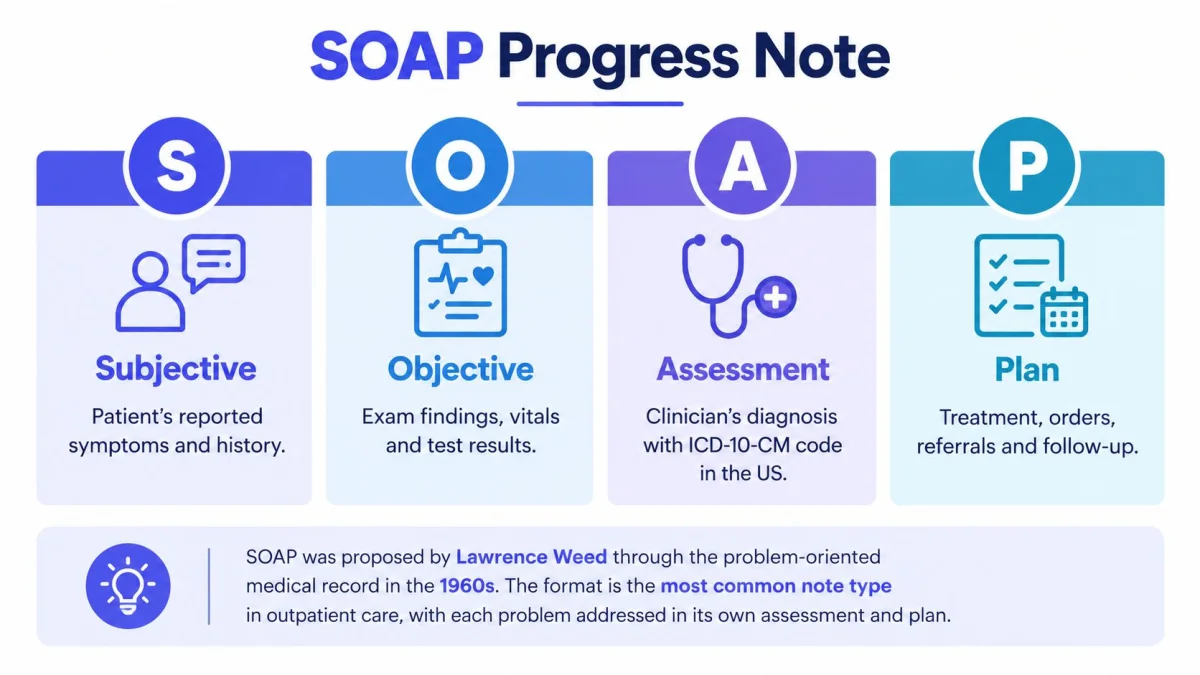
A hypertension follow-up needs a different level of detail from an admission assessment. SOAP provides a compact structure for connecting the patient's account, measured findings, clinical interpretation, and next steps.
Its strength is scanability. Its limitation is that headings alone don't explain the clinician's reasoning. NHS England emphasizes accuracy, appropriate coding, and correct context in its guidance on high-quality patient records, principles that support this separation without prescribing SOAP itself.
Educational sample for a hypertension follow-up
- Subjective: The patient reports home readings above the agreed target and describes how medication is being taken. Document relevant symptoms and adverse effects discussed.
- Objective: Enter verified office measurements, relevant examination findings, and available results. Distinguish patient-reported home measurements from measurements obtained in the practice.
- Assessment: State the working impression and explain how the readings, adherence history, and symptoms support it.
- Plan: Record the clinician's medication decision, monitoring instructions, follow-up arrangement, and responsibility for reviewing results.
For a dermatology visit, the same structure could place lesion measurements in Objective and the clinician's biopsy decision in Plan. The format stays stable while the content changes.
Address each problem separately in the assessment and plan. A medication change shouldn't disappear inside a paragraph about unrelated symptoms, and an unconfirmed diagnosis shouldn't read like an established finding.
Structured notes achieved higher quality scores than unstructured notes in a multicenter study of standardized documentation, but the study doesn't establish that every field should be mandatory. The medical report sample collection offers starting formats that clinicians can adapt rather than copy unchanged.
The diagram shows how the components relate.
2. History and Physical (H&P) Report
An admission H&P establishes a baseline rather than merely summarizing the presenting complaint. For a fictional patient admitted with suspected community-acquired pneumonia, the report should connect the history and observed findings to the working assessment and initial management decisions.
Suggested core fields include the chief complaint, history of present illness, medical and surgical history, medications, allergies, relevant family and social history, review of systems, examination, assessment, and initial plan. These headings are a drafting framework, not permission to populate normal findings automatically.
The review step matters when information comes from several sources.

Separate verified findings from missing information
A useful educational sample might state that the patient reports cough and reduced exercise tolerance, followed by the actual vital signs, respiratory examination, and available investigations. The assessment should distinguish the working diagnosis from alternative explanations still being considered.
- Medication history: Identify the source and whether reconciliation remains incomplete.
- Examination: Record what was assessed. Don't convert an unperformed examination into a normal result.
- Initial plan: Separate treatment decisions, further investigations, monitoring, and outstanding information.
In US Medicare-participating hospitals, 42 CFR 482.22(c)(5) governs H&P completion and update requirements. The applicable timing, practitioner qualifications, and institutional process need checking before an outpatient template is reused for an admission or preoperative encounter.
The H&P's strength is breadth. Its main weakness is copy-forward material that obscures the current presentation. A preoperative assessment for elective knee replacement therefore needs its own purpose and verified findings, not a lightly edited pneumonia admission note.
An AI-generated first draft can organize a recorded history, but it can't supply an examination that wasn't performed. The signing clinician must reconcile the draft with the encounter and available records.
3. Discharge Summary
The next clinician should be able to identify what changed, what remains unresolved, and who will act next without reading the entire hospital record. That makes a discharge summary a handover document, not a chronological transcript of the admission.
For US hospitals, 42 CFR 482.24(c)(4)(vii) requires the discharge summary to include the outcome of hospitalization, disposition, and provisions for follow-up care. A practical template should make those elements visible.
The patient also needs an understandable explanation of the transition.

Educational sample for a heart failure admission
The clinician-facing summary would state the admission reason, confirmed diagnoses, significant treatment, response, and condition at discharge. It would then identify the prescribed diuretic regimen and distinguish medications that were started, changed, continued, or stopped.
- Pending results: Name the investigation, responsible clinician or service, and planned review process.
- Follow-up: Record the actual arrangement, its purpose, and any booking responsibility still outstanding.
- Patient instructions: Explain medication changes and individualized warning signs in plain language.
A post-surgical summary uses the same handover logic but emphasizes the operation, recovery, wound instructions, restrictions, and agreed review arrangements. Neither sample should supply generic medication doses or recovery deadlines as though they apply to every patient.
Handover test: “Follow up with the usual clinician” is less actionable than identifying the responsible service and explaining what needs review.
Preparing the summary while the admission details remain available is a sensible workflow choice. Its limitation is that completion alone doesn't confirm that the receiving service has accepted a task.
Plain-language instructions should preserve important uncertainty, pending results, and responsibility. Simplification must not turn a working diagnosis into a confirmed one or omit the clinician's safety-net advice.
4. Operative and Procedure Note
A skin biopsy note and a joint injection note share a documentation problem: the next reader needs an accurate account of what happened at a specific site. A generic paragraph about a completed procedure isn't enough to reconstruct the technical details.
In US hospitals, 42 CFR 482.51(b)(6) requires an operative report describing techniques, findings, and tissues removed or altered to be written or dictated immediately following surgery and signed by the surgeon. Office procedure templates need adaptation to the procedure and applicable local requirements.
Educational sample for a skin biopsy
- Procedure and site: Identify the procedure, anatomical location, and laterality where applicable.
- Indication and consent: Record the clinical reason and the consent discussion completed.
- Technique: Document preparation, anesthetic, technique, closure, and other relevant procedural details.
- Findings and specimens: Describe observed findings and identify specimens and their destinations.
- Outcome and plan: Record complications or their absence as assessed, immediate care, result review, and patient instructions.
For a joint injection, the relevant technical detail changes to include the joint, approach, medication, administered dose, and observed response. These are fields for the clinician's verified information, not suggested treatment choices.
The format's strength is reproducibility. Its limitation is the temptation to treat a prefilled technique as proof that every step occurred.
A useful drafting strategy is to dictate the site, laterality, specimen details, and any deviation from the expected technique before adding routine wording. If the procedure changed, the final note should describe the procedure performed rather than the original plan.
Coding remains a separate review task. For US billing, any suggested CPT code should be checked against the current AMA CPT publication and relevant payer requirements. A convincing procedure narrative doesn't establish that a suggested code is correct.
5. Psychiatric Evaluation and Psychotherapy Progress Note
A psychiatric evaluation and an ongoing psychotherapy progress note answer different questions. The evaluation establishes the clinical picture; the progress note explains the session's focus, intervention, response, current risk considerations, and next steps.
A psychiatric intake template can prompt for the presenting concern, psychiatric and substance use history, relevant medical context, mental status examination, diagnostic reasoning, risk formulation, and treatment plan. Where DSM-5-TR criteria inform a diagnosis, the clinician should document supporting evidence rather than insert a diagnosis from a template.
Educational examples with different purposes
Psychiatric intake: A fictional patient presents with mood symptoms. The note separates reported symptoms from observed mental status findings, distinguishes a working diagnosis from alternatives, and records the clinician's treatment and safety decisions.
Psychotherapy progress note: A fictional cognitive behavioral therapy session records the agreed focus, intervention used, patient response, relevant risk review, and planned work before the next appointment. It needn't reproduce every personal detail discussed.
The psychiatric evaluation example provides a starting structure, but the clinician must determine what belongs in the particular record.
Routine psychotherapy progress notes aren't automatically the separately maintained “psychotherapy notes” defined by HIPAA.
45 CFR 164.501 distinguishes separately maintained psychotherapy notes from information such as diagnosis, treatment plans, symptoms, prognosis, and progress. Practices should confirm their storage, access, and disclosure arrangements with their privacy lead rather than assume that a sensitive title changes the record's legal status.
The practical trade-off is detail versus relevance. Too little detail can leave the rationale unclear; an indiscriminate transcript can include sensitive material that doesn't help subsequent care.
A useful template prompts the clinician to address current risk without defaulting to reassuring language. Any AI draft requires particular attention to diagnostic certainty, negation, and statements about safety.
6. Referral and Consultation Letter
The clinical question belongs near the beginning. A dermatology referral concerning a suspicious pigmented lesion should explain what assessment is sought before presenting an extended history.
A consultation reply should answer that question, state the findings and interpretation, and make responsibilities explicit. Otherwise, both clinicians may assume that the other will arrange testing or communicate results.
The exchange should preserve the relevant context without transferring an entire unfiltered chart.

Educational sample for a focused referral
- Request: Assessment of a changing pigmented lesion and advice on whether biopsy is indicated.
- Relevant context: Patient-reported change, verified examination findings, relevant history, and photographs where appropriately obtained and shared.
- Supporting information: Relevant medication, allergy, and investigation details.
- Coordination: Requested urgency, communication route, and responsibility for outstanding actions.
A cardiology consultation request would use the same logic for new exertional chest symptoms, while leaving test selection and urgency to the responsible clinician's assessment. An educational sample shouldn't imply that a routine referral is appropriate for every presentation.
For UK workflows, the NHS Professionals record-keeping guidance supports clear assessments, documented actions and information sharing, and entries with date, accurate time, and author identification. Practices should also check NHS England's Records Management Code of Practice and local referral arrangements.
Referral content and referral destination are separate decisions. Clinicians looking to find telepsychiatry referrals still need to confirm suitability, access, and responsibility for care.
PatientNotes supports UK and US workflows; its comparison information can help practices assess workflow fit. A generated letter remains a draft until its question, attachments, recipient, and action ownership have been checked.
7. Physical Therapy Initial Evaluation and Plan of Care
A rehabilitation evaluation becomes useful when it connects measured impairment to the activity the patient needs to regain. A list of range-of-motion findings alone doesn't explain the intended treatment outcome.
For a fictional patient with lumbar pain, an initial evaluation might record difficulty sitting for work, relevant history, symptom behavior, functional baseline, and the examinations performed. The assessment would explain how those findings support the proposed rehabilitation approach.
From baseline to an actionable goal
- Baseline: Record the current functional limitation and the measurement method used.
- Objective findings: Include relevant range of motion, strength, gait, balance, or other assessed measures.
- Goal: State the target activity, expected level of performance, and review date.
- Plan: Describe proposed interventions, frequency, duration, reassessment, and required coordination.
A post-stroke gait evaluation would emphasize a different baseline and different measures, potentially including the Berg Balance Scale where appropriate. Neither example should inherit a numerical target from another patient's template.
For US Medicare outpatient therapy, 42 CFR 424.24(c) governs certification requirements for therapy services. The practice should verify the applicable certification, recertification, signature, and referral or order provisions rather than assume that an evaluation note alone satisfies them.
The physical therapy SOAP note sample can help organize subsequent treatment documentation. The initial evaluation still needs enough detail to explain the plan's rationale.
The strength of a structured evaluation is comparability at reassessment. Its limitation is false precision when a carried-forward score was not remeasured.
A documentation intervention at Hasahesa Hospital demonstrated the value of auditing specific missing fields rather than checking only whether a note existed, as described in the documentation-quality improvement study. Rehabilitation practices can apply that audit principle to baseline measures, goals, and plan ownership without treating the hospital findings as therapy-specific evidence.
8. Dental Periodontal Charting and Examination Note
The chart holds the site-level findings; the narrative explains their meaning and the agreed plan. A paragraph stating “periodontal disease present” can't substitute for structured examination data.
A useful periodontal record provides fields for probing depths, bleeding on probing, recession, mobility, furcation involvement, and plaque or calculus findings. The examination and diagnosis should reflect the clinician's actual assessment, not a staging label copied from an example.
Educational sample for a periodontal re-evaluation
The structured chart records the assessed sites and findings. The accompanying note compares relevant findings with the prior examination, describes the clinician's interpretation of the response to treatment, and records the discussed next steps.
- Examination context: Identify whether the encounter is an initial assessment, maintenance visit, or re-evaluation.
- Diagnostic summary: Explain the evidence supporting the diagnosis and any staging or grading recorded.
- Management discussion: Document options discussed, the patient's decision, and the agreed plan.
- Follow-up ownership: State who will arrange further treatment or review.
The AAP and EFP periodontal classification, described by Caton and colleagues in the Journal of Periodontology, provides the specialty framework for classification. Clinicians should consult that primary publication and applicable specialty guidance rather than infer staging or grading from a short sample.
A new-patient record might document a clinician-assigned stage and grade with the supporting findings. A re-evaluation instead needs to show what was assessed again and how the clinician interpreted any change.
The accompanying video provides additional context.
Patient-facing material such as save your teeth Upper East Side serves a different purpose from a diagnostic chart. Educational treatment information shouldn't replace individualized findings or consent documentation.
For US billing, CDT suggestions require review against the current ADA CDT publication. Neither the narrative nor an automatically suggested code establishes claim eligibility.
Comparison of 8 Medical Report Samples
| Report Type | Implementation Complexity | Resource Requirements | Expected Outcome | Ideal Use Cases | Key Advantage |
|---|---|---|---|---|---|
| SOAP Progress Note | Low | Visit history, exam findings, assessment, and plan | Clear, problem-based record of a visit | Outpatient visits, follow-ups, and telehealth | Familiar format that is quick to write and scan |
| History and Physical (H&P) Report | High | Comprehensive history, review of systems, full exam, and admission plan | Baseline record supporting admission and ongoing care | Hospital admissions, surgical clearance, and new-patient workups | Provides a broad clinical baseline for comparison |
| Discharge Summary | Moderate | Admission details, hospital course, medication reconciliation, pending results, and follow-up plan | Handover of care and clear post-discharge instructions | Hospital or facility discharge | Highlights medication changes and follow-up tasks |
| Operative and Procedure Note | Moderate to high | Procedure details, consent, anesthesia, findings, specimens, and complications | Accurate record of the procedure and immediate plan | Surgery, biopsies, injections, and endoscopy | Supports clinical continuity and procedure documentation |
| Psychiatric Evaluation and Psychotherapy Progress Note | Moderate | Mental health history, mental status exam, risk assessment, interventions, and treatment plan | Structured record of diagnosis, safety, and progress | Psychiatric intake and ongoing therapy or medication visits | Tracks change over time and documents risk assessment |
| Referral and Consultation Letter | Low to moderate | Referral question, relevant history, medications, results, and urgency | Focused information exchange between clinicians | Specialist referrals and consultation requests | Clarifies the clinical question and supports care coordination |
| Physical Therapy Initial Evaluation and Plan of Care | High | Functional history, objective measures, goals, and treatment frequency and duration | Measurable baseline and certified treatment plan | Outpatient rehabilitation and therapy evaluations | Tracks functional progress and supports medical necessity |
| Dental Periodontal Charting and Examination Note | High | Full-mouth, six-site-per-tooth measurements and disease staging | Measurable periodontal baseline and treatment plan | Periodontal exams, re-evaluations, and treatment planning | Provides comparable findings and evidence for claims |
Build a Documentation System That Stays Consistent
The right report is the one that matches the clinical job. SOAP suits focused outpatient encounters, an H&P establishes an admission baseline, and a discharge summary supports the transition to another setting or clinician.
Procedure notes preserve technical detail. Behavioral health and rehabilitation reports need specialty-specific reasoning and progress measures, while referral letters need a focused question and clear responsibility. Periodontal records need structured charting alongside a concise interpretation.
Standardize the important elements, but don't standardize findings that the clinician hasn't verified.
A small practice can start with a single encounter type rather than replace every template at once. The review should ask whether the completed note reflects the encounter, distinguishes uncertainty, identifies pending work, and gives each follow-up action an owner.
- Test the workflow: Compare the draft with the recording, verified findings, and available records.
- Review the handoff: Confirm who orders, books, reviews, and communicates each outstanding action.
- Inspect the final record: Check medication details, negation, laterality, diagnostic certainty, and unnecessary copied text.
PatientNotes is an AI medical scribe for individual clinicians and small practices, built by a London-based company. It produces structured drafts, follow-up tasks, and plain-language patient instructions, with notes and tasks in the clinician's own language.
Its specialty library covers 37 specialties, including psychiatry, psychology and psychotherapy, physiotherapy, PM&R, dentistry, and periodontics. An AI template builder supports custom formats, while the native iOS app supports offline recording.
PatientNotes states that it is HIPAA compliant, with a BAA included at no extra cost. The HHS business associate agreement requirements explain why practices must review permitted uses, safeguards, breach reporting, and other contractual obligations rather than rely on a compliance label alone.
Semble is the only EHR integration; every other EHR workflow uses copy and paste. ICD-10, CPT, and CDT suggestions apply to US billing only and require review. Clinical judgment, coding accuracy, and legal compliance can't be delegated to generated text.
PatientNotes pricing is $70 per user per month billed monthly or $50 per user per month billed annually, with a 7-day free trial requiring no credit card and a 14-day money-back guarantee. There's no enterprise tier or sales call.
The product resources can support a focused trial. The useful outcome is a verified, actionable record, not merely a faster draft.
PatientNotes offers structured report drafts, specialty templates, follow-up tasks, and patient instructions for clinician review. A practical next step is to visit PatientNotes, select a frequently used report format, and test how well it preserves verified findings and follow-up ownership before signing.