A clinician opens the chart, the colleague on call opens it next, and the payer may open it after that. Each reader wants the same thing, a note that makes sense fast, shows what happened, and leaves no doubt about the plan. Good sample medical reports do that when they use the right format and when the annotations point out what matters, not just what looks polished. The value is in the structure, the handoff, and the follow-up. The details below cover eight common note types that clinicians see every week, from outpatient progress notes to dental charting, with a focus on what a reviewer, billing team, or next clinician looks for.
1. SOAP Progress Note
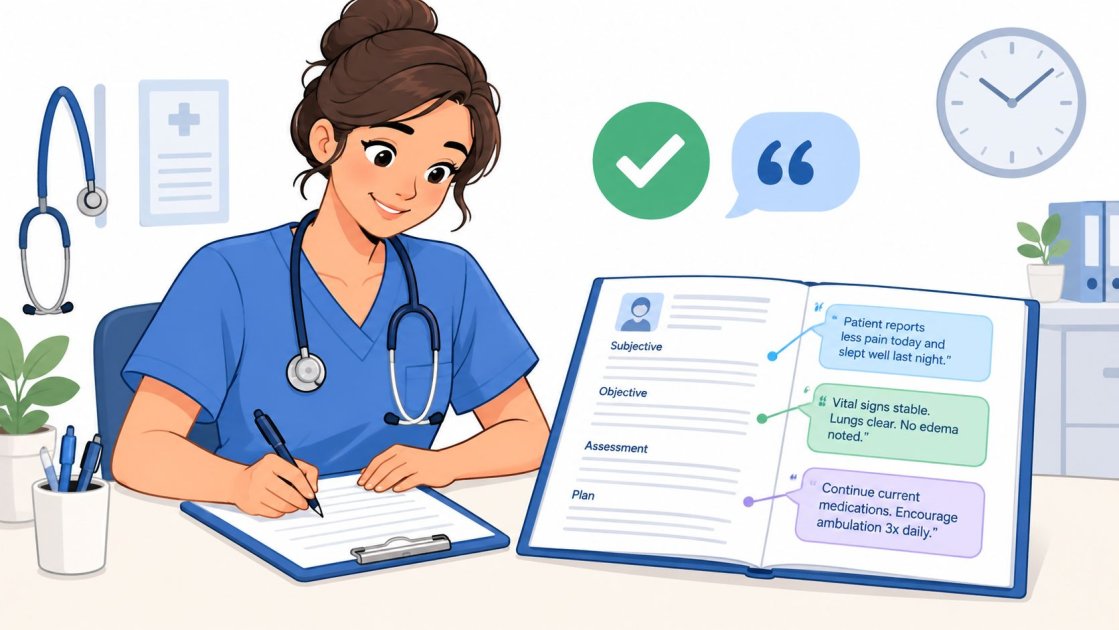
SOAP is still the cleanest way to turn a busy visit into something another clinician can read in under a minute. Subjective captures the patient's history and symptoms, Objective holds exam findings and test results, Assessment states the diagnosis or working impression, and Plan lists treatment and follow-up. That structure fits the problem-oriented approach Lawrence Weed introduced when he pushed medical records toward the patient's problems rather than the author's paperwork bucket history of medical reporting and the problem-oriented record.
A strong SOAP note does not bury the link between the problem and the plan. A hypertension follow-up should show the home blood pressure log in Subjective, the clinic readings in Objective, and the medication change in Plan. A post-operative orthopedics check should make the range of motion visible in Objective and the physical therapy referral easy to find in Plan. The next reviewer wants to see that each Assessment line is supported by a finding, not copied forward from last month.
Practical rule: one problem per Assessment line, one matching action in the Plan.
A common pitfall is leftover text. Old medication lists, copied exam defaults, and stale assessment language make a note look complete while hiding the actual visit. That is how a good sample report becomes a bad real chart. For a specialty-specific template, the SOAP progress note example is useful because it shows how the same format can be tuned for different outpatient workflows.
2. History and Physical Report
A patient arrives on the ward with a new chest pain workup, or a primary care visit turns into the first formal look at a long-standing problem. The H&P is the chart that frames that encounter. It should include the chief complaint, HPI, past medical, surgical, family, and social history, review of systems, physical exam, assessment, and initial plan. In U.S. hospitals, CMS hospital Conditions of Participation require the medical history and physical exam to be completed no more than 30 days before or 24 hours after admission CMS Conditions of Participation guidance.
The timing rule matters because an H&P should reflect the actual visit, not a polished recap written later from memory. The exam must match what was done at the bedside. A normal template that does not fit the findings can create problems quickly, especially on admission, when several clinicians may rely on the same note. The hospitalist starting pneumonia treatment needs the social history, the exam, and the initial plan in one place. So does the internist establishing a baseline for a chronic problem.
The safest H&P reads like a real encounter, not a generic admission shell.
A reviewer looks for completeness. The next clinician looks for usable detail. The note should show why the patient came in, what changed, what was found, and what happens next. It should also make the source of the history clear, especially when the patient is a limited historian or a family member adds key details. For the behavioral health side of intake documentation, Total Mental Wellness diagnostic evaluation insights explain what a psychiatric diagnostic evaluation covers. A solid H&P is long enough to support decisions and short enough to scan without hunting.
3. Discharge Summary
A discharge summary is the handoff note that keeps the move from hospital to home from falling apart. It should state why the patient was admitted, the major findings, procedures, hospital course, discharge condition, medications started, changed, or stopped, pending results, and follow-up. The CMS discharge planning requirements also call for clear documentation of the outcome of hospitalization, disposition, and follow-up care.
The next clinician usually scans for three things first, what changed, what still needs attention, and who owns the follow-up. A heart failure discharge note should make the diuretic change obvious, point to the repeat potassium check, and name the cardiology follow-up. A surgical summary should place wound care and pending pathology where they are easy to find. If those items sit halfway down a long narrative, the transition weakens.
Medication errors often start with vague wording. New, changed, and stopped medications should stand out clearly, and each pending result needs a named owner, not just a label in the chart. The hospital team may know the plan, but the outpatient team often sees only the summary.
What works: put pending results and medication changes near the top, then assign each pending item to a specific clinician.
For a practical example of the follow-up framing caregivers need after discharge, the guide for caregivers of seniors is a useful companion reference. A reviewer looks for clarity, a billing team looks for a clean record of the hospital course, and the next clinician looks for a note that can guide action without guesswork.
4. Procedure Note
A procedure note should show exactly what was done. Record the indication, consent, procedure name and technique, site, equipment or materials, sedation or anesthesia, findings, specimens sent, complications, and the post-procedure plan. That level of detail supports the CPT code selected for billing in the United States, and coding responsibility also depends on choosing the correct ICD-10-CM code from the code book for the service year ICD-10-CM Official Guidelines for Coding and Reporting.
A strong procedure note reads like a clean technical record. A knee corticosteroid injection should state the side, needle size, approach, drug, dose, and tolerance. A punch biopsy should state lesion size, depth, closure method, and where the specimen was sent. Missing laterality or vague technique creates coding questions and clinical questions.
Reviewers, billing staff, and the next clinician all look for the same core facts, but for different reasons. The reviewer checks whether the note supports the service. Billing staff checks whether the documentation matches the code. The next clinician checks whether the site, materials, and follow-up are clear enough to trust the record.
Template drift is the pitfall that causes the most trouble. Defaults can stay in the chart after the plan changed, so the note says more than the clinician did. Dictating laterality and site right after the procedure helps because those details are still fresh.
Record only what was done. A polished note that describes a different procedure is worse than a short one.
For office workflows, a phone dictation right after the procedure helps preserve the exact site, step order, and tolerance. Offline recording is useful when signal is weak or the room layout makes web-based capture awkward. The goal is accuracy that holds up under review.
5. Mental Health Progress Note
DAP notes fit mental health work because they stay focused. Data holds what happened in session and what the patient reported, Assessment holds the clinician's reasoning, mental status, and risk, and Plan captures interventions, next steps, and follow-up. That format is widely used in psychiatry, psychology, and psychotherapy, and practices set their own standard because no single federal rule requires DAP.
A depression follow-up can use the Data section to capture mood, therapy work, and the patient's report of how the week went. The Assessment section should state the clinical impression and include risk, even when the risk is low. The Plan then names the therapy approach, medication changes if any, and the date of the next visit. A psychiatric medication check should do the same thing, while keeping the language concise and clinically grounded.
Practical rule: document suicide and safety risk in every Assessment, even when the screen is negative.
The pitfall is oversharing session content. Mental health notes do not need a transcript of every word. They need enough detail for continuity, safety, and payer requirements, without turning the chart into a wall of narrative. A mental status template helps because it keeps the fields consistent from visit to visit. For a direct comparison of note styles, DAP notes versus SOAP notes is a practical reference.
A second pitfall is skipping the therapy modality. When CBT, supportive therapy, or another approach is part of the encounter, the note should show it. That helps the next clinician understand what was tried and what was planned next.
6. Physical Therapy Initial Evaluation and Plan of Care
PT evaluation notes have to do more than describe pain. They need to show baseline impairment, functional limits, objective testing, diagnosis, prognosis, goals, and the planned frequency and duration of care. For Medicare patients, the plan of care must be certified by a physician or allowed practitioner, and the Medicare Benefit Policy Manual lists required elements such as diagnosis, prognosis, functional limitations, goals, and the type, amount, and frequency of services Medicare plan of care requirements.
The best PT notes make progress measurable. A shoulder evaluation should include a range-of-motion measurement, a pain score, and a goal tied to function, such as overhead reach by a target date. A lumbar evaluation should connect the current limitation to a goal like sitting for a defined period without pain. That keeps the plan visible at re-evaluation and gives the next therapist a real benchmark.
A common pitfall is writing goals that sound positive but cannot be measured. “Improve strength” does not help much. “Reach overhead without pain by week 6” gives the therapist and the payer something concrete to track. The same is true for outcome measures. Record the score at evaluation and again at each re-evaluation so change is visible, not assumed.
What reviewers want: a goal with a number, a function, and a time frame.
For a practical template example, the physical therapy SOAP note sample shows how to keep measurements readable without losing detail. In daily use, a physiotherapy template works best when the clinician can dictate the numbers during the visit instead of reconstructing them later.
7. Dental Periodontal Charting Note
Periodontal charting is the note that proves the diagnosis is based on actual measurements. It records probing depths, bleeding on probing, recession, mobility, furcation involvement, and the overall stage and grade of periodontitis. The stage and grade framework from the 2017 classification by the American Academy of Periodontology and the European Federation of Periodontology helps describe both severity and progression rate 2017 periodontal classification framework.
Dentists and periodontists use this note to track change over time. That matters because a re-evaluation after scaling and root planing should show whether pockets have improved. It also matters for treatment planning and for CDT code selection in U.S. billing. The note should make quadrant and tooth-level findings easy to review, not force the reader to decode a block of shorthand.
The pitfall is inconsistency. If charting is done in a different order each visit, it becomes harder to compare one appointment with the next. Dictating by quadrant and tooth number keeps the transcript readable. Confirming the stage and grade against the classification before signing reduces downstream corrections.
The chart should show disease status, not just a list of numbers.
A periodontal note also has to support the next decision. If the initial record says stage III, grade B periodontitis with a surgical referral, the follow-up note should make it easy to see what changed and why. A dental template helps most when it forces the same core fields every time, then leaves room for clinician judgment where the anatomy and disease pattern demand it.
8. Dermatology Lesion Assessment Note
Dermatology notes work best when they make change easy to see. A lesion note should record location, size, color, border, shape, symptoms, and evolution over time. Pigmented lesions are often organized with ABCDE criteria, which helps the clinician stay disciplined about asymmetry, border, color, diameter, and evolving features. The note also records the clinical differential, whether a biopsy was done, and the follow-up plan.
The next clinician usually wants to know whether the lesion is stable. That is why comparison with a prior photo or note matters so much. Clear lesion notes help detect evolving melanoma because change over time is often the signal that moves the case forward. Dermatology notes also often include photos, and local policy should govern how those images are stored in the record.
A common pitfall is vague sizing. “Small mole” or “slightly larger” does not help much. A note should use millimeters and describe the border and shape clearly. A 6 mm pigmented lesion with an irregular border tells the reader much more than a casual description. If a punch biopsy is planned, the note should make that plan visible without burying it in narrative.
Practical rule: size in millimeters, comparison to prior image, and next step all belong in the same note.
For a clinic that follows lesions over time, that consistency is more important than elegant prose. A dermatology template helps each lesion get the same fields, which makes serial comparison easier at the next visit. The best note reads like a careful skin exam, not a generic rash paragraph.
8 Medical Report Sample Comparison Matrix
| Documentation Example | Implementation Complexity and Resources | Expected Outcome | Ideal Use Cases | Key Advantage |
|---|---|---|---|---|
| SOAP Progress Note | Moderate; four sections and problem-linked findings and plans | Scannable record connecting clinical findings to decisions | Outpatient visits, follow-ups, and telehealth | Familiar and adaptable across specialties |
| History and Physical (H&P) Report | High; requires comprehensive history, review of systems, and physical exam | Complete baseline record for care and handoffs | Hospital admissions and new-patient evaluations | Provides a broad clinical baseline |
| Discharge Summary | Moderate; requires hospital course, medication reconciliation, pending results, and follow-up details | Supports continuity of care after discharge | Hospital-to-home or facility transitions | Clarifies medication changes and follow-up responsibilities |
| Procedure Note | Low to moderate; focused details about consent, technique, site, findings, and complications | Documents the procedure for subsequent care and billing | Injections, biopsies, repairs, and minor surgery | Concise record of what was performed |
| Mental Health Progress Note (DAP Format) | Low to moderate; session data, clinical assessment, risk, and plan | Captures session content, clinical reasoning, and next steps | Psychotherapy and mental health follow-ups | Quick, focused format for routine sessions |
| Physical Therapy Initial Evaluation and Plan of Care | High; requires measurements, functional scores, goals, and care schedule | Establishes a measurable baseline and plan for tracking progress | Initial physical therapy evaluations and re-evaluations | Makes functional goals and progress explicit |
| Dental Periodontal Charting Note | High; requires site-by-site periodontal measurements and classification | Supports diagnosis, treatment planning, and tracking over time | Periodontal evaluations and follow-ups | Standardized data shows changes in periodontal health |
| Dermatology Lesion Assessment Note | Moderate; requires lesion measurements, visual descriptors, and comparison data | Supports monitoring, biopsy decisions, and referrals | Lesion checks and skin cancer surveillance | Makes lesion changes easier to compare over time |
Build Your Own Note Set From These Samples
The fastest way to improve documentation is to start with the two or three note types written most often, then rebuild those templates first. A primary care practice may begin with SOAP progress notes and discharge summaries. A mental health clinic may begin with DAP notes. A dental or therapy practice may need the specialty note first, then the referral or follow-up format. The goal is not to own every template at once. The goal is to make the daily charts cleaner, more consistent, and easier to review.
Each sample above should be checked against the relevant primary sources and the payer rules that apply to the setting. CMS rules matter for discharge content, admission timing, and coding specificity. HIPAA business associate requirements matter when a vendor touches protected health information, because a written agreement has to define permitted uses and disclosures and assign the privacy and security terms HHS business associate agreement guidance HHS sample BAA provisions. That same discipline matters in small practices, where a short note can still fail if it leaves out the elements the reviewer expects.
For clinicians comparing template workflows, PatientNotes pricing includes a 7-day free trial with no credit card, which makes it a low-risk way to test whether a template fits daily practice. The point is to see how the note reads after a real visit, not after a demo. If the sample still makes sense when a colleague, biller, or next clinician opens it, the format is doing its job.
PatientNotes gives individual clinicians and small practices a way to capture a visit, turn it into a structured note, and adapt templates for different specialties. It fits this topic because the same note types covered above can be built into daily workflow, with notes, tasks, and coding suggestions ready for clinician review.