
A major evaluation of linked fit note records in England found that mild-to-moderate mental health disorders, including depression, anxiety, and stress, accounted for 35% of all fit notes, making mental health the single largest diagnostic category, according to the UK government fit note evaluation. That scale changes how a clinician should treat a mental health doctor note. It's not proof that a visit happened. It's a shared clinical and legal record that the next clinician, a payer reviewer, the patient, and sometimes an employer will read and act on.
Core Components of a Mental Health Note
A mental health doctor note fails most often at the handoff. The writer knows the patient, so gaps feel obvious. A covering clinician, utilization reviewer, or auditor doesn't have that context and can't safely fill it in.
The Seven Parts in Reading Order
| Component | Question it answers | Leave out |
|---|---|---|
| Encounter details | When, how long and in what format was the visit? | Full transcript or session content |
| Presenting problem | Why the patient came and how long symptoms have lasted | Every complaint, quoted verbatim |
| Relevant history | Psychiatric, medical, substance and social factors that affect care | Family or relationship detail unrelated to care |
| Risk assessment | What is the current safety status and what is the basis for it? | Generic phrases such as 'no concerns' |
| Mental status exam | What did you observe and what did the patient report, by domain? | Adjectives without observed evidence |
| Diagnosis | What is the working diagnosis and how does it limit function? | Labels that add stigma but do not change care |
| Plan | What treatment, referral, medication change and follow-up interval comes next? | Plans with no date, owner or next step |
Encounter details come first because they frame everything else. Date, duration, format, and who attended tell a reviewer what kind of encounter supports the entry. A collateral participant, an interpreter, or a telehealth format can change how findings should be interpreted.
The presenting problem needs a course, not just a label. "Anxiety" doesn't tell the next clinician whether symptoms began last week or have worsened over six months. Duration, triggers, prior treatment response, and current functional impact make the entry usable.
History That Changes a Decision
Relevant history should stay relevant. Psychiatric history, medical conditions, substance use, medications, allergies, and social factors belong when they affect diagnosis, safety, or treatment selection. Relationship detail that doesn't change care adds privacy exposure without clinical value.
Risk assessment and the mental status exam are the two sections reviewers read closest. Both need observed evidence and the patient's own report, kept distinct. A note that mixes inference into observation forces the next reader to guess which is which.
The diagnosis section should name a working diagnosis or differential and state how the condition limits function. Function is what employers, schools, and payers decide on. A diagnostic label alone supports very little.
Practical rule: Every component should pass one test. Could the next clinician, or a reviewer, act on this line without calling the writer?
The plan closes the loop. Treatment, medication changes, referrals, safety steps, and a follow-up interval each need an owner and a timeframe. "Continue current plan" isn't a plan. It tells nobody what happens if symptoms worsen before the next visit.
SOAP, H&P and Progress Note Templates
Two structures cover most mental health encounters. Choosing the wrong one creates clutter in one direction and omissions in the other.
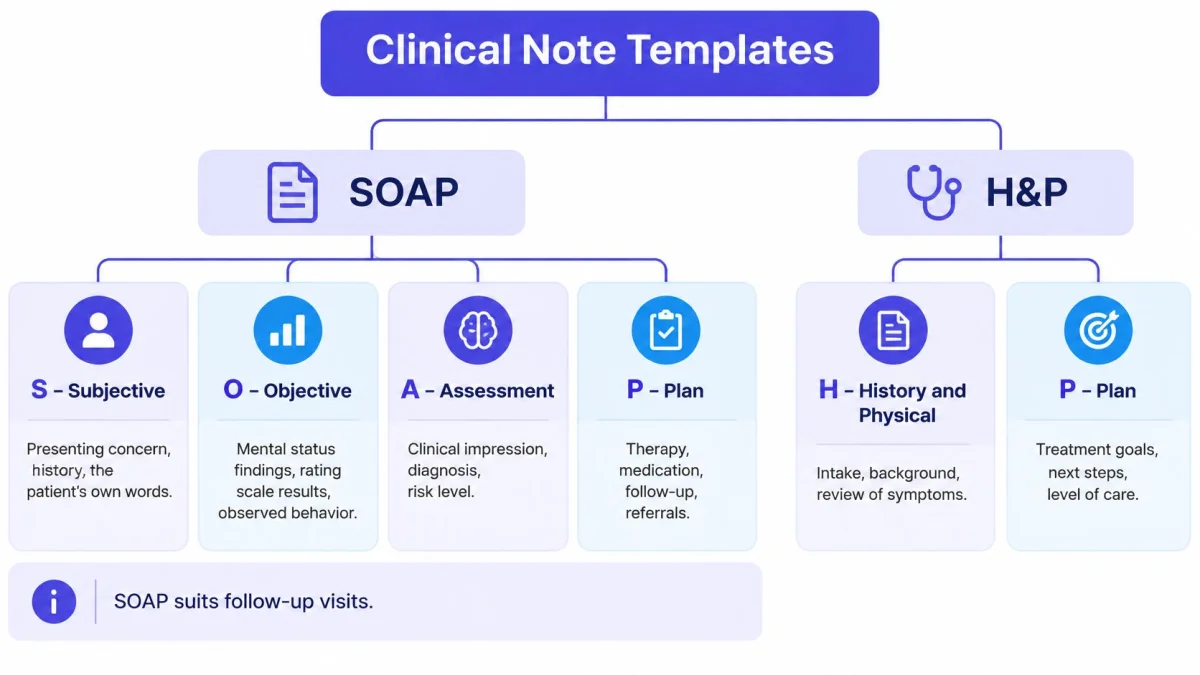
SOAP for Follow-Up Visits
SOAP suits follow-up visits where the clinical picture is already established.
- S, subjective: The presenting concern, interval history, and the patient's own words where wording matters.
- O, objective: Mental status findings, rating scale scores, observed behavior, and vitals if relevant.
- A, assessment: Diagnosis or working diagnosis, risk formulation, and progress against treatment goals.
- P, plan: Therapy approach, medication decisions, referrals, and the follow-up interval.
H&P for New Patient Evaluations
H&P suits intake evaluations. The structure runs through chief complaint, history of present illness, past psychiatric and medical history, medications, allergies, family history, social history, review of systems, examination, assessment, and plan. That breadth is the point at intake. Repeating it at every follow-up buries interval change under static history.
A Follow-Up Skeleton That Holds Up
California's behavioral health documentation guidance states that progress notes should contain essential information supporting service delivery rather than unnecessary detail, while supporting the selected service code and effective clinical coordination, as set out in the CalMHSA clinical documentation guide. A numbered skeleton built on that standard looks like this.
- Date, duration, and modality. "Video visit, 45 minutes."
- Symptom change since the last visit. Include a scale score if one was used.
- Mental status findings. Brief, by domain, focused on change.
- Current risk status. Current, not copied forward.
- Intervention delivered. Name the technique, not just the therapy brand.
- Patient response. What changed in session or since the last visit.
- Goals updated. Which goal moved, stalled, or was replaced.
- Next appointment or escalation step. A date and a contingency.
Weak Entries and Stronger Rewrites
Therapy provided; patient stable.
That entry proves almost nothing. It doesn't show medical necessity, intervention specificity, or continuity. A stronger version takes one more line.
45-minute session, CBT for panic. Reports two panic attacks this week, down from five. Denies SI; risk unchanged. Practiced breathing exercise in session with good response. Return in two weeks; review sleep and medication adherence.
Three more pairs show the same pattern in common situations.
- Medication change: Weak wording says "increased dose." Stronger wording states the drug, the new dose, the reason tied to symptoms, side effects reviewed, and the monitoring plan with a review date.
- Shortened or missed session: Weak wording says "session cut short." Stronger wording records actual duration, the reason, what was covered, current risk status, and the rescheduled date.
- Declined treatment: Weak wording says "patient refused." Stronger wording records what was recommended, the risks and benefits discussed, the patient's stated reasons, capacity to decide, and the agreed alternative or review point.
The length rule stays simple. Enough detail to support the service delivered, and no more. Excess narrative increases privacy exposure and hides decision-relevant facts. Omissions weaken billing support, handoffs, and continuity. Specificity, not volume, is what makes a progress note defensible.
Writing the Mental Status Exam and Risk Assessment
Clinicians look up the mental status exam while writing, so the domain list comes first. The domains below follow the standard set used in psychiatric training. Each training program and specialty names its own reference text for the list, and the note template should cite that reference so every clinician in a practice documents to the same standard. A worked psychiatric evaluation example shows how the domains sit inside a full intake note.
Mental Status Domains and Sample Wording
| Domain | What to document | Sample wording |
|---|---|---|
| Appearance and behavior | Dress, grooming, eye contact, psychomotor activity | Casually dressed, fair eye contact, mild restlessness |
| Speech | Rate, volume, rhythm and quantity | Slow, low volume, normal rhythm |
| Mood and affect | The patient's stated mood and the observed affect | Mood 'down'; affect constricted |
| Thought process | Logic, organization and goal direction | Linear and goal-directed |
| Thought content | Suicidal or homicidal ideation, delusions, obsessions | Denies SI and HI; no delusions elicited |
| Perception | Hallucinations and whether the patient responds to them | Denies auditory or visual hallucinations |
| Cognition | Orientation, attention and memory as tested | Oriented to person, place, time and situation; attention intact on serial sevens |
| Insight and judgment | Understanding of the illness and quality of decisions | Partial insight; judgment fair |
Two habits keep this section honest. First, mood is what the patient reports and affect is what the clinician observes, and the note shouldn't merge them. Second, every adjective needs evidence. "Disheveled" means little. "Arrived in sleep clothes, hair uncombed" tells the next clinician what was seen.
Cognition deserves the same discipline. Record what was tested and how the patient performed, not a global claim. "Attention intact" without a task is an opinion. A named task with a result is a finding.
Risk Assessment That Shows Its Work
A risk assessment should name the structured tool used. The Columbia Suicide Severity Rating Scale (Posner et al., American Journal of Psychiatry, 2011) is one established option for a structured screen of ideation and behavior. Whichever tool a practice adopts, the note should record the date, current ideation, intent, plan, and access to means if assessed, plus risk and protective factors, an overall risk level, and the safety plan.
Contrast two entries. "Denies SI" records one answer with no context. A fuller entry reads differently. "C-SSRS screen negative today. Denies current ideation, intent, or plan. No access to firearms reported. Protective factors include two children at home and active treatment engagement. Risk low at this time; safety plan reviewed and copy given."
A negative screen still needs a note. Silence in the chart doesn't show that anyone asked. For patients with fluctuating symptoms, the entry should also state what would change the risk level and what the patient was told to do between visits. That reasoning is what a covering clinician needs at 2 a.m., and it's what a reviewer looks for after an adverse event.
Privacy Limits and What Patients Can Read
A mental health record has two layers, and confusing them creates both legal and clinical problems. The image below shows the split between the shared record and private process notes.
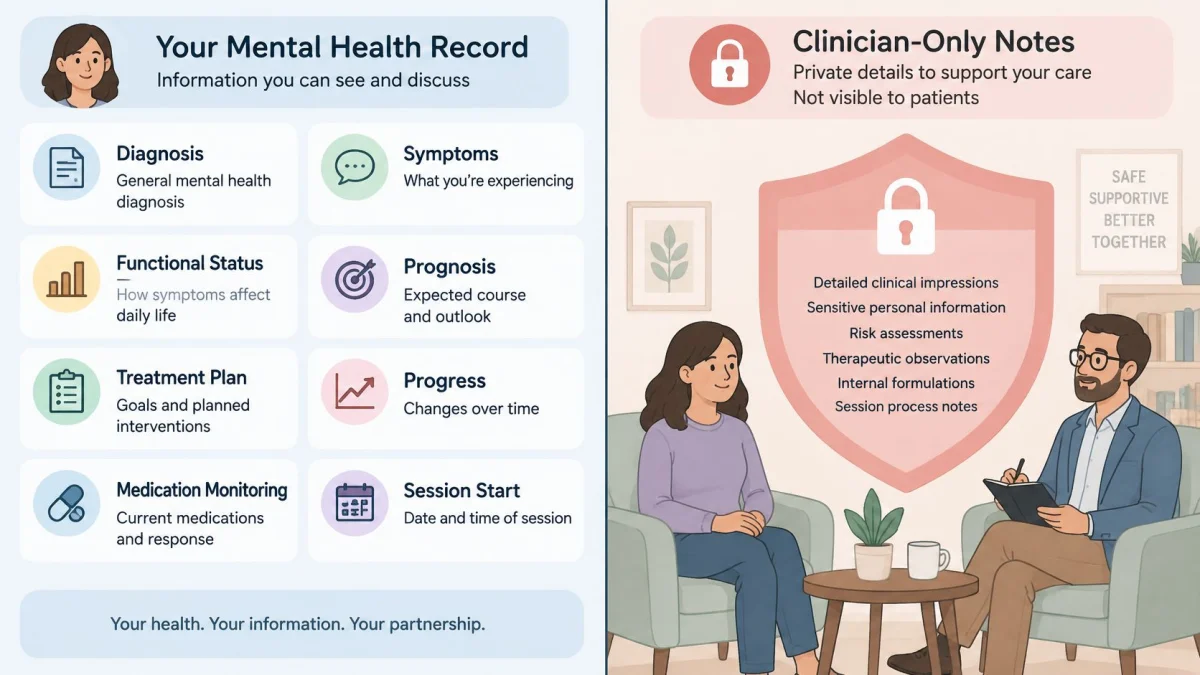
The Two Layers Under HIPAA
Under US HIPAA, the ordinary record may contain diagnosis, symptoms, functional status, prognosis, treatment plan, progress, medication prescribing and monitoring, session start and stop times, treatment modality, frequency, and test results, and those elements are generally usable for treatment, case management, and care coordination, per the HHS guidance on HIPAA mental health protections. Psychotherapy notes are different. They're the clinician's separate personal notes documenting or analyzing the counseling conversation itself, they exclude summaries and operational clinical data, and disclosure generally requires the patient's specific authorization, even when another provider requests the information for treatment.
The definitions sit in 45 CFR 164.501, and the patient right of access sits in 45 CFR 164.524. The practical consequence is straightforward. Routine progress documentation belongs in the medical record and shouldn't be mislabeled as protected psychotherapy notes. Process reflections don't belong in the shared chart at all.
Writing for a Patient Reader
Patients in many settings can now read their notes, and that changes wording choices. The short video below walks through how the access rules apply in practice.
Three wording rules hold up under patient access. Describe observed behavior and function instead of character. Drop stigmatizing labels that don't change care. Review sensitive wording with the patient when the clinical situation allows it, especially around trauma, substance use, and suicidality.
Open access can improve trust and error detection, but some patients read clinical shorthand as judgment. Neutral, person-centered language costs nothing and prevents that harm. Access, confidentiality, and amendment rules differ between the US under HIPAA and the UK under the UK GDPR and the Data Protection Act 2018, so local rules need checking before any note is released.
Notes for Work, School and Benefits
A note for work, school, or benefits is a separate document from the clinical record. It has a different reader, a different purpose, and different rules. Sending a chart excerpt to an employer is almost always the wrong move. The same discipline that applies to an ER doctors note applies here. The recipient gets a purpose-built statement, not the medical record.
Four Documents Patients Confuse
| Document | Usually requested by | What it should state |
|---|---|---|
| Diagnosis letter | Patient, school or program | Treatment and functional limits; diagnosis only with consent |
| Fit note (England) | Employer, through the patient | Fit or may be fit for work, with adjustments and a review date |
| Work or school absence note (US) | Employer, school or leave administrator | Dates of absence or restrictions and the functional limit |
| Accommodation request | Employer under the ADA | Limitations, the accommodation needed and expected duration |
A diagnosis letter confirms treatment and names a diagnosis only with the patient's consent. In England, the NHS fit note states whether the patient is "not fit for work" or "may be fit for work" with adjustments, and it's the document an employer usually sees.
In the US, ADA guidance allows employers to request medical information in limited circumstances, including when an employee requests an accommodation, disclosed information must remain confidential, and the framework generally applies to employers with at least 15 employees, as summarized in a review of mental health at work guidance. The statute at 42 U.S.C. 12112(d) limits medical inquiries to job-related information and requires confidential handling.
Function Over Diagnosis
The most useful answer is usually not proof of a diagnosis. It's the medically justified functional adjustment. "Reduced concentration during sustained meetings; benefits from written instructions and a quiet workspace; review in six weeks" gives an employer something to act on. A diagnostic label doesn't.
A more detailed note isn't a stronger note. Excess diagnostic detail exposes the patient to stigma without improving the accommodation decision.
The patient should receive a written statement covering limits, supports, and a review date, and only what the patient authorizes gets released. Fluctuating symptoms need explicit wording too, because a fixed restriction rarely matches a condition that varies week to week.
Billing Requirements Your Note Must Meet
One rule governs this section. The note must support the service billed. A clinically good note that doesn't support the code still fails an audit.
What a Medicare Reviewer Checks
For Medicare outpatient psychiatry and psychology services, CMS identifies record elements including the beneficiary's name, date of service, service type, the time element when duration determines the code, treatment modalities and frequency, and a clinical note for each encounter, as set out in the CMS documentation guidance for outpatient psychiatry and psychology. CMS also states that the record should document the patient's capacity to participate in and benefit from psychotherapy, especially when cognitive impairment affects participation.
| Element | Rule source | What the note must show |
|---|---|---|
| Beneficiary and date of service | CMS Medicare outpatient psychiatry and psychology elements | Patient name and the date of the encounter |
| Service type and modality | CMS record elements; CPT service code | Type of service, treatment modality and session format |
| Time element | CPT time-based psychotherapy codes (AMA CPT manual) | Start and stop or total session time, when the code depends on duration |
| Diagnosis | ICD-10-CM | Diagnosis, symptoms and functional status that support it |
| Treatment goals and monitoring | CMS Medicare psychotherapy documentation | Goals, the outcome measures used and the results |
| Frequency | CMS record elements | How often the service was delivered and the planned interval |
| Capacity to participate | CMS Medicare psychotherapy documentation | Patient's capacity to participate in and benefit from psychotherapy when cognition affects participation |
| Medication management | CPT evaluation and management codes (AMA CPT manual) | Medication changes, reasons and monitoring plan |
Two Code Families, Two Different Jobs
ICD-10-CM codes the diagnosis. CPT codes cover time-based psychotherapy and evaluation and management visits. The diagnosis code justifies why the service was needed. The procedure code states what was done and, for psychotherapy, how long it took.
Time thresholds and code definitions change between editions, so they need checking against the current AMA CPT manual rather than memory or a saved cheat sheet. Practices billing longer psychotherapy sessions benefit from guidance on defending against 90837 claim denials from Clarity, since duration documentation is where those claims usually break down. A periodic self-review using a documentation audit checklist catches missing time elements before a payer does.
The capacity rule deserves plain statement. When cognition affects participation, the note must say whether the patient can take part in and benefit from psychotherapy. Skipping that line invites a denial for a service the record never justified.
Code suggestions from any tool, including AI scribes, need clinician review against the actual encounter before submission. A suggested code is a prompt, not a decision. These codes apply to US billing only, and UK clinicians shouldn't map them onto NHS or private UK billing.
Confirm Each Note Before You Sign It
Speed doesn't fix a bad note. A short confirmation workflow does, because it catches errors while the encounter is still fresh.
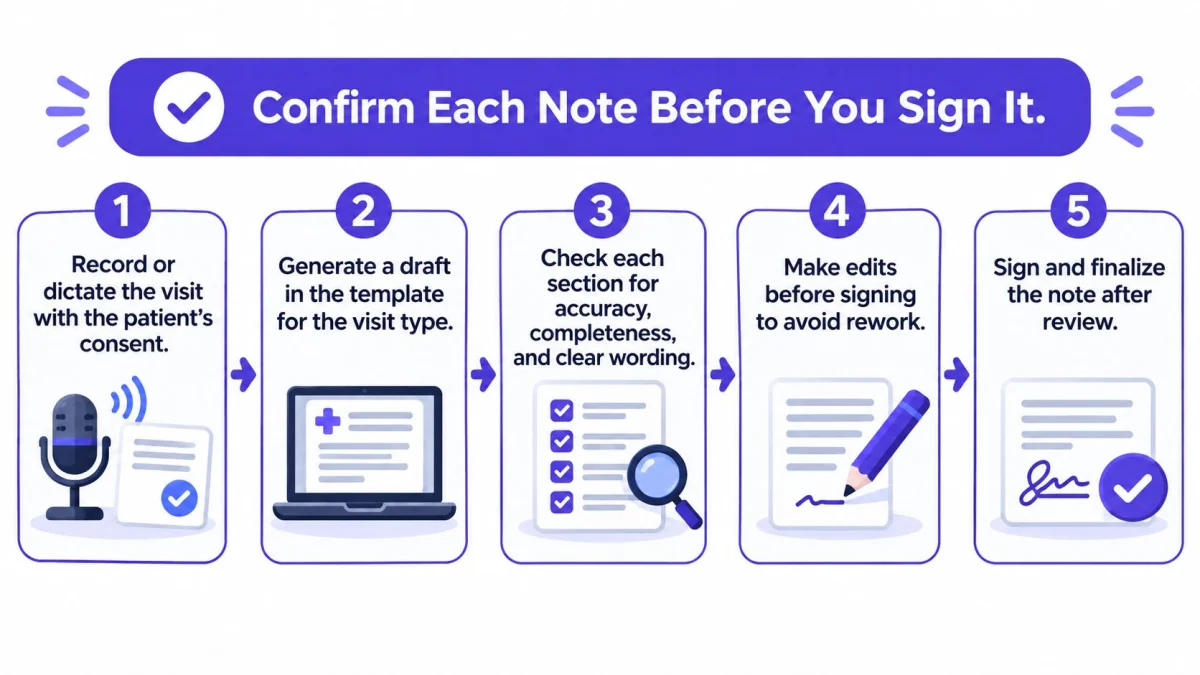
Six Steps to a Signed Note
- Record or dictate the visit with the patient's consent.
- Generate a draft in the template for the visit type.
- Check each part against what happened, especially risk, mental status, diagnosis, and plan.
- Remove content not needed for care and rewrite labels in neutral, observed language.
- Check codes for US billing against the service type and time.
- Sign the note only after that review.
PatientNotes is built for solo clinicians and small teams, and the clinician confirms what was captured before signing. Semble is the only EHR integration. Every other EHR works by copy and paste. Templates cover psychiatry and other specialties, and further guides sit in the resources library.
Plans on the PatientNotes pricing page run $70 per user per month billed monthly or $50 per user per month billed annually, with a 14-day money-back guarantee, no enterprise tier, and no sales call. A BAA is included at no extra cost for HIPAA compliance. The practical test is small. Run the 7-day free trial, which needs no credit card, on one visit type this week and compare the draft against a hand-written note.
A mental health doctor note that holds up for the next clinician, the patient, and a payer starts with a template built for mental health work and a clinician who confirms every line before signing. PatientNotes turns recorded visits into structured notes in the clinician's own template, with code suggestions for review on US billing and a BAA included. Start the free trial on one visit type this week and judge the draft against the standard set out here.