
At 2:00 p.m., a patient's pain has changed, and the next nurse starts in an hour. The note you leave determines how fast that nurse sees what happened, what you did, and what still needs attention. These nurse charting samples show eight formats matched to common shift tasks. Each one comes with a sample entry, a pick-this-when rule, and an editing check to run before you sign.
A useful note does not need length. It needs to separate what the patient said from what you observed, tie care to the concern, and make the next step clear. Documentation takes a large share of nursing time. One review found estimates ranging from 19% to 35% of nurses' practice time, while other studies cited in that review put the range at 25% to 55% of a shift (peer-reviewed review of nursing documentation). A consistent format beats extra detail.
The formats are grouped by shift task: handoff, shift charting, problem tracking, and routine care. That grouping matches the moment you reach for a note. A handoff note and a routine check note solve different problems, and mixing them wastes time.
The sample entries are illustrative. Your organization's approved forms and clinical judgment still govern what goes in the chart. For a focused bowel record, Nursing Assessment Australia's bowel chart guide shows how one assessment tool maps to a chart entry.
1. SOAP Note for a Visit or Focused Assessment
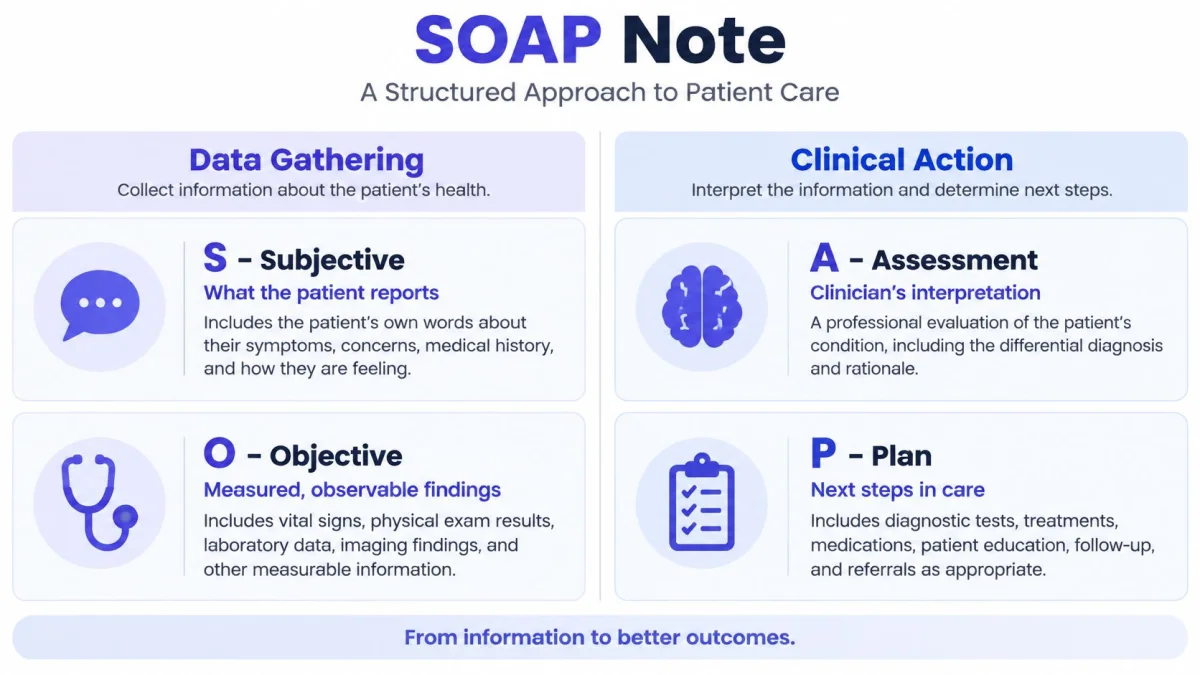
SOAP separates a patient's report from the nurse's findings and the plan that follows. Use it for a focused visit or a specific problem that needs a clear account of the concern, assessment, and next steps. If a visit covers several unrelated issues, give each issue its own SOAP block rather than compressing them into one mixed note.
Sample entry
- Subjective: Patient reports home blood pressure readings above their usual range this week. Denies headache or dizziness.
- Objective: Blood pressure measured in clinic and recorded in the vital signs section. Patient alert and speaking comfortably.
- Assessment: Blood pressure above the patient's reported baseline today.
- Plan: Prescriber notified for review. Patient advised to follow the agreed monitoring plan. Follow-up arranged as documented in the care plan.
Keep the Subjective section to what the patient reports. Put measured findings and direct observations in Objective. The Assessment should interpret the information without repeating the entire findings section. The Plan should identify who will do what next and when, rather than ending with a vague phrase such as “continue to monitor.”
Editing check: Read the Assessment and Plan together. Can the next clinician understand what concern the findings raise and what action is pending?
A common mistake is putting a conclusion in Subjective, then copying it into Assessment. Another is writing “stable” without documenting the observations that support that description. NHS guidance calls for records that are contemporaneous, clear, factual, and accurate, and recommends avoiding unnecessary jargon and abbreviations (NHS nursing and midwifery documentation guidance).
2. SOAPIE Note for Care and Response
SOAPIE adds Intervention and Evaluation to SOAP. It fits a visit where the record needs to show not only what was planned, but what the nurse did and how the patient responded. That makes it useful for wound care, home health visits, and other encounters where a treatment or teaching action needs a documented outcome.
Sample entry
- Subjective: Patient reports tenderness at the dressing site during movement.
- Objective: Wound appearance and dressing condition assessed and recorded in the designated fields.
- Assessment: Patient reports tenderness; findings documented for comparison with the prior assessment.
- Plan: Continue the wound-care plan as ordered.
- Intervention: Dressing changed according to the current care plan. Patient shown the steps for keeping the dressing in place.
- Evaluation: Patient tolerated the care. Patient repeated the key steps and identified a question for follow-up.
Keep Plan in future-oriented language and Intervention in past tense. The distinction helps the reader tell what was intended from what occurred. Evaluation should record an observable outcome or the patient's own response, not a general phrase such as “doing well.”
A completed action without a documented response leaves the care loop open.
Choose SOAPIE when the intervention and its result are central to the visit. If the encounter only needs a concise assessment and next step, SOAP may be easier to scan. Local forms may use different field names, so match the sample to the documentation policy in the care setting. For a more detailed comparison of the formats, see SOAP, SOAPIE, and SOAPE note differences.

3. SBAR for an Urgent Handoff
A heart rate climbing past the patient's documented baseline at 2 a.m. calls for a 60-second report to the covering clinician. SBAR gives that report a fixed order: Situation, Background, Assessment, Recommendation. The entry captures the communication itself. It does not stand in for the full clinical record, so the assessment and ongoing plan still belong in the appropriate progress note.
Sample entry
- Situation: Patient reports new chest discomfort. Heart rate is higher than the patient's earlier documented measurement.
- Background: Patient is recovering from surgery and has a documented history of atrial fibrillation.
- Assessment: New discomfort and change in heart rate reported to the covering clinician for urgent review.
- Recommendation: Request bedside assessment now. Further plan to be documented after the clinician responds.
The recommendation should state the request plainly. “Please review” is less useful than naming whether a bedside assessment, an order clarification, or another response is wanted. Record when the call occurred, whom the nurse contacted, what information was communicated, and the response or pending follow-up.
An escalation entry with no named request leaves the receiving clinician guessing at what to do next.
Pick SBAR when the next person needs a quick, structured account to act on. If the issue also requires a full assessment and ongoing plan, add the appropriate progress note rather than relying on the handoff entry alone. For a sample handoff layout, see this RN report template.

4. DAR Note for a Shift Event
DAR organizes a short entry around Data, Action, and Response. It works well when a nurse needs to document a shift event and show the connection between the concern, the care provided, and the patient's response. Keep the Data section factual. Avoid labels that assume a cause or state of mind without supporting observations.
Sample entry
- Data: Patient reports right knee pain. Guarding observed while repositioning.
- Action: Medication administered as ordered. Ice applied according to the care plan.
- Response: Patient later reports reduced pain and is resting. Follow-up assessment documented in the pain record.
For an anxiety-related event, describe what was observed or reported instead of writing only “patient anxious.” Then record the action taken, whether the patient accepted it, and what changed afterward. If the patient declines an intervention, document the refusal and the response or follow-up. Don't turn a refusal into a judgment about the patient.
Pick DAR when one event needs a compact, chronological account. Use a separate care plan or ongoing progress note for longer-term goals and unresolved issues. A note that records an action but not the response can make it hard for the next nurse to understand whether the issue changed or needs follow-up.
Editing check: Does each Action correspond to something in the Data, and does the Response describe what happened after the action? Add times where they help establish sequence, especially when care and reassessment occur at different points.
5. PIE Note for Tracking a Problem Across Shifts
PIE keeps each entry centered on a named problem. That can make recurring concerns easier to follow across shifts, provided the team uses consistent wording and links the note to the applicable care plan. It is a useful fit when the nurse is tracking a defined issue, such as a skin concern, pain, or difficulty meeting an agreed care goal.
Sample entry
- Problem: Reduced oral intake noted during this shift.
- Intervention: Food and fluids offered according to the patient's plan. Concern shared with the relevant team member.
- Evaluation: Intake recorded in the designated record. Patient's stated reason for eating less documented. Follow-up identified for the next shift.
Use the same problem name when documenting that issue again. If one entry says “poor intake,” another says “nutrition,” and a third says “not eating,” the record may be harder to scan as a single sequence. The label should still be specific enough to describe the concern, not just a broad category.
Pick PIE when one problem needs to be followed from intervention to outcome over time. It's less suitable when the encounter contains several unrelated concerns; separate entries help prevent one issue from obscuring another. The Evaluation should state what changed, what remains unresolved, or what follow-up is needed. “Continue plan” alone doesn't show whether the intervention helped.
For a structured link between identified concerns and planned nursing actions, see this nursing care plan template.
6. FOCUS Note for Shared Understanding
FOCUS puts the main concern first, then records the observations, actions, the patient's understanding, and the shared plan. That structure is useful when the patient's perspective or preferences affect what happens next. It can also make a note easier to follow when the patient and clinician need to agree on a practical plan.
Sample entry
- Focus: Concern about taking medication as prescribed.
- Observations: Patient reports missing doses because of unwanted effects. Medication history and the patient's description documented for review.
- Actions: Concern discussed with the appropriate prescriber. Patient's questions recorded.
- Understanding: Patient says, “I'm worried it makes me feel dizzy.”
- Shared Plan: Patient and clinician agree on the next step for review and how the concern will be followed up.
Keep the Focus short. Use the patient's words where they help explain a preference, concern, or reason for declining care. Don't present the patient's interpretation as a measured finding; attribute it clearly, then record the nurse's own observations separately.
Editing check: Can a reader tell what the patient believes, what the nurse observed, and what both agreed to do?
Pick FOCUS when shared understanding is central to the encounter. If the entry is mainly a rapid escalation, SBAR may be a better fit. If it documents a treatment and its immediate effect, SOAPIE or DAR may make the sequence clearer.

7. Charting by Exception for Routine Checks
At 06:10, a med-surg nurse opens the skin assessment for a patient admitted overnight. The skin check field is pre-filled as normal. The patient has new redness on the left heel that was not there at midnight. If the nurse signs without looking, the record says normal when the shift assessment found an exception.
Charting by exception records deviations from expected findings instead of repeating every normal finding. It can cut duplicate narrative on a routine shift. It works only when the nurse assesses the relevant findings and the approved record makes the normal baseline clear. Confirm each defaulted item was assessed during the shift before signing.
Sample entry
- Routine finding: Use the facility's designated fields to record findings that were assessed and within the documented expected range.
- Exception: New redness observed on the left heel during the shift assessment.
- Action and follow-up: Pressure relief provided according to the care plan. Relevant team member notified, and follow-up documented.
Pick CBE only when facility policy supports it and the chart defines what counts as an exception. Repeated checks can be efficient, but carried-forward normal findings hide a missed assessment. If the default does not match the patient, change it before signing.
The peer-reviewed review of electronic nursing documentation found that electronic record implementations were associated with increased documentation time in some analyses. Structured fields standardize capture. They do not automatically make charting faster or more timely. Review the actual content, not just whether the boxes are populated.
Use free text when the exception needs context a checkbox cannot carry, such as how a finding changed or what follow-up remains pending. Structured collection tools support this work: when intake and survey data arrive in set fields, a nurse can compare the current finding with a clear baseline and document the exception once. For more on collecting information across languages, see multilingual surveys and data collection.
Editing check: Does the note show that the nurse assessed each defaulted item this shift, and does it name the exception, the action taken, and the follow-up?
8. Narrative Note for Context
Narrative charting uses free text to describe a visit or event in connected sentences. It can capture context that structured fields may not fit, such as a patient's concern, a caregiver's question, or an unusual change. Its trade-off is variation: without a clear sequence, two notes about similar events may be difficult to compare.
Sample entry
Patient seen at home for follow-up. Patient reports breathing has improved since discharge. The patient's son asked about medication timing. The schedule was reviewed with both, and the patient described the next dose correctly. Follow-up plan reviewed and documented.
Start with why the encounter took place. Then separate reported information from observed findings, describe the care provided, and finish with the response and next step. Use the patient's or family member's words when the exact concern matters. Attribute each statement so the reader knows who provided the information.
Pick narrative charting when context matters more than a fixed sequence of fields, or when an event doesn't fit the available structured options. For routine or repeated observations, structured fields may be easier to compare over time. A short checklist can help the nurse include the reason for the note, relevant findings, actions, response, communication, and follow-up without turning the narrative into a full shift diary.
A clear note doesn't need polished prose. It needs facts another clinician can understand and act on.
Before signing, check that the note doesn't blur observation with interpretation or leave the next step unstated. A systematic note can remain concise while making the patient's situation understandable.
How the eight nurse charting formats compare
The format should follow the moment in the shift, not the habit of the nurse writing it. Sorted by what you are trying to accomplish, the eight formats look like this.
| Format | Shift task | Pick this when | Editing check before you sign | Main risk |
|---|---|---|---|---|
| SOAP | Visit or focused assessment | One encounter, and the plan has to stand on its own for the next reader | Assessment and plan are your words; subjective text is attributed, not carried forward from a prior note | Copied text and template bloat |
| SOAPIE | Shift charting with a response | You gave an intervention and the record must show what changed afterward | Evaluation describes the change, not the intervention again | Length, with intervention and evaluation running together |
| SBAR | Handoff, urgent | The next clinician has to act within minutes on a change in condition | Recommendation names a specific action and who owns it | Too thin to serve as a visit or shift record |
| DAR | Shift event | Something happened mid-shift and care has to link to an outcome | Response is measurable: vitals, pain score, behavior. Not "tolerated well" | No formal assessment or plan |
| PIE | Problem tracking across shifts | One problem spans several shifts and the trend matters more than any single entry | Problem label matches the previous shift, and evaluation compares against baseline | Collapses without a maintained problem list |
| FOCUS | Shared understanding | The patient or family needs to see the plan and agree to it | Shared plan records who agreed and what they understood | Inconsistent use without training |
| Charting by exception | Routine care and checks | The check is routine, parameters are predefined, and the assessment was actually done | A blank exception field must mean normal, not unexamined | Normal findings assumed without assessment |
| Narrative | Context and unusual events | The event does not fit the structured fields and sequence matters | Observation stays separate from interpretation, and the last line states the next step | Hard to scan and compare between nurses |
The trade-off runs along one line: handoff formats compress, tracking formats persist, and routine formats default. Compression loses detail you may need later. Persistence costs time on every shift. Defaulting saves the most time and carries the most risk, because a blank field only means normal when someone assessed the patient.
These formats also stack. An urgent call still needs a shift entry behind it, and a problem tracked in PIE still needs a narrative line when the patient's own account of the symptom is the point. Pick the primary format for the task, then put supporting detail where the team expects to find it.
Choose One Format per Task and Hold the Team to It
A night nurse inherits three accounts of the same blood pressure drop: an SBAR from the charge call, a DAR in the shift note, and a narrative left in a flowsheet comment. The facts are present. The next clinician still has to rebuild the sequence. I treat a second format for the same event as a charting error, not as extra detail.
Match the format to the task, then keep later entries in that format. Use SBAR for urgent handoffs. Use SOAP or SOAPIE when the record is a visit or a focused assessment. Use DAR or PIE when the shift note must show an event or follow one problem. Use narrative charting when fixed fields leave out context that changes the plan. Charting by exception needs a completed assessment behind every default within-normal-limits entry. A default line does not replace that assessment.
Agree, as a team, which format covers each recurring task and where the supporting detail lives. Standard labels and one place for follow-up make the chart scannable on a busy handoff. Facility policy and applicable state rules decide which formats are allowed. Those rules override unit habit.
The editing checks for attribution, observed versus interpreted findings, and actions versus responses are in the format sections above. Run the check that belongs to the format you chose before you sign. When accounts conflict, record each source and the steps taken to clarify it. For a late entry, follow the organization's process and keep both times visible: when the care occurred, and when the note was entered.
A template can line up the fields. It cannot prove the content. A 2025 systematic review of AI scribes describes omissions, misattribution, and contextual errors, and it treats human review as required (2025 systematic review of AI scribes). Compare the draft with the patient, the record, and the care given before you sign. A smooth note can still be wrong.
For US practices that use a documentation vendor, confirm the privacy arrangement before patient information is handled. The US Department of Health and Human Services says covered entities must have a written business associate agreement that sets permitted uses and requires safeguards for protected health information (HHS guidance on business associates). That agreement covers permitted uses and safeguards. Accuracy of the signed note stays with the clinician.
Choose one format for each recurring shift task, set it against the facility's approved process, and test it on a real handoff. Another nurse should name the concern, the action, and the follow-up without guessing. If the template does not prompt those three items, revise it or add an approved field before it becomes routine care.
PatientNotes offers SOAP, progress, H&P, and procedure note templates, an AI template builder, and tools to review and edit a draft before you sign. A 7-day free trial is available without a credit card; visit PatientNotes to see whether those templates fit the charting tasks in your practice.