In 2024, 73.26% of respondents to the American Medical Informatics Association's TrendBurden survey disagreed or strongly disagreed that the time and effort spent documenting patient care was appropriate, according to the survey analysis. A useful RN report template should help nurses pass on what matters for the next decision, not turn handoff into another round of charting.
Why a Short RN Report Beats a Long Chart
An RN report template is a structured handoff tool, built for a narrower purpose than the medical record. Its job is to confirm the patient's identity and immediate safety needs, explain what changed, summarize the assessment findings that shape the next few hours, and assign risks, pending tasks, and escalation thresholds. If a field won't change what the receiving nurse does next, it belongs in the chart rather than in report.
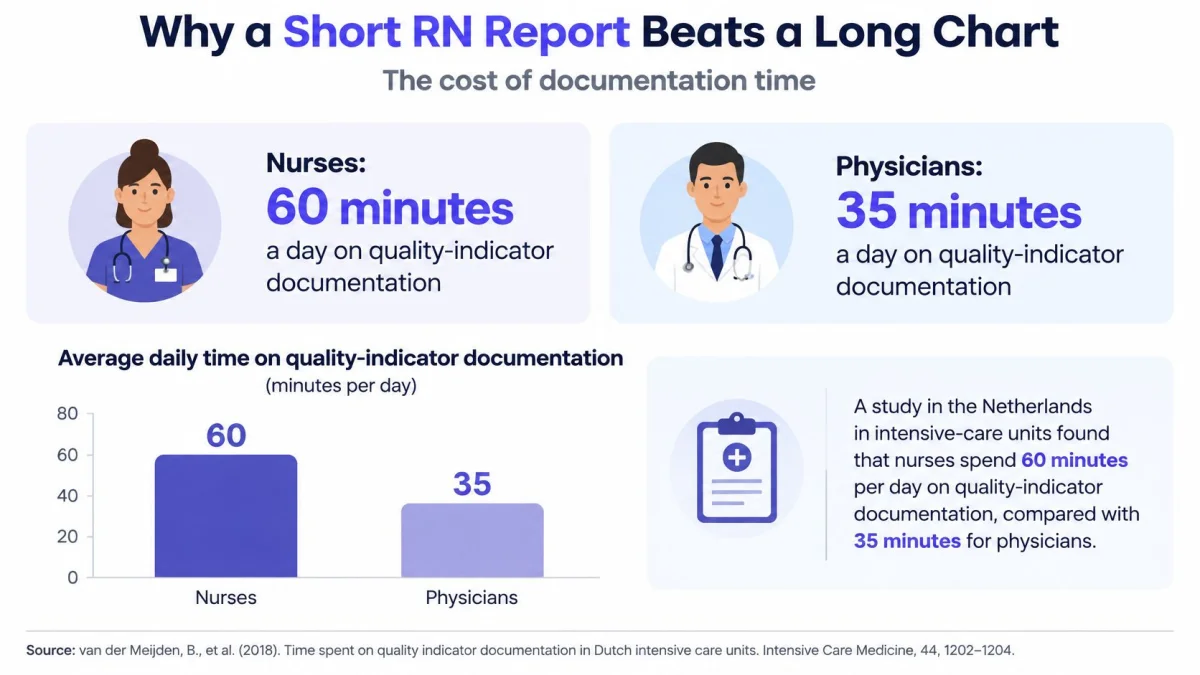
In a review of nursing documentation, a multicenter study of intensive-care professionals in the Netherlands found that nurses spent a median of 60 minutes per working day documenting quality-indicator data, compared with 35 minutes for physicians, while community-nursing documentation took about 26% of nurses' time in Canada, 17% in Great Britain, and 25% to 41% in the United States. Those figures argue for keeping handoff focused rather than packing more chart data onto a page.
Length alone is not the enemy. Unfiltered length is. A long chart spreads critical items across dozens of fields, so the oncoming nurse has to hunt for the two or three facts that drive the next decisions. A short report works like a checklist ordered by cognitive load: identity and safety land first, when attention is highest, and open tasks close the loop at the end.
The same core blocks serve inpatient shift change, clinic follow-up, telephone triage, and home health, with each setting adding its own optional details. A home-health report may need visit-related safety concerns; an inpatient report may need a time-specific task owner. A narrative note still has a place for clinical reasoning, and narrative nursing notes preserve context that a brief handoff field cannot hold.
The template below turns that order into a two-way safety check, separating what is written from what is said aloud and what the oncoming nurse must read back. Before adapting it, a unit can name its last handoff miss, whether an unclear code status or a lab result with no assigned owner, and check that the form would have caught it.
The Fillable RN Report Template
| Block | Capture this | When required | Confirmation |
|---|---|---|---|
| Identity and safety | Name, second identifier, location, date, time, outgoing nurse, code status, allergies, isolation or fall risk | Every handoff | Read back code status and allergies |
| Situation | Immediate concern, stability, what changed this shift | Every handoff | Say aloud if the patient is unstable |
| Background | Diagnosis, relevant history, lines, drains, devices, medications that affect the next hours | Every handoff; shorten if unchanged | Write it; speak only if it changes the plan |
| Assessment | Abnormal vital signs, pain, neurological status, breathing, circulation, intake and output, skin, mobility, risk scores that changed care | Abnormal findings always; normal findings only if they changed the plan | Write it; read back critical values |
| Recommendations | Pending tests, medication timing, escalation threshold, next action, owner, deadline | Every open task | Receiver states the owner and deadline |
| Exception | Findings that don't fit a field, or an unresolved discrepancy | Only when a box would mislead | Receiver states what remains unclear |
The order puts identity and immediate safety first, followed by what is happening now. Background stays brief, and the assessment focuses on abnormalities or changes that affect the plan. Recommendations turn incomplete work into an action with a named owner and deadline. An exception line prevents a case from being forced into a misleading category.
A peer-reviewed analysis of electronic health-record flowsheets found that nurses entered an average of 633 to 689 manual data points during a 12-hour ICU shift and 631 to 875 during a 12-hour acute-care shift, excluding device-generated data. Device data automated only 5% to 20% of flowsheet entries, while a systematic review of 28 studies found that nursing documentation's share of workload rose from 9% to 23% after EHR implementation, according to this analysis of nursing documentation and EHRs. The handoff shouldn't repeat the flowsheet. Its purpose is to identify the few details that support continuity and action.
A completed example
For a stable patient, the identity and safety block might read: “Maria Lopez, second identifier checked, bed 14, 06:45, outgoing RN A. Diaz, code status full, penicillin allergy, high fall risk.” The situation could say: “Stable. Systolic pressure lower than at 15:00; fluids running. Wound check pending.” The recommendation might read: “Repeat BP at 08:00. Owner: receiving RN. Deadline: 08:15.”
That example is brief, but it identifies a change, points to a pending check, and names who owns it. Each unit can mark its fields as always required or conditional, then remove fields that staff never use in report. The next step is to practice how the written template supports a two-way conversation.
How to Give Report With This Template
A report works best as a two-way exchange in which both nurses take part. Order the exchange by cognitive load: the written page carries the stable facts, the spoken handoff carries risk and change, and read-back confirms the details that can affect immediate care.
Identify the patient and the reporting nurse. State the patient's name, second identifier, location, date, time, and code status. Pause while the receiver matches the wristband or chart. This check catches a wrong-patient or wrong-encounter error before details are passed along.
This order follows SBAR or ISBAR. A systematic review of SBAR communication found moderate evidence that structured approaches improve patient safety, particularly for telephone communication, while a later synthesis rated the certainty of benefits as low and noted that results vary by context. A structure supports the exchange and still leaves room for judgment. Written reports can leave out details that matter, so the National Center for Biotechnology Information's discussion of nursing handoffs supports pairing written content with verbal interaction and space for questions.
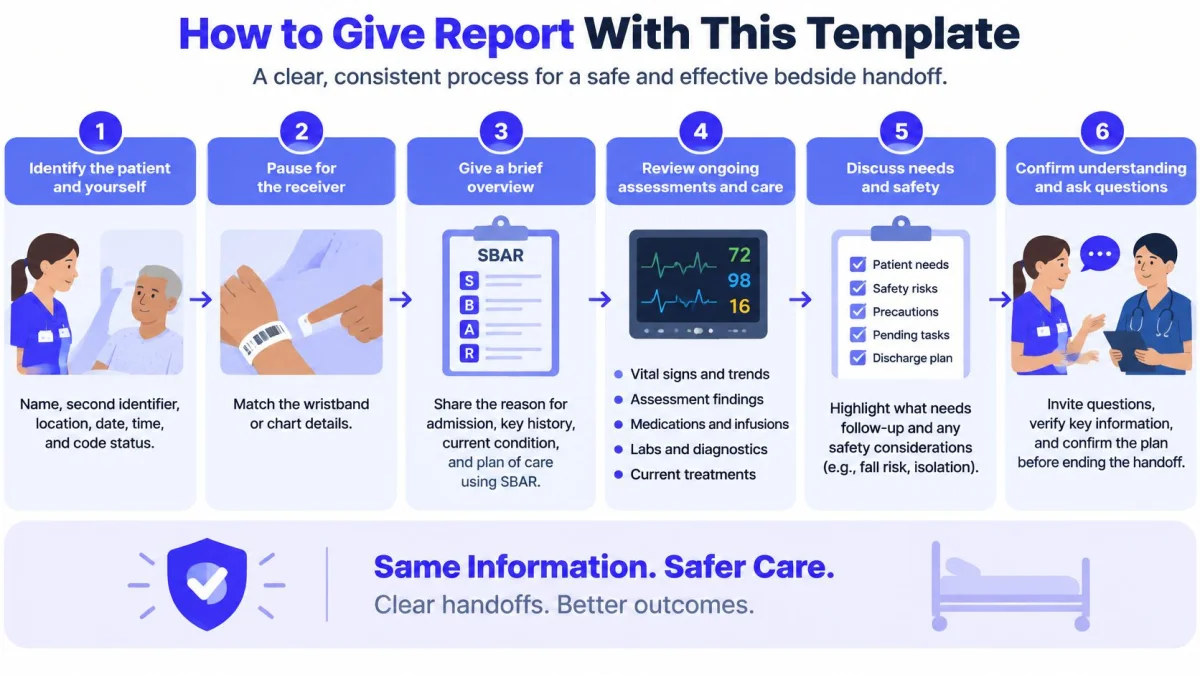
Bedside report can help the nurses and patient review visible details, such as a dressing or drain, when bedside practice and the patient's preferences allow. Sensitive details belong in a more private setting. If an interruption breaks the exchange, identify the last completed block and resume there; restarting from memory can drop a task that was already assigned.
A nursing care plan can supply context for goals and interventions, while the handoff stays focused on the next shift. A nursing care plan template can help keep longer-term planning distinct from time-sensitive tasks due soon.
Watch a short video on bedside report for a quick demonstration of the exchange in practice.
Full Reports and Rapid Deterioration Reports
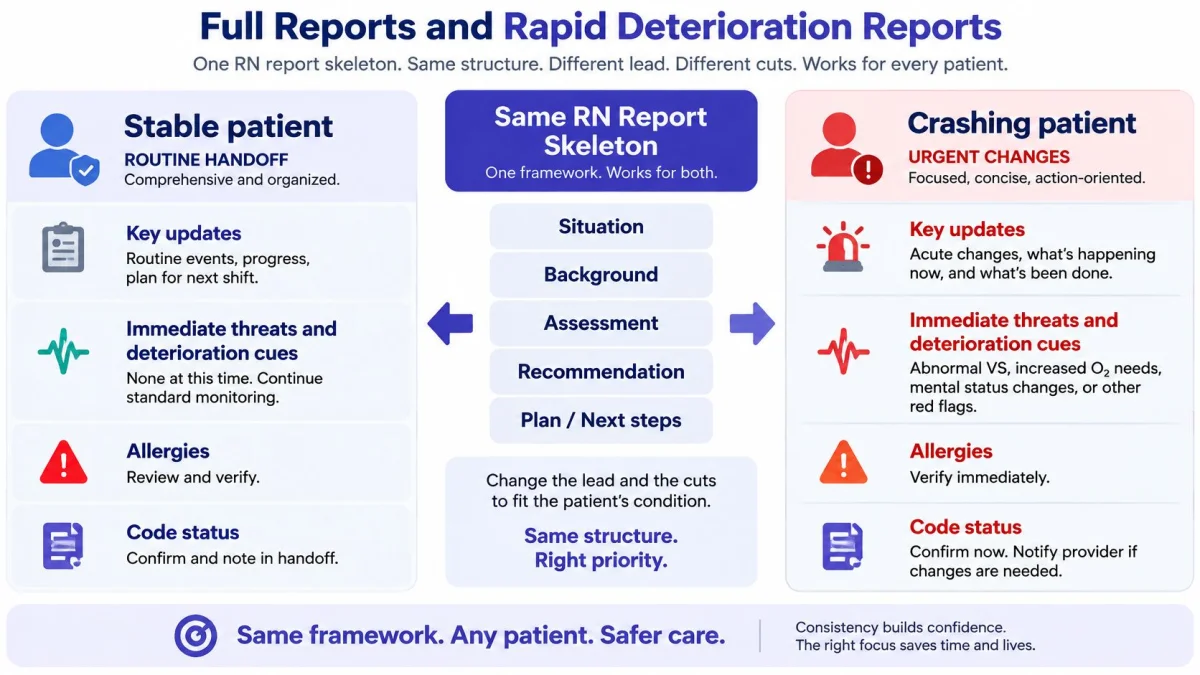
The same report structure can serve a stable patient and a deteriorating patient. What changes is the lead and the level of detail. For a stable patient, begin with what changed and what remains open. For deterioration, start with the immediate threat, latest relevant findings, escalation threshold, and contingency plan. Keep identity, allergies, code status, and task ownership visible in either version.
A 2025 AI-supported patient-report-template study described placing abnormal laboratory values before routine results and grouping allergies and alerts such as fall risk or isolation requirements near the top to reduce cognitive load. Separately, interdisciplinary-handoff evidence found that a standardized sign-out program produced a 23% relative reduction in overall error rates across six of nine hospitals without impeding workflow, as summarized in this study of patient-report template design and handoff. A shared order can make urgent information easier to find without adding more fields.
Situation Lead with Shorten or skip Still read back Stable medical-surgical What changed, active problems, pending tasks Distant history already in the chart Allergies, code status, task owner Deteriorating or ICU Immediate threat, latest vital signs, call threshold, contingency Routine normal findings and old history Critical values, code status, who to call Emergency or transfer Reason for move, last treatment, response, open orders Flowsheet detail the receiver can't act on Identity, allergies, unfinished treatment Discharge or home health Medications changed today, red-flag symptoms, follow-up owner Devices already removed Follow-up owner and return precautions Behavioral health Current risk, observation level, what de-escalated Unrelated medical history Safety plan and precautions Pediatric Weight-based doses, caregiver present, baseline behavior Adult-style social history Weight, allergies, caregiver contact The table distinguishes mandatory safety details from information that belongs only when it changes the plan. A full social history, for instance, may be left out of a rapid report unless it affects the immediate action. An exception field helps keep important context when the usual categories don't fit.
For a stable postoperative patient, a concise lead might cover what changed, pain control, and who owns the 18:00 antibiotic. If the patient's pressure is falling, the report should instead lead with the latest pressure, the response to fluids, the call threshold, and who is coming. The receiving nurse should be able to identify the immediate next action without searching through routine history.
More fields aren't automatically safer. A crowded report can bury the abnormality that needs attention, while a short report with clear exceptions and contingencies can make the priority easier to see. The stable and rapid versions should keep the same safety backbone while letting the amount of background detail change.
Tips for Auditing Handoff Quality
A handoff audit works like a read-back: it checks whether the receiver can act on what was written, not whether the report felt smooth. In a 1,349-record EMR quality-improvement audit, nursing documentation was rated good at 80% or higher, moderate at 60% to 80%, and poor below 60%. The same audit scored nursing handover at 84% and rounding at 83%, while risk assessments came in poor at 21%.
Set the scoring rules first
Define the required items for the setting: patient identification, allergies, code status, assessment, active problems, interventions, patient response, pending results, and follow-up ownership. Score each field as complete, partially complete, absent, or contradictory. Test the form on a small sample and settle ambiguous rules before a wider review.
Audit the three channels of a report separately: what was written in the template, what was said aloud, and what the oncoming nurse read back. An item documented on paper but never spoken can still leave the receiver guessing. Check the heaviest-load items first, meaning code status, allergies, and the owner of each open task, before scoring routine fields.
In the same audit's re-audit phase, missing assessment notes fell from 58% to 8%, although evaluation and progress reporting did not significantly improve. A template can close a missing field faster than it can fix weak judgment in narrative.
Habit that weakens report Practical correction Too many mandatory fields Make fields conditional when they don't apply to every handoff Copy-forward text Add timestamps and verify each carried detail against the current situation No task owner Require a named next owner and deadline Recording that a task was done without the patient's response Include the response or state that reassessment is still pending Treating “not applicable” as a negative finding Use a distinct exception or not-assessed option Audit rule: An item can be present and still be useless if it's vague or copied forward.
The form itself shapes the result. In a 2024 survey of 146 inpatient registered nurses across five U.S. states, 56% identified improved user-interface features as their top priority for documentation systems, according to the Journal of Nursing Administration study. Keep the handoff view to one page or screen when possible, and revise fields that slow the exchange without helping the receiver act.
A documentation audit checklist can help teams run the same scoring pass every time. The audit should reveal which omissions or unclear statements prevent a safe next action.
Use the Template on Your Next Shift
On the next shift, print or paste the six blocks into an approved note format and test them with two patients: one stable, one higher risk. The template works as a two-way safety check, so split the trial by cognitive load. What is written stays in the blocks. What is said aloud carries the reasoning that does not fit a field. What the oncoming nurse reads back is the short list that protects the patient: code status, allergies, critical values when present, and the owner of each open task.
If after-hours charting is a recurring burden, an AI scribe can draft structured documentation from a recorded conversation, while the clinician still reviews the result and keeps responsibility for the handoff. PatientNotes records consultations in person, by phone, or through telehealth, then prepares a structured note moments after recording stops for review, editing, and copying into the EHR.
Reference points for units weighing a scribe:
- Regulatory: the service is HIPAA compliant with a business associate agreement (BAA) included at no extra cost. HHS explains that a BAA must define permitted uses and disclosures, require safeguards, and address breach reporting in its business associate guidance and privacy guidance.
- Billing: ICD-10, CPT, and CDT suggestions apply to U.S. billing only. CMS identifies these as distinct code sets, so suggestions need clinician or practice review against the encounter and applicable billing policy.
- Coverage: a native iOS app records offline, Semble is the only EHR integration, and every other EHR uses copy and paste. There is no Chrome extension.
Clinicians comparing templates and workflows can check specialty templates, comparisons, and documentation resources. For practical ways to support energy during a long shift, Optimal Native's guide to shift fuel offers another resource alongside workplace routines.
After the handoffs, score ten reports as complete, partial, absent, or contradictory, then review what the read-back caught that the written blocks missed. Fix the fields that produced those gaps before adding new ones.
PatientNotes can turn a clinician's preferred format into a structured draft, with templates for 37 specialties and a builder for custom layouts. It costs $70 per user per month billed monthly or $50 per user per month billed annually ($600 per year), with no contract, no enterprise tier, and no sales call. A 7-day free trial needs no credit card, and a 14-day money-back guarantee applies. Clinicians can review the workflow and start a trial by visiting PatientNotes.