A major U.S. study found that office-based physicians spent a mean of 1.77 hours per day on documentation outside office hours, and that roughly 125 million hours of after-hours documentation accumulated across U.S. physicians in 2019 (study on after-hours documentation). That is not a time-management nuisance. It is a workflow problem that keeps pushing charting into the evening, where mistakes, delays, and burnout all get worse.
Why Charting Has Become a Workload Problem
A chart now has to do too much. It supports billing, documents medical decision-making, carries handoff details, and satisfies the electronic record, all while the clinic keeps moving.
The old paperwork burden did not disappear, it changed shape. A nationwide survey found that 87% of physicians named paperwork and administrative concerns as the leading cause of work-related stress and burnout, and 92% of residents said documentation obligations were excessive. That lines up with what clinicians feel in practice. The work follows you home, then it sits on the edge of the evening until it gets done.
What is unavoidable and what is not
Some charting is necessary. The record has to support coding, show the reasoning behind decisions, and give the next clinician enough context to act safely. But a lot of note bloat is optional, including duplicated fields, copied text that no longer fits the visit, and free-text sections that should have been structured once instead of rewritten every day.
Practical rule: better prose inside a broken workflow still leaves the clinician typing at 9 p.m.
The more useful question is not how to make the note sound cleaner. It is which parts of the workflow create extra charting work in the first place. A JAMA Internal Medicine study showed how documentation and desk work keep expanding beyond the encounter itself. That is the core problem in charting for doctors, spillover that turns a visit note into evening admin.
The after-hours load has been measured plainly in After-hours documentation study, but the number matters less than the pattern behind it. Clinicians are not just writing notes. They are cleaning up incomplete workflows, reconciling repeated data, and fixing charts that should have been easier to complete during the visit. An ambient AI scribe helps only when it removes that cleanup work. If it only produces a longer draft to edit later, it saves nothing.
Some of that burden comes from structure, not prose. A note that is built around the visit, the decision, and the handoff is faster to finish than one that tries to document everything in one pass. That is why workflow choice matters more than polished wording.
Core Note Structures Every Clinician Should Know
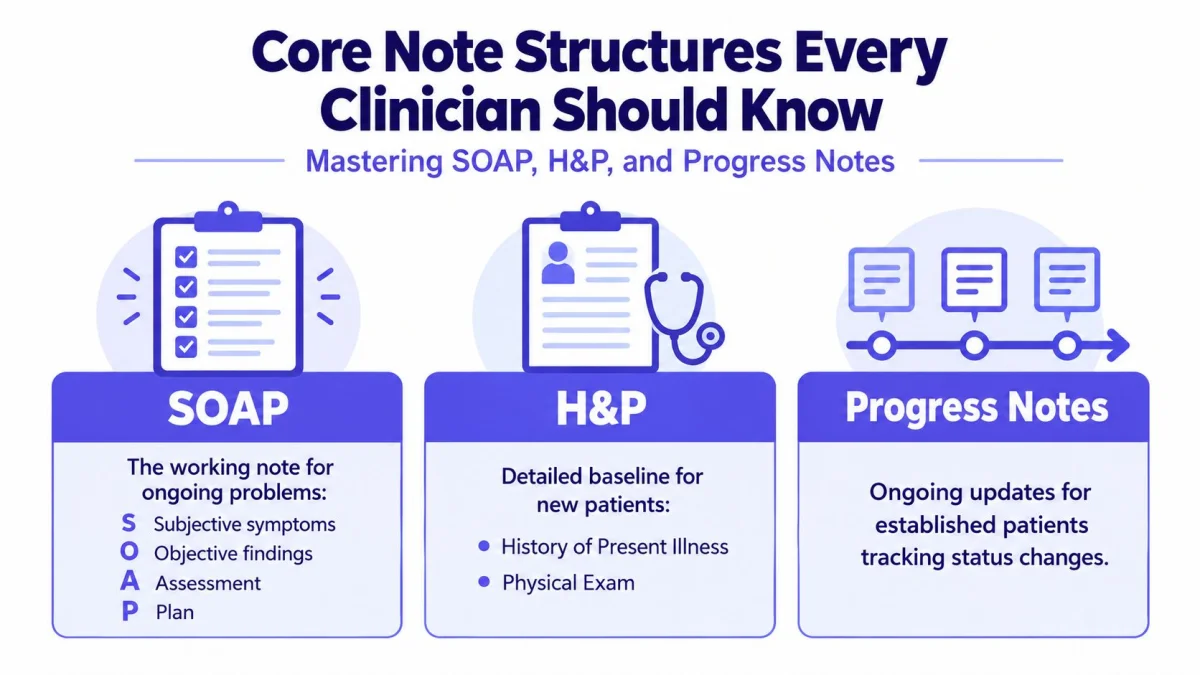
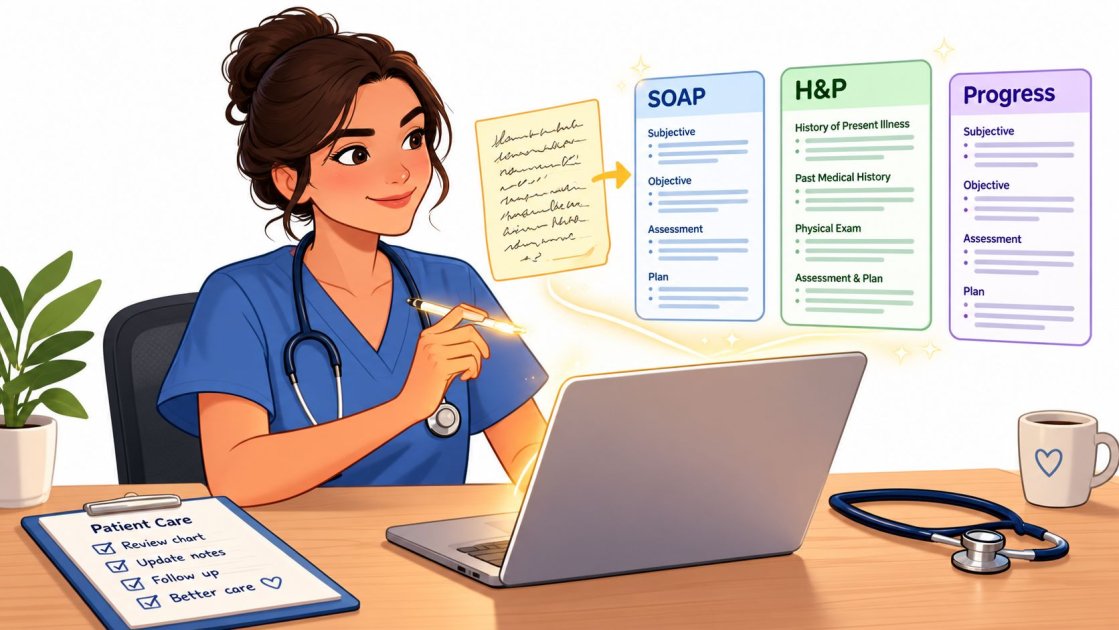
A note gets easier to write when the container is right. SOAP, H&P, and progress notes are not interchangeable labels. Each one answers a different clinical question, and using the wrong one usually creates either missing information or bloated text.
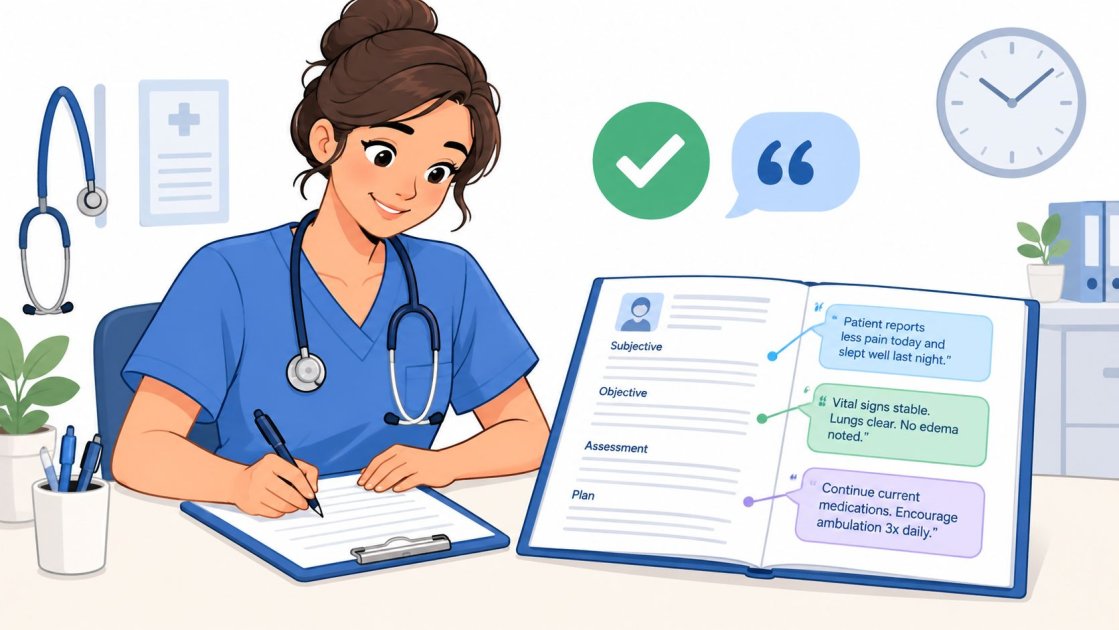
SOAP is the working note. It keeps the focus on the current problem, so the patient's story, exam findings, reasoning, and plan stay separate instead of turning into one long paragraph. H&P is the intake note, which needs the broader baseline. Progress notes are for interval updates, so they should show what changed since the last contact and what happens next.
SOAP, H&P, and progress notes in practice
A 55-year-old with chest pain can look different in each format.
- SOAP: the subjective section holds the pain description and associated symptoms, the objective section records vitals, exam, and test data, the assessment explains why the presentation looks more like one diagnosis than another, and the plan lists the next steps.
- H&P: the same patient's first encounter needs the full history, review of systems, past history, medication list, allergies, exam, and the initial assessment and plan.
- Progress note: the daily update should be shorter. It should show whether symptoms improved, whether the workup changed the diagnosis, and whether treatment or monitoring changed.
The point is not to write more. The point is to place the same facts into the right structure so the next clinician can find them quickly.
A structured note is easier to read, but it only works if the clinical thinking stays visible inside it.
For clinicians who want a starting point, a practical SOAP note template helps standardize the working note without forcing every visit into the same shape. That matters because the note should match the job it is doing, not the other way around.
Efficiency Habits During the Encounter
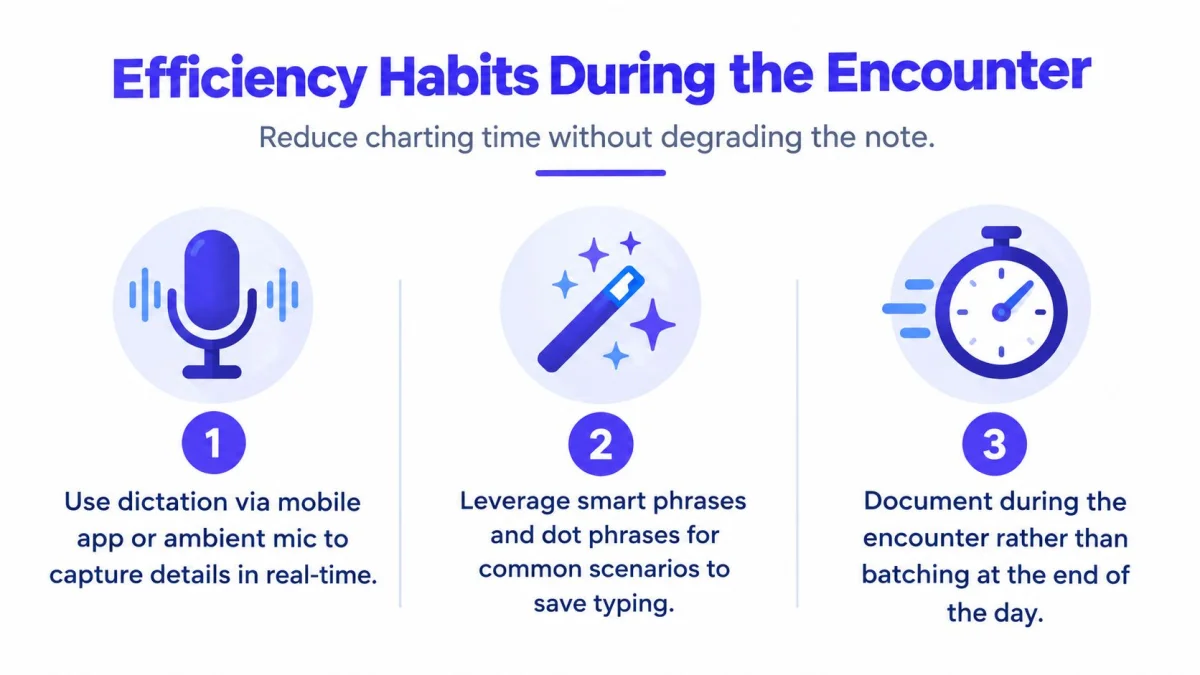
The fastest notes usually come from work done before the patient leaves the room. Waiting until the end of the day feels efficient in the moment, but it is where context gets lost and minor details become burdensome. A chart that is mostly complete at checkout is much easier to finish than one built from memory three hours later.
Dictation is often the first time-saving move. A mobile app or ambient mic can capture details while the conversation is still fresh, but the trade-off is verbosity. Smart phrases and dot phrases cut typing for normal exams and routine boilerplate, but they can make notes sound mechanical if they're not edited. Copy-forward saves minutes, yet it becomes risky when yesterday's information no longer fits today's patient.
A two-minute end-of-visit routine
A short closing routine keeps the note from becoming an evening chore.
- Update the active problem list.
- Place the orders while the decision is still live.
- Draft the assessment in plain clinical language.
- Set the follow-up plan before the patient stands up.
That small sequence does more than save time. It reduces the chance that the chart turns into a reconstruction project later. It also makes it easier to close the encounter before the next patient enters, which keeps unfinished work from multiplying in the background.
The same discipline matters when a practice uses a documentation time-saving tips guide to train staff. The useful habits are the boring ones, done consistently. Notes get faster when the clinician captures the thinking in real time instead of trying to remember it after the clinic has already moved on.
Legal and Compliance Essentials for Clinical Notes
A chart has to answer four questions fast. Who is the patient. What was decided. Why was it decided. What happened next. If the note cannot support those points, the record is weak even when the care was sound.
Coding rules also shift under your feet. CMS updates ICD-10 guidance on a federal schedule, including upcoming ICD-10-PCS updates scheduled to take effect October 1, 2026, which is a reminder that coding follows policy, not habit (CMS ICD-10 page). CMS also describes ICD-10-PCS as a procedural code catalog used in hospital inpatient settings, so the setting matters as much as the wording in the chart (CMS coverage database).
Where notes fail under review
Certain shortcuts fail repeatedly:
- Copy-forward without reattestation: prior text survives even when the patient changed.
- Cloned HPI text: the story reads like a duplicate rather than a current assessment.
- Vague medical-necessity language: the note says care was needed, but not why it was needed now.
- Late entries without timestamps: the chart loses sequence, which creates doubt about what was known when.
HIPAA sets the floor. It does not make a note clinically or legally strong on its own. The chart still has to show reasoning and continuity, and the clean test is whether another clinician could take over care from the note alone.
For the history component, see our Review of Systems guide to make sure ROS documentation supports medical necessity. For teams that manage documentation risk more broadly, a guide for compliance buyers is useful because it treats charting as part of workflow control, not just a writing task. The same principle applies in daily practice. A late addendum can be appropriate, but it has to be clearly marked, and the note still has to stand on its own.
A simple rule works in every setting. If a colleague who never saw the encounter cannot pick up care or defend the decision from the chart alone, the note is not finished.
A Same-Day Workflow for Solo and Small Practices
Small practices lose time when notes, inbox work, and billing tasks all compete for the same mental space. The better pattern is to separate them. Notes get finished in the visit flow. Inbox work gets batched. Billing checks happen before claims leave the building.
A solo clinician can usually run a same-day closeout in about 30 to 45 minutes if the sequence is tight. The work starts with a clean-claim pause, then inbox triage into urgent, routine, and archive. After that comes two-batch signing of notes, oldest first, followed by a short end-of-day chart sweep.
A daily rhythm that actually holds up
- Before the first patient: review overdue notes, queue the inbox, confirm the template for today's clinic type, and verify the scribe settings if one is being used.
- Between patients: close each note before rooming the next patient.
- Late afternoon: block labs and results from the previous day into one review window.
- By 6:30 p.m.: stop non-urgent inbox work and leave the rest for the next business day.
- At shutdown: sweep the chart for unsigned addenda, unfinished orders, and any note that still needs a final review.
That routine keeps refills and prior-auth work out of the same window used for note closure. It also reduces the most common failure mode in small practices, where notes drift into the weekend and the backlog becomes normal. A weekly check between two clinicians can be simple, just compare turnaround time, open encounters, and overdue results, then fix the one bottleneck that keeps recurring.
Operational rule: billing work and note work can happen in the same day, but they should not happen in the same mental block.
A practice that follows that pattern sees the chart as a queue, not a pile. That shift matters more than any single productivity trick.
Where AI Scribes Actually Help and Where They Don't
Ambient AI scribes help most when the day is heavy with ambulatory visits and the note is hard to finish after hours. In some primary care and behavioral health workflows, the practical gain is meaningful because the draft arrives already structured and the clinician is editing, not typing from scratch. That said, benefit is uneven. Procedural visits, highly templated exams, and fast back-to-back follow-ups often leave less room for dramatic savings.
The best way to judge these tools is by workflow fit, not by hype. Ambient scribing, in-encounter dictation, smart phrases, and human transcription each solve a different bottleneck. Ambient capture reduces recall burden. Dictation speeds narrative capture. Smart phrases reduce repetitive clicks. Human transcription shifts the typing elsewhere, but it still needs review.
| Tool | Time Saved Per Day | Accuracy on Medical Terms | EHR Integration | Cost Per Encounter |
|---|---|---|---|---|
| Ambient AI scribe | Variable, often strongest in high-volume ambulatory days | Depends on audio quality and speaker clarity | Usually export or copy-paste based | Subscription-based or per-seat |
| Dictation | Moderate when the clinician speaks clearly | Good for direct speech, weaker for complex jargon if rushed | Often supports simple transfer | Low direct cost |
| Smart phrases | Small but reliable for repetitive content | High for standard boilerplate, lower for nuanced findings | Native inside the workflow | Minimal direct cost |
| Human transcription | Variable, depends on turnaround | Can be strong on clean audio, still needs clinician review | Usually manual transfer | Per encounter or per minute |
Where AI still breaks
The weak points are predictable. Accents can trip the model. Pediatric and geriatric voices can be harder to separate. Multi-speaker visits create confusion. Physical exam language can get flattened. Medication lists and plan items are the most dangerous place to trust output blindly, because a plausible sentence is not the same thing as a correct chart.
An AI note is a draft. It is not a finished document until a clinician reads it. That applies whether the draft came from audio, typing, or a copied template. The legal risk is the same if the final chart carries forward a wrong statement.
A useful live transcribe for doctor visits resource can help clinicians think through live capture in a practical way, but the workflow still has to include review, consent, and a clear record of what was recorded. PatientNotes is one option in this category. It records encounters, creates structured notes from the recording, extracts follow-up tasks, and suggests ICD-10, CPT, and CDT codes for review, with Semble as the only direct EHR integration and copy-and-paste for other systems.
Quality Over Speed, Making Notes Clinically Useful
Shorter notes are not automatically better notes. A 2023 paper in Annals of Internal Medicine tied clinically meaningful documentation to longer notes and richer assessment and plan sections, not to bare-bones brevity (AMA summary of the study). That matches what covering clinicians need overnight. They need the reasoning, not just the conclusion.
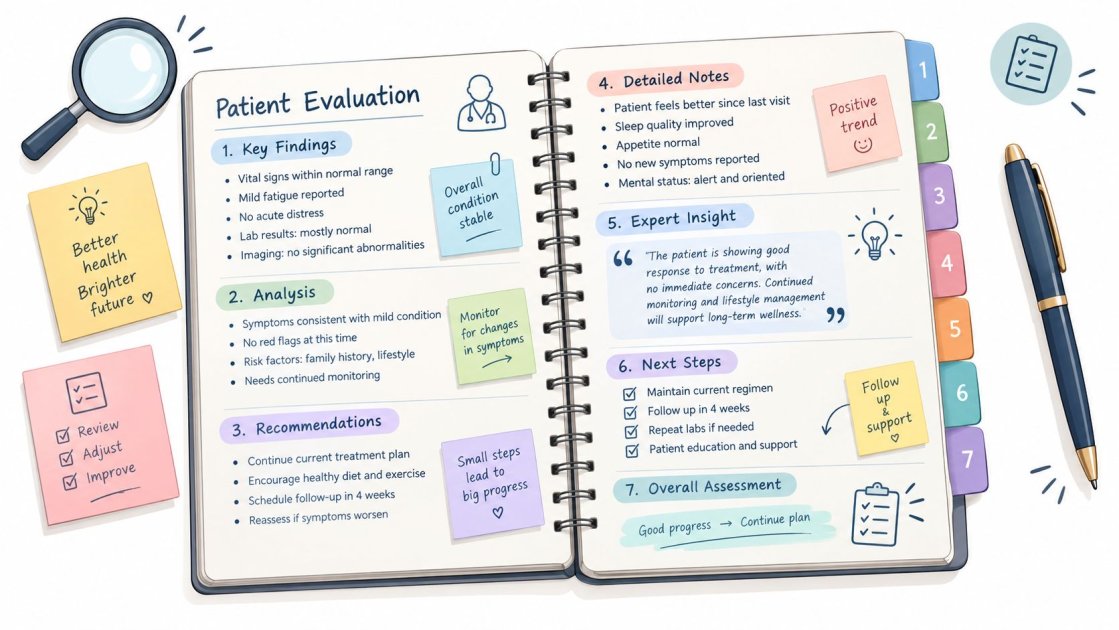
The note has to preserve the problem representation, the logic behind the differential, and the next action if the patient worsens. A list of symptoms is not enough if it hides the decision path. A copied template is not enough if it strips out the contingency plan.
A seven-item quality check
- Problem representation: Does the note state the patient's core issue in one sentence?
- Reasoning transparency: Does it explain why one diagnosis is more likely than another?
- Data synthesis: Does it connect symptoms, exam, and test results instead of listing them separately?
- Contingency planning: Does it say what should happen if the patient deteriorates?
- Medication instructions: Are dose changes and stop-start decisions explicit?
- Follow-up ownership: Is it clear who is responsible for the next step?
- Five-second summary: Can a covering clinician understand the plan almost instantly?
That last item matters more than people admit. A note can be short and still useless if it hides the action items. It can be long and still clinically sharp if the assessment and plan are easy to find.
The guardrail is simple. Dot phrases, copy-forward, and templates are acceptable when they preserve reasoning and follow-up. They are not acceptable when they erase those parts to save keystrokes. That is where audit reviewers draw the line.
Putting It Together, A Practical Charting Checklist
The best charting systems are built around repeatable habits, not heroic late-night cleanup. Same-day note closure protects billing integrity and liability defense. Structured templates keep the thinking complete. In-encounter capture reduces after-hours work. AI scribes belong on high-volume ambulatory days, not every single visit by default.
A practical morning routine keeps the day from drifting:
- Review overdue notes before clinic starts.
- Queue the inbox into urgent, routine, and archive.
- Confirm templates for today's visit type.
- Verify scribe settings if recording is part of the workflow.
An end-of-clinic routine keeps the chart from leaking into the evening:
- Close today's charts before leaving.
- Batch the inbox instead of answering items one by one.
- Reconcile orders against the day's decisions.
- Set tomorrow's note defaults while the context is still fresh.
- Scan one week of notes for copy-forward bloat and missing addenda.
Those habits are small, but they compound fast. The point is not to make charting exciting. The point is to make it sustainable.
PatientNotes gives solo clinicians and small practices a way to record visits, create structured notes, extract tasks, and review suggested billing codes without adding a sales process or enterprise overhead. For practices trying to cut after-hours charting while keeping notes usable, PatientNotes is built around that exact workflow.