It's late evening, and a clinician still has unfinished follow-up notes. The medication visit needs a clear account of tolerability and prescribing decisions. The therapy visit needs an intervention and response. The crisis follow-up needs risk reasoning that another clinician can follow without guessing.
The late-note problem often starts with the wrong format. A blank narrative field invites too much detail, while a rigid template can bury the clinical decision beneath repeated observations. Useful mental health progress notes examples show what changes between formats and what stays fixed: the presenting concern, care delivered, patient response, clinical interpretation, safety findings, and next steps.
The examples below follow comparable visits involving depression, anxiety, and impaired daily functioning. They're fictional documentation illustrations, not prescribing instructions, billing determinations, or substitutes for an individualized risk assessment. Bracketed fields require encounter-specific information, not automatic completion.
For additional writing guidance, the therapy progress notes guide provides a companion resource. The practical starting point is simpler: choose headings that make the work performed easy to find.
1. SOAP Progress Note for Psychiatric Medication Management
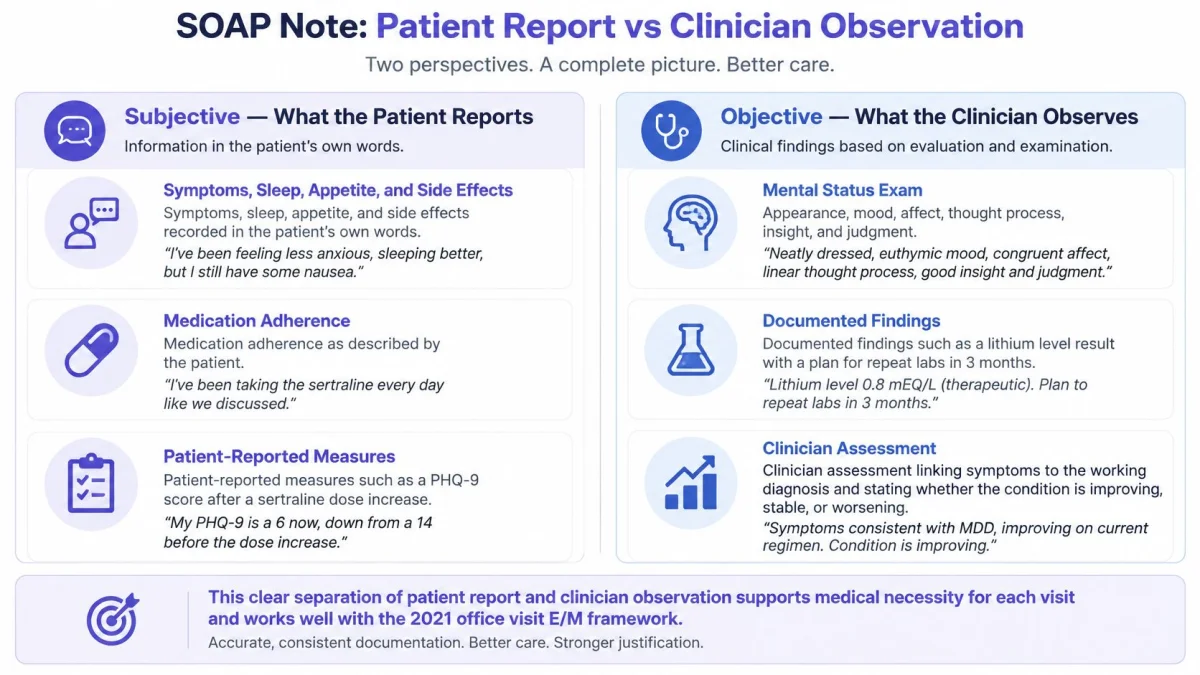
SOAP separates patient report from clinician observation. That distinction is useful when a follow-up includes symptoms, medication effects, mental-status findings, and a prescribing decision. Its weakness is repetition when the Assessment merely copies the Subjective section.
The NHS clinical record-keeping guidance calls for relevant findings, decisions, agreed actions, responsible professionals, and prescribed medicines. SOAP offers a practical place for each, although the headings alone don't establish completeness.
Worked example
Subjective: Patient reports improved morning activity following the sertraline increase. Work-related worry persists. Adherence, nausea, sleep changes, and sexual effects reviewed; actual findings recorded separately. PHQ-9 result: [current result and comparison].
Objective: Patient alert and engaged. Speech coherent and normally paced. Affect constricted but reactive. Relevant mental-status findings and observed medication effects: [findings].
Assessment: Depressive symptoms have improved, but work functioning remains impaired. Medication tolerability and the patient's treatment preferences inform the decision below. Safety assessment and clinical reasoning: [findings].
Plan: Sertraline [verified dose, route, frequency, and prescribing decision]. Monitoring: [specific action and responsible clinician]. Follow-up: [date], selected because [clinical reason]. Earlier-contact instructions: [actual instructions provided].
The psychiatry progress-note template offers a structure for organizing these fields.
Copy-ready tactics
- Interpret change: Assessment: [improved, unchanged, or worsened] since the previous encounter, supported by [evidence].
- Name tolerability findings: Reviewed [specific effects]; patient reports [findings].
- Explain timing: Follow-up interval selected because [response, tolerability, monitoring, or safety concern].
2. DAP Progress Note (Data, Assessment, Plan)
A patient describes better sleep while visibly tensing during a discussion of work. DAP keeps those connected observations together. Data contains the report, observations, intervention, and response; Assessment explains their meaning; Plan records the next actions.
DAP saves structural decisions, not clinical thinking. The main trade-off is attribution: without clear wording, a reader can mistake a patient's account for an observed fact.

Worked example
Data: Patient reports improved sleep and completion of thought-record homework, with continuing anticipatory worry before work. Clinician observed tense posture during discussion of an upcoming meeting. Cognitive restructuring addressed the prediction that any mistake would lead to dismissal. Patient generated an alternative interpretation and rehearsed using it.
Assessment: Homework use and in-session skill application indicate progress toward the treatment goal of reducing work-related avoidance. Persistent avoidance remains a barrier to improved functioning. Current safety findings and their interpretation: [actual assessment].
Plan: Patient will complete a thought record following a work-related worry episode. Next session will review avoidance and application of the alternative interpretation. Safety actions, responsible clinician, and next appointment: [details].
A peer-reviewed study of collaborative documentation examined changes in clinical-note structure and content when clinicians and service users documented encounters together. That approach can help make the patient's perspective visible, but agreement shouldn't replace the clinician's independent assessment.
Documentation distinction: Patient reported improvement and clinician observed improvement aren't interchangeable statements.
Copy-ready tactics
- Attribute facts: Patient reported [experience]; clinician observed [behavior].
- Name the goal: Progress toward [treatment-plan goal] is supported by [session evidence].
- Connect safety to action: Assessment findings: [details]. Plan arising from those findings: [actions].
3. BIRP Progress Note (Behavior, Intervention, Response, Plan)
Behavior: Patient reports avoiding work meetings because of anticipated criticism. Clinician observed frequent reassurance-seeking during discussion. Relevant safety findings: [assessment].
Intervention: Clinician used Socratic questioning to examine the predicted consequences of speaking during a meeting. Clinician modeled a balanced response and guided rehearsal.
Response: Patient identified evidence inconsistent with the feared outcome, completed rehearsal, and described continuing uncertainty about applying the skill at work. Skill use suggests progress, but independent application remains limited.
Plan: Patient will attempt the agreed meeting-participation task and record the outcome. Clinician will review barriers at the next appointment. Safety actions: [details].
That sequence shows the point of BIRP. It keeps the clinician's action separate from the patient's response, so the note records what changed and what did not. The format works well when the main documentation question is what the clinician did. Its weak point is assessment. Symptoms and responses can sit in separate boxes without a clear explanation of why treatment should continue or change.
A study of inpatient mental-health nursing notes found that only 12.0% met its sufficient-quality standard for describing nurse–patient interactions, within the study's inpatient setting. That is a narrow record of documentation quality, but it makes the practical risk plain. A note that captures attendance and tasks without the interaction misses much of the clinical work.
Use BIRP when the visit centers on a specific intervention, such as rehearsing a workplace response or practicing a coping skill. I would keep the response section concrete. Write what the patient said, did, or demonstrated, then state the remaining difficulty in the same entry. That gives the plan a reason to exist.
The therapy-session notes template provides another starting structure when the note needs a broader therapy frame.
Copy-ready tactics
- Specify the technique: Clinician used [technique] to address [target].
- Describe the response: Patient demonstrated [observable action], with [remaining difficulty].
- Preserve reasoning: Response supports [interpretation], so the next step is [action].
4. Psychotherapy Session Note with Time Documentation
A strong therapy narrative can still omit the information needed to understand the service delivered. Time documentation belongs beside the clinical work, not in a disconnected scheduling record.
For US Medicaid behavioral-health services, the CMS documentation factsheet says records should support the service, follow applicable state rules, and be complete, concise, accurate, signed, and dated. It also calls for face-to-face time spent with the patient and documentation supporting medical necessity and clinical rationale where required.
Worked example
Service: Individual psychotherapy for depressive symptoms and reduced activity.
Modality and location: [actual encounter details].
Start, end, and psychotherapy duration: [verified times and applicable duration].
Treatment goal: Improve participation in personally meaningful activities.
Session content: Patient reports ongoing withdrawal despite improved sleep. Clinician reviewed the activity record and used behavioral activation to examine the difference between anticipated and experienced enjoyment. Patient selected a manageable activity and identified fatigue as a likely barrier.
Clinical interpretation: Patient can identify an activity–mood connection but needs further support translating that understanding into action. Safety assessment, safety-plan review, and resulting actions: [actual findings and decisions].
Plan: Patient will attempt the agreed activity and document the experience. Clinician will review completion, barriers, and mood at the next appointment.
A morning mental health self-check may support patient reflection between visits. It doesn't replace encounter documentation or clinician assessment.
Recording session length doesn't establish that a particular billing code is appropriate. The service, documented work, current coding rules, and payer requirements still need review.
Copy-ready tactics
- Separate time fields: Encounter start [time]; end [time]; psychotherapy duration [verified duration].
- Avoid automatic coding: Billing selection reviewed against [current applicable rules].
- Keep the clinical link: Intervention addressed [goal]; patient response was [evidence].
5. Suicide Risk Assessment Progress Note Using the C-SSRS
A patient reports recent passive thoughts of death at a depression follow-up. The note for that visit carries more weight than a routine check-in, because the clinician's reasoning about risk will matter as much as the score itself. A C-SSRS-based entry should identify the instrument used and its findings, then make the clinician's reasoning and actions visible. The score opens the entry. The formulation and the response carry it.
The East London NHS Foundation Trust clinical record-keeping policy requires a timely, factual account of assessment, treatment, care planning, and evaluation. A risk-focused entry needs that same sequence, with particular attention to what happened after the assessment.
Worked example
Structured assessment: C-SSRS version, administration date, responses, and timeframe: [actual findings]. Additional assessment addressed current thoughts, intent, planning, behavior, access to means, relevant history, and changes in circumstances: [findings].
Clinical formulation: Current concerns are [specific factors]. Protective factors are [specific factors], with [limitations or uncertainties]. The clinician's assessment of acute and longer-term risk is [individualized formulation and supporting reasoning].
Actions and response: Safety plan reviewed on [actual date]. Means-safety discussion addressed [specific access and agreed steps]. Patient's response, ability to participate, and unresolved concerns: [details].
Disposition and follow-up: Level-of-care decision and rationale: [details]. Contact or referral completed: [recipient and outcome]. Next assessment and responsible professional: [details].
Notice what this structure fixes in place. The instrument, the individualized formulation, the completed actions, and the named follow-up responsibility appear in every risk entry regardless of severity. What changes between visits is the content inside those fields: a higher-acuity presentation expands the means-safety and consultation detail, while a stable patient with improving symptoms fills the same fields with shorter entries.
The mental-health assessment templates can help organize fields, but sample wording cannot determine an individual patient's safety.
Copy-ready tactics
- Record evidence: Findings supporting the formulation include [details]; uncertainty remains about [details].
- Document completed actions: [Professional] contacted [recipient], with [outcome].
- Make responsibility explicit: [Named professional or service] will complete [action] by [agreed time].
- Treat template language as a prompt, not a conclusion: Low-risk phrasing belongs in the note only when the clinician's own assessment supports it, never because it appears in a template.
6. Medication Monitoring Progress Note with Rating Scales
Medication review: Patient reports taking sertraline [verified dose, route, frequency]. Adherence and missed doses: [findings]. Effects reviewed by name, including those relevant to the patient's concerns: [findings].
The useful question is how the medication review, the scale results, and the visit findings fit together. A patient may report fewer depressive symptoms while remaining unable to work, experiencing medication effects, or facing an unresolved safety concern. A systematic review of measurement-based mental-health care identified concerns including inadequate capture of clinical complexity, reporting bias, time constraints, training, and privacy. Pair measures with functioning, patient priorities, clinical interpretation, and the decision made. That keeps the note clinically readable rather than score-driven.
Worked example
Medication review: Patient reports taking sertraline [verified dose, route, frequency]. Adherence and missed doses: [findings]. Effects reviewed by name, including those relevant to the patient's concerns: [findings].
Measures: PHQ-9 [current result], compared with [previous result and date]. GAD-7 [current result], compared with [previous result and date]. Completion conditions or concerns about reliability: [details].
Function and goals: Patient reports improved morning activity but continuing absence from work meetings. The patient identifies returning to reliable work participation as the main treatment priority.
Interpretation: Symptom measures suggest improvement, while occupational functioning remains impaired. Medication effects, patient preference, and safety findings are [details]. These findings support [individualized treatment decision and rationale].
Plan: Medication decision: [verified prescription or continuation]. Monitoring actions and responsible clinician: [details]. Follow-up: [date and reason].
For an antipsychotic follow-up, record the actual AIMS findings and the individualized monitoring plan. A generic normal result should not replace an examination that was not performed.
Measurement rule: Document missing or unreliable measures as such; do not treat them as evidence of stability.
Copy-ready tactics
- Show the comparison: [Measure] current [result]; previous [result/date].
- Reconcile disagreement: Score improved, but [function or safety concern] persists.
- Explain the decision: Medication [continued or changed] because [clinical reasoning] and [function, safety, or preference finding], with the result used as context.
7. Group Therapy Progress Note
Eight patients sit through the same ninety-minute DBT skills group. They hear the same explanation and watch the same modeling. What each chart should contain afterward is anything but identical. The group summary records the shared intervention once; the individual entry records what this particular patient did with it, how they responded, and what happens next for them.
Copying the curriculum description into every chart is reasonable. Copying the response is not. When "patient participated actively and benefited from skills practice" appears in all eight charts after a session where two members declined to practice and one left early, the note no longer reflects treatment. If that same patient later arrives in crisis, the chart shows a string of successful sessions and no warning signs. A clinician reviewing the record has nothing real to work from, and the error can steer decisions about risk, medication, or level of care in the wrong direction.
California's Department of Health Care Services documentation standards illustrate why service context matters: documentation frequency differs across mental-health, crisis, residential, and other programs. A group template therefore needs to fit its actual program rather than assume a universal recording schedule.

Worked example
Shared session content: DBT skills group focused on distress tolerance. Facilitator explained the selected skill, modeled its use, and guided practice. Service details, facilitator, attendance, and time: [actual details].
Individual participation: Patient described anticipatory anxiety before work and participated in guided practice. Patient identified a workplace situation in which the skill might be useful.
Response and interpretation: Patient demonstrated the practiced sequence with prompting. Independent use outside the group remains untested, consistent with the treatment goal of reducing avoidance.
Individual plan: Patient will practice the agreed skill and report the context and outcome. Any concern requiring individual assessment or treatment-team contact: [findings and completed actions].
Notice what stays fixed here compared with the individual formats: service details, observed response, clinical reasoning, and a specific plan. What changes is the split between shared content and individual evidence, and the added confidentiality risk of mentioning other members.
Copy-ready tactics
- Separate shared from individual: Group intervention [content]; this patient's response [evidence].
- Limit unrelated detail: Describe the patient's experience without reproducing another member's disclosure.
- Individualize follow-up: This patient will [task]; responsible clinician will [action].
- Record deviation: Patient declined practice / left early / required prompting: [facts and response].
8. Narrative Progress Note for Psychotherapy (Process Note Style)
Patient described expecting rejection after receiving corrective feedback at work. Clinician explored the link between that expectation and the patient's pattern of withdrawing before clarification could occur. Patient initially disagreed, then named a recent example of pulling back from a supportive colleague.
The note reads as a focused account of the therapeutic process. It connects theme, intervention, response, and decision in one line. That helps a later clinician see why the plan follows from the session. The trade-off is drift. A fluent account can hide missing treatment goals, safety findings, or follow-up actions. Keep the story tight.
Worked example
Session focus: Patient described expecting rejection after corrective feedback at work. Clinician explored the connection between that expectation and withdrawal before clarification. Patient identified a recent example with a supportive colleague.
Clinical interpretation: The session stayed focused on interpersonal expectations that contribute to avoidance. Patient's ability to identify the pattern supports progress toward the treatment goal. Applying that insight outside therapy remains difficult. Mental-status observations, safety findings, and relevant functional changes were [actual findings].
Plan: Patient agreed to notice situations in which criticism is assumed before its meaning is checked. The next session will review those situations and the patient's response. Follow-up and any coordination actions: [details].
For US practices, psychotherapy notes have a specific HIPAA meaning under the regulation identified in the documentation guidance, including separation from the ordinary clinical record. A narrative heading alone doesn't create that status. The guide to progress-note privacy distinctions explains why the categories shouldn't be mixed.
Copy-ready tactics
- Keep reasoning concise: Theme [pattern] relates to goal [goal] because [clinical connection].
- Record response: Patient responded to [intervention] by [observable or attributed response].
- Remove unnecessary exposure: Replace detailed disclosure with the clinically necessary concern, intervention, response, and plan.
How the eight mental health progress note formats compare
Take the same patient, a 30-minute outpatient follow-up for depression with partial medication response, and write it eight ways. The clinical facts stay fixed: symptoms, functioning, mental status, safety findings, intervention, response, plan. What changes is where those facts live, how long the note takes, and what an auditor looks for first.
| Note type | Best for | What changes for the same visit |
|---|---|---|
| SOAP Progress Note for Psychiatric Medication Management | Psychiatric medication follow-ups | Reported symptoms and clinician observations sit in separate sections; lowest audit risk when a payer questions what was observed versus reported |
| DAP Progress Note (Data, Assessment, Plan) | Brief outpatient and community mental health notes | Report and observation merge into one data section; fastest structure, but the clinician must still label sources inside it |
| BIRP Progress Note (Behavior, Intervention, Response, Plan) | Therapy, case management, and residential care | The intervention and the client's response get their own sections; suits visits where the therapeutic work, not the symptom list, justifies the service |
| Psychotherapy Session Note with Time Documentation | Time-based psychotherapy billing | Start and stop times become load-bearing; the note fails audit if documented duration falls short of the billed code's threshold |
| Suicide Risk Assessment Progress Note Using the C-SSRS | Visits involving present or changing suicide risk | Screening results, protective factors, and the safety plan join the note; the documented risk level must match the actions taken |
| Medication Monitoring Progress Note with Rating Scales | Tracking medication response and safety over time | Scale scores and prior-score comparisons anchor the assessment; decisions must trace back to numbers and dates |
| Group Therapy Progress Note | Group therapy and structured behavioral health programs | One session produces a distinct note per participant; each record carries only that client's response, never another member's disclosure |
| Narrative Progress Note for Psychotherapy (Process Note Style) | Complex therapy sessions needing clinical context | Structure gives way to prose; the writer controls depth, and detailed psychotherapy notes stay separated from the standard record |
The trade-off is consistent across all eight. Tighter structure speeds writing and review but can flatten clinical reasoning. Looser structure captures complexity but costs time and invites inconsistency across clinicians. Time documentation and risk documentation are the two additions that change audit exposure most, because both create objective checkpoints a reviewer can verify.
Copy-ready tactics:
- Pick structure by visit type: medication check, SOAP or monitoring format; therapy-heavy session, BIRP or narrative.
- Add time lines only when billing requires them: start [time], end [time], total minutes [number].
- Match risk language to action: risk level [level] because [findings]; action taken [action].
- Write group notes individually: patient [name] engaged by [observable behavior]; no other member identified.
Pick One Core Format and Adapt It Per Visit
Choose one base format for the practice and adapt its fields to each visit. SOAP suits visits with distinct medication, examination, or monitoring information. DAP suits encounters where report, observation, and therapeutic work are closely connected. BIRP gives intervention and response more prominence. Keep the clinical content consistent when changing the structure.
Clinicians using an AI-supported platform submitted notes an average of 55 hours earlier than the treatment-as-usual group while retaining required documentation elements in a randomized trial published in JMIR. When adopting a documentation workflow, assess both completion time and whether required clinical information remains intact.
Keep the core stable
Make these fields easy to locate in every version of the template:
- Encounter details: Patient identifier, service date, service type, modality, author, and relevant time documentation.
- Clinical evidence: Symptoms, functioning, observations, intervention delivered, and patient response.
- Clinical reasoning: Progress toward the treatment goal, remaining impairment, and rationale for decisions.
- Safety and next steps: Actual assessment findings, resulting actions, responsible professionals, and follow-up.
- Authentication: Clinician review, signature, and an accurate chronology of additions or corrections.
Adapt the depth to the encounter. For a medication follow-up, record the actual prescription and rationale alongside the monitoring findings. For a therapy visit, connect the intervention to the patient's response and treatment goal. If safety concerns change, replace carried-forward language with the current findings and resulting actions. Review time documentation against applicable coding and payer requirements before submitting a time-based claim.
Before adopting the template, confirm state, payer, professional, and local record-keeping requirements. UK clinicians should align its fields with their organization's documentation policy. Build those requirements into the headings, then check that each completed entry contains the required information.
PatientNotes includes a Psychology DAP progress note template, psychiatry templates, and an AI template builder within its library across 37 specialties. It offers a 7-day free trial with no credit card required. Semble is its only EHR integration; other EHRs use copy and paste.
PatientNotes turns recorded consultations into structured notes and extracts follow-up tasks for clinician review. Visit PatientNotes to adapt a mental-health template. Before transferring the result to the clinical record, check accuracy, missing findings, speaker attribution, clinical reasoning, and who is responsible for each follow-up action. Sign only after completing that review.