
It's 6:40 on a Tuesday evening. The last patient left forty minutes ago, and there are still eleven notes open on the screen. One of them was a twenty-minute follow-up for a patient with hypertension, diabetes and early kidney disease, three refills, and a lab panel that changed the plan. The note says "chronic conditions stable, continue current medications." That note supports a low-level visit. The work done in the room supports something higher, and the difference is now unrecoverable, because nobody can reconstruct the reasoning after the fact.
That's the subject of any evaluation and management coding guide. The visit isn't what gets coded. The note is. An auditor who never met the patient reads only what was written, and every level stands or falls on one of two things: a documented medical decision making (MDM) result that meets two of three elements, or a dated total time statement covering the physician's own work on the date of service. Everything below is built around those two anchors, with the sentence an auditor needs to see for each common encounter.
Office and Outpatient E/M Levels With Times
Two pathways decide the level of an office or outpatient visit. Either the clinician documents medical decision making, or the clinician documents total time personally spent on the date of the encounter. History and physical examination no longer pick the code.
The CMS office and outpatient E/M fact sheet describes the Medicare and CPT framework change that took effect on January 1, 2021, covering CPT codes 99201 through 99215 and removing history and physical examination as the elements used to determine the visit level. The same fact sheet confirms that the lowest-level new-patient code, 99201, was deleted, leaving four new-patient levels, while the five-level established-patient structure stayed in place.
What didn't change matters just as much. A medically appropriate history and examination still belong in the record when clinically indicated. They no longer serve as the counting exercise that drove the code.
The lookup table
| Code | Patient type | MDM level required | Total time on date of service |
|---|---|---|---|
| 99202 | New patient | Straightforward | 15 to 29 minutes |
| 99203 | New patient | Low | 30 to 44 minutes |
| 99204 | New patient | Moderate | 45 to 59 minutes |
| 99205 | New patient | High | 60 to 74 minutes |
| 99211 | Established patient | None required | No time threshold |
| 99212 | Established patient | Straightforward | 10 to 19 minutes |
| 99213 | Established patient | Low | 20 to 29 minutes |
| 99214 | Established patient | Moderate | 30 to 39 minutes |
| 99215 | Established patient | High | 40 to 54 minutes |
Read the table as two independent columns, not as a combined requirement. A visit qualifies on either the MDM column or the time column. A fourteen-minute established-patient visit with moderate decision making is still a 99214. A forty-minute visit with straightforward decision making can be a 99215 on time, provided the minutes are the clinician's own qualifying work.
99211 sits outside both columns. It carries no MDM or time requirement and fits nurse visits that meet incident-to rules, which is a payment policy question rather than a documentation-of-complexity question. Check the supervising clinician's presence and the payer's incident-to terms before billing it, because that's where these claims fail.
Say which pathway was used
The single cheapest habit in this whole guide costs one line. Write it at the end of the assessment:
Level selected by medical decision making.
Or, when time carries the visit:
Level selected by total time on the date of service.
That line tells the reviewer which rulebook to apply and stops the most common audit mismatch, a note whose narrative looks like low complexity while the billed code implies a time claim nobody documented. The time option covers qualifying work performed on the same day both inside and outside direct patient contact, subject to CPT and payer rules, so the pathway statement is what makes those outside-the-room minutes legible.
The MDM column is where most of the money is won or lost, and it has its own internal test.
The Three MDM Elements and the Two-of-Three Rule
MDM is three scored elements and an arithmetic rule. The note must support the level in each element before you select the overall level.
Under the MDM method, the selected level generally requires meeting or exceeding the threshold for at least two of three elements, as outlined in the CMS Evaluation and Management Services Guide. Those elements are the number and complexity of problems addressed, the amount and complexity of data reviewed and analyzed, and the risk of complications and/or morbidity or mortality associated with patient management.
The thresholds worth memorizing
| MDM level | Problems addressed | Data reviewed and analyzed | Risk of patient management |
|---|---|---|---|
| Straightforward | 1 self-limited or minor problem | Minimal or none | Minimal risk |
| Low | 2 or more self-limited problems; 1 stable chronic illness; or 1 acute uncomplicated illness or injury | Limited: qualifying combination of external notes, unique test results or orders; or assessment requiring an independent historian | Low risk |
| Moderate | 1 or more chronic illnesses with exacerbation, progression, or treatment side effects; 2 or more stable chronic illnesses; 1 undiagnosed new problem with uncertain prognosis; 1 acute illness with systemic symptoms; or 1 acute complicated injury | Moderate: qualifying combination of notes, unique tests and independent historian; independent interpretation; or qualifying discussion with an external clinician | Moderate risk, such as prescription drug management or minor surgery with identified risk factors |
| High | 1 or more chronic illnesses with severe exacerbation or progression; or 1 acute or chronic illness or injury that threatens life or bodily function | Extensive: qualifying activity in at least two data categories, including review and orders, independent interpretation, or external discussion | High risk, such as drug therapy requiring intensive monitoring for toxicity or a decision about emergency major surgery |
Use the data column as a category guide, not a checklist where any single action earns the stated level. Reviewing several tests, independently interpreting a study, and discussing management with an external clinician have different requirements. Count qualifying work under the applicable CPT category.
Problems addressed means problems evaluated or treated at this encounter. A patient with eight chronic conditions whose visit addressed one of them has one problem addressed. Diagnoses carried forward without assessment or management do not expand that count.
Data requires attention to what was analyzed. Identify the external note, unique test, independent interpretation, or external discussion that supports the score. A general phrase such as “records reviewed” leaves the qualifying work unclear.
Why one strong element doesn't lift the code
An established patient comes in for a blood pressure check. Hypertension is stable. The clinician refills lisinopril at the same dose. No labs, external records, or imaging are reviewed or ordered.
Score the documented work:
- Problems: one stable chronic illness, which is low.
- Data: nothing reviewed or ordered, which is minimal or none.
- Risk: prescription drug management, which is moderate.
Only one element reaches moderate. The visit supports 99213, not 99214. The refill can support moderate risk, but it cannot raise the problems or data scores. Overcoding occurs when the prescription decision is treated as sufficient for the entire MDM level.
The assessment can make the distinction explicit:
Hypertension stable; continue lisinopril at the current dose. No tests or external records reviewed or ordered.
The reverse case also matters. A patient with two stable chronic illnesses whose prescription regimens are both adjusted has moderate problems and moderate risk, provided the note documents assessment and management of both conditions. Data can remain at none. Two elements meet moderate, supporting 99214 without laboratory review.
Scoring habit: write the three element levels before selecting the code. Choose the highest overall level that at least two elements meet or exceed.
The scores do not have to match exactly. A higher-scoring element can satisfy a lower threshold; a single higher score cannot carry the encounter.
For a structured check, use the MDM calculator alongside the documented problems, data, and management decisions. Review the result against the note before finalizing the code. Keep the current CPT criteria available, particularly for data counting and risk qualifications, rather than relying on a shortened grid alone.
Documentation That Supports the Level You Chose
An auditor reads a note cold, with no memory of the room and no interest in how busy the day was. Three questions get asked in order: which problems were worked on, what evidence changed the plan, and what management risk was accepted. If the note answers all three in specific terms, the level holds. If it answers them in adjectives, it doesn't.
The First Coast Medicare guidance on office and other outpatient E/M services makes the point directly: documentation should identify the problems addressed, relevant data reviewed or analyzed, and management risk, rather than relying only on diagnosis labels or the length of the narrative.
Editing a weak line into a strong one
Take a real-world pattern and run an editor's pass over it.
Weak: "Labs reviewed. Continue current management."
Strong: "Reviewed today's basic metabolic panel and last week's outside cardiology note. Potassium high on an ACE inhibitor, so lisinopril reduced from 20 mg to 10 mg daily, repeat panel in one week, and the outside note's recommendation for a beta blocker deferred until potassium normalizes."
Same visit. Same minutes. The second version names the data source, the finding, the drug and dose change, and the risk being managed. Nothing was invented and no boilerplate was added. The reasoning was already there, it just wasn't written down.
The same edit works on the problem statement. "Diabetes, hypertension, CKD" is a list. "Type 2 diabetes with a rising A1c despite metformin, starting a second agent today; stage 3 CKD limiting agent choice" is a problem being addressed with its complexity attached.
The time statement that survives review
When time carries the level, the sentence has a fixed shape:
Total physician time on the date of service: 38 minutes, including pre-visit record review, the face-to-face visit, counseling on medication changes, ordering, and documentation.
Room time doesn't qualify. Neither does the scheduled appointment length. A 40-minute slot with a 12-minute encounter and no other qualifying work is a 12-minute claim, and writing "40 minute visit" because that's what the schedule said is the fastest way to lose a time-based audit.
A medically appropriate history and examination still belong in the record. They're clinical documentation now, not level-selection evidence, so keep them proportionate to the problem instead of padding them to reach a code.
Short notes and specialist notes
Specialists often write two lines of assessment that carry moderate decision making comfortably, because the two lines name the problem, the data and the risk. A cardiologist writing "New atrial fibrillation with rapid ventricular response, independently interpreted the outside ECG, starting rate control and anticoagulation after weighing bleed risk" has done the whole job in one sentence. Length isn't the variable. Specificity is.
The most common documentation failure isn't brevity. It's template text that doesn't match the visit, a review-of-systems block or an exam macro carrying findings from a different encounter. That failure mode is what turns a defensible note into an audit finding, and it's worth checking line by line before signature.
Time-Based Selection and Prolonged Services
Use the time definition from section 1 as the starting point, then apply a strict exclusion list. If the clinician's qualifying date-of-service time selected the code, any later add-on has to be measured from that same clock.
Who doesn't count
- Nursing and medical assistant time: vitals, rooming, injections and teaching done by clinical staff sit outside the clinician's total.
- Scribe time: someone else typing doesn't add minutes to the clinician's clock, though the clinician's own review and editing does.
- Front-desk and scheduling work: check-in, insurance verification and booking the follow-up aren't qualifying professional time.
- Other days: record review the night before doesn't join the total, because the measure is the date of service.
Those exclusions matter because clinical teams often remember the visit as a busy block, while the code needs clinician time only. The written total should name the work covered, not just the minutes. "Total time on the date of service was 68 minutes, including record review, the encounter, medication counseling, ordering and documentation" gives an auditor something to test. "Busy 40-minute visit" gives them nothing.
Prolonged services with G2212
When time selected the base code, Medicare uses HCPCS G2212 for time beyond the maximum required time of the primary service. The CMS Medicare Claims Processing Manual change request on prolonged services describes G2212 as an add-on for each additional 15 minutes of physician or qualified health professional time, with or without direct patient contact, on the date of the primary service, reportable with 99205, 99215 and 99483 when the applicable prolonged-service requirements are met.
| Base code | Time range for the base code | First G2212 unit | Each additional unit |
|---|---|---|---|
| 99215 | 40 to 54 minutes | 69 minutes or more | Every further 15 minutes |
| 99205 | 60 to 74 minutes | 89 minutes or more | Every further 15 minutes |
| 99483 | Set by the 99483 service descriptor | May be reported per CMS when prolonged-service requirements are met | 15 minutes per unit |
| Any office visit selected by MDM | Not applicable | G2212 is not reportable | Not applicable |
Read the bands before signing the note. A 99215 visit with 68 documented minutes gets no add-on. At 69 minutes it gets one unit. At 84 minutes it gets two. Small differences in the time statement change the claim, so the note should not leave the number to inference.
The mistake that voids the add-on
G2212 isn't reported when MDM selected the office or outpatient level. A long, complex chart coded 99214 on decision making can't take a prolonged-service add-on, no matter how many minutes went into it. The additional time has to be qualifying date-of-service work attached to a base service chosen by time. The pathway controls the add-on.
Payer policy adds a second layer. Some private payers recognize CPT 99417 for prolonged services instead of G2212, and the thresholds differ, so the payer's written policy decides which code goes on the claim. Verify it once per payer, write it into the practice's billing sheet, and stop re-deciding it per encounter.
The supporting line stays simple: total time on the date of service and the work it covered. That line should match the chosen pathway, the base code and the add-on units. If it doesn't, the claim has no clean defense when the note is reviewed.
Code Families for Hospital, ED and Preventive Care
Office codes are the family most small practices live in, but the neighboring families don't all follow the same rules, and two of them break the pattern outright.
Start with the patient-type test. Established means the patient received a professional service from the practice within the past three years, applied at practice level rather than to the individual clinician. A patient seen by a partner in the same group is established, which is why new-patient codes get misused most often after a schedule change.
| Setting and patient type | What sets the level |
|---|---|
| Hospital inpatient or observation, initial (99221 to 99223) | MDM or time |
| Hospital inpatient or observation, subsequent (99231 to 99233) | MDM or time |
| Hospital inpatient or observation, same-day admission and discharge (99234 to 99236) | MDM or time |
| Emergency department (99281 to 99285) | MDM |
| Critical care (99291, 99292) | Time only |
| Nursing facility (99304 to 99310) | MDM or time |
| Preventive medicine (99381 to 99397) | Age and risk factors, not MDM |
| Longitudinal care add-on (G2211) | Add-on to a qualifying office or outpatient visit under CMS rules |
The AMA CPT E/M descriptors and guidelines make the governing principle explicit: when time is used, the time defined in the service descriptor determines the appropriate level, so the office definition of total date-of-service time doesn't transfer automatically to another family. That document also flags the continuing-care complexity add-on G2211, established by Medicare, as a component that correct E/M level selection alone may not capture.
Two rows deserve rote memory. Subsequent hospital care allows MDM or time, so a short rounding visit with high-complexity decision making still codes high. Preventive medicine is chosen by age and risk factors, so a wellness visit that surfaces a new complaint needs a separately documented problem service alongside it, not a higher preventive code.
Home and residence visits are now reported with office or outpatient codes under current CPT, with payer rules governing the rest. Dental and periodontal practices face the same discipline in their own code set, and the gum maintenance guidance for Delaware patients from Periodontal Associates of Delaware is a useful example of how a maintenance interval gets explained to patients before the recall visit is scheduled and coded.
Common Billing Scenarios and How They Code
Each of these is a hypothetical encounter of the kind a small practice meets weekly, with the code path and the line that makes it hold.
- Three stable chronic conditions with refills. Two or more stable chronic illnesses meet moderate problems, and prescription drug management meets moderate risk, so 99214. The note names each condition and each refill decision: "Hypertension, type 2 diabetes and hypothyroidism all assessed today; lisinopril, metformin and levothyroxine continued at current doses after review of today's labs."
- A chronic condition worsening, new drug started. The exacerbation is the problem, the new prescription is the risk, so 99214. Write the exacerbation, the drug and dose, and the monitoring: "Heart failure with increased edema and 3 kg weight gain; furosemide increased to 40 mg twice daily, daily weights and a repeat panel in five days."
- New patient, two acute uncomplicated problems. Two acute uncomplicated illnesses sit at low problems with low-risk management, so 99203. Name both problems and the limited data: "Acute ankle sprain and uncomplicated contact dermatitis, both examined today, no imaging indicated, topical steroid and supportive care."
- Visit ending in a minor procedure. E/M with modifier 25 plus the procedure code, only when the evaluation is separately identifiable. The note needs its own problem and plan outside the procedure, not a restatement of the procedure consent.
- Preventive visit with a new complaint. Preventive code plus E/M with modifier 25, with the problem work documented in a separate block. If the new complaint is the only thing written, the preventive service has no support.
- A 99215 visit with 75 documented minutes, 20 of them outside the room. One G2212 unit, because the first unit starts at 69 minutes. The note states total date-of-service time and the work it covered, including the outside-the-room review and coordination.
- Nurse blood-pressure check under incident-to rules. 99211, with the supervising clinician named and the service performed described. No MDM or time claim is needed, but the supervision conditions are.
- Telehealth visit with the patient at home. An office code with the payer's telehealth modifier and place of service, which depends on questions the office workflow never asks.
The pattern across all eight is the same. The code follows from a named problem, a named data action or a named risk, or from a stated total. Nothing follows from how hard the visit felt.
Telehealth Visits and Model-Specific Codes
Telehealth isn't a modifier appended after the office code is chosen. It's a separate decision sequence, and skipping steps in it produces denials that look mysterious until someone reads the payer's policy.
The flow below shows where the sequence starts.
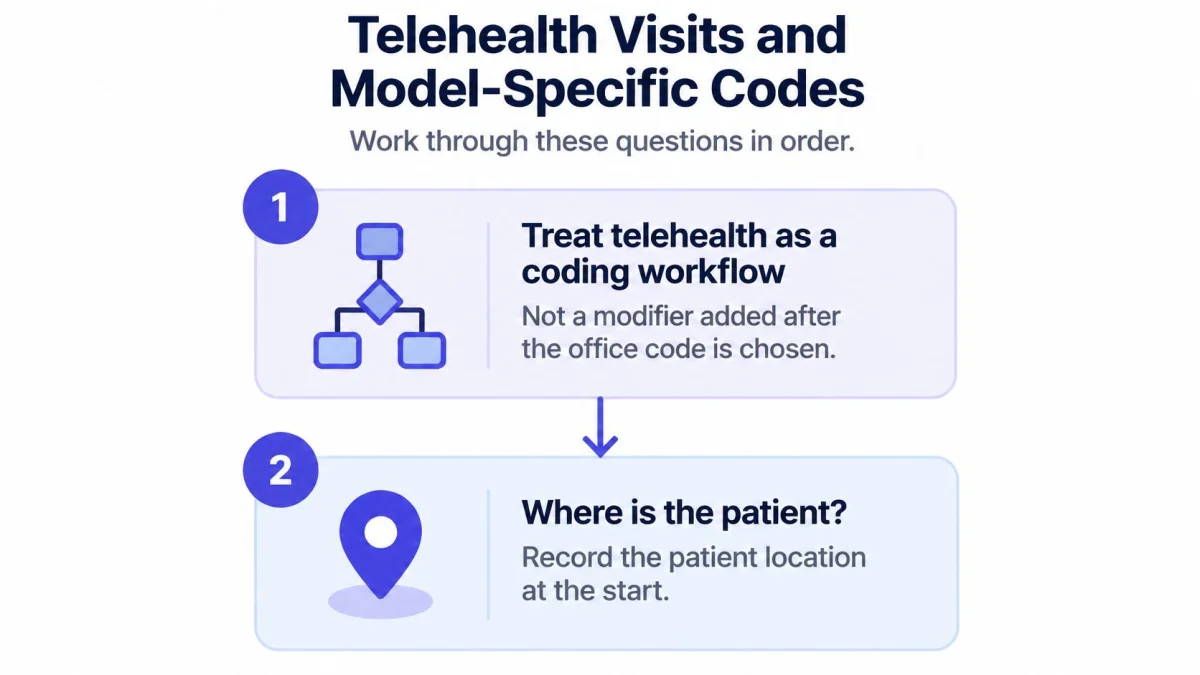
Work through the questions in this order:
- Patient location. Record it at the start of the visit, in the note, in the patient's terms.
- Clinician location. Record where the clinician is sitting, not the practice address.
- Modality coverage. Does this payer cover the service by audio-video, audio-only, or both?
- Consent. Keep an explicit consent line, not an implied one.
- Place of service and modifier. Use what the payer requires, which isn't always what the last payer required.
- Time documentation. If the service is time-based, record start and stop times.
- Model-specific codes. Check whether a program-specific code replaces the ordinary office code.
Questions 3 and 7 change the code most often. The CMS MLN Connects newsletter for January 22, 2026 reports that CY 2026 adds five CPT/HCPCS codes to Medicare's telehealth list, and that the TEAM model introduces nine new E/M HCPCS codes, G0660 through G0668, requiring certain home-based telehealth visits to use TEAM-specific, time-based codes. The same guidance states that telehealth documentation may need patient and provider locations, explicit consent, and start-and-stop times for time-based billing.
The walkthrough below covers the documentation sequence in practice.
Build two template lines once and stop rebuilding them: one for consent, one for both locations. Everything else in the sequence is a lookup, and lookups belong on a payer sheet rather than in the clinician's memory. The telehealth documentation requirements checklist is a reasonable starting point for that sheet.
Outside the US, CPT is a US code set and doesn't travel. The documentation discipline transfers cleanly, because naming the problem, the evidence and the risk is good clinical practice anywhere. The codes, modifiers and place-of-service values don't. UK and international clinicians should treat the local payer or health system as the authority on what's claimable.
Audit Risks and the Pre-Signature Checklist
The finding that costs the most money isn't a missing signature. It's a note that lists activity instead of reasoning, because it looks thorough while supporting nothing.
The coding session materials hosted by the National Indian Health Board emphasize that data ordering alone doesn't increase MDM: the record must show analysis that affected management, such as independent interpretation or discussion of results with an external clinician. The same materials note that CMS has highlighted improper same-day E/M billing with intravitreal injections, which shows that coding problems can arise from the relationship between an E/M service and a procedure rather than from the apparent complexity of the note.
Findings and the fix at the keyboard
| Audit finding | Why it happens | Fix before submission |
|---|---|---|
| Level supported by time with no total time statement | Appointment length recorded instead of clinician time | Add the total date-of-service minutes and the work they covered |
| Data ordered but never analyzed | Activity lists replace reasoning | Show the result reviewed or discussed and what it changed |
| Same-day E/M and procedure with modifier 25 | The E/M isn't separately identifiable | Document the separate problem and the work done outside the procedure |
| Cloned or mismatched template text | The template carries findings from a different visit | Edit to the problems actually addressed |
| G2211 on a visit that doesn't qualify | The add-on is applied out of habit | Check the longitudinal care requirement and the payer policy |
| Prolonged service on an MDM-selected visit | G2212 appended to any long note | Report it only with a time-selected base code |
| History and exam used to justify the level | A pre-2021 habit | The level rests on MDM or time, with history and exam documented separately |
Every fix in that table is a subtraction or a substitution, not an expansion. That's deliberate. A longer note isn't a safer note. Excessive activity lists obscure medical necessity and can create the appearance of code inflation, which is the opposite of what the clinician intended.
The pre-signature pass
Run these in order, before the note is signed:
- Problems: each one addressed is named, not merely listed on the problem list.
- Data: the result reviewed or the discussion held is named, with what it changed.
- Risk: the management decision is specific, with a drug name and dose or a stated decision about admission, referral or further workup.
- Level: two of three MDM elements match, or the documented total time matches the code.
- Pathway: the note says which one was used.
A straightforward visit should take under two minutes to check. The documentation audit checklist is worth printing once and keeping beside the keyboard until the pass becomes automatic.
Coverage questions deserve the same pre-visit treatment, especially in behavioral health where telehealth rules vary by plan. Patients can check telehealth psychiatry benefits through Integrative Psychiatry of America's verification process before the appointment, which removes one of the more common causes of a clean note attached to an unpayable claim.
If a line fails the check, drop the level. Don't write the note to fit the code.
That last rule is the one clinicians resist and the one that keeps a practice out of trouble. Downcoding a visit costs a small amount today. Defending an unsupported level costs the practice its credibility with a payer for years.
Pick One Coding Habit to Change This Week
Choose one documentation habit for the week: state the coding pathway, write a dated total-time statement, or remove template text the encounter does not support. Keep the change narrow enough to repeat on a busy clinic day. Add another only when the first is routine.
Make the habit specific to your encounter types. For a breast surgery practice, the service context described on OC Breast Surgery's our lead breast surgery physician page is a starting point for choosing which specialty templates to review. The coding habit remains concrete: retain only encounter-specific documentation that supports the selected pathway.
If you choose time, make the sentence explicit: “On [date], I spent [total time] on this patient's care.” Enter the actual qualifying total rather than copying a default. When selecting by MDM instead, the documented work must support two of the three elements. A polished note alone does not establish the level.
PatientNotes records encounters on the web or iPhone and produces structured notes with suggested ICD-10 and CPT codes for US billing; clinicians must review, edit and approve the output before copying it into the EHR.
Keep responsibility for the time statement and final code with the clinician.
For workflow guidance, use PatientNotes resources. Current options include $70 per user per month billed monthly or $50 per user per month billed annually, a 7-day free trial with no credit card, a 14-day money-back guarantee, and HIPAA compliance with a BAA at no extra cost. Templates cover 37 specialties, with an AI template builder; there is no enterprise tier or sales call. If that workflow fits, start with PatientNotes and apply your chosen habit to the next ten notes. Judge the result by whether the documentation supports the code, not whether the software suggested it.