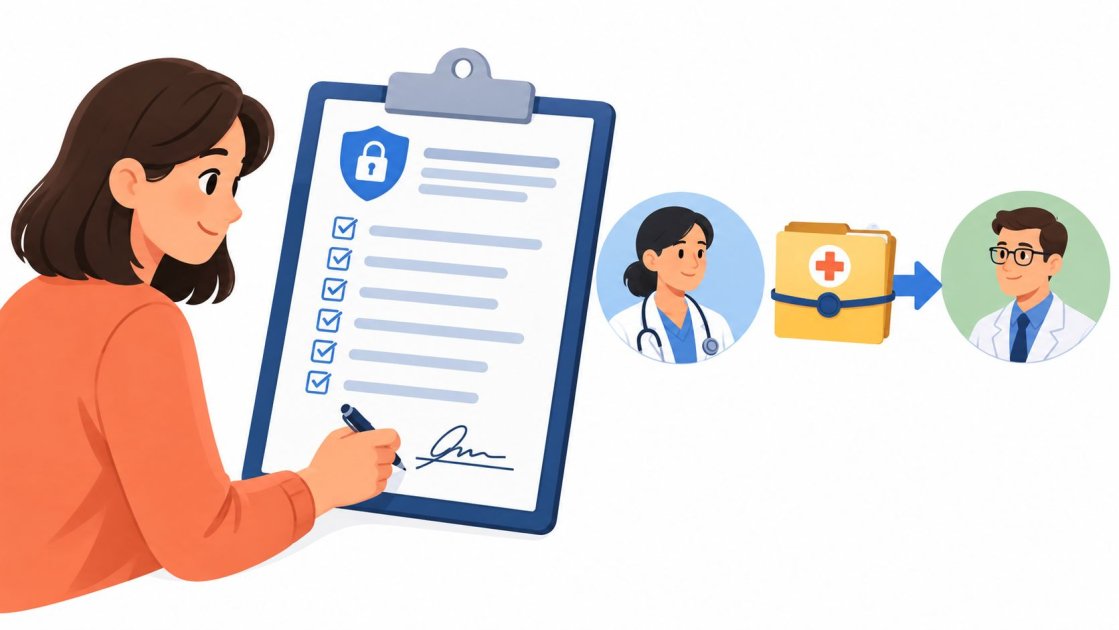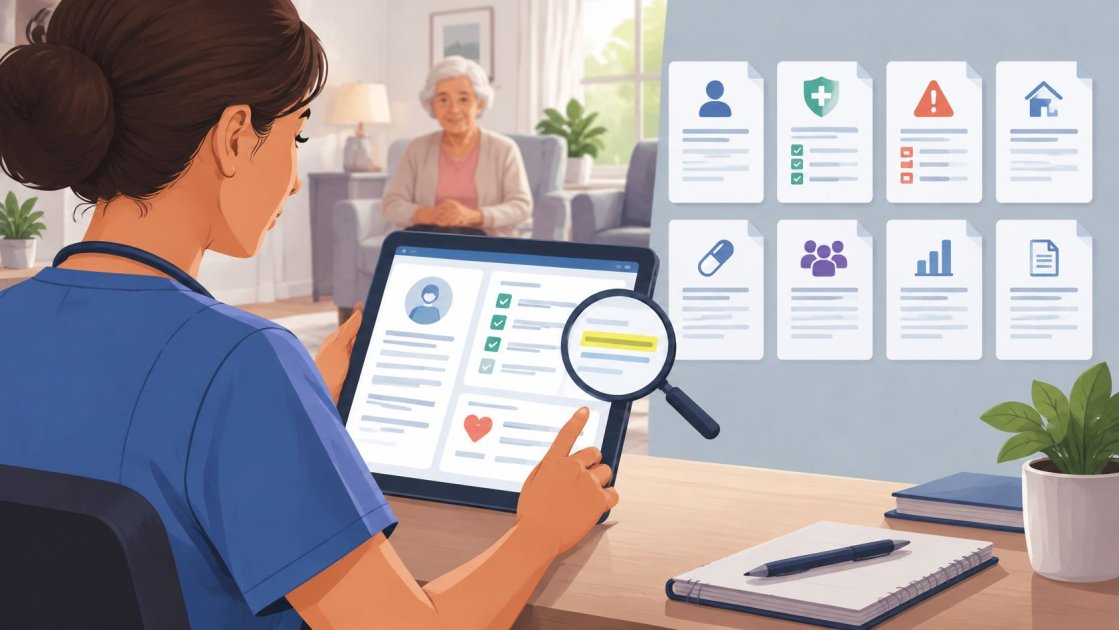
It is 7 p.m. A covering nurse opens a chart for a home visit she did not make. The note says patient stable and nothing else. She can't tell what changed, what was taught, or what to check in the morning.
That gap is not minor. Insufficient documentation accounted for 51.4% of improper payments for home health services during the 2024 reporting period, according to CMS guidance on home health services compliance. Reviewers don't return notes because the prose is weak. They return them because eligibility, findings, interventions, and response don't connect.
The eight home care documentation examples below pair a document type with the line reviewers, covering clinicians, and payers check first. Each one also gives a customization step for solo and small-practice use. US Medicare rules and UK community practice are flagged where they differ, because a note that works for a Medicare-certified agency won't match a UK GP discharge letter.
Start with the document written most often. Fix its first checked line. Then move to the next.
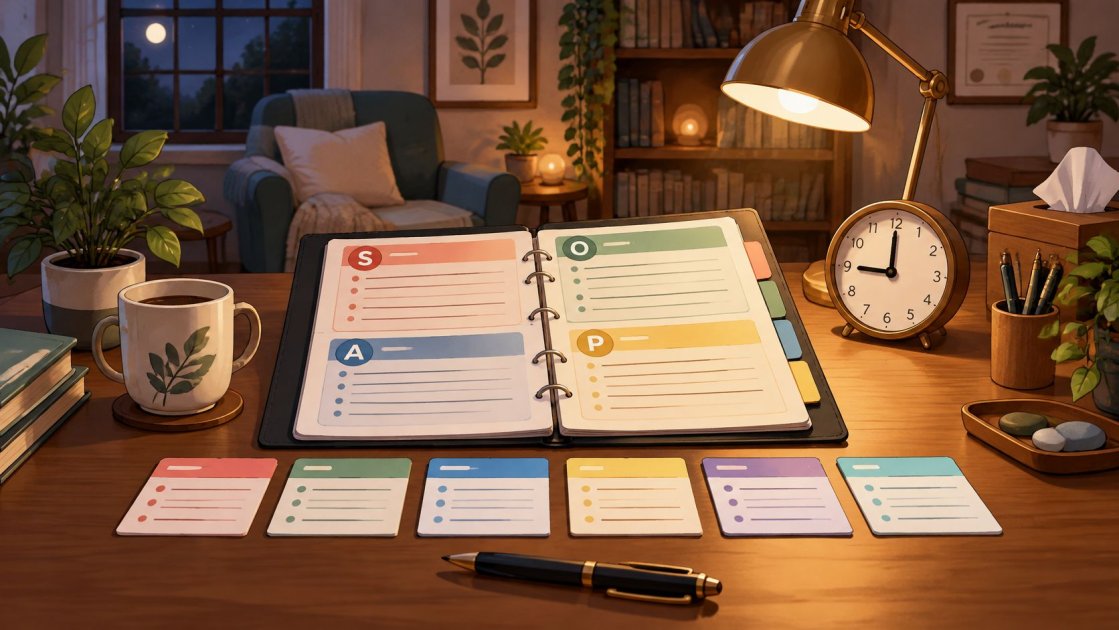
1. Home Visit SOAP Note

A SOAP note records Subjective, Objective, Assessment, and Plan for a visit in the patient's home. The format came from Lawrence Weed's problem-oriented medical record, described in 1968. Home care adds location, others present, home environment, and caregiver input to the office structure.
Say a family physician visits an older adult with heart failure after discharge. Subjective captures breathlessness and sleep. Objective records weight, edema, and medication bottles checked. Assessment states whether findings have changed. Plan names the teaching done and the next action.
The Line Reviewers Check First
Reviewers look for change since the prior visit and patient response. In a central Texas home-health evaluation of 160 de-identified nursing notes, documenting the patient's response to treatment increased from 57% to 85% after retraining. A note without that line forces the next clinician to guess.
- Fixed header: Add location, others present, consent, and source of each fact, such as patient report, caregiver report, or direct observation.
- Objective only where relevant: Record stairs, rugs, or bathroom access only when the environment affects care.
- Actionable Plan: Write each task with an owner and timing so a covering clinician can act without a phone call.
PatientNotes offers SOAP and home-visit style templates across 37 specialties, and its AI template builder can turn a preferred layout into a reusable template. Further detail on skilled visit structure sits in the home health documentation guide.
2. OASIS Assessment (Outcome and Assessment Information Set)
OASIS is not a visit note. It's a standardized data set that Medicare-certified home health agencies collect at start of care, follow-up, transfer, resumption of care, and discharge. Solo clinicians who contract with an agency often supply findings that feed those items.
The CMS home health quality program states that CMS has required Medicare-certified home health agencies to collect and transmit OASIS data for eligible adult patients since 1999. CMS reported 11,474 Medicare-certified home health agencies in 2021. That scale explains why inconsistent functional scoring creates problems far beyond one chart.
A Worked Pattern
A home health nurse completes the start-of-care OASIS on the first visit. A therapist later supplies gait, transfer, and bathing findings. The nurse uses those findings for the functional items, but only if the therapist's note gives assist level and distance, not a general comment about mobility.
If the visit note says independent and the OASIS item says assistance required, reviewers will trust neither document.
- Current version: Use the CMS OASIS guidance in effect on the date of the visit, not a saved form from a prior episode.
- Consistency check: Compare functional answers against the visit note before submission.
- Clear boundary: PatientNotes does not produce OASIS items. Clinicians write the visit note there and copy findings into the agency system, as with any EHR that is not Semble.
UK clinicians don't complete OASIS. The transferable lesson is narrower. Standardized functional items only work when the underlying note records observable function.
3. Home Health Plan of Care (CMS-485)
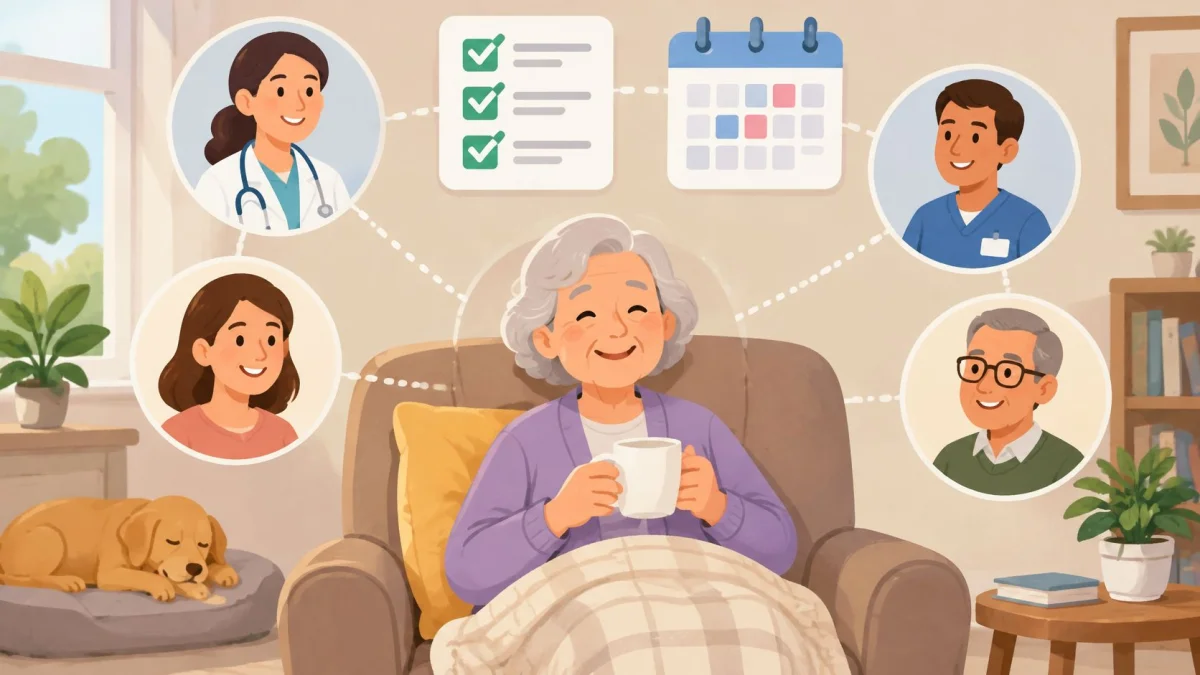
The plan of care is the order set. It lists services, visit frequency, goals, medications, and diet. A certifying physician or allowed practitioner signs it, and the agency updates it as the condition changes.
A weak plan says physical therapy to improve mobility. A usable plan says physical therapy three times a week for four weeks after hip fracture, with a goal such as walks 100 feet with a walker in 3 weeks. The second version lets a reviewer match visits to orders and progress to a target.
Medication detail deserves the same discipline. The Accreditation Commission for Health Care 2024 findings reported that 61% of medication profiles contained documentation deficiencies involving missing dosage instructions or parameters, oxygen-therapy details, conflicting orders, administration sites, or unlisted medications.
Customization for Small Practices
- Measurable goals: Replace improve and increase with distance, time, frequency, or assist level.
- Signature control: Confirm the signed date falls within the certification window set by CMS rules and confirm who holds the certifying role.
- Cross-discipline alignment: Check that nursing, therapy, and aide notes deliver what's ordered, no more and no less.
Where wound care sits in the plan, agencies sometimes add specialist wound support at home alongside the visiting nurse. The plan still needs the order, frequency, and measurable wound goal in plain terms.
4. Home Health Face-to-Face Encounter Note
This note fails on dates and vagueness, rarely on length. Medicare requires a face-to-face encounter related to the primary reason for home care, within a defined window before or after start of care. The certifying practitioner documents the encounter and the findings that support home health.
A physician sees a patient 10 days before start of care. A diagnosis alone doesn't carry the note. The useful lines record gait instability, a recent fall, the effort it takes to leave home, and the skilled therapy need that follows from those findings. A reviewer can then connect encounter, homebound status, and skilled need without hunting through the chart.
Fields That Should Never Be Free Text Only
- Encounter date: Put the date in a fixed field and check it against the current CMS window before scheduling.
- Related findings: Tie examination findings to the primary reason for home care, not to an unrelated problem list.
- Homebound evidence: State the functional limit and the taxing effort involved in leaving home.
- Skilled need: Name the service that requires a clinician, not general support.
An agency template sent to a referring physician works when the fields are fixed rather than open. A one-page form with printed prompts for the encounter date, related findings, homebound evidence, and skilled need leaves little room for a narrative that skips the date. That setup suits a small practice that receives referrals from several agencies, each with a different portal.
The trade-off is simple. A dedicated template feels rigid on a routine visit, but it prevents the missing date that causes a denial weeks later. The encounter requirement itself is specific to US Medicare home health, yet the same fields hold up under review elsewhere because payers read the same evidence chain.
5. Home Therapy Visit Note (PT and OT)
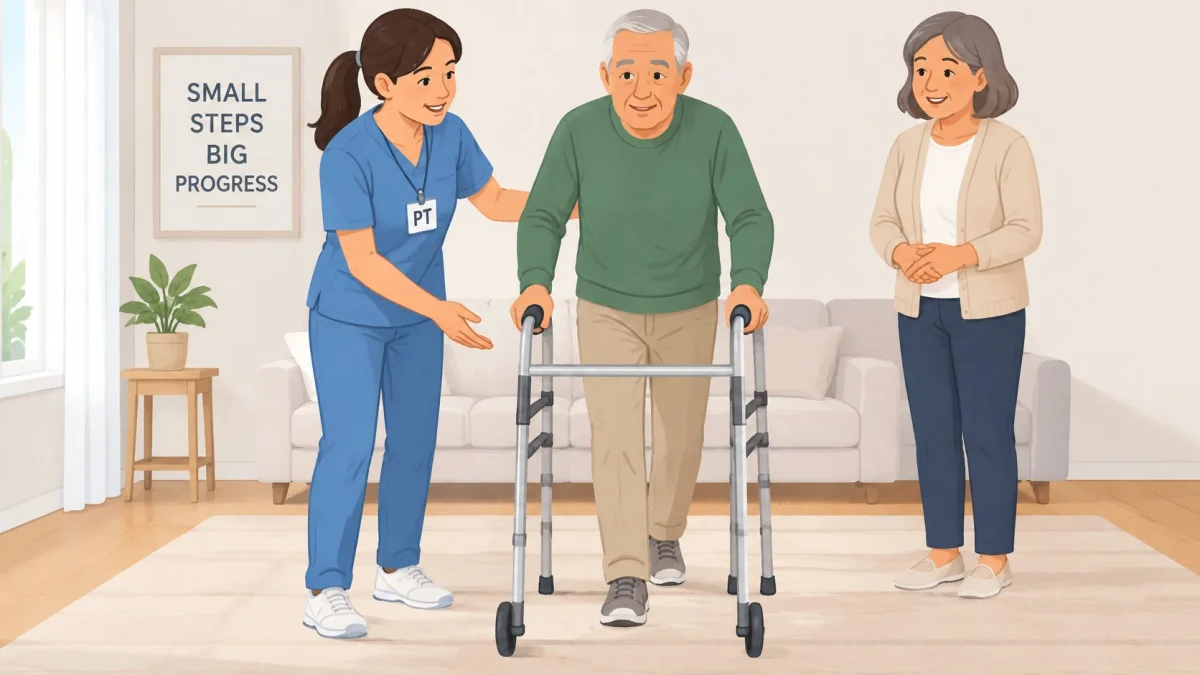
Payers read therapy notes for skilled care and measured progress. Gait training performed tells them almost nothing. Distance walked, assist level, device used, cues given, and change from the prior visit tell them whether a therapist was needed.
The observed finding carries the note. "Ambulated 40 feet with a front-wheeled walker, contact guard assist, one standing rest break, steadier turning than last visit" gives a reviewer a measurement. "Gait training performed" gives them a label. An occupational therapist on the same case documents a kitchen safety assessment, the recommended changes, and the caregiver's agreement. Together, those notes show function in the rooms where the patient lives.
Timeliness matters as much as content. A note written during or right after the visit captures distances and assist levels while they are still accurate, and it keeps the claims cycle moving. A note written days later tends to round those details into vague summaries.
What to Put in Every Note
- Measured result: Record distance, time, repetitions, or assist level at each visit.
- Skilled element: State the cueing, progression, or safety judgment that required a therapist.
- Home program: Write a short summary the patient or caregiver can follow between visits.
- Progress timing: US Medicare sets progress report timing in the CMS Medicare Benefit Policy Manual, Chapter 15, section 220.3. UK community teams follow the review interval set by their own service, so state the schedule your note is working to.
A small practice can prefill its template with the devices and assist levels it uses most, so each visit starts from a partly structured note. Structure options appear in this physical therapy progress note template.
6. Home Safety and Environment Assessment
A hazard list without an owner is unfinished work. The safety assessment should link each observed risk to the patient's function, a recommended change, an agreed action, and a date to recheck it. Reviewers read this document for one thing first: whether the top risk has a named owner before the clinician leaves the home.
The short video below shows the kind of room-by-room observation that should sit behind the written assessment.
On one visit, an occupational therapist finds a loose rug and no bathroom grab bar. The note ranks the grab bar first, records the patient's transfer difficulty, names who will arrange installation, and states that the caregiver agreed to remove the rug before the next visit. A physiotherapist assessing stairs on the same case records rail side, step pattern, rest needs, and whether the patient can repeat the climb safely.
That ranking is the line a covering clinician or payer checks first. A hazard with no owner reads as observed but unmanaged.
Connectivity is a second constraint. Industry reporting on mobile documentation in home health notes that 19% of home healthcare agencies provided no mobile devices to clinicians and only 28% of Medicare-certified agencies electronically exchanged information with outside providers at the point of care. A template that assumes live connectivity will break in that setting. For solo and small practices, the practical fix is a one-page room checklist covering hallway, bathroom, stairs, kitchen, and exits, with a blank owner field beside each hazard.
The framing also shifts between systems. Under Medicare home health, safety findings feed the plan of care and support skilled need. UK community clinicians record the same risks for the GP and district nursing handover, with the emphasis on who monitors the fix. PatientNotes records visits on iPhone or the web, so a safety walkthrough can be captured as the clinician moves room to room.
Practical rule: Label each fact by source, preserve the visit timestamp, and list unresolved discrepancies instead of presenting caregiver statements as clinician-verified findings.
- Consent for photos: Photograph hazards only with consent and under practice policy.
- Risk ranking: Put the hazard most likely to cause harm before the next visit at the top.
- Agreement line: Record what the patient and caregiver agreed to do, and what they declined.
The AOTA framework supports documenting the environment as part of occupational profile and performance context. That context earns its place in the note only when it changes a decision, an order, or a follow-up task.
7. Home Care Discharge Summary
Discharge summaries go wrong when clinicians start them on the last day. Memory fills the gaps. Medication changes get missed. Follow-up ownership stays vague.
A better method starts the summary at the first visit. Reason for care, baseline function, and goals go in early. Each visit adds outcomes, medication changes, and unresolved risks. At discharge, the clinician edits a near-complete draft instead of reconstructing weeks of care.
A six-week episode closes with a list of medication changes. The summary records status at discharge, goals met and unmet, each change checked against the current medication list, equipment left in the home, and the primary care follow-up date. Reviewers and covering clinicians read the reconciliation first, then look for who owns each open task. A UK community clinician sends a similar discharge letter to the GP, but the emphasis shifts to ongoing monitoring, district nursing handover, and who holds the next review.
The Handoff Lines That Matter
- Medication reconciliation: Check every medication against the current list before sending.
- Unfinished work: Name pending results, equipment orders, and symptoms that still need review.
- Next responsible person: State the clinician or service taking over, not just "follow up as needed."
- Same-day sending: Send the summary to the next clinician on the same day when possible.
A reusable structure is available in the discharge summary template, which solo clinicians and small practices can adapt for agency, private, or UK GP formats.
8. Home Visit Mental Health Progress Note

Home-based mental health notes need two separations done well. The standard progress note stays distinct from detailed psychotherapy notes. Observations made by the clinician stay distinct from reports given by family members present in the home.
On paper, the progress note covers sleep, mood, medication adherence, risk screening, safety plan review, intervention, and next contact. Reviewers read the risk line first. They want screening, protective factors, and safety plan status in one place, even when nothing has changed since the last visit. A psychologist providing home-based therapy keeps detailed session content in a separate psychotherapy note, while the progress note records attendance, themes at a summary level, risk, and plan.
The UK handles this split differently. Community mental health records usually sit in a single shared record accessible to the GP and the wider team, so sensitive session detail gets summarized rather than filed apart. For solo and small practices, the practical customization step is a collateral block in the template: every family report gets labeled with who said it, so clinician findings and relative accounts never blur.
Vendor contracts matter here because mental health records carry sensitive protected health information. HHS guidance on HIPAA business associates states that HIPAA requires a written contract or other written arrangement with a business associate. Further HHS guidance on business associate contracts says the agreement must cover permitted uses and disclosures, safeguards, subcontractor restrictions, and return or destruction of protected health information where feasible. The HIPAA Security Rule summary from HHS also requires satisfactory assurances that a business associate will appropriately safeguard electronic protected health information.
- Risk at every visit: Document screening, protective factors, and the safety plan, even when risk appears unchanged.
- Separate storage: Keep detailed psychotherapy notes apart from the standard progress note.
- Specialty structure: Use a psychiatry or psychology template that prompts for mental status, adherence, and collateral source. PatientNotes includes built-in templates across 37 specialties, with psychology formats such as a DAP progress note among the examples.
How the eight home care documents differ
| Item | Setting | Who usually completes it | Governing rule or source | Best for |
|---|---|---|---|---|
| Home Visit SOAP Note | Patient's home | Physician or allied health clinician | SOAP format; Weed's problem-oriented medical record (1968) | Structured documentation of a home visit |
| OASIS Assessment (Outcome and Assessment Information Set) | Medicare-certified home health episode | Agency clinicians, often with nurse coordination | CMS OASIS guidance; 42 CFR 484.55 | Standardized assessment and quality reporting |
| Home Health Plan of Care (CMS-485) | U.S. Medicare home health | Certifying physician or allowed practitioner, with agency team input | 42 CFR 484.60 and 424.22 | Coordinating and authorizing home health services |
| Home Health Face-to-Face Encounter Note | Encounter before or shortly after home health start of care | Certifying practitioner or other qualifying encounter practitioner | 42 CFR 424.22; CMS Medicare Benefit Policy Manual, Chapter 7 | Documenting homebound status and skilled need |
| Home Therapy Visit Note (PT and OT) | Patient's home during therapy services | Physical or occupational therapist | CMS Medicare Benefit Policy Manual, Chapter 15; AOTA practice framework | Recording interventions, functional progress, and skilled need |
| Home Safety and Environment Assessment | Patient's home | Occupational or physical therapist; may also be completed by a nurse or physician | AOTA Occupational Therapy Practice Framework; CDC STEADI | Identifying hazards and planning fall prevention |
| Home Care Discharge Summary | At the end of a home care episode | Home care clinician or agency team | 42 CFR 484.110; England's Health and Social Care Act 2008 Regulations, Regulation 17 | Communicating outcomes and follow-up needs |
| Home Visit Mental Health Progress Note | Patient's home during a mental health visit | Psychiatrist, psychologist, therapist, or other mental health clinician | HIPAA Privacy Rule, including 45 CFR 164.501 and 164.508(a)(2) | Recording session care, risk, and safety planning |
Start With One Template and Adapt It This Week
Choose the note you write most and fix that first. In many home episodes that is the visit SOAP note or the PT/OT visit note, because the OASIS answers, face-to-face date, plan-of-care goals and discharge summary all lean on the same observed findings.
Build the template around the line a reviewer checks first. For a SOAP note: what changed since the last visit, who supplied each fact, what you did, and how the patient responded in measurable terms. For a plan of care: ordered frequency, a measurable goal, and a signature date inside the certification window. For discharge: medication reconciliation, unfinished work, and the named person now responsible.
Then run it through three real visits. One visit exposes missing prompts. Three expose duplicate entry, fields that never change a decision, and information a covering clinician needs at 7 p.m. buried on line twelve. Move the covering-clinician fields up. Delete prompts that only make the note longer.
Adapt the same skeleton to the setting. US Medicare work needs OASIS consistency, face-to-face timing, and plan-of-care alignment. UK community work needs a GP-ready summary, a clear handover to district nursing or therapy services, and wording a patient or carer can follow. The order stays constant in both: observable findings first, interpretation second, ownership of the next task explicit.
Let offline reality shape the template before you rebuild around software. Judge a scribe by the actual constraints of home work: recording on iPhone or web, still recording with a locked screen, notes and tasks in the clinician's language, and export limits that matter because Semble is the only native EHR connection, every other EHR relies on copy and paste, and there is no Chrome extension. ICD-10, CPT and CDT suggestions are US billing only. Test that in a driveway with weak signal, during a caregiver interruption, and against a cold read by a reviewer.
Start this week with one note type, one missing field, and three visits. That is enough to show whether home care documentation examples survive a porch, a dead zone and a payer reading later.
Record a home visit on iPhone or web, keep recording through poor signal and a locked screen, review a structured SOAP, progress, discharge or specialty note with follow-up tasks and US billing-code suggestions, then copy it into the EHR. HIPAA compliance includes a BAA at no extra cost. Pricing is $70 per user per month billed monthly or $50 per user per month billed annually ($600 per year), with a 7-day free trial, no credit card, no contract, and a 14-day money-back guarantee: PatientNotes.