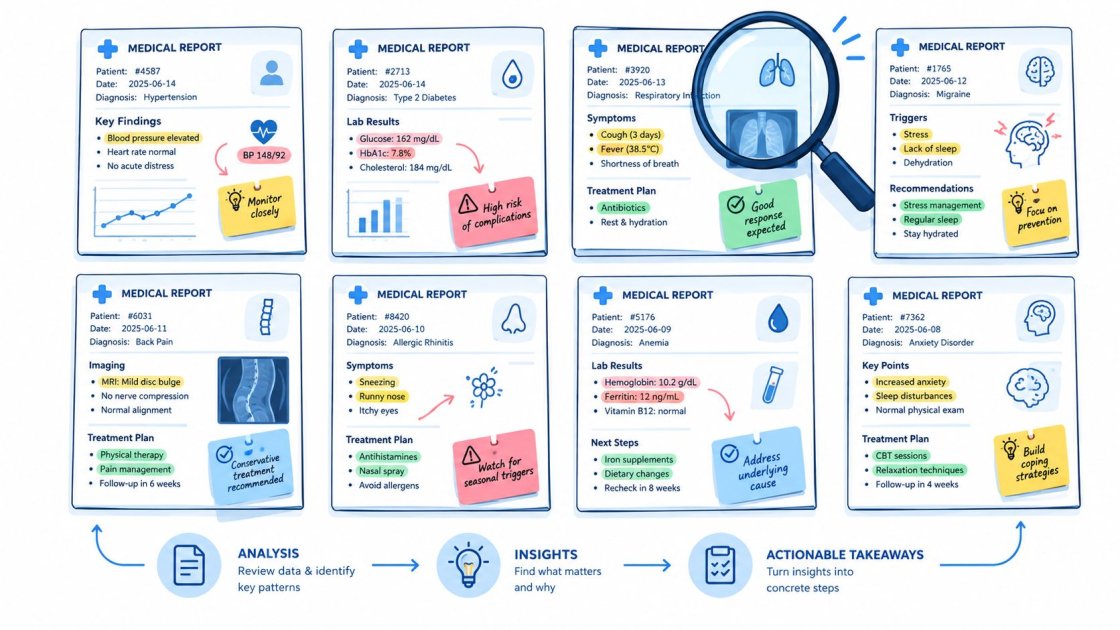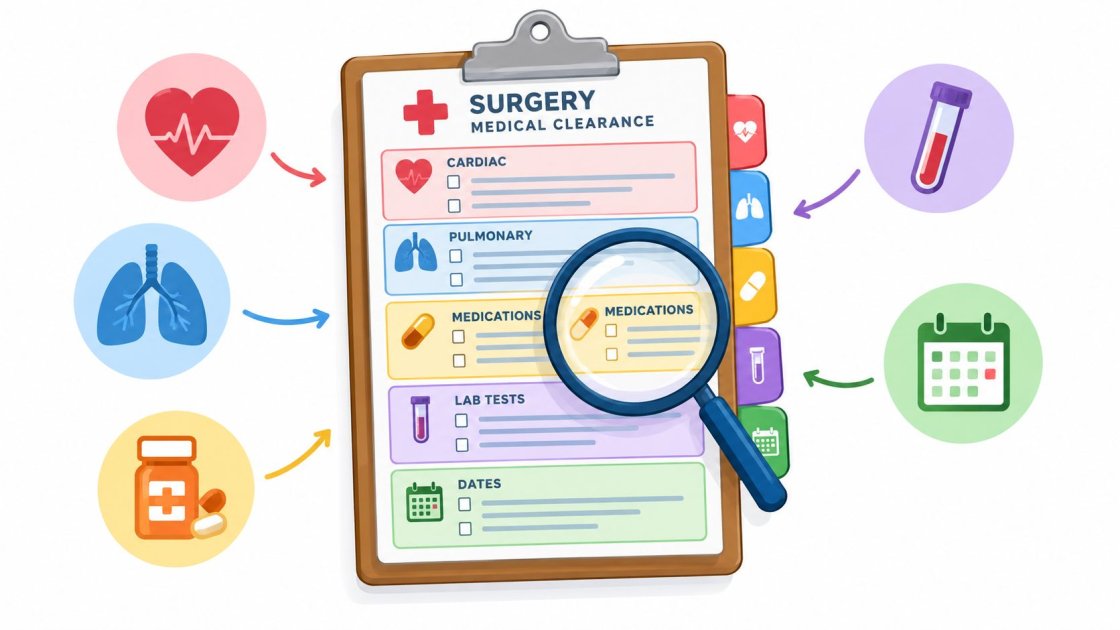
The clearance request arrives between appointments. The patient's operation is approaching, the surgeon's form has a signature box, and the attached paperwork doesn't identify the anesthetic plan or explain who will manage the anticoagulant. Signing is the easy part. Establishing what the signature means takes a better document.
A useful medical clearance for surgery form records the assessment, the remaining risks, and the actions needed before surgery. It gives the receiving team enough information to act without reconstructing the consultation from scattered notes.
What a Medical Clearance for Surgery Form Actually Does
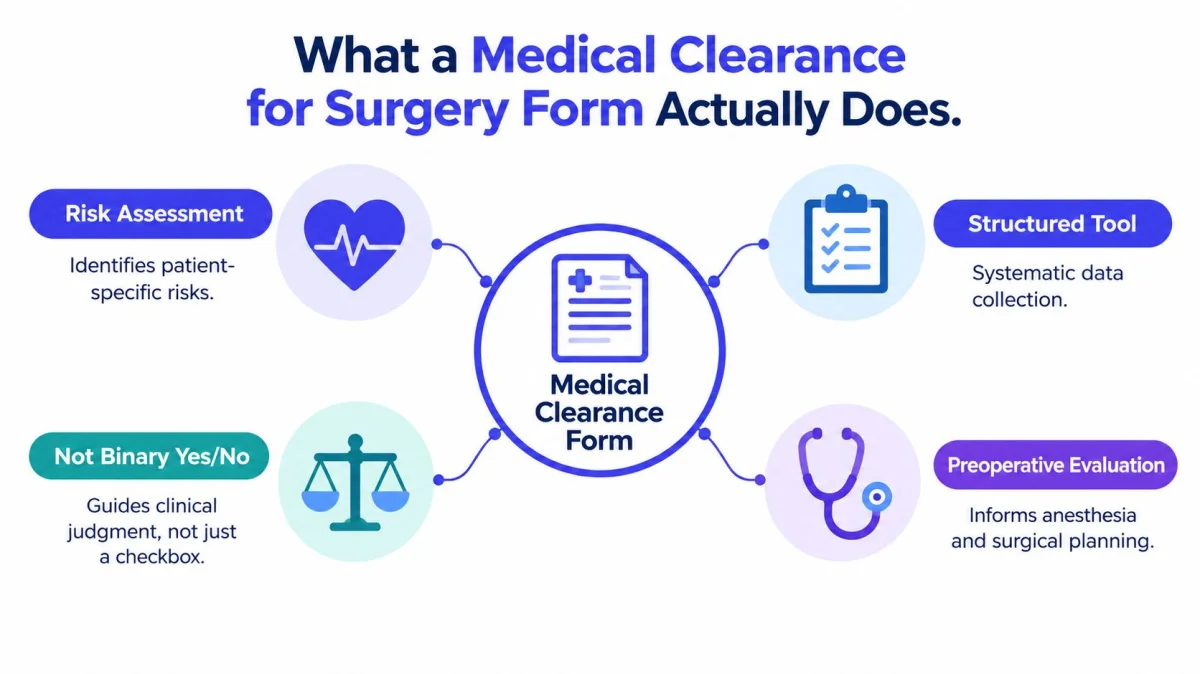
A clearance form is a structured preoperative risk-assessment document, not a certificate of risk-free surgery. Its value lies in connecting the patient's current condition to the proposed operation and identifying anything that needs further evaluation or treatment. The NHS explanation of surgical preparation describes preoperative assessment as a review of health, medical history, and home circumstances to identify problems requiring treatment and special care needs.
The practical failure is a form that contains diagnoses and a signature but no reasoning. A list that says diabetes, hypertension, and asthma doesn't explain current control, relevant symptoms, or what the surgical team should do differently.
The diagram separates the document's related functions.
A communication document, not a permission slip
The originating clinician contributes an assessment. The surgeon, anesthesia team, and hospital pre-assessment service still have their own questions to resolve. A signed form doesn't guarantee that the scheduled procedure will proceed.
A practical template should make these questions easy to answer:
- What was assessed? Identify the operation, available anesthetic information, and current clinical findings.
- What remains unresolved? Separate pending investigations from reviewed results.
- What needs action? Record optimization recommendations and medication instructions.
- Who receives the information? Identify the surgical and anesthesia contacts, with pharmacy involvement where medication decisions need coordination.
Practical rule: A receiving clinician should be able to identify the recommendation and its conditions without searching the entire consultation note.
The field tables below can be copied into a practice template. They're a documentation framework, not a substitute for procedure-specific assessment.
Purpose and Regulatory Context of the Form
A form can be correctly dated and still fail its main purpose if the receiving team cannot tell what was assessed, what remains conditional, and what needs follow-up. Treat it as a structured risk-assessment communication document, not a yes-or-no permission slip.
In the United States, Medicare and The Joint Commission require a completed history and physical within 30 days before surgery, according to this peer-reviewed discussion of preoperative evaluation and unnecessary testing. That timing requirement makes clear dates important. It does not guarantee that a patient's health will remain unchanged or that the procedure will proceed.
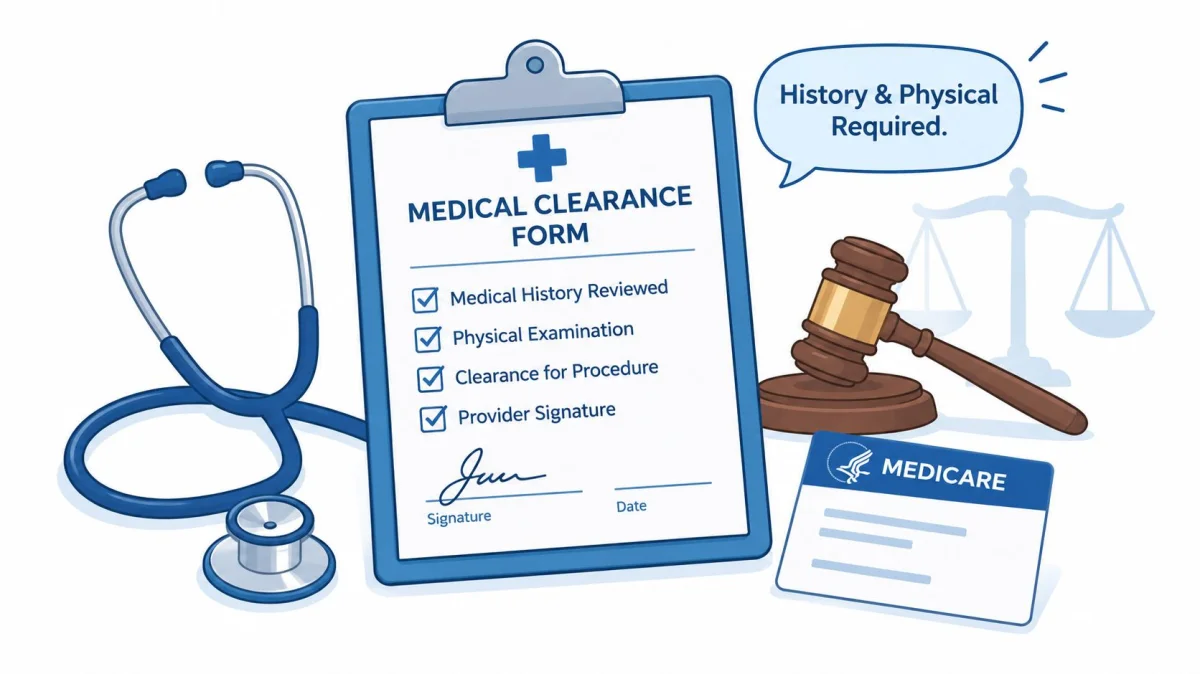
Keep the encounter date, signature date, and transmission date distinct. An office sending an updated document should not make it appear that a new examination took place. Date the assessment itself, then identify later results or communications as updates.
The recommendation also needs a defined scope. Name the proposed operation and include the anesthetic plan when available. The procedure's invasiveness and the patient's relevant disease affect the assessment; a generic statement covering any operation does not help the surgical or anesthesia team make decisions.
Before signing, confirm the procedure description, scheduled date, and receiving facility's paperwork requirements. A facility may have its own process for accepting or updating a history and physical, so do not assume the practice form replaces it. Keep the original assessment identifiable, and make new symptoms, medication changes, pending results, and optimization targets visible to the people coordinating care. Medication decisions that affect anesthesia need a clear handoff, not a vague instruction to “review medications.”
There is a practical trade-off: shorter forms are easier to process, but cutting the assessment, conditions, or follow-up steps leaves the receiving team without the context needed to act on the recommendation.
Required Fields on the Clearance Form
The template should separate history, findings, and assessment. Mixing them into a single free-text box makes it difficult to tell what the patient reported, what the clinician examined, and what the clinician concluded.
The ASA practice advisory for preanesthesia evaluation integrates the medical record, patient interview, physical examination, and relevant test findings. It identifies airway, heart, lungs, and vital signs as baseline examination components. That supports a form with distinct places for each information source.
Required Field Categories on a Medical Clearance for Surgery Form
| Field category | What to capture | Why it matters |
|---|---|---|
| Patient identifiers | Name, date of birth, record identifier, contact details | Keeps the assessment matched to the correct patient |
| Procedure details | Operation, surgical approach, scheduled date, urgency, surgeon | Establishes the scope of the recommendation |
| Anesthesia | Planned type, if known; uncertainty requiring clarification | Connects the assessment to anesthetic planning |
| Medical history | Active diagnoses, current status, cardiopulmonary symptoms, exercise tolerance | Distinguishes a diagnosis label from its current significance |
| Surgical and anesthetic history | Previous procedures and relevant anesthetic problems | Makes prior concerns visible |
| Medications | Prescription medicines, nonprescription products, supplements; anticoagulant and antiplatelet flags | Supports reconciliation and an explicit management plan |
| Allergies | Substance and reaction type | Avoids an unexplained allergy label |
| Focused examination | Vital signs, airway, cardiovascular and respiratory findings | Records the examined baseline |
| Investigations | Indication, date, result, pending status, interpretation | Shows what information informed the decision |
| Assessment and plan | Relevant risks, optimization needs, disposition, unresolved issues | Explains the recommendation |
| Authentication and contact | Clinician name, credentials, signature, date, contact route, follow-up responsibility | Identifies the author and routes questions |
Airway findings should describe the assessment performed rather than imply a complete anesthetic evaluation. The originating clinician's examination contributes information; the anesthesia team uses that information within its own evaluation.
A history and physical template can provide the underlying structure. The surgery-specific additions are the proposed operation, anesthetic information, conditional recommendation, and handoff requirements.
A blank field is ambiguous. “Not assessed,” “not available,” and “pending clarification” communicate different situations.
The signature block should sit beside the recommendation, not beneath pages of disconnected results. Include explicit follow-up requirements and a usable contact route so the receiving team can resolve uncertainty before the procedure.
Indication-Driven Testing Instead of Routine Panels
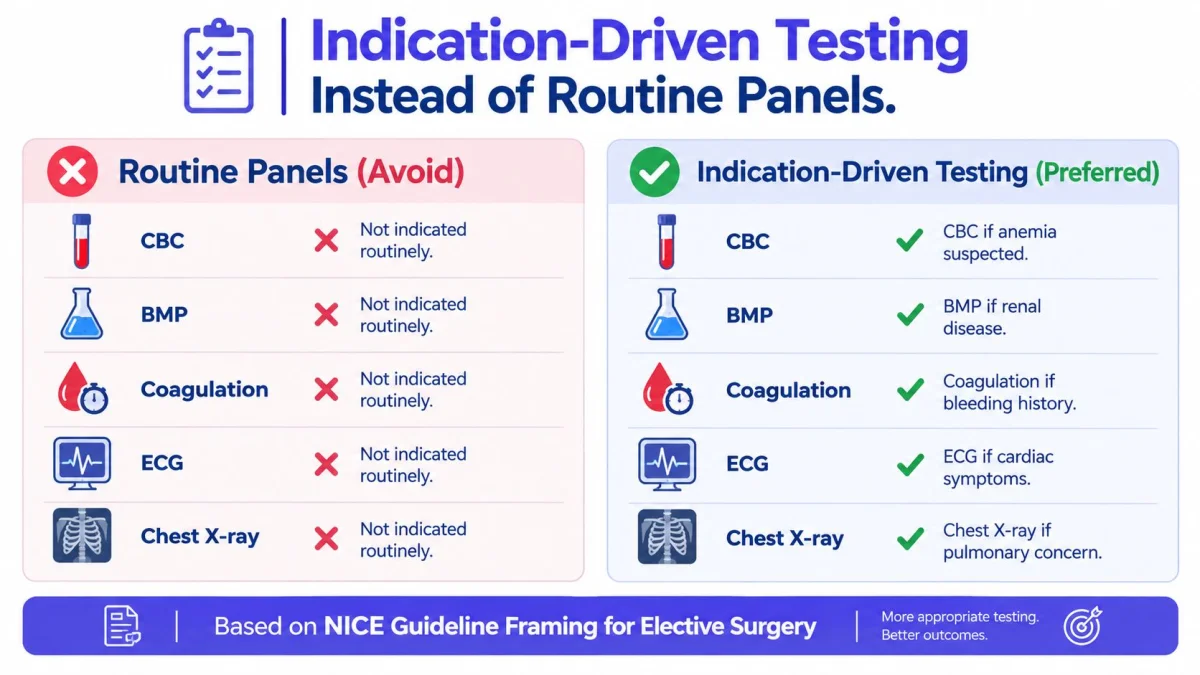
A preoperative form that requires a CBC, metabolic panel, coagulation studies, ECG, and chest X-ray for every patient rewards completed boxes, not sound assessment. The clinician should document the reason for each test and how its result affects the surgical plan.
NICE guidance on routine preoperative tests for elective surgery links investigations to the scale of surgery and relevant conditions, including cardiovascular, renal, or respiratory disease, diabetes, and obesity. The ASA advisory discussed earlier also supports testing for a clinical indication rather than automatically ordering panels for healthy patients having low-risk procedures.
A practical entry answers four questions: What prompted the test? When was it done? What did it show? Does it change management? “Normal” by itself leaves the receiving team unsure whether the original concern was addressed.
For example, document the anemia or bleeding concern behind a CBC. Link renal function and electrolyte testing to kidney disease or medication effects. For coagulation studies, state the relevant bleeding history, condition, anticoagulant context, or procedural concern. An ECG entry should name the cardiovascular condition or symptom and relate it to the proposed procedure's risk. For any other investigation, record the management question it is meant to answer.
These examples reflect the NICE framework, not stand-alone ordering rules. The chart also should not be read as support for chest imaging in every patient with a pulmonary concern.
“Awake” procedures still require clarity about the anesthetic plan. Luxe Aesthetic Surgery's awake tummy tuck overview offers procedure-specific context for that discussion, but it is not a testing guideline.
The 2024 ACC/AHA cardiovascular framework also emphasizes appropriate indications and functional capacity. The quick-reference criteria below distinguish indicated ECG assessment from a blanket requirement.
Translating Risk into a Clearance Statement
The assessment block should explain what the clinician recommends and what must happen next. A checkbox can help staff route the form, but it can't carry the reasoning by itself.
The ASA framework discussed earlier ties evaluation to the patient and proposed procedure. In practical terms, the recommendation should name the operation, state any assumptions about anesthesia, and identify the unresolved issues that could change the conclusion.
Use a disposition with actionable conditions
| Disposition | Documentation needed |
|---|---|
| Proceed | Assessment scope, relevant findings, and recommendations for the receiving team |
| Proceed after optimization | Specific target, action owner, completion deadline, and confirmation process |
| Postpone pending evaluation | Unresolved concern, requested evaluation, and clinician responsible for reassessment |
| Obtain anesthesia consultation | Question requiring anesthesia input and how that response will affect the plan |
A useful optimization target describes an observable endpoint. “Improve medical condition” is too vague for scheduling staff or the patient to act on. “Review the pending investigation and document the resulting management recommendation before confirming readiness” identifies an actual task.
The form can use a structured statement with fields for procedure, anesthetic assumptions, current assessment, required actions, responsible clinician, and review deadline. This is preferable to a reusable sentence asserting that every patient is medically cleared.
Documentation check: A conditional recommendation should remain visibly conditional when copied into a letter, fax cover sheet, or scheduling message.
Specialty consultation should also have a defined question. Requesting cardiology input to clarify an unresolved cardiovascular concern is more useful than requesting another generic clearance signature.
The deadline should correspond to the planned workflow, not an invented universal interval. If a result or consultation remains outstanding, the document should identify who will review it and who will communicate the updated recommendation.
Medication Reconciliation and Perioperative Instructions
A medication list isn't a medication plan. The clearance form needs to distinguish what the patient currently takes from the instructions authorized for the perioperative period.
The 2024 AHA/ACC perioperative guideline overview emphasizes appropriate cardiovascular assessment and avoiding unnecessary delays, overscreening, and overtreatment. Medication decisions likewise require an individualized, coordinated plan rather than blanket instructions copied from a generic form.
Perioperative Medication Guidance
The table below is a documentation checklist, not a drug-holding protocol. The named authorizer should be confirmed through the practice's clinical pathway.
| Medication class | Decision driver | Who authorizes |
|---|---|---|
| Anticoagulants and antiplatelets | Drug, treatment indication, kidney function, bleeding risk, procedure, and bridging question | Named prescribing clinician or specialist, coordinated with surgery and anesthesia |
| Diabetes medicines, including insulin | Actual regimen, fasting plan, glucose-management instructions | Named diabetes prescriber or perioperative clinician |
| SGLT2 inhibitors | Agent-specific perioperative instructions and restart plan | Responsible prescriber with the perioperative team |
| Antihypertensives | Specific agent, indication, and agreed anesthetic instructions | Named prescriber or anesthesia clinician |
| Steroids | Current treatment and need for an explicit perioperative plan | Responsible prescriber with anesthesia input |
| Supplements and nonprescription products | Product, ingredients where known, and procedural review | Designated perioperative clinician |
This structure makes missing decisions visible without asserting a universal stop interval. The medication reconciliation resource can support assembling the list, but the clinician must verify the resulting instructions.
For every medicine requiring a perioperative decision, add fields for continue or change, last dose, restart criteria, authorizing clinician, and date communicated. Include a bridging field where relevant, with space for the actual decision rather than an automatic selection.
Patient-facing preparation material, such as the pre-op guide from a Santa Rosa surgeon at Chernoff Cosmetic Surgery, can support discussion of preparation. It shouldn't override individualized instructions from the responsible team.
Patient instruction: Don't stop or change a medicine without instructions from the responsible clinical team.
The plan also needs a postponement contingency. If surgery moves, staff should route the medication question back to the authorizing clinician rather than leave the patient following instructions tied to the original date.
A single authoritative version, clearly dated and shared with the patient and surgical team, is a practical defense against conflicting instructions.
Beyond the Signature, Handoff and Optimization
A signed form may reach the surgical team without the attachment that explains an unresolved risk or the response being requested. Treat the clearance form as a structured risk-assessment handoff, not a yes-or-no decision. The receiving clinician needs to know what remains open, who owns the next action, and what would change the recommendation.

Evaluation, optimization, recommendation, and anesthesia approval describe different decisions. Evaluation records that an assessment occurred. Optimization states the status of modifiable risks, while the originating clinician's recommendation communicates whether those findings support proceeding. Anesthesia approval is a separate decision by the anesthesia team. These terms should not be used interchangeably or treated as a fixed sequence.
A 2025 study of 1,319 total shoulder arthroplasty patients reported similar cancellation and 90-day complication outcomes for specialized pre-assessment clinics and primary-care evaluations. The practical point is to communicate findings and responsibilities clearly, regardless of where the assessment took place.
At handoff, make the outstanding decisions easy to find: the operation and date assessed, active conditions and optimization targets, and test results reviewed or still pending. Include any facility requirements affecting test validity. Medication reconciliation should identify the current list and point to the agreed perioperative instructions, rather than leaving the surgical team to infer the plan. Record relevant CPAP, mobility, or home-care support needs, as well as pending referrals, who will follow up, and what should trigger renewed review.
A referral-letter structure can help state the specific question for a consultant and the response needed. The accompanying video can serve as a discussion prompt during workflow review.
Document when and where the form was sent, and how the team should resolve unanswered questions. Transmission does not close the follow-up.
US Versus UK Requirements at a Glance
The underlying assessment is similar across jurisdictions, but the administrative language and pathway differ. Practices shouldn't import a US clearance form into UK care unchanged or assume that a hospital pre-assessment questionnaire replaces the originating clinician's findings.
The US timing requirement and ASA framework described earlier address different parts of the process. In the UK, NHS guidance describes assessment in person, by video, or by telephone, commonly one or more days before surgery, with tests depending on the operation and anesthetic.
US vs UK Clearance Form Differences
| Requirement | United States | United Kingdom |
|---|---|---|
| Timing context | Medicare and Joint Commission H&P timing described above, plus facility-specific processes | NHS preoperative assessment pathway and local service scheduling |
| Cardiovascular guidance | ACC/AHA perioperative cardiovascular framework | Applicable UK clinical guidance and local perioperative pathways |
| Testing framework | Patient- and procedure-specific assessment informed by relevant guidance | NICE elective preoperative testing framework |
| Anesthesia documentation | ASA-informed evaluation and communication with anesthesia | Anesthetic planning within the local pre-assessment pathway |
| Form terminology | Clearance or preoperative medical evaluation | Preoperative assessment and optimization |
| Coding context | US billing-code suggestions require separate review | US billing-code suggestions aren't a UK billing workflow |
Keep coding separate from readiness
Billing information shouldn't determine the clinical recommendation. A code suggestion describes documentation for review; it doesn't establish that the patient is optimized or that the anesthetic plan has been accepted.
The form should also identify the handoff destination. In either jurisdiction, a hospital pre-assessment clinic may collect information that the originating practice hasn't obtained, while the practice may hold longitudinal information absent from the hospital questionnaire.
For small practices, a shared clinical core with jurisdiction-specific administrative fields is more manageable than maintaining unrelated templates. The practical distinction is between information needed to understand the patient and information needed to satisfy a particular receiving service's workflow.
Quick Reference, Clearance Categories and Criteria
This lookup is intended for reviewing a completed form before signature. It identifies missing context rather than supplying universal thresholds for surgical readiness.
For cardiac assessment, the 2024 AHA/ACC guideline slide set supports an indicated resting 12-lead ECG for specified cardiovascular disease or symptoms before higher-risk noncardiac surgery, further evaluation of new abnormalities, and functional-capacity assessment using tools such as the Duke Activity Status Index. It doesn't support ECG as a universal clearance requirement.
Clearance Categories Quick Reference
The remaining testing entries apply the indication-driven framework described earlier.
| Category | Document | Typical test indication |
|---|---|---|
| Cardiac | Disease, symptoms, functional capacity, procedural risk | Appropriate cardiovascular indication; new ECG abnormality requiring review |
| Pulmonary | Symptoms, current respiratory status, treatment and support needs | Relevant respiratory concern, not an automatic panel |
| Endocrine, including diabetes and thyroid | Current disease status, regimen, unresolved management questions | Diabetes-related testing where indicated; thyroid testing only with a defined clinical question |
| Hematologic and anticoagulation | Bleeding history, anemia concern, treatment indication, medication plan | CBC or coagulation testing when justified |
| Renal | Kidney disease, relevant medicines, available results | Renal function or electrolyte assessment when indicated |
| Hepatic | Disease status, available findings, unresolved concerns | Investigation tied to the identified disease or bleeding question |
| Airway and anesthesia | Focused findings, prior anesthetic problems, planned anesthesia | Anesthesia review when additional assessment is needed |
| Functional status | Exercise tolerance, mobility, assistance and home circumstances | Structured functional assessment when relevant |
Procedure-specific candidacy reading, including the Beverly Hills breast reduction candidacy guide from Ideal Face & Body, can help distinguish patient questions about eligibility from the clinician's assessment of perioperative readiness.
The final review should catch diagnosis labels without current status, tests without indications, and recommendations without owners. A polished form isn't complete until the receiving team can identify what remains to be done.
PatientNotes is one documentation option for individual clinicians and small practices: its London-based team offers structured consultation notes, follow-up tasks, and patient instructions in the clinician's own language, specialty templates across 37 specialties, an AI template builder, and a native iOS app with offline recording. For preoperative documentation, clinicians can review its draft against the assessment and handoff fields above; it is HIPAA compliant with a BAA included at no extra cost, integrates directly only with Semble, supports every other EHR through copy and paste, and limits ICD-10, CPT, and CDT suggestions to US billing. Visit its pricing page to try the 7-day free trial without a credit card: pricing is $70 per user per month billed monthly or $50 per user per month billed annually, with a 14-day money-back guarantee, no enterprise tier, and no sales call.