
A more detailed medical certificate isn't necessarily a better one. An employer may request evidence for sick leave, but a healthcare provider generally cannot disclose information directly to that employer without the patient's authorization unless another law requires it, according to U.S. Department of Health and Human Services guidance. Adding a diagnosis can create a privacy problem without answering the employer's actual question.
A medical certificate is a formal professional statement, not a courtesy note. Bhutan's Ministry of Health certification guidance treats certificates as legal documents and emphasizes known facts, clear dates, patient identification, and identifiable issuers. Its requirements aren't universal, but the documentation principles are useful.
A useful sample of a medical certificate therefore does more than supply polished wording. It identifies the authorized issuer, separates clinical findings from administrative conclusions, and makes the relevant dates unmistakable. The examples below illustrate drafting approaches, not substitutes for official forms or patient-specific assessment.
1. UK Fit Note (Statement of Fitness for Work)
A weak fit note creates extra work for everyone who touches it after you. The fit note records fitness for work, and illness is only one input to that decision. It replaced the previous medical statement in England, Wales, and Scotland in April 2010, introducing a clearer focus on whether a patient may work with suitable adjustments, according to the government's fit-note reform document.
Only specific registered professionals can issue it. Eligible issuers include doctors, registered nurses, occupational therapists, pharmacists, and physiotherapists. The assessment can take place in person, by telephone or video, or through consideration of another healthcare professional's written report, as explained in the government's patient and employee guidance.
Make the advice usable
The official outcomes are "not fit for work" and "may be fit for work." A general declaration that the patient is fit does not substitute for those outcomes.
Record the basis in the clinical note, then separate the assessment date, certification period, and review date on the form itself. A template for structuring a doctor's note can help organize the draft without replacing the official fit note.
A drafting example for an assessed musculoskeletal limitation might read:
Functional advice: May be fit for work with temporarily amended duties. Avoid the lifting activities identified during assessment. Consider altered hours and a phased return, with review on [date].
Broad language fails here. Light duties alone leaves the employer guessing about lifting, standing, travel, or shift length, and that vagueness is what triggers the follow-up query you wanted to avoid.
2. US DOT Medical Examiner's Certificate for Commercial Drivers
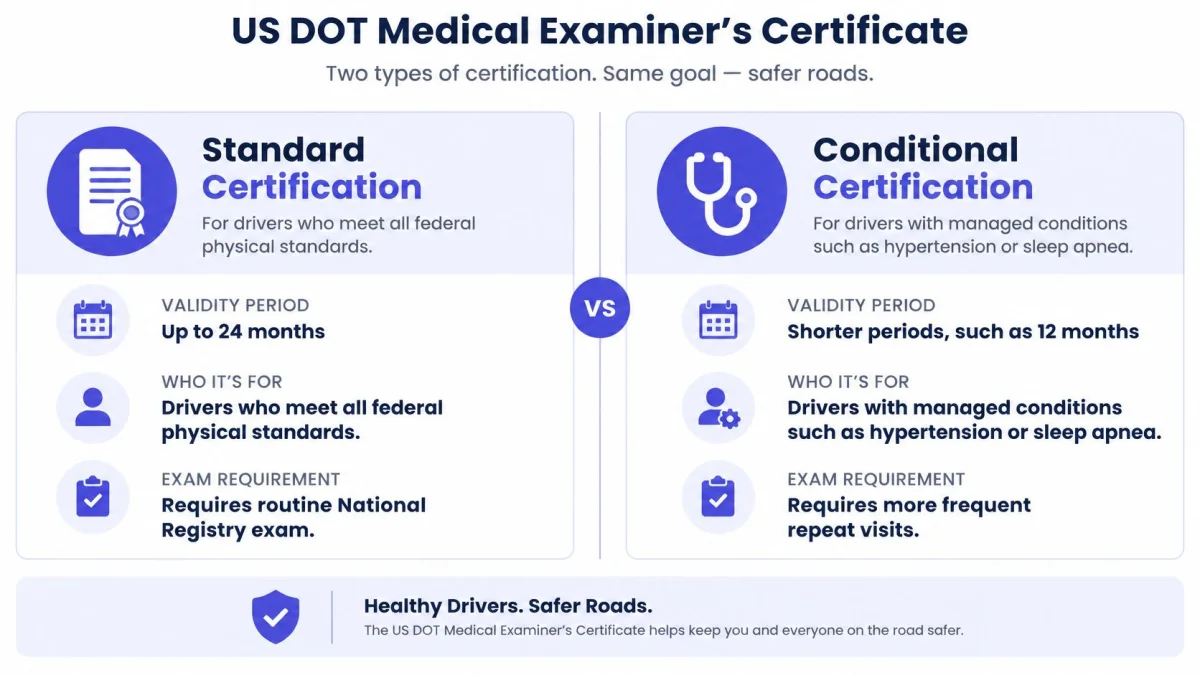
A driver with treated hypertension brings a recent blood pressure log and a medication list and asks for commercial clearance on the spot. A supportive letter describes treatment; the DOT certificate records a regulated examiner's decision. Commercial-driver certification belongs within the Federal Motor Carrier Safety Administration's regulated examination process, with examiner eligibility and current requirements checked through the FMCSA.
The working-document distinction protects both clinicians. The letter can confirm stability, adherence, and side effects. It should not imply that the treating clinician completed the regulated certification when that has not happened.
Keep supporting evidence separate from the decision
The treating practice can prepare an accurate summary of recorded findings, treatment, and relevant symptoms for the hypertension case above. The certified examiner then applies the current standards and determines the certification outcome.
Useful supporting documentation separates:
- Observed findings: What the practice measured or assessed, with dates.
- Treatment information: Current medications and relevant documented effects.
- Certification outcome: The examiner's decision, restrictions, and expiration details.
Avoid a blanket statement that a patient is safe to drive commercially when the document is only a treatment summary. Do not select a certification period from a generic sample or assume that a diagnosis automatically determines the outcome.
An administrative overview of FMCSA medical certificate verification can help practices understand verification questions, but the regulator remains the authority. Before writing anything, ask the driver to confirm whether they need a records summary for an upcoming examination or the regulated examination itself, then document only what your role permits.
3. FMLA Certification of Health Care Provider (Form WH-380-E)
Form WH-380-E concerns an employee's own serious health condition. Unlike a routine absence note, the certification needs enough information to support the particular leave request.
The federal FMLA certification regulation specifies provider details, approximate onset, probable duration, and sufficient medical facts. For intermittent or reduced-schedule leave, it also calls for estimates of medically necessary frequency and duration.

Replace open-ended wording with supported estimates
For an employee receiving chemotherapy, intermittent leave as needed doesn't explain the anticipated treatment schedule or recovery time. A useful draft separates scheduled appointments from unpredictable episodes:
Treatment-related leave is anticipated according to the documented treatment schedule. Additional recovery-related absence may be necessary, with estimated frequency and duration recorded below.
The clinician should complete those estimates from clinical knowledge and the available record, not from a standard allowance. At the next consultation, clarify the treatment calendar and the patient's essential job functions before completing the form.
Employees generally have 15 calendar days to provide requested certification, subject to the qualifications described in the Department of Labor's certification fact sheet. That is not a clinician-only turnaround deadline.
Check authorization before direct transmission, retain the completed form, and distinguish known facts from estimates. A secondary overview of Form WH-380-E requirements may help with administration, but it doesn't replace the federal requirements.
4. DVLA Medical Fitness to Drive Report (UK)
A patient attends two weeks after a witnessed seizure and asks for a letter saying he is safe to drive. That request tests the core boundary of this report. The clinician records findings and advice. The licensing authority makes the licensing decision. Wording like fit to drive collapses those roles and invites challenge.
Check the current condition-specific guidance and use the requested DVLA form before writing. Issuer eligibility, notification duties, confidentiality exceptions and licensing standards change, so confirm them against current official DVLA and professional guidance rather than reusing a certificate paragraph.
Document the question being answered
A practical report structure includes:
- Request and scope: The condition or concern under review and the information requested.
- Evidence: Relevant history, examination findings, investigation results and specialist correspondence.
- Advice and communication: What the patient was told, what they understood and the follow-up arranged.
- Uncertainty: Outstanding evidence or matters outside the clinician's assessment.
For the post-seizure case, describe the event, the collateral account and the available results without implying that one consultation settles every licensing question. Record driving status, the exact advice given and the patient's understanding in the notes. Disclosure to an outside agency rests on consent or a defined legal basis, and the report should show which basis was relied on for that patient.
A report should state what the clinician knows, what remains uncertain and what advice was communicated. It should not imply that the clinician has issued a driving license.
A sample medical report can help organize that narrative into request, evidence, advice and uncertainty. Uncertainty is part of the document, not a weakness in it.
5. MATB1 Maternity Certificate (UK)
A replacement request arrives with a new due date that the scan does not support. That conflict is where most MATB1 problems start. Employers and payroll reject the certificate when the expected week of confinement disagrees with the maternity record, and a second submission delays statutory maternity pay.
Only an authorized issuer working under the official MATB1 process should complete the form, and within the permitted timing window. A standard pregnancy confirmation letter does not carry the same status. Check what the recipient will accept before sending anything else.

Verify the source of the date
State the dating evidence on the record. Name the scan or clinical source behind the expected date, mark the document clearly as original or replacement, then compare the finished certificate against the maternity notes before release.
Do not overwrite an issued certificate to fit a patient request. If the record does not support a changed date, record that fact and explain what evidence would support a correction. I recommend refusing a backdated reissue unless the notes justify it, because a mismatched issue date triggers the next query.
Background on the Mat B1 certificate for employers explains why payroll teams query these dates. Issuing decisions still rest on the official process, not on that employer summary. At the next maternity consultation, reconcile dating before completing the form so the certificate leaves the clinic consistent with the record.
6. Preparticipation Physical Evaluation (Sports Clearance Form)
A sports clearance form records a participation decision for a defined sport and season. It does not certify general health. The school or league form, the athlete history questionnaire, and your examination note each have a separate job, and the signed clearance must show which history and exam it rests on.
Check the receiving organization's current form first. Confirm who may legally sign in that state and whether it accepts MD, DO, NP, PA or other qualified clinicians. Follow current preparticipation evaluation guidance and local rules for that decision. Never lift a clearance sentence from another athlete's record.
Separate the history from the clearance decision
An athlete with a family history suggesting sudden cardiac death needs explicit handling. Name the concern, list the unanswered history items and pending cardiology review, and mark the assessment as unresolved. A blanket statement of good health hides the very detail that protects the athlete and the practice. At the next sports consultation, close those history gaps before you sign.
Asthma calls for the same discipline. State the severity, current control and management plan, then tie any conditions to that plan, such as carrying a rescue inhaler at practice, rather than attaching an automatic restriction to the diagnosis.
The purpose gap is concrete. A medical clearance for surgery example documents perioperative risk and anesthesia fitness for a single procedure. The sports form documents readiness to play, with clearance, clearance with conditions, or no clearance pending further workup. Reusing operative risk phrasing leaves the participation question unanswered and invites rejection by the school.
Scope matters: Limit the certificate to what you assessed. Do not imply cardiac, neurologic or other screening you did not perform.
7. Medical Certification of Cause of Death (US Death Certificate)
A death certificate creates a permanent legal and statistical record. Errors here trigger registrar rejections, queries from medical examiners, and distorted mortality data.
The certifier must meet the state's eligibility rules and follow current National Center for Health Statistics instructions for the medical certification section. Only the authorized physician, medical examiner, or coroner for that jurisdiction should sign.
The certificate requires a reasoned causal sequence. A hospital death involving pneumonia and septic shock needs the chain stated in order, with the underlying cause on the lowest line. A problem list copied into the cause fields will be returned.
Build the sequence from the terminal clinical course:
- Underlying to immediate cause: State what started the train of events, then what followed, then what directly caused death.
- Contributing conditions: Record significant conditions that contributed but did not belong in the chain separately.
- Timing and authority: Confirm manner of death, who may legally certify, and local filing deadlines.
- Supporting record: Keep notes that explain how the conclusion was reached from examination, records, or investigation.
Where investigation is outstanding, use the jurisdiction's pending process. Do not enter a guessed final cause to close the record.
Common wording mistakes cause most rejections. Avoid abbreviations, mechanisms without etiology such as cardiac arrest alone, and competing causes on one line. At the next certification, reconstruct the terminal course before completing the cause fields.
A reusable template can prompt the sequence, interval, and contributor fields. It cannot establish eligibility, determine manner of death, or replace the current official handbook.
The seven certificates compared
Use this table to pick the right form before you write. Each certificate has a different legal issuer, a different decision it supports, and a different wording failure that triggers queries.
| Certificate | Country | Who can issue it | What it certifies | Typical validity | Common reason for query or rejection |
|---|---|---|---|---|---|
| UK Fit Note (Statement of Fitness for Work) | UK | Registered doctors and some other registered health professionals | Whether the patient is unfit for work or may work with support | Period set by the assessing clinician | Vague functional advice with no clear dates or adjustments |
| US DOT Medical Examiner's Certificate for Commercial Drivers | United States | Examiners listed on the FMCSA National Registry | That a commercial driver meets federal physical qualification standards | Limited period set at examination | Certificate completed by an examiner without current registry status |
| FMLA Certification of Health Care Provider (Form WH-380-E) | United States | The employee's health care provider | A serious health condition and the related need for leave | Period stated on the certification | Missing dates, frequency, or duration of leave needed |
| DVLA Medical Fitness to Drive Report (UK) | UK | A doctor or other clinician | A medical opinion on fitness to drive; the DVLA makes the licensing decision | Determined through licensing review | Opinion stated as a final licensing decision rather than clinical findings |
| MATB1 Maternity Certificate (UK) | UK | A midwife, GP or hospital doctor | The expected week of childbirth | Issued for the maternity pay claim window | Expected week of childbirth missing or inconsistent with the record |
| Preparticipation Physical Evaluation (Sports Clearance Form) | United States | A qualified clinician performing the evaluation | Whether an athlete is cleared, cleared with conditions, or not cleared for sport | Period set by the school or league | Clearance box left ambiguous, with conditions not written out |
| Medical Certification of Cause of Death (US Death Certificate) | United States | A physician, medical examiner or coroner, subject to state rules | The cause and manner of death | Permanent legal record | Causal sequence entered out of order or left incomplete |
Check authority, dates, and exact wording before you sign. At your next consult, match the recipient decision to one row first, then record only what that certificate asks for.
Build Your Own Certificate Templates and Stop Retyping Forms
Rejections rarely come from a missing signature. They come from a vague statement that leaves the recipient guessing. A certificate works when it answers three questions on the page: who is allowed to issue it, what was recorded, and what wording the decision maker needs.
Capture the assessment once, then transfer verified information into the official form. Keep identity, assessment date, issue date, relevant findings, functional limits, and issuer details in separate fields. A targeted prompt for each certificate beats a single paragraph that calls a patient fit or unfit.
Make uncertainty visible in the note behind the certificate. Separate what the patient reported from what was observed. Separate an estimated duration from a confirmed date. Keep a copy of the issued version in the record, so a later query about a fit note, a DOT card, or a sports clearance can be answered against the exact text that was sent.
Build prompts, not automatic conclusions
Useful template prompts include:
- Recipient and purpose: Who needs the document, and what decision will it support?
- Authority: Is this clinician authorized to complete this particular form?
- Evidence and consent: Which facts support the statement, and what disclosure is authorized?
- Dates and review: What period is covered, and what follow-up is planned?
PatientNotes includes an AI template builder and built-in templates across 37 specialties, with recording on web and iOS and copy and paste into any EHR besides its Semble integration. Clinicians confirm the draft before signing.
Start with the certificate the practice completes most often. Build its supporting note template, test whether it captures the necessary fields, and compare correction requests and administrative effort before expanding the approach.