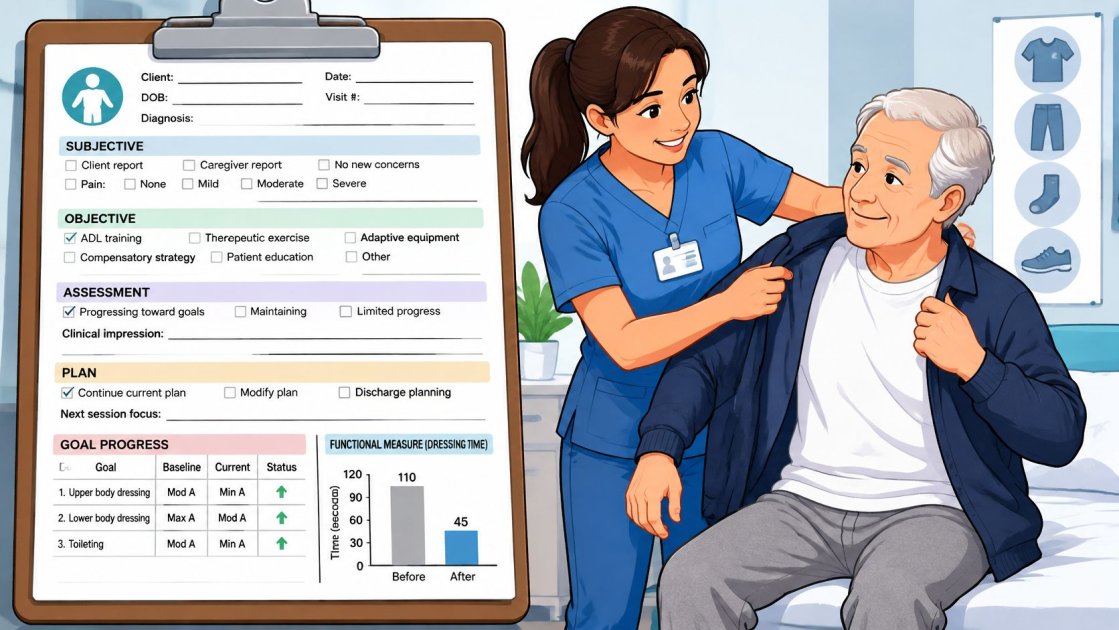
The last patient has left, but the daily notes are still open. The exercise list is there. The harder part is explaining what changed, why treatment needed a physical therapist, and what happens next.
A useful physical therapy SOAP note example makes those decisions visible. The difference between a vague note and a defensible one isn't length. It's whether another clinician or reviewer can follow the reasoning without reconstructing the visit.
A Finished Physical Therapy SOAP Note, Line by Line
Consider a hypothetical outpatient visit for a 58-year-old with chronic low back pain, attending visit 6 of a 12-visit plan. These are illustrative chart values, not treatment recommendations.
The vague version:
Pt doing better, tolerated exercise well, pain improved, continue PT, discharge when better.
The defensible version for the same visit:
Completed Daily Note
Header
Patient: [Full name and date of birth]
Date of service: [Actual date]
Treating clinician: [Full name], PT, [credentials]
Note type: Daily treatment note
Visit: 6 of 12
Diagnosis: Chronic low back pain
Referral and plan-of-care details: [Verified chart reference]
Subjective
Patient reports worst pain this week of 4/10, compared with 6/10 at evaluation. Home exercise program completed 5 of 7 days. Sitting tolerance remains approximately 30 minutes before stiffness requires a position change.
Objective
Lumbar flexion: 52 degrees, compared with 38 degrees at evaluation, using the same measurement method. Oswestry Disability Index (ODI): 34%, compared with 46% at evaluation. Five times sit-to-stand: 12.4 seconds; [record chair height and arm use].
97110 therapeutic exercise: 22 minutes, including bridges, sit-to-stand 3 × 10, and cat-camel. Therapist provided movement correction and adjusted exercise range to symptom response.
97140 manual therapy: 8 minutes, including L4-L5 posterior-anterior mobilization. Segmental assessment identified hypomobility at L4-L5 with restricted extension.
Total timed treatment: 30 minutes. Total treatment time: 30 minutes; no untimed services. Completed prescribed exercises without symptom escalation; [enter observed post-treatment response and remaining exercise dosage].
Assessment
Improving lumbar mobility and patient-reported function, with an ODI reduction of 12 percentage points. L4-L5 hypomobility continues to limit extension and sustained sitting. Skilled manual therapy remains necessary to address the assessed restriction, with therapist-directed reassessment and exercise progression based on response. Sitting goal remains unmet.
Plan
Proposed continuation: twice weekly for four weeks, subject to reconciliation with remaining authorized visits and the established plan of care. Progress to hip-hinge lifting once pain remains below 3/10 for three sessions. Update the home program. Discharge targets: ODI of 20% or lower and sitting tolerance of 60 minutes.
Authentication
[Actual treating clinician's signature, credentials, and date]
What Each Block Contributes
- Subjective: Identifies the reporting period, adherence, and the activity still limited.
- Objective: Keeps the scored ODI with repeatable outcomes, even though the patient supplies its answers. It also identifies treatment and time.
- Assessment: Connects the change to function and explains the therapist's decision, rather than merely declaring improvement.
- Plan: Makes progression conditional. The proposed schedule needs reconciliation because it exceeds the remaining visits.
- Authentication: Identifies who takes responsibility for the completed entry.
The bracketed details must be completed before signing. More polished wording can't substitute for missing observations.
For patient education about comfort measures, SunnyBay's explanation of using moist warmth to ease tension can support a discussion. A resource handout doesn't establish that a modality was delivered or justify billing it.
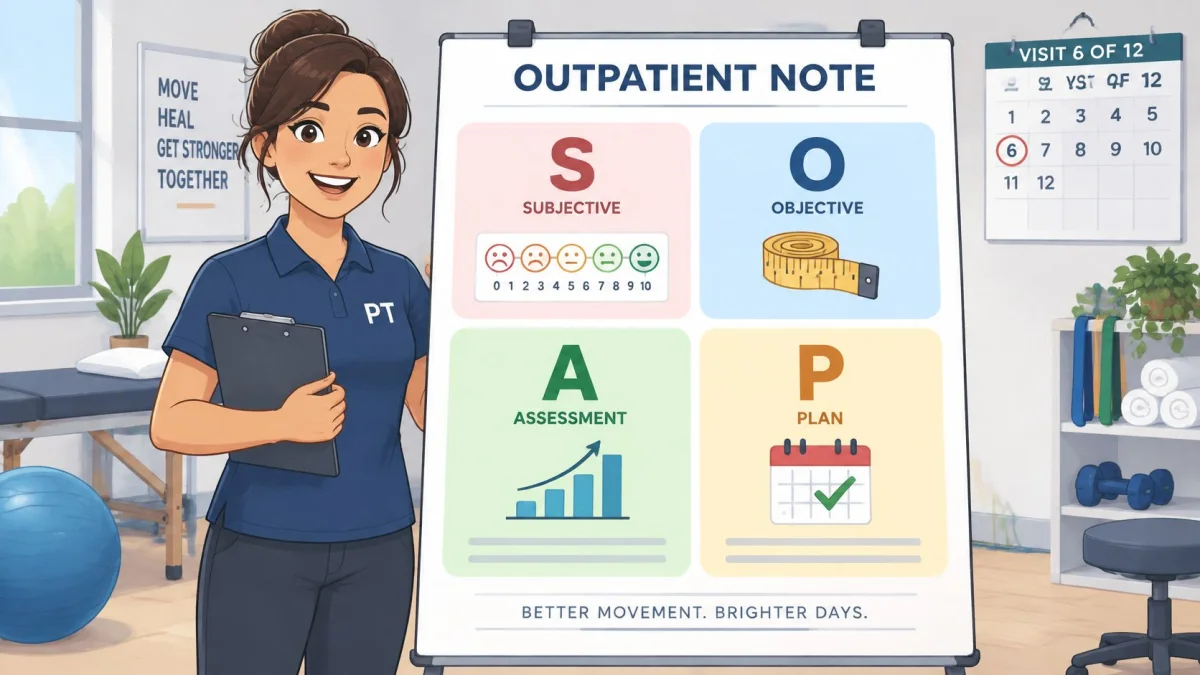
The visual separates the SOAP components:
Standardized Measures That Anchor the Assessment and Plan
A score helps only when the therapist can explain the comparison. APTA's initial-examination guidance recommends standardized outcome measures to evaluate change and connect outcome status with goal attainment.
Collect, Repeat, Interpret
- Establish the baseline. In the hypothetical case, record ODI 46% at evaluation, the assessment date, administering clinician, and relevant conditions, including whether pain medication preceded testing.
- Repeat under documented conditions. At visit 6, record ODI 34%, retaining the completed questionnaire with its date and the person who administered it.
- Explain the decision. Interpret the 12-percentage-point reduction alongside sitting limitations. State whether the findings support progression, maintenance, referral, or discharge. The illustrative discharge target is ODI 20% or lower, paired with the functional sitting goal.
The following table is a practical selection guide, not a requirement to administer every measure.
Standardized PT outcome measures and what to record
| Measure | Typical use | What to record |
|---|---|---|
| Oswestry Disability Index (ODI) | Low back pain | Percent score at evaluation and each reassessment |
| Neck Disability Index (NDI) | Neck pain | Percent score at evaluation and each reassessment |
| Lower Extremity Functional Scale (LEFS) | Lower limb conditions | Score out of 80 |
| QuickDASH | Upper limb conditions | Score from 0 to 100 |
| Five times sit-to-stand test | Lower extremity strength and function | Time in seconds, with arm use noted |
| Six-minute walk test | Endurance and gait | Distance in meters, rest breaks, and oxygen saturation if measured |
| Berg Balance Scale | Balance and fall risk | Score out of 56 |
| Numeric pain rating scale (NPRS) | Pain | Score from 0 to 10 at rest and with activity |
Record assistive device, footwear, assistance, and time of day when relevant. A faster walking test with a different device isn't a clean comparison unless the change is explicit.
The therapy treatment plan template helps organize the connection between findings and goals. MEDISTIK's patient-facing discussion of managing recurring back pain with physiotherapy can support education, but it doesn't replace an individualized reassessment.
Blank Template Fields to Copy Into Any Chart
Blank SOAP template fields and what to enter
| Template field | What to enter | What it proves |
|---|---|---|
| Header | Patient full name, date of birth, date of service, note type, treating PT full name and credentials, and how the visit was initiated | Identifies the record, clinician, and referral source |
| Subjective | Patient-reported status, pain score 0-10, response to last visit, home program adherence, and patient goal for the day | Captures the patient's reported experience |
| Objective | Measured values with units: ROM in degrees, strength grade, outcome score, timed test, and each intervention with sets, reps, and minutes | Provides reproducible findings and treatment details |
| Assessment | Progress against each goal, remaining impairments, activity limits, precautions, response to care, and why skilled care is still needed | Connects findings to clinical decisions |
| Plan | Next interventions, visit frequency, duration, progression criteria, home program changes, and discharge criteria | Records the next steps in the plan of care |
| Signature block | Actual handwritten or electronic signature, date, and credentials. Medicare does not accept stamped signatures, as APTA's documentation tips note | Authenticates the entry |
SOAP headings organize the note, but the clinician still needs to document the content that supports care. APTA's visit-documentation guidance explains how visit documentation fits within patient and client management. APTA's documentation tips address identifiable, dated, authenticated entries, clear note-type labels, clinician names and designations, and how services began.
Copy-Ready Chart Fields
Header: [Patient full name] | [DOB] | [Service date] | [Note type] | [Clinician and credentials] | [Referral, consultation, or direct access]
S: [Current status] [Pain 0-10 and context] [Response since last visit] [Home program adherence and barriers]
O: [ROM degrees and method] [Strength] [Outcome score and date] [Functional test and conditions] [Interventions, dosage, timed minutes, total time] [Observed response]
A: [Change against goals] [Remaining functional limitation] [Precautions] [Skilled decision and rationale]
P: [Next intervention] [Frequency and duration] [Progression condition] [Home program change] [Discharge criteria]
Communication: [Recipient, reason, date, information shared, and resulting action]
Signature: [Actual signature, credentials, date]
Fields That Need Deliberate Attention
Drafting the Objective field first can help: it gives the Assessment specific findings to interpret. Keep the final chart in SOAP order so readers can follow the patient's report, measured findings, clinical reasoning, and next steps.
Use separate templates for daily notes, progress reports, and discharge summaries. A daily-note form may not prompt enough detail for reassessment or discharge planning, so check that each template captures the decisions its note type requires.
Give communication its own field. SOAP does not provide an obvious place for the recipient, reason, date, information shared, and resulting action. Keep these fields in the downloadable or print-ready checklist so it matches the chart template.
Vague Phrases and the Measurable Wording to Replace Them
Vague PT phrases and measurable replacements
The replacements below are hypothetical wording examples, not findings to copy into an actual record.
| Vague phrase | Measurable replacement | What it gives the reader |
|---|---|---|
| Patient tolerated treatment well | Completed 3 sets of 10 bridges; pain 2/10 during and after | Shows response with a number |
| Improved strength | Right hip abduction 4/5, up from 3+/5 at evaluation | Gives a baseline and a change |
| Exercise performed | Therapeutic exercise, 22 minutes: bridges, sit-to-stand, and cat-camel; record dosage and skilled cueing | Names the activity and time the billing record needs |
| Pain improved | NPRS 3/10 today, 6/10 at evaluation | Replaces an impression with a comparison |
| Doing home program | Home program 4 of 7 days; stopped step-downs due to knee pain | Records adherence and the barrier |
| Continue PT | Continue 2x/week for 4 weeks; progress to single-leg bridge when 3 × 10 is pain-free | States frequency and a progression condition |
| Discharge when better | Discharge when ODI is 20% or lower and sitting tolerance is 60 minutes | Sets a measurable endpoint |
A 2025 systematic review reported that treatment response and rehabilitation effectiveness were documented in only 35% of therapy notes. Listing an intervention without its response leaves the next clinician guessing about the treatment decision.
Make Every Replacement Do a Job
The practical rules are straightforward: name the activity, attach a meaningful value with a comparison, and state the next step with a condition. Not every sentence needs every element, but the note needs the complete chain.
The original vague visit becomes traceable through separate replacements. Doing better becomes the measured outcome change. Pain improved becomes a rating with a defined reporting period. Continue PT becomes a schedule and progression criterion, while discharge when better becomes a functional endpoint.
APTA's documentation guidelines recommend limiting abbreviations, comparing current findings with prior findings, and linking interventions to skilled care and the established plan. Spell out physical therapist and home exercise program on first use rather than assuming every reviewer knows local shorthand.
Read-aloud check: If an Assessment sentence could fit almost any patient's chart, it needs a patient-specific finding or decision.
Copy-forward text deserves the same scrutiny as newly dictated text. An unchanged Assessment can be accurate, but it must still reflect today's findings. Unsupported copied progress language makes the record less credible, not more complete.
CPT, ICD-10 and Medicare Documentation Elements to Check
CPT and ICD-10 suggestions apply to US billing only. The checklist below concerns Medicare outpatient documentation, not a universal billing standard.
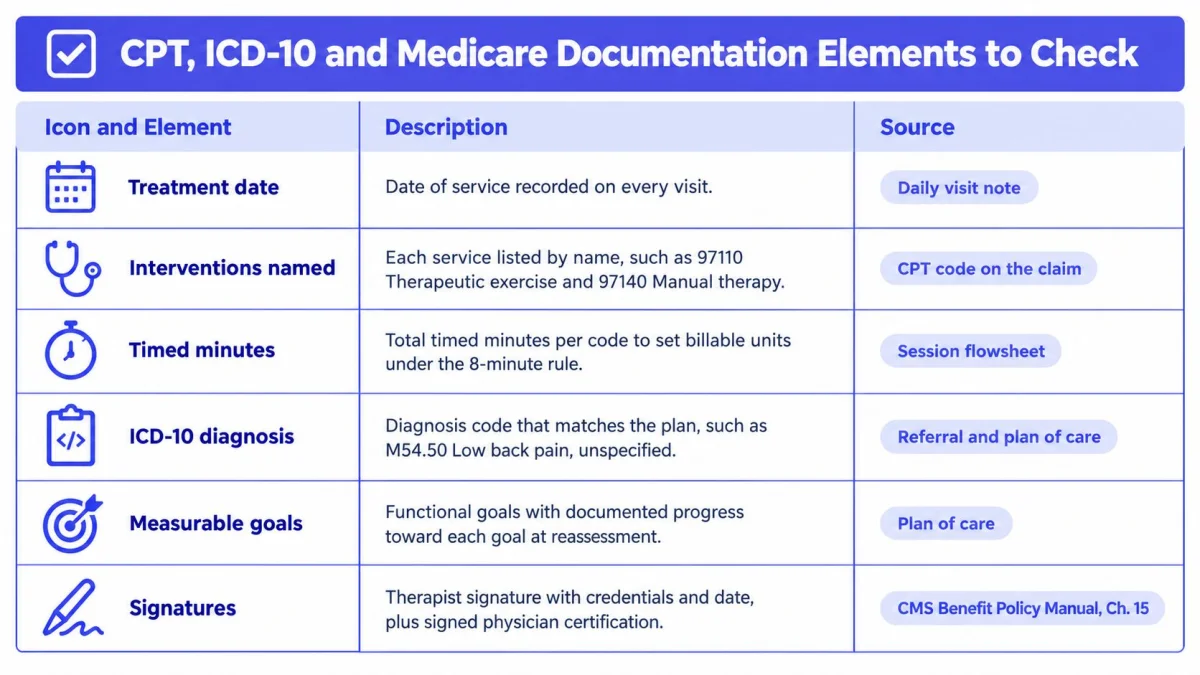
The infographic provides a quick visual reference:
Medicare Record Check
| Element | What the record needs | Primary reference |
|---|---|---|
| Treatment date | Date of service | CMS treatment-note requirements |
| Services delivered | Specific interventions in language comparable with billed CPT codes | CMS treatment-note requirements |
| Time | Timed-code minutes and total treatment time, including untimed services | CMS treatment-note requirements |
| Authentication | Signature and credentials of everyone providing skilled interventions | CMS treatment-note requirements |
| Plan of care | Diagnoses, long-term goals, service types, sessions per day and week, total duration, signature, role, date, and approval | CMS outpatient rehabilitation guidance |
| Discharge | Clinician-written discharge note for each episode | CMS treatment-note requirements |
CMS treatment-note requirements support the visit, time, authentication, and discharge elements. CMS outpatient rehabilitation guidance specifies plan-of-care contents and physician or qualified practitioner approval, including approval of significant or long-term goal changes.
Common code-label examples include 97110 therapeutic exercise, 97140 manual therapy, 97530 therapeutic activities, 97112 neuromuscular re-education, and 97116 gait training. M54.50, low back pain, unspecified, is an illustrative ICD-10 example only. Code selection needs verification against the actual service, referral information, and clinical findings; a template isn't coding authority.
For specialty context, Lake City Physical Therapy discusses pelvic rehabilitation insurance billing codes. The documentation audit checklist offers a separate record-review workflow.
A diagnosis code doesn't explain why a particular intervention required skilled care that day.
UK clinicians can retain the SOAP structure without adopting US billing codes. Their record review should use applicable local requirements, including the HCPC Standards of conduct, performance and ethics.
The accompanying video offers another documentation reference:
Plateaus, Missed Visits and Other Edge Cases to Document
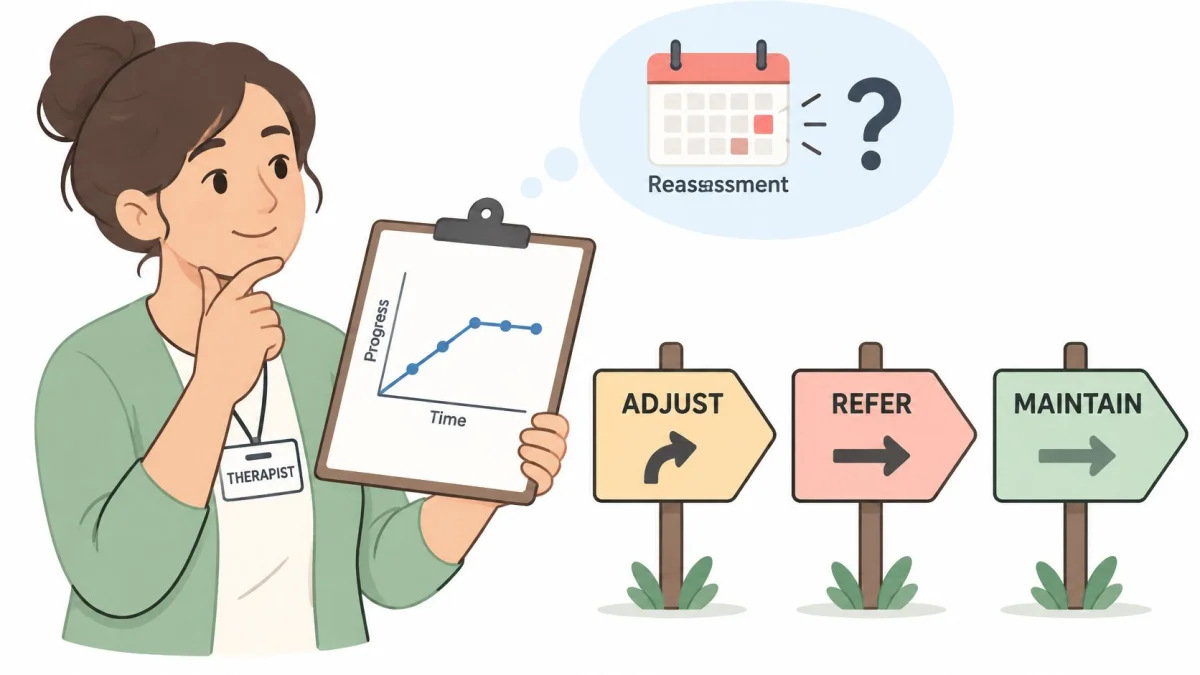
An unchanged score doesn't justify invented progress. For a plateau, record the stable result, reassessment date, suspected reason, and decision: adjust treatment, refer, or maintain with an explicit rationale. Distinguish a clinical hypothesis from an established finding.
The therapist's decision needs to follow the actual trend:
Record the Exception, Not a Standard Progress Sentence
These are practical chart prompts. They help preserve the facts without turning uncertain explanations into diagnoses.
- Regression: Enter the measured decline and its date. Record a reported flare-up or increased activity separately from the therapist's interpretation, then explain the plan change.
- Nonattendance: Record each cancellation or no-show, the reason provided, outreach, and any scheduling or plan-of-care action. An attendance entry isn't evidence that treatment occurred.
- Home program barriers: Identify work hours, symptom response, equipment problems, or unavailable caregiver support. Non-compliant doesn't explain what needs changing.
- Telehealth limitations: Identify the modality, observed tasks, assistance available, and measurements that couldn't be obtained. Don't imply that an unperformed examination was completed.
- Discharge against advice: Document the recommendation, risks discussed, patient's stated decision, and follow-up information actually provided.
The physical therapy progress note template can organize reassessment when routine daily-note fields no longer capture the decision.
Keep Report and Measurement Separate
A plateau note can contain a positive patient report without claiming measured improvement:
Patient report: Daily activities feel easier, but prolonged sitting remains difficult.
Clinician measurement: Repeated functional score is unchanged under comparable testing conditions.
The disagreement is clinically useful. It may prompt clarification of the patient's activity goals or selection of an additional relevant measure, rather than deletion of the less favorable result.
For Medicare threshold cases, CMS guidance on the KX modifier states that its use attests that services above the threshold remain reasonable and medically necessary, with justification in the record. The narrative should identify the remaining deficit, relevant goal, expected benefit, and skilled decision supporting continued care.
Administrative delays also belong in the timeline. An authorization gap can explain interrupted treatment, but it shouldn't be presented as measured clinical regression unless reassessment establishes that change.
Choose a Specialty Template and Test It on Real Notes
A generic SOAP form gives the visit a consistent structure. Specialty fields should capture the examination, relevant precautions, and practice setting, while avoiding boxes that do not apply to the patient.
Specialty Fields as Clinic Choices
These are suggested clinic template choices, not universal requirements. For postoperative care, use the treating surgeon's actual protocol for procedure-specific restrictions.
| Clinical area | Useful fields to consider |
|---|---|
| Orthopedic postoperative care | Surgery date, precautions, weight-bearing status, and ROM compared with the applicable surgeon's protocol |
| Neurologic rehabilitation | Assistance level, balance findings, gait device, distance, and test conditions |
| Pelvic health | Pain scales, continence history, consent documentation, and findings from the examination the patient agreed to |
| Pediatrics | Developmental movement, caregiver training, home program responsibilities, and participation in routines |
| Hand therapy | Edema circumference, grip and pinch measurements, and reported splint wear time |
Test the Drafting Workflow
A template is useful only if it preserves the clinical reasoning behind the visit. Test it against real notes, then compare the output with the clinician's source documentation. PatientNotes offers physiotherapy and PM&R options among its 37 specialty templates, along with a builder for creating a form from dictation, chat, or an uploaded clinic template.
Use a small set of representative visits, including one with measurable change and one where the response or plan needs clarification. Draft each note through the practice's approved recording and privacy process. Check whether the template gives the clinician enough room to document findings, skilled decisions, and the next step without making irrelevant fields appear mandatory.
- Review every draft: The clinician must check and sign the note. Treat suggested ICD-10, CPT, and CDT codes as suggestions for US billing, not as verified coding.
- Compare against the source: Confirm that measurements, treatment response, and the plan match what was documented during the visit.
- Check for omissions: Look for missing response, unsupported findings, incorrect time, and follow-up tasks that were not agreed to.
A good draft is specific enough to support the clinical and billing rationale, but it still needs clinician review. Check the pricing page for the trial and plan terms before deciding whether the workflow fits the practice.