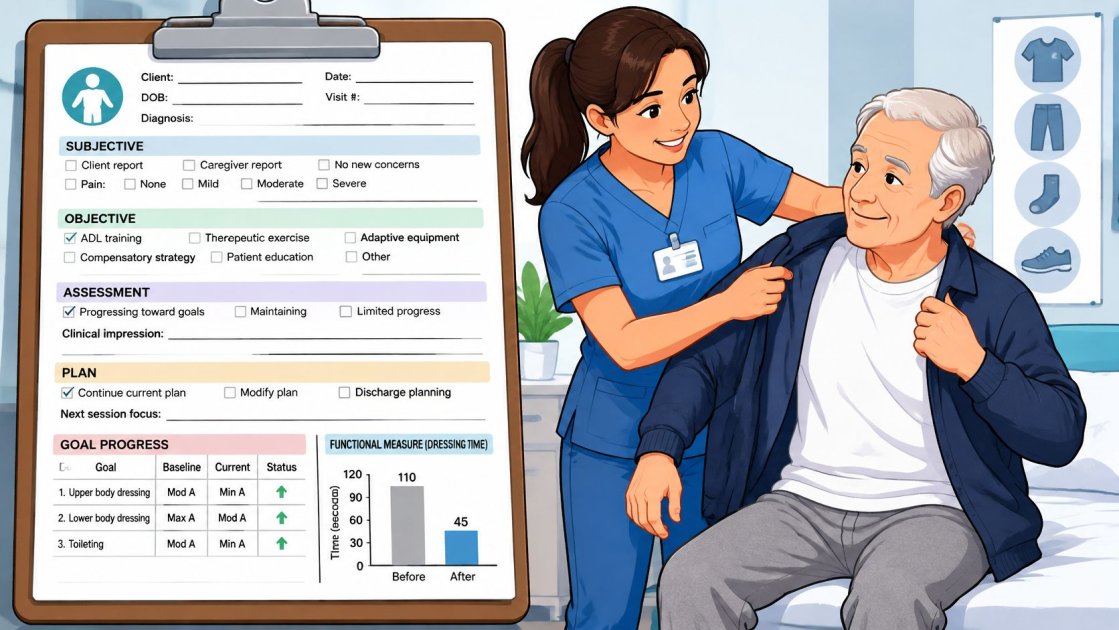
No US federal law requires a practice to employ a medical scribe. The actual requirement is a complete, accurate record that the clinician reviews, signs, and can defend.
Popular advice often flips that order. It treats certification, a vendor claim, or a hiring preference as if it's a legal rule. That mistake costs small practices money and still leaves gaps in the record. A medical scribe requirement is best read as a set of duties that stay with the clinician, plus choices the practice makes about who, or what, drafts the note.
Medical Scribe Requirements at a Glance
No US federal law requires a practice to employ a medical scribe, and no law requires AI documentation software. What the law does require is a complete, accurate, signed record that supports the service billed.
Find the row that matches who writes the note and where the practice operates. The middle columns separate a legal rule from an employment or software choice, and they name the task that can't be delegated.
| Case | Is a scribe required? | What the clinician still does | Primary source |
|---|---|---|---|
| US practice using a human scribe | No; it is an employment choice | Reviews, corrects and signs every note the scribe drafts | CMS Medicare documentation requirements |
| US practice using an AI scribe | No; it is a workflow choice | Reviews the draft, fixes errors and approves it before it enters the record | CMS Medicare documentation requirements |
| US practice whose vendor handles PHI | A written business associate agreement is required | Confirms the BAA is signed before first use | HHS business associate guidance |
| US practice billing Medicare | Note must support the service billed and medical necessity | Documents medical necessity in the note itself | CMS Medicare documentation requirements |
| UK practice using AI ambient scribing | No statutory scribe requirement; UK GDPR and NHS data-security standards apply | Completes a data protection impact assessment and patient information; verifies output | NHS England ambient scribing guidance |
| Recorded telehealth or mental-health visit, US | Patient notice and consent rules vary by state and organization | Documents the notice given and any objection | State recording-consent statute; NHS England guidance for UK settings |
When a Row Changes
Four points can change a row for a specific practice.
- State recording rules: Notice and consent for recording aren't set by one federal scribe rule.
- Payer rules beyond Medicare: A commercial payer can ask for fields Medicare doesn't.
- Specialty documentation rules: Procedure, therapy, and behavioral health notes carry distinct elements.
- NHS organization policy in the UK: A trust or integrated care board can set controls above the national baseline.
Practical rule: If a requirement can't be traced to a payer rule, privacy law, state statute, or organization policy, treat it as a preference and price it that way.
Practices should confirm state, payer, and organization points with counsel or a compliance lead before the first recorded visit. That check takes less time than unwinding a workflow built on the wrong rule.
What a Medical Scribe Does and Why Practices Hire One
A medical scribe can draft the visit record, but the clinician remains responsible for deciding what is accurate, what is ordered, and what gets signed. Hiring a scribe is a practice choice, not a legal requirement.
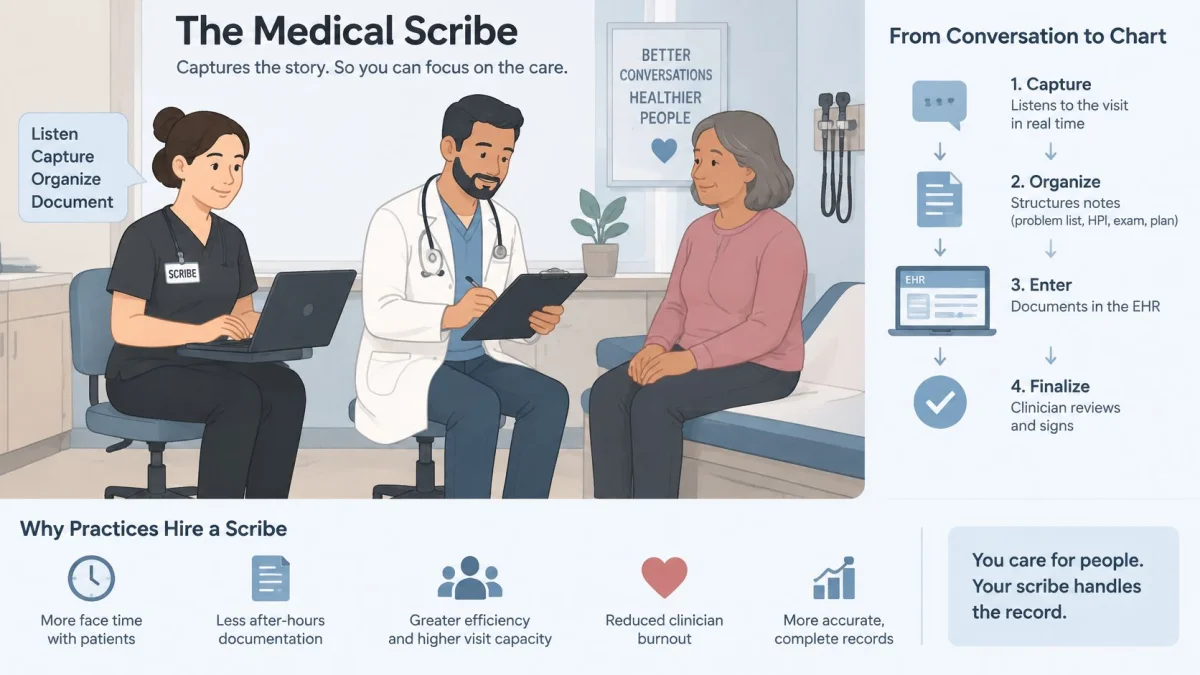
The 2018 crossover study of 18 primary-care physicians at two practices found that primary-care physicians spent approximately 2 hours on EHR-related work for every 1 hour of direct patient care, with some work taking place after clinic hours. In that study, scribe use was associated with a greater likelihood of physicians reporting less than 1 hour per weekday on EHR work, with an adjusted odds ratio of 18.0. The study also found that clinicians using scribes were more likely to report spending over 75% of the visit interacting with the patient rather than documenting, with an adjusted odds ratio of 295.0.
The American Medical Association EHR use research reports that physicians spend more than five hours in the EHR for every eight hours of scheduled patient time. It also tracks work outside of work, including EHR activity beyond scheduled patient-care hours. These measures help explain why practices may choose to add a scribe, but they do not create a requirement to hire one.
Three Forms, One Draft
- Human scribe in the room: Listens during the visit and drafts in the EHR in real time.
- Remote human scribe: Joins by audio or works from a recording and returns a draft.
- AI ambient scribe: Records the visit, separates speakers, and drafts a structured note for review.
For a diabetes follow-up, any of the three may capture the history, exam, assessment, and plan from the conversation. The draft still needs clinical review. A scribe or tool does not decide the diagnosis, change the dose, or take responsibility for the follow-up interval.
The practical benefit is less typing and charting time during or after visits. Before signing, the clinician must check that the note reflects the encounter, that the assessment and plan are correct, and that no unsupported detail has entered the record. The workflow may change; responsibility for the signed record does not.
Training and Competence a Medical Scribe Needs
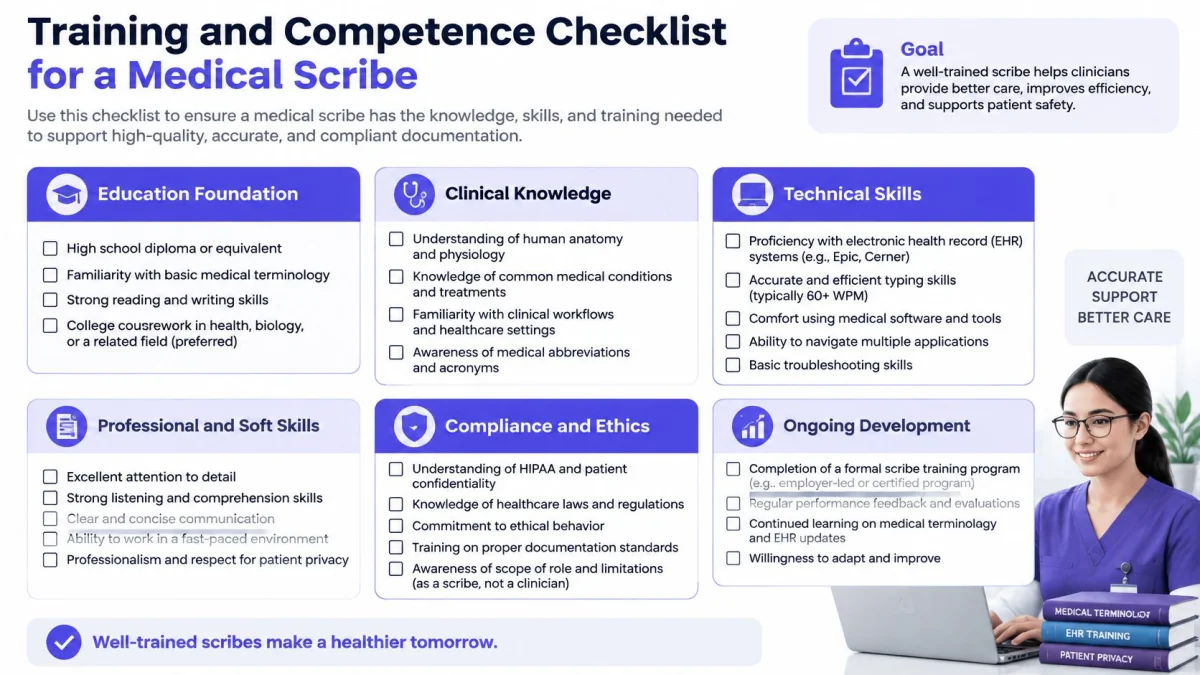
A medical scribe does not need a universal US certificate. The AHRQ PSNet perspective on medical scribes and patient safety describes the field as largely unregulated, with certification generally not mandatory and formal training or recertification not required for every position. The practice hiring the scribe sets the role-specific competence checks. A certificate may support a hiring decision, but it does not show by itself that someone can document accurately in a particular specialty or workflow. The distinction between a course credential and practical competence also matters when choosing a hyperbaric training program.
A Seven-Item Onboarding Checklist
- Medical terminology for the specialty: Teach the terms, abbreviations, and common exam language used by the clinician.
- HIPAA basics: Cover minimum necessary access, handling protected health information, and keeping information within approved records and systems.
- Coding and reimbursement basics: Explain what ICD-10 and CPT codes represent, and make clear that the clinician selects them.
- EHR navigation: Train the scribe on the template, note flow, and any copy-and-paste steps into the destination record.
- Order-entry boundaries: Specify what the scribe may enter under clinician direction and what only the clinician may enter.
- Clinician authentication: Set a process for the clinician to review and correct each note before signing.
- Documentation standards: Require dates, times, and clear attribution of statements to the correct speaker.
Optional certificates can include medical terminology and HIPAA training. Treat them as supporting education, not proof of competence or permission to make clinical decisions. Practices can compare medical scribe training and certification options with the tasks and boundaries in this checklist.
The boundary needs to be explicit in daily work. A scribe can document the clinician's decisions, but diagnosis selection, prescriptions, and follow-up plans remain clinical decisions for the clinician.
Give the clinician a one-page role checklist to sign, covering permitted tasks, limits, and the review process. For an AI scribe, the equivalent preparation is training the clinician to check the generated note, correct errors, and confirm it reflects the encounter before signing.
Legal, HIPAA and Record Duties That Stay With You
The scribe question matters less than ownership of the record. A common myth says a good draft, a signature, or a vendor's compliance claim settles the legal duty. It doesn't.
The CMS Medicare documentation requirements require documentation to support the service billed, medical necessity, coding, and coverage. CMS also states that a physician signature, order, or attestation alone is insufficient when the underlying record does not substantiate medical necessity. Requested records can include orders, referrals, face-to-face evaluations, therapy notes, assessment notes, and patient correspondence.
Record quality has a second test. NHS guidance on high-quality patient records uses the CARAT attributes, complete, accurate, relevant, accessible, and timely. Entries should be dated, timed, signed, chronological, understandable, and free of unexplained alterations, with omissions and deviations from planned care documented.
What the HIPAA Contract Does and Does Not Do
The HHS business associate guidance requires a covered entity to have a written contract or other arrangement requiring the business associate to protect PHI and comply with applicable HIPAA requirements. The agreement must define permitted and required uses and disclosures, prohibit unauthorized use or disclosure, require appropriate safeguards, address breach reporting, and require applicable subcontractors to accept equivalent restrictions.
PatientNotes states that it is HIPAA compliant and includes a BAA at no extra cost. That gives the practice the required paper before use. It doesn't decide whether the practice's own access controls, devices, and handling procedures are compliant. Practices reviewing the contracting step can read HIPAA BAA requirements for small practices alongside a clinic guide to safer automation before they sign.
Encryption and a BAA also don't settle recording governance. NHS England guidance on AI-enabled ambient scribing products says organizations should address data protection, cybersecurity, clinical safety, regulatory status where applicable, and supplier controls, with UK GDPR compliance and clear handling of access and third-party involvement.
The Pre-Signing Checklist
Before signing, the clinician should check five things in every draft:
- Negations: Confirm denials weren't flipped, for example no chest pain recorded as chest pain.
- Speaker attribution: Confirm patient statements, family comments, and clinician findings sit with the right person.
- Uncertain talk: Confirm a discussed possibility hasn't become a stated diagnosis or completed action.
- Every code by hand: Treat ICD-10, CPT, and CDT suggestions for US billing as review-only, never auto-posted.
- Referrals and follow-ups: Confirm orders, referrals, return intervals, and patient instructions appear in the note, not only in audio.
UK practices add four steps before routine use, a data protection impact assessment, a lawful basis, patient information about recording and processing, and a record of any objection. US practices should document notice given and any refusal under their state and organization policy.
Before signing: If a statement would surprise the patient, change a code, or start an order, it gets checked against the conversation, not waved through.
Keep the original session and the audit trail, and confirm retention and access settings. PatientNotes includes a session archive and audit logs, and the practice still owns who can open them.
Human Scribe or AI Scribe Side by Side
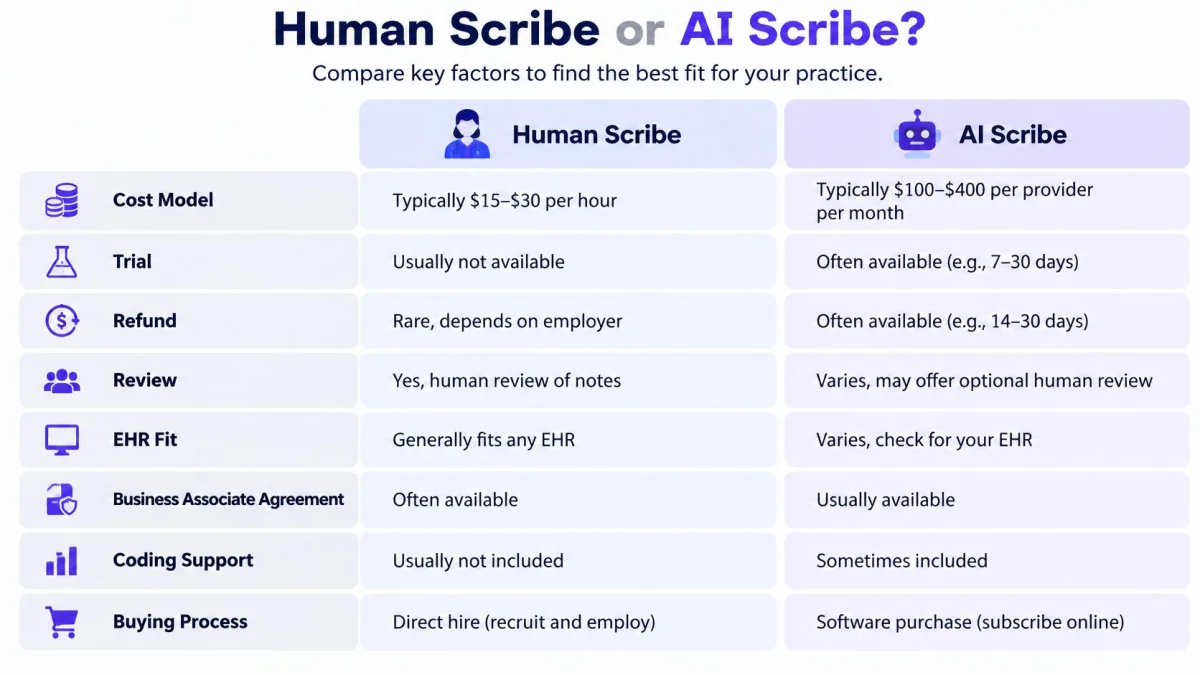
The legal duty is the same whichever tool creates the draft: the clinician reviews the record and signs it. The choice between a human scribe and AI affects cost, workflow, and how a practice gets started, not who remains responsible for the final note.
| Factor | Human scribe | AI scribe (PatientNotes) |
|---|---|---|
| Cost model | Salary or agency fee, plus benefits | $70 per user per month billed monthly or $50 per user per month billed annually |
| Who reviews the draft | Clinician reviews and signs | Clinician reviews and signs |
| EHR fit | Works in any EHR through the practice's own workflow | Semble integration; every other EHR by copy and paste |
| Business associate agreement | Needed if the agency handles PHI | Included at no extra cost |
| Coding suggestions | Coder or clinician | ICD-10, CPT and CDT suggestions for US billing only, for clinician review |
| Buying process | Agency contract or hiring | No sales call and no enterprise tier |
What the Time Evidence Supports
The 2021 study comparing scribed and nonscribed outpatient visits found that physician documentation averaged 4.7 minutes per scribed note versus 7.6 minutes per nonscribed note, a reduction of approximately 38%. Visits with a scribe were approximately 2.9 minutes longer, while average time to chart closure was 9.15 hours for scribed visits versus 10.5 hours for nonscribed visits. In an academic dermatology practice, documentation fell from 6.1 minutes per patient to 3.0 minutes per patient, as reported in the same 2021 study comparing scribed and nonscribed outpatient visits.
Time savings depend on how the practice assigns and reviews notes. A study covering 1,218,528 encounters, 430 physicians, 55 specialties, and 134 scribes found that only 23% of physicians used scribes, and assignment did not significantly improve every record-closure measure. The figures come from the 2021 study comparing scribed and nonscribed outpatient visits. A scribe can reduce typing, but the workflow still needs a clear review step so drafts become completed charts.
AI use at scale shows adoption, not a guarantee of the same result in a small practice. Between October 2023 and December 2024, 7,260 Kaiser Permanente physicians used an AI scribe across 2,576,627 patient encounters, according to The Permanente Medical Group report in 2025. A separate 2025 peer-reviewed study reported that high-use physicians experienced a 28.8% reduction in documentation time per encounter, equivalent to approximately 50 minutes saved per day.
Choose by asking who will review each draft, how quickly the practice needs to begin, and whether its workflow requires a person present during the visit. A human scribe can work within an established EHR routine, but hiring adds recruitment and coverage considerations. AI avoids recruitment and can produce notes and follow-up tasks in the clinician's language. PatientNotes records through its native iOS app with offline recording; it integrates with Semble, while other EHRs use copy and paste.
Use Cases for Solo Clinicians and Small Practices
A solo or two-clinician practice fits an AI scribe when it can sign a BAA and paste notes into its current EHR. Larger operational questions, including outsourcing tasks in your private practice, still turn on the same point, delegation works only when ownership stays named.
| Practice | Likely fit | Check before you start |
|---|---|---|
| Solo family physician, US; about 20 patients a day, notes finished after 8 pm | AI scribe on iPhone (native iOS app with offline recording) | Signed BAA; copy-and-paste step into the current EHR |
| Two-clinician dermatology clinic, US; procedure and lesion documentation | AI scribe with a specialty template | Template fields for procedures and lesion notes |
| Solo psychiatrist or therapist, US; telehealth visits | AI scribe with a written notice policy | Patient notice, consent record and minimum necessary access |
| Two-clinician physiotherapy clinic, UK | AI scribe with UK data settings | Data protection impact assessment, lawful basis and patient information before the first recording |
| Practice billing Medicare | Either option | Every suggested code checked before submission |
| Health system running deep Epic integration | Enterprise product, not a small-practice tool | Integration needs; PatientNotes does not target this setup |
Three Points the Table Cannot Carry
Specialty templates matter more than the software brand. The dermatology row works only if the template covers lesion location, procedure details, and plan fields the clinician uses. PatientNotes offers specialty templates for 37 specialties and an AI template builder, listed on the PatientNotes specialties page.
Telehealth and psychiatry put more weight on notice and access. The clinician should decide who may access recordings, how long they're kept, and how an objection is recorded. That decision belongs in practice policy, not in a default setting left unreviewed.
UK practices do the data protection work before the first recording. Patient information and the impact assessment come first. Practices that want a broader product check can use the PatientNotes compare page for side-by-side comparisons, then test the actual note quality on their own visits.
Confirm Your Requirements Before You Hire or Buy
A scribe requirement is partly a legal duty and partly a practice choice. Use this checklist to separate the two and confirm that the workflow fits your visits.
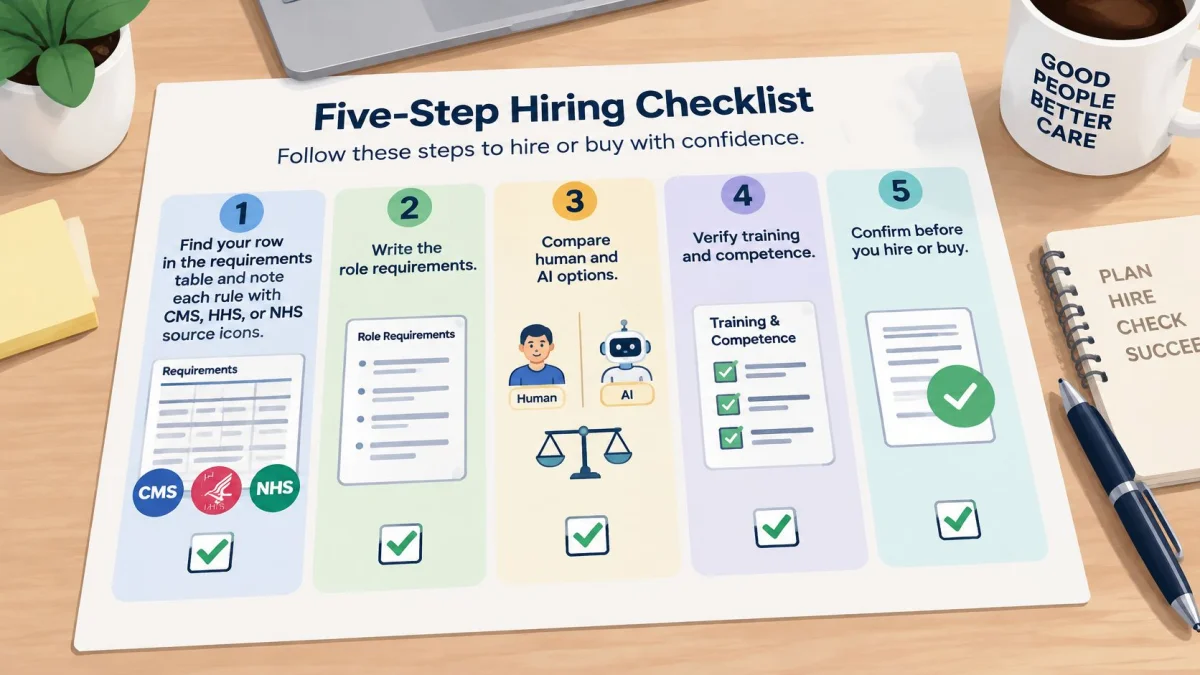
- Identify the rules that apply: Record the relevant CMS, HHS, or NHS guidance, along with any state or payer requirements that affect the practice.
- Set the role boundary: Specify what the scribe or AI tool may draft and what the clinician must decide, including diagnoses, orders, prescriptions, and follow-up.
- Sign the BAA before entering patient data: PatientNotes includes a BAA at no extra cost. The practice still needs to confirm who has access and which devices they use.
- Trial it on 10 real notes: During the 7-day free trial with no credit card, review each draft for negations, speaker mix-ups, uncertain statements presented as fact, and missing follow-ups. Test the medical recording app workflow in the rooms and visit types where it will be used.
- Set a decision point: Check that the workflow meets your documentation and review requirements, then decide whether to continue within the refund window. Compare the per-user price with your practice's needs before making the purchase.
The video below shows the recording and draft review flow.
For a practical next step, schedule the trial around a familiar visit type and review 10 notes before expanding to other appointments.
PatientNotes records consultations, drafts structured notes to a selected template, and extracts follow-up tasks. The clinician remains responsible for checking the record and signing it. A solo clinician or small practice can test whether its BAA, copy-and-paste workflow, and review-only US code suggestions fit its needs by starting a trial at PatientNotes.