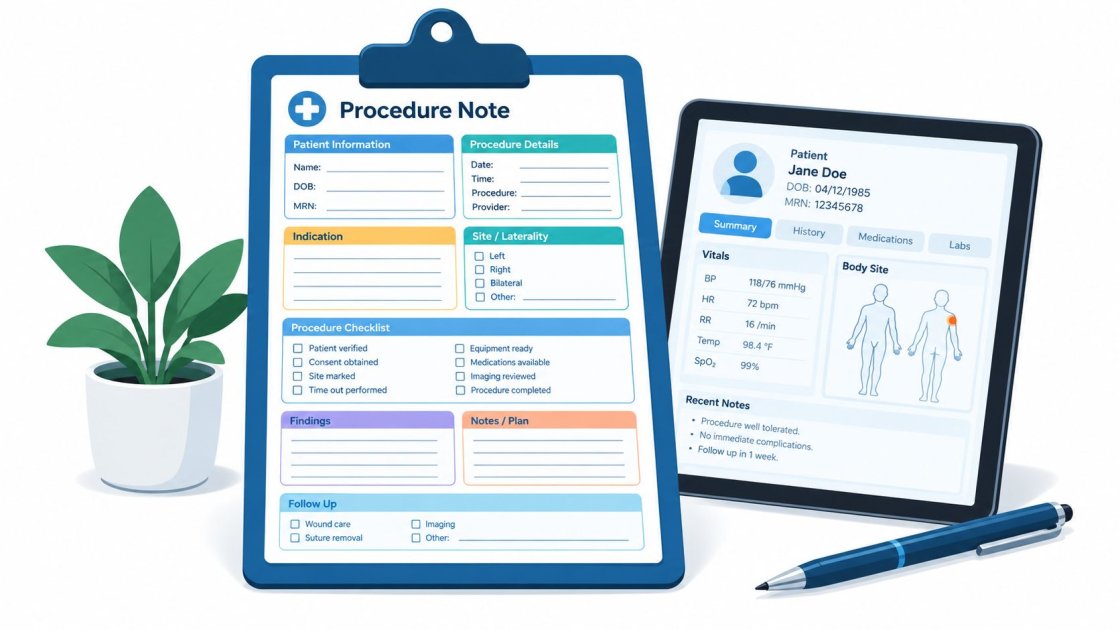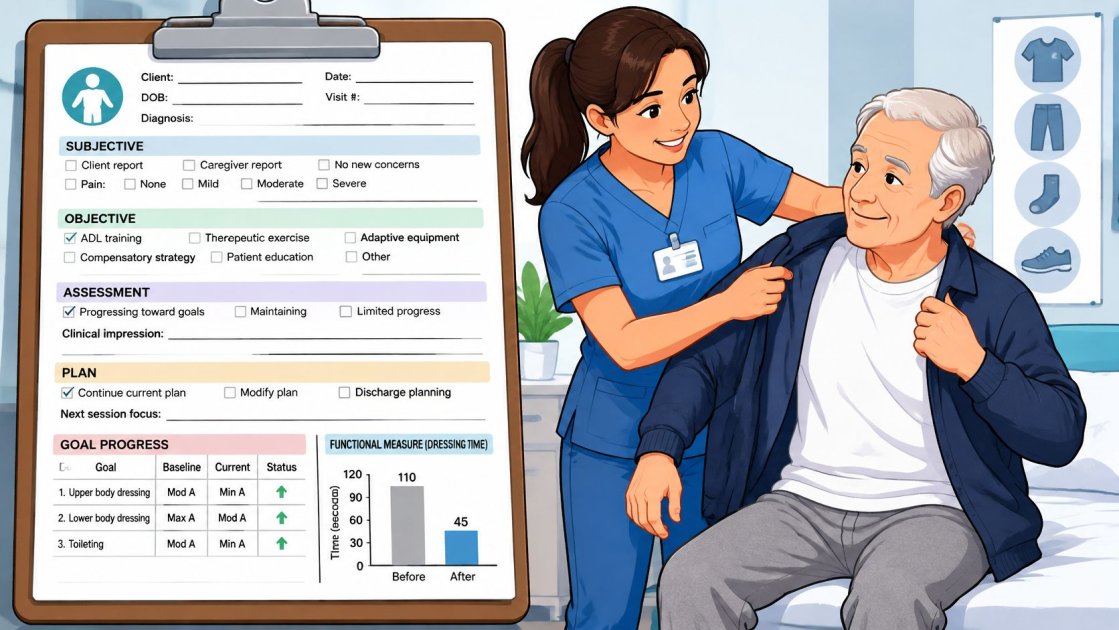
A progress report can follow SOAP headings and still leave continued skilled care unsupported if it records activity without showing its effect on function. Each entry should connect treatment to evidence a reviewer can assess.
Use the recurring 10-day and 30-day reporting clocks to keep that evidence current. For each active goal, record measured change, explain a lack of progress, and state the clinical decision that follows. This makes the occupational therapy progress note template a record of medical necessity across visits, not just a summary of one session.
Blank Occupational Therapy Progress Note Template
Use the table below as the working form. It separates encounter-level fields, completed on every treatment day, from periodic-report fields, completed for each reporting period. One structure can then serve both purposes without turning a daily note into a full progress report.
CMS requires the progress report to include the date written, relevant documentation of subjective statements, objective measurements that quantify impairment or functional progress, changes relative to every active goal, an assessment of improvement or lack of progress, and a plan for continued treatment or revision, as set out in CMS guidance on outpatient therapy progress reports. The report must also identify goal changes, discharge decisions, or an updated plan sent for certification when applicable, and carry the clinician's signature and credentials. No particular format is mandatory, provided the required information appears during each reporting period.
| Section | Field | What to enter |
|---|---|---|
| Header | Client name, ID and date of birth | Full name, ID number, DOB as in the chart |
| Header | Diagnosis and payer | Diagnosis, ICD-10 code (US billing only), payer and plan |
| Header | Reporting period | Start date and end date of the period covered |
| Header | Precautions | Weight-bearing limits, fall risk, cognitive or safety concerns |
| Plan of care | Frequency and duration | Visits per week and length of current plan |
| Subjective | Client and caregiver report | Direct statements in their own words |
| Objective | Outcome measures | Instrument name, baseline, current score, date |
| Intervention | Techniques and modifications | Skilled methods, task changes, environment changes |
| Intervention | Equipment and orthoses | Device name, fitting or adjustment made |
| Intervention | Education | Who was trained, what they can now do |
| Response | Client response | Tolerance, fatigue, carryover between sessions |
| Goal status | Each active goal | Baseline, current level, degree of progress |
| Assessment | Reason for progress or lack of it | Barrier and clinical judgment |
| Plan | Continue, modify, discontinue or refer | Revised goals, frequency, next review date |
| Authentication | Signature and credentials | Clinician name, credentials, date written |
| Billing (US) | Timed-code minutes | Minutes per timed service and total treatment time |
How to Adapt the Form Without Breaking It
Copy the table into a document or template system. Add one line per active goal in the goal status section, and keep the field order fixed. Fixed order helps reviewers find reporting-period dates, measurements, goal status, rationale, and authentication without searching across notes written by different clinicians.
Local detail can sit inside fields. A hand therapy service may add edema or range prompts under objective measures. A pediatric service may add school-based observations under response. The core fields shouldn't move or disappear, because they're the fields that carry medical necessity, billing accuracy, and the decision to continue, modify, discontinue, or refer.
Practical rule: If a field doesn't help prove function, safety, time, or a clinical decision, it belongs in working notes, not in the signed template.
Keep precautions visible in the header, not buried in prose. Weight-bearing limits, fall risk, and cognitive safety concerns shape which interventions are appropriate and how progress should be judged. A gain achieved by ignoring a precaution isn't evidence of safe progress.
How Often Progress Reports Are Due Under Medicare
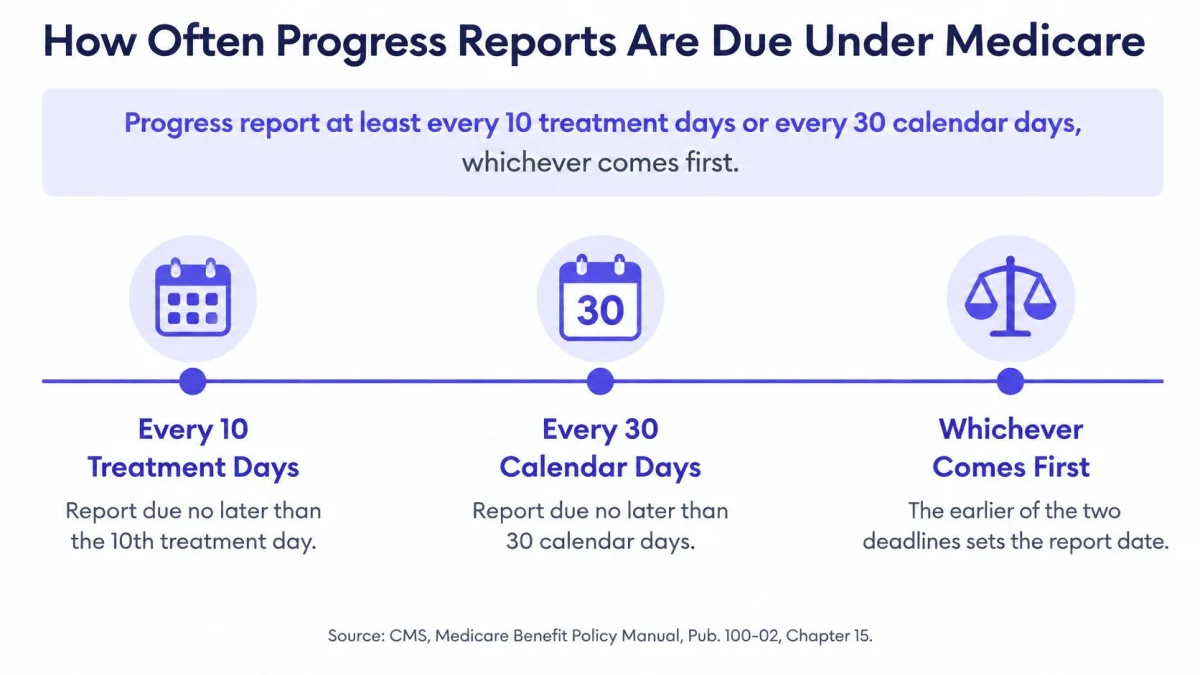
Medicare requires a progress report at least every 10 treatment days or every 30 calendar days, whichever comes first. CMS doesn't mandate a particular format, but the medical record must contain the required information during each reporting period, including reporting-period dates, subjective information, objective measurements, status relative to each current goal, assessment, plan, revisions, and clinician credentials, as summarized in CMS material on outpatient therapy documentation and progress reports.
Working the Two Clocks
At three visits per week, ten treatment days take about 23 days. The 10-treatment-day count sets the due date. At one visit per week, ten treatment days take about 70 days. The 30-calendar-day limit comes first instead.
A new period starts after each signed progress report. Clinics should track both counts from that point, because frequency changes can move the earlier deadline. A client who increases from once to three times weekly may hit ten treatment days well before day 30.
Note Types That Sit on the Same Clock
- Daily treatment note: Completed every treatment day, with date, intervention, timed-code minutes, total treatment time including untimed services, and signature with professional identity.
- Progress report: Completed at the 10-day or 30-day limit, with reporting-period dates, objective measures, status for each goal, continuation plan, signature, and credentials.
- Plan or goal revision: Completed when goals or the plan of care change, with revised goals and certification where applicable.
- Discharge decision: Completed at discharge, with goal outcomes and discharge status under facility and payer policy.
The same recurring logic applies when building a comparable form for another discipline, such as a physical therapy progress note template, although the clinical content and measures differ. The shared point is calendaring. A template without a deadline system invites late synthesis from scattered daily notes.
Set reminders at day 10 and day 30 of each period, and make one clinician responsible for signing the report. Shared caseloads need an explicit owner. Otherwise, each treating clinician can assume someone else has completed the periodic summary while treatment continues on daily notes alone.
Filled Sample Progress Note for a Post-Stroke Client
The following note is illustrative. It uses a 68-year-old client seen in outpatient occupational therapy six weeks after a right-hemisphere stroke. Treatment occurred two times per week for 45 minutes per session.
The reporting period covers 30 calendar days and 8 treatment days. The 30-day limit therefore sets the due date at this frequency. Precautions recorded in the header are fall risk and left-side inattention.
Header and Subjective Report
The diagnosis, payer, reporting-period dates, and precautions appear at the top. The subjective section records the client's own priority. She states that she wants to dress herself before her grandson visits.
That statement matters for two reasons. It identifies the occupation the client values, and it gives the assessment a concrete participation goal. Dressing isn't framed only as a motor task. It's framed as preparation for a family visit that carries personal meaning.
Objective Measures and Intervention
The COPM performance rating moved from 3.5 to 6.0 on the 1 to 10 scale, with dates recorded for each rating. The note links that change to observed dressing performance rather than treating the score as self-explanatory. Current performance, assistance level, and cueing are recorded beside the rating.
Interventions during the period included task-specific training in upper-body dressing with a stocking aid, visual scanning drills, and caregiver training on bathing transfers. Equipment, modifications, and caregiver instruction are named specifically. The note doesn't stop at listing activities. It records the skilled purpose each activity served.
The response section states that the client tolerates 30 minutes of treatment, reports fatigue after about 25 minutes, and showed carryover at home twice during the period. That detail helps explain session pacing. It also prevents a reviewer from mistaking reduced late-session performance for lack of effort or lack of response to treatment.
Goal-by-Goal Evidence
| Goal | Baseline | Current | Measure | Status | Decision |
|---|---|---|---|---|---|
| Upper-body dressing with supervision or less | Moderate assist, 2 of 6 steps | Supervision, 5 of 6 steps | Task checklist, 6 steps | Partially met | Continue, add scanning drills |
| Stand at sink for grooming for 5 minutes | Seated only, 2 minutes | Standing 3 minutes with one rest | Timed observation | Progressing | Continue |
| Heat a meal in the microwave with left hand | Unable | Heats item with one verbal cue | Task performance log | Progressing | Continue |
| Toilet transfer with grab bar, minimal assist | Moderate assist | Minimal assist, consistent over 3 sessions | Observed transfer | Met | Replace with community goal |
| Call caregiver on mobile phone | Not attempted | Independent in 3 of 3 trials | Trial log | Met | Discontinue goal |
Assessment, Plan, and Signature
The assessment explains the remaining dressing gap. Left-side neglect limits sequencing, so the goal is partially met and scanning drills were added. Improvement is real, but the written note doesn't overstate it. The barrier, the intervention change, and the expected functional effect all appear together.
The plan continues treatment two times per week for four more weeks and adds a toilet transfer goal. Met goals are closed or replaced rather than carried forward automatically. The note closes with the therapist's name, credentials, date written, and total timed-code minutes for the period.
A filled note works when a reader can trace the chain without guessing. Baseline leads to current measure. Current measure leads to status. Status leads to a decision, and the decision leads to a dated next step.
Goal Status Terms and the Evidence Behind Them
Each goal needs its own evidence trail: baseline, current measure, functional consequence, barrier, and change to the plan. Without that trail, a status term is only an opinion. CMS requires objective measurements, status linked to each current goal, assessment of progress or lack of it, and a plan for continued treatment or revision, as described in CMS guidance listing required progress report content.
AOTA similarly advises documenting how interventions affect functional performance, participation, or another meaningful outcome, rather than merely naming activities. The required information may be distributed across treatment notes, progress reports, or formal reevaluations during the reporting period. Distribution is allowed, but completeness still has to be visible.
| Status | Use when | Evidence to record |
|---|---|---|
| Met | Client reaches the goal criteria | Measure at or above the goal criterion, with date and setting |
| Progressing | Measured change toward the goal, goal not yet reached | Baseline, current value and remaining gap |
| Partially met | Some criteria met, others not | Each criterion listed with its own status |
| Plateau | No measured change across the reporting period despite treatment | Repeated measures across the period, suspected barrier, plan change |
| Regressed | Measured loss of a previously gained skill | Date of loss, likely cause, safety impact, plan change |
| Caregiver-dependent | Performance only with caregiver cue or set-up | Level of cue, caregiver training record |
| Discontinued | Goal no longer relevant or client chooses to stop | Reason, client input, date |
The Three Hardest Calls
Partial progress should name both the gain and the remainder. Writing supervision for 5 of 6 steps, up from 2 of 6, shows movement and the gap that still requires skilled input. A vague label hides both. The plan should then target the missing step or the barrier behind it, not merely repeat the same activity.
Plateau requires repeated measures across the period. One flat session doesn't establish plateau. The note should state the suspected barrier, then change the intervention, modify the task or environment, reconsider frequency, or refer. Continuing unchanged treatment after documenting no change weakens the case for skilled care.
Regression needs a date and a likely cause, such as new fatigue, a medical change, or reduced caregiver support. Safety impact belongs in the same entry. A loss in transfer ability, for example, may change supervision needs at home even before the next formal review.
Caregiver-dependent gains deserve equal precision. The note should state that performance occurs only with a caregiver's cue or set-up, and record what the caregiver was trained to do. That distinction protects honest reporting when a treatment plan, including one built from a therapy treatment plan template, depends on support outside the clinic.
Do not state a gain the record does not show. The template can prompt for evidence, but the clinician still makes the status call.
Before signing, check each goal against the table. If the evidence column can't be completed, the status isn't ready to sign.
Wording and Mistakes That Weaken a Progress Note
A complete activity list can still fail to show why skilled occupational therapy should continue. The recurring progress record must connect current performance to the goal, the intervention, and the clinical decision. Use the 10-day treatment documentation cycle and 30-day progress-report clock as checkpoints: each entry should capture the service delivered, while the report should summarize change and support the next decision.
AOTA guidance calls for a progress report that summarizes intervention and movement toward goals, with new data, treatment-plan changes, and the need to continue, discontinue, or refer. It also calls for measurable progress or lack of progress, outcome measures, modifications, equipment, client response, and education, as described in AOTA documentation guidance reproduced for occupational therapy services. A copied paragraph rarely establishes those details for the current reporting period.
Weak Wording Against Strong Wording
- Grip: “Improving grip” gives no measure to compare. Record grip strength 14 kg right, 22 kg left, with the instrument, side, position, and trial where relevant.
- Tolerance: “Tolerated well” hides the response that guides treatment. Record tolerated 30 minutes, fatigue at 25 minutes, carryover at home twice.
- Cueing: “Needed cues” does not show the level of help. For example, document completed a meal-preparation sequence with two verbal cues, compared with five cues at the prior visit.
Replace adjectives with values, time, assistance level, and context. SOAP headings can organize the entry, as in these SOAP notes for occupational therapy, but the headings do not establish medical necessity. The assessment must explain what the evidence means for skilled care.
Other Errors That Create Review Risk
An activity list without a link to occupational performance leaves the reviewer to infer the purpose. Naming pegboard work or dressing practice does not explain how the intervention affects function or participation. State that connection in the assessment.
Check the reporting-period dates, timed-code minutes, signature, and credentials. CMS requires complete treatment-day documentation, including service details and time; do not rely on memory to fill those fields later. Goals must also match the current plan. If treatment changes but the goal list does not, the record describes conflicting courses of care. Late entries written from memory can make dates, cue counts, and responses unreliable.
Documentation burden explains the pressure to use shortcuts, but it does not support them. In 2024, 23% of occupational therapists reported often documenting outside business hours, according to a summary of therapist documentation patterns. Keep the template brief and ordered. Prompts and goal rows should reduce typing without carrying forward stale findings.
Pre-Signature Check
- Goal coverage: Every active goal has a status and supporting evidence.
- Measurement: Each reported measure includes a baseline and current value.
- Time: Minutes and total treatment time are entered.
- Reasoning: The assessment connects the findings to the goal and continued skilled need.
- Next step: The plan states the frequency.
- Authentication: The signature and credentials are present.
Use this check before signing each entry and again at the reporting checkpoint. It catches omissions that can make clinically sound care appear unsupported.
Billing Fields and Outcome Measures to Add
US billing fields belong inside the occupational therapy progress note template, not in a separate memory-based process. Each treatment note should record timed-code minutes for each service, total treatment time including timed and untimed services, diagnosis code, and CPT procedure codes that match the minutes documented. Code suggestions for ICD-10 and CPT apply to US billing only.
CMS requires documentation for every treatment day and therapy service, including treatment date, intervention or activity, total timed-code minutes, total treatment time, and the signature and professional identity of the qualified professional, as stated in CMS instructions on therapy claims documentation. Before setting any minute threshold from memory, clinics should check the CMS Medicare Claims Processing Manual, Pub. 100-04, Chapter 5, for timed-code unit rules. A template can prompt for minutes. It shouldn't hard-code billing rules that may be applied incorrectly.
Measures Worth Recording Consistently
| Measure | Domain | What to record |
|---|---|---|
| COPM (Canadian Occupational Performance Measure) | Client-identified daily occupations | Performance and satisfaction ratings, each on a 1 to 10 scale, per problem |
| Barthel Index | Basic ADL independence | Total score from 0 to 100 |
| Assessment of Motor and Process Skills (AMPS) | Motor and process skills during real tasks | Ability measures in logits, scored by a trained rater |
| Grip dynamometer | Hand strength | Value in kilograms or pounds, side, position and trial number |
| Task checklist | Steps completed in a clinic-set task | Steps completed out of total, with cue level |
Choosing and Repeating Measures
Pick one measure per goal domain. More measures don't automatically create stronger evidence, and unused scores invite confusion. Use the same instrument across reporting periods so change is comparable, and record the score direction where the meaning of higher or lower isn't obvious.
Conditions of measurement matter. Grip values lose value when side, position, or trial aren't recorded. A task checklist loses value when cue level is omitted, because the same step count can represent independent performance or heavily cued performance. The template should prompt for those qualifiers beside the score.
UK clinicians can use the same measures, but US billing fields don't apply. The measurement logic transfers. The reimbursement logic doesn't.
A score does not replace clinical reasoning. The note still needs the functional consequence in plain language, such as what the client can now do at home, at school, or at work.
A strong note pairs the number with its occupational meaning. A Barthel Index change, for example, should be tied to the specific self-care tasks that changed. Otherwise, the record contains a score without a usable account of daily life.
Progress Notes for UK Clinicians
The Medicare 10-day and 30-day cadence doesn't apply in the UK. US timed-code fields don't apply either. The goal-linked structure in the blank template still works, because baseline, current performance, barrier, and plan are sound record-keeping in either country.
Checks Before Setting a Local Interval
Before a review interval is set, clinicians should check the employer's record-keeping policy and the Health and Care Professions Council (HCPC) Standards of conduct, performance and ethics, which set the record-keeping duty for registrants. NHS services also follow local clinical records policy. Those local requirements should govern review timing, retention, authentication, and any service-specific content.
One review interval should be chosen for the service and written in the template header. A visible interval lets every reviewer see whether the note is timely. It also stops individual clinicians from using different informal cycles on the same caseload.
Fields to Keep and Fields to Remove
- Keep in every note: Date, intervention, goal status, client response, and plan. Those fields show what happened and why care continues or changes.
- Keep the measures: Outcome instruments from the previous section work in either country when they're used consistently and interpreted in context.
- Remove US-only fields: ICD-10 and CPT prompts should be left out, since they apply to US billing only.
Precautions, equipment, task or environmental modifications, and caregiver training should remain. They're clinically important regardless of payer. A UK note that records only activities has the same weakness as a US note that records only activities. Neither shows occupational change.
UK clinicians should confirm local policy with the clinical governance lead before rollout. That check is short, but it prevents a well-designed template from conflicting with employer requirements on signatures, review dates, or record format.
Build Your Template and Start Charting
A progress-note template is not a one-time form. It is a recurring record that must show what changed, what evidence supports continued care, and when the next review is due. Keep its fields stable so clinicians and reviewers can compare goal performance across reporting periods.
Set Up the Template
- Copy the blank table: Keep the field order consistent. Make sure each field captures evidence a reviewer can use to assess skilled need, client response, and the next treatment decision.
- Build from an existing note: A template builder can convert a note, dictation, or uploaded document into a reusable structure. Review every field before using it in a signed record.
- Add goal structure: Give each active goal its own line. Include reporting-period dates in the header, and record the measure, current performance, and change for each goal.
- Test one case: Complete the template for a current client. Before signing, check that the intervention, response, goal evidence, and plan support the documented need for continued care.
- Set review reminders: For Medicare caseloads, mark the 10-day and 30-day points in the reporting cycle. Use the applicable Medicare requirements to confirm when a progress report is due.
PatientNotes offers an AI template builder and specialty templates for clinicians. Check its current template list before assuming an occupational therapy template is available.
Keep the template focused on clinical evidence. A reminder can prompt a timely review, but it cannot replace documentation of functional change or the therapist's rationale for continuing, modifying, or ending treatment. Stable fields make those decisions easier to compare from one reporting period to the next.
Start with one case rather than changing an entire caseload at once. Complete a reporting period, review what the template captured, and adjust only prompts that failed to produce usable evidence. Confirm that clinicians can record goal status and the rationale for the plan without relying on vague statements.
Build the occupational therapy progress note template, use it for one reporting period, and check that a reviewer can find the evidence for each active goal. PatientNotes can convert an existing note or dictation into a reusable structure. Review and sign every generated note, then test the template on a current case before its next reporting deadline.